The Greatness of the Guru, Linga, and Jangama: The Path of Pure Vision
25.10.2026
0 мин. чтения
0
Share
copy
search
add
share
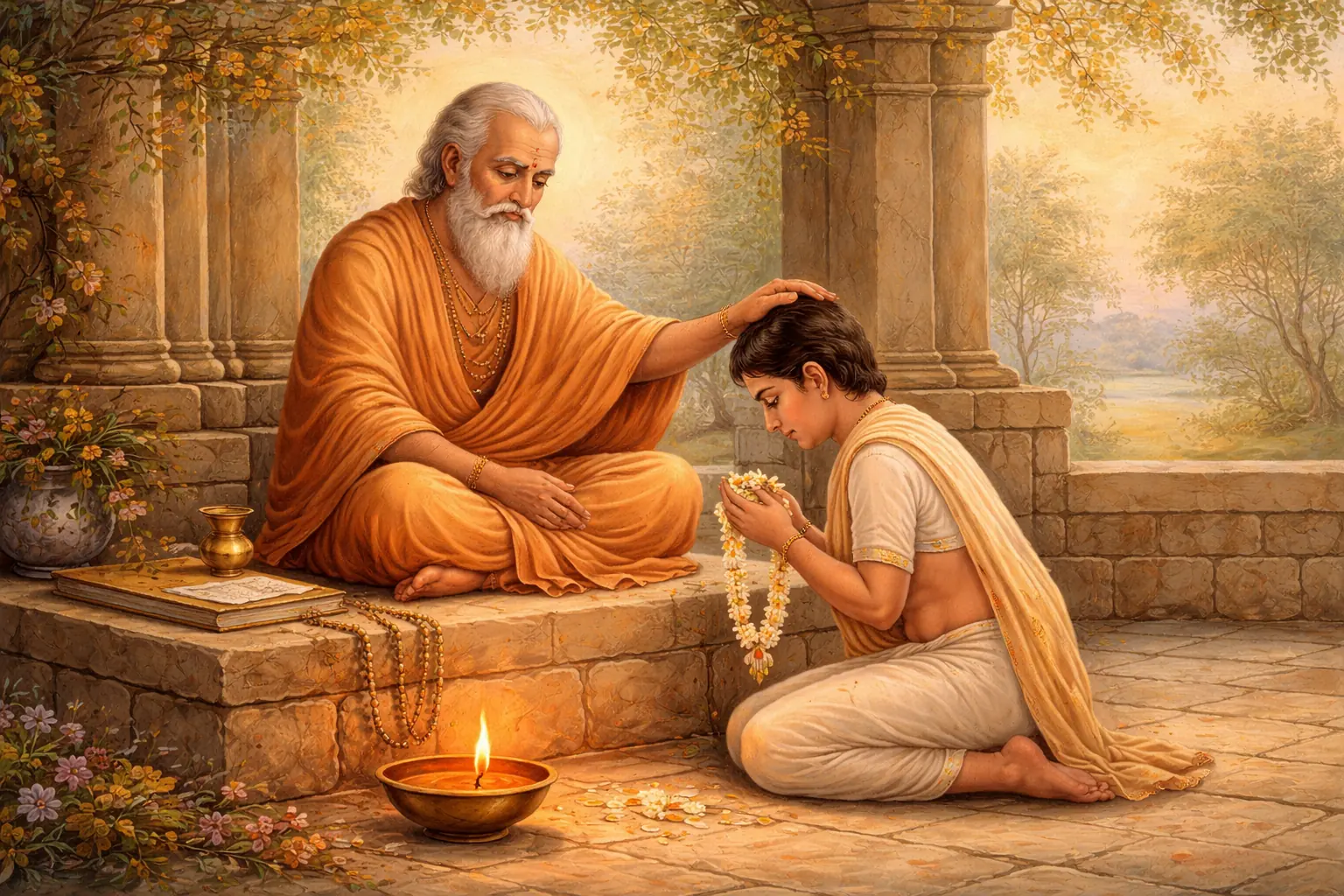
It is the Guru who is the cause of successful actions (the attainment of the desired result), because in reality the great God Himself is present here, embodied in the Guru. The Great Lord (Shiva), the ocean of eternal knowledge, is unmanifest. He takes form as the Guru in order to bestow His grace upon all.
The greatness of the Guru, the greatness of the linga, the greatness of the jangamas, the greatness of devotees, and the greatness of those who have taken Refuge—these are the five objects that radiate greatness. To follow the path of Dharma means to draw closer to such greatness, to be purified through it, and to give rise to one's own inner greatness.
Such inner greatness is called brahma-aham-bhava, divya-bhava, and in certain practices, the greatness of the deity or divine pride. In general, this is a broad term referring to the principle of self-deification. The principle of self-deification in this sense consists in first perceiving divine vibrations externally, then discovering them within oneself, fully attuning oneself to them, and becoming firmly established in them.
The spiritual path is a continuous establishment in such divine greatness. What, then, is greatness? It is pure vision, sacredness, sanctity, and also mystery, such as that associated with samayas. It is especially important to emphasize that divine greatness increases through observing the samayas, while neglecting them causes it to be quickly lost.
The Importance of Observing Samayas and the Protectors of the Teaching
For example, the secret teaching of nonduality should be transmitted only to mature disciples. If immature disciples receive it, they will inevitably fail to understand it, misinterpret it, and be unable to apply it, and as a result the teaching will be distorted. Therefore, important tantric teachings place very strong emphasis on observing the samayas, and the protectors of the subtle world watch over this—it is not fiction, but a reality.
If you follow the samaya correctly and observe it, they will help you. Conversely, if the samaya is misused, you may encounter such formidable beings of the subtle world, and they will ask you, “What is the problem? What is going on with your samaya?” They will begin setting your mind in order, because at some point they undertook this service.
These are forces—perhaps they were once human beings, once sadhus, once deities, or once spirits subdued by siddhas—but they swore an oath, took a vow to protect the teaching and preserve the purity of its samaya. For what purpose? So that the teaching may be of benefit.
There is also this esoteric aspect: there are lokapalas (guardians of the teaching). In this regard, one should be very attentive when transmitting the teaching to others, especially secret instructions and secret methods. Therefore, siddha teachers are extremely careful in selecting disciples according to the requirements of adhikari, examining them, testing their qualities, training them, and so forth.
In other words, the teaching is something very serious and very important not only for us, but also for many thousands of people, perhaps millions of living beings. Saints and divine forces also participate in this teaching, and we must respect the spirit of transmission. We must never treat the teaching or anything connected with it lightly.
Discovering the Sacred Side of Reality
If we maintain the purity of the samaya, we gradually enter into the spirit of pure vision and divine love, beauty, purity, greatness, and refinement. This becomes an all-encompassing principle of divya-bhava that takes up residence in our heart and begins to reveal to us the hidden side of reality.
We think, “My God, how could I once have looked at the world through worldly eyes?! How could I have failed to understand that the world has an inner side, another side of life—sacred, holy, and pure? It has always been there; it was always there, but we did not see it.”
Pure vision has always existed, siddhas and saints have always existed, and the transcendent view of Advaita has always existed. But there was a time when we did not understand this, and then came a time when we began to penetrate it and it was revealed to us.
For example, mice and moles often run around the grounds here, and sometimes squirrels wander in. And the squirrels do not know that there is an altar here, that Shiva and Dattatreya are here, that bhajans are sung, and that the philosophy of Advaita is studied. For them, this is simply a plot of land where they can run around, dig a burrow, and eat nuts stored away for later. The ashram exists, but for them it does not exist. What is the difference? The difference lies in its inaccessibility to their consciousness.
Likewise, the sacred dimension of life is forbidden, inaccessible in samsara. It is not that it is deliberately forbidden—our limitations prevent us from entering it. Refuge makes it possible to enter the sacred dimension of life if we follow it correctly.
Sometimes, as the years pass, we forget that we must properly follow the path of Refuge, and our habitual tendencies and our mind entice and tempt us. “Karma takes its course,” as they say. At first, a person tried deeply to penetrate the Dharma, but then their habitual tendencies, judgments, and accumulated worldly experience once again gain the upper hand, and they adopt an in-between position, halfway in the Dharma but with a worldly mind.
But a sadhu does not allow this; he gives his worldly mind no quarter. He constantly purifies it, constantly liberates, dissolves, and controls it, and subordinates it to yukti—reasoning according to the logic and spirit of the Dharma. Most importantly, he subordinates it to divya-bhava (divine love and divine majesty).
The Majesty of the Sources of Refuge
These sources of Refuge, and understanding the majesty of these sources of Refuge, constitute such a powerful method that it allows us to purify our karma through ordinary relationships. After all, like everyone else, we live, walk around, and communicate—nothing seemingly special. But if we act correctly in the spirit of samaya, those very same ordinary relationships can become a path to liberation.
Two people live in a room and communicate—or three people, or five people—and they accumulate karma and kleshas and are reborn. Here are the very same people, yet they are different people: they communicate differently, cultivate a different vision, meditate, contemplate, and attain liberation. That is the difference.
Know that the one who is known as Shiva is the Guru, and the one who is the Guru is Shiva. A wise person who wishes to attain knowledge should not distinguish between them.
Guru Yoga and Convincing the Mind
On the path of Guru Yoga, it is very important to convince your mind that your Guru is Shiva, or that the Guru is Dattatreya. In the same way, Buddhists convince themselves that their Guru is the Buddha. They have a whole complex chain of logical reasoning for this.
Suppose he is not the Buddha, but he could be the Buddha—yes, that possibility exists. But if he could be the Buddha, why should he not be the Buddha? From the standpoint of liberation, it is, after all, more beneficial for your Guru to be the Buddha. But if he could be the Buddha, why not regard him as the Buddha for the sake of the path to enlightenment, since you can receive a blessing? If he can be regarded as the Buddha, then you can regard him as the Buddha. If he can be regarded as the Buddha, then he is the Buddha, and since he is the Buddha, he is definitely the Buddha. And if he is definitely the Buddha, then cultivate admiration, practice Guru Yoga, and receive the blessing.
There is an entire, intricately constructed chain of logic—they are intellectuals, after all, and rely heavily on the mind. In Sanatana Dharma, we rely more on bhava, not on the mind, while they rely more on the intellect, but the principle is the same—in the end, one must arrive at this for one’s own benefit.
In the same way, a disciple must cultivate such devotion so that their mind never doubts and so that they can be connected to the source of this majesty. The Guru, like the other objects of Refuge, is a particular source. And if you are connected to it, this source fills you with shakti and blessings.
It is not a source of money or worldly success, although this is sometimes how the Guru is perceived in India. Yes, and the Guru says, “Very well, I give you my blessing—become a businessman,” and the person becomes a businessman. But this is a misuse of the Guru, of Guru-shakti.
In the true sense, Guru-shakti is a source of subtle spiritual energy capable of nourishing the disciple’s subtle body with the blessings of Anugraha-shakti, nurturing their inner greatness, inner purity, inner beauty, and inner divine love. It nurtures inner devotion, inner exaltation, transcendence, and harmony.
But it can nourish us properly only if we understand that the Guru is Shiva and if we have a samaya bond—then it will work. If we lack such an understanding or do not have a samaya bond, we cannot connect to this source in this way. Therefore, one who is connected to such a source is always inspired, because they are nourished by this shakti through the proper practice of Guru Yoga.
The same applies to the ishta-devata and the jangamas, and to the principle of pure vision in general. The principle here is this: pure vision as a principle permeates everything, and it can either nourish you or not nourish you; there is no third option. Everything depends on the perspective you adopt and on how you train your mind.
The Uniqueness of the Guru
The teacher bestows knowledge. He is pure. He is the embodiment of Shiva. He must not be compared with other people merely because he has similar hands, feet, and so on.
As your practice progresses and you become convinced that the Guru is a manifestation of Shiva or a manifestation of Dattatreya, the next stage is to develop, through such conviction, the ability to receive blessings. That is, if the Guru is Shiva or the Guru is Dattatreya, then I am always with the source of grace, and this grace is always flowing toward me. I am always capable of receiving it, so why not receive it for spiritual practice—after all, that is precisely my goal. The ability to be an empty vessel and receive grace is a quality of a disciple.
Finally, the third stage: through the descent of grace and the dissolution of the ego, we must begin to penetrate the deeper aspects of the nature of our soul and come to the conviction that we ourselves are Shiva, that we ourselves are Dattatreya—this is the most difficult part: self-liberation, self-surrender, and self-recognition.
When we begin to establish the conviction that we are Shiva and that we are Dattatreya, the subtle structures of consciousness will resist desperately. They will understand that their ignorance and their kleshas will come to an end, that they will not be fulfilled, that future lives may not take place, and that future desires may not be selfish or fulfilled. Shiva has not a single selfish desire, nor does Dattatreya have a single klesha. They will tremble violently and resist, saying: “No, we are not Shiva—anything but Shiva; we are not Dattatreya. We are just people, we are at least someone, because otherwise we will not be fulfilled, we will not realize our intentions, our desires, our tendencies.”
And they will resist: “Let Shiva be Shiva, let Dattatreya and the Guru and the saints be Shiva, but we still want to be human.” That is how they will behave. Akharas sometimes speak this way. Sadhus come, bow, and say: “Let the great ones meditate, while we defend the Dharma. That is enough for us.”
But here, if we practice correctly, we will be able to unite this consciousness, this vision of ourselves as Shiva and as Dattatreya, with our kleshas in such a way that these kleshas submit, are pacified, and transformed, gradually becoming wisdoms thanks to such inner purity.
Insults and Aparadhas
An insult directed at the teacher prevents one from attaining the highest good; therefore, one who aspires to the highest good must worship the teacher with concentration.
An insult is called an aparadha. There are Guru-aparadhas, sadhu-aparadhas, sangha-aparadhas, and Dharma-aparadhas. An insult means that we generate something sharply opposed to the essence of what is being spoken about.
For example, if the Guru expresses the principle of Shiva, spiritual radiance, wisdom, and so on, while in our mind we abruptly paint a picture of something negative or worldly, making worldly value judgments. Likewise, if the Dharma represents the highest light, the highest transcendent purity and holiness, while we conceive of something base about the Dharma, say it, or express it—these are all aparadhas.
Therefore, a sadhu must always remain attentive so as never to commit aparadhas, either consciously or unconsciously. For example, one should not use improper words when speaking about the objects of Refuge. As soon as you use improper words with an improper bhava, in a state of disrespect, that too is an aparadha.
Why? Because this majestic perception, which is very pure and sublime and is meant to bless you, is destroyed; in other words, the channel is destroyed, and instead of connecting to the first tattva, you connect, for example, to the sixteenth tattva. That is, when looking at the Guru, at Dattatreya, at a murti, or at any saint, you can perceive them through the first tattva. This is perception in absolutely pure vision, and then it will bless you.
You can lower your perception and perceive from the twentieth tattva, or even from the thirty-sixth. To look at a murti from the thirty-sixth tattva is to see it as: “Oh, bronze, clay, painted—there will be no blessing,” or to perceive it from the standpoint of the ego, in the sixteenth tattva, the ahamkara tattva: “What an insolent person.”
That is it—as soon as you project your vision in a human way. A sadhu must be extremely vigilant so as never to commit aparadhas in relation to the Refuge—at first, this requires a great deal of vigilance if you are inexperienced. When you are experienced, it becomes so natural that you do not even need to think about it. It becomes your culture and ethics, ingrained in your very bone marrow; but in the beginning, vigilance is necessary.
It is like entering a transformer booth, a substation with 380 volts, wearing gloves and handling tools very carefully, with every action precisely measured. This is how one should come into contact with the objects of Refuge.
Devotion as the Path to Dissolving the Ego
One who has no devotion to the Guru cannot develop devotion to Shiva either; therefore, the same devotion one has toward Shiva must also be directed toward the Guru.
Devotion and attachment are not the same thing. Even an ordinary person can have attachment. Attachment is when one ego sees another ego and forms a relationship in order to receive something from the other ego—for example, attention, support, or worldly love.
But Guru Yoga is not attachment. Guru Yoga is devotion; it is a much higher state. For example, if you become attached to the Guru as an ego, there will not be much benefit in it; perhaps there will be some indirect blessing, but it will not be right.
Devotion means that we perceive the first tattva and see God through the object to which we are devoted, and this devotion must dissolve our ego. Even if devotion begins on the plane of the ego, it will never end at the level of the ego, because the ego melts in devotion, the ego dissolves. The process of devotion is a powerful melting force, like the rays of the sun shining on a disk of ice—the disk of ice melts and dissolves over time.
The fire of devoted love dissolves the icy heart of the sadhu, and beneath this icy heart the purest light of the divine lingam, the radiance of the single bindu, is revealed. The icy heart—the ice—represents layers of karma; they are all made of ice, they are all frozen. But they are waiting for their time to manifest. Devotion, however, is like concentrated rays of sunlight—they melt and evaporate all of it.
We must cultivate the kind of devotion that helps us melt the ice of our karma. If devotion is slight, melting this ice is impossible. It is not actually so difficult to melt the ice of karma—it is enough to direct the sun toward it, and it begins to melt. But if these rays are very weak, the karma will not melt. Therefore, a sadhu must always ensure that his devotion is sufficiently deep, strong, and pure; then it is not difficult to melt the ice of his karma.
How does this happen? It is simple: greed, pride, or envy may have arisen in you, but at that moment you thought of Guru-bhava, of Dattatreya, of Shiva, or of any object of Refuge, and an exalted feeling arose within you.
This exalted feeling activates the anahata chakra and the sahasrara chakra, and a very pure world, a very pure state, opens up—one that is deeply inspiring. Then the vibrations of the manipura chakra, muladhara chakra, or svadhisthana chakra are drawn into the central channel and also rise upward, and you feel that no negative feelings trouble you anymore. The kleshas have been transformed into wise, pure, blissful states; they have surrendered themselves.
If you have strong devotion, through grace and inspiration you can easily change your impure state at the snap of your fingers. But if you have no devotion, while the kleshas and negative emotions are present, then changing them is very difficult. You will carry them around for a long time, thinking, “What should I do? I am in some kind of obscured state, and I do not like it.” Then you will decide to recite a mantra, apply an upaya, or make some offerings—and all of this will also be done in a graceless state, which will remain unchanged. Then you will read a text and reflect on it, yet the state still will not go away. Then you will contact the Guru, and the Guru will advise you to do something. You will do it once again, and only with great difficulty will the state subside after a day or two. This is the difference between having no devotion and no such bhava, and having them.
When it is present, the state disappears at the snap of your fingers, and you instantly move yourself into a spontaneously free, natural, playful state. The Guru often says, “Do not pass judgments. Do not cling to your opinion; accept things lightly, preserve Brahma-aham-bhava, abide in pure vision, preserve divya-bhava, view things with equanimity, do not reject them but integrate them. Regard them purely, accept them as the darshan of the deities. Regard them lightly as a play—what is the problem? Regard them as an illusion; regard them as emptiness.”
If you have devotion, you can easily follow this advice, and any one of these instructions will work instantly. If you do not, it will be very difficult for you; these words will be beyond your reach. You will mentally try to portray emptiness and play, thinking that everything is an illusion, but the soul cannot be deceived: the soul feels the prana, and within it lies the samskara, the force of karma. With your mind you will say, “It is all an illusion. It is all emptiness,” but nothing will work.
But if there is devotion, you will immediately enter an exalted, pure, divine, beautiful state and simply forget. When you understand this way of being, it will become yours always, everywhere, and naturally. You will playfully release karma and dissolve it; you will playfully dissolve any perceptions, and life will become easy, playful, spontaneous, and empty for you, while the world will be perceived as illusory. You will see the world with equanimity, preserving divya-bhava, clinging to no opinion and associating with no lower aspects of consciousness. Everywhere and in everything, you will see the darshan of the deities and nothing but purity. Then life becomes grace pouring forth—this is the unceasing state of grace, self-illumined remembrance.
Practice in Grace
From an unceasing state of grace, it is easy to complete the cycle of the day, easy to contemplate, easy to attain lofty experiences, and meditation proceeds with ease. It will be like this: you enter a seven-day retreat—you enter the light, enter samadhi, and gain an experience. You undertake a three-month retreat—during that retreat, you realize the higher dhyanas, gain the experience of the illusory body and the experience of the samadhi of the formless realm, and emerge from it with profound awareness. You enter a year-long retreat—you attain initial enlightenment, the fourth ground of wisdom. This is practice in grace.
If it is absent: you enter a seven-day retreat—you sleep. You enter a month-long retreat—you spend twenty days coming to your senses and ten days trying to concentrate the mind; toward the end, something begins to work, but the retreat is already over, and you are told to leave. You enter a three-month retreat—you spend two months settling in and the third month practicing, struggling as best you can. You enter a year-long retreat—something begins to work, but you do not have enough time to recognize it properly.
You see, there are different ways to practice, and everything depends on the bhava you were in before the retreat, whether there was grace in your life, and whether you worked on purifying the mind.
Thus ends the sthala “The Greatness of the Guru.”
The Sthala “The Greatness of the Linga”
As a result of knowing the greatness of the Guru, and through complete knowledge of oneself, the unsurpassed greatness of the linga is also realized.
Thus, when divya-bhava has arisen through devotion to Guru-bhava and Guru Yoga, and through meditation one has experienced light and samadhi, the first experience of light may occur even at the stage known as the encounter with light. This is one of the sixteen kalas. Who remembers which stage this is among the sixteen kalas? The fourth, yes.
It may happen like this: you were simply reading and meditating, then you lay down, and a dazzling light flashed in the anahata chakra, and you realized that there is light within you. It disappeared, but the memory remained; you know what to focus on, and you know that you must continue to bring this light outward and become accustomed to it in order to move on to the stage of transmission. You must learn to apply it somehow so as to dissolve thoughts.
Through these initial experiences of Guru Yoga and the inner encounter with light, the yogin can perceive the principle of the lingam. He begins to recognize Brahman, Shiva, as the principle of light. He begins to feel this light as permeating the entire universe—this is the linga, the majesty of the linga. The external lingam is merely a reflection of the boundless inner lingam; therefore, true yogins worship the inner bhava-lingam above all. The bhava-lingam is the light of the causal body and, in general, the principle of light as Brahman within, and this light possesses boundless majesty. To practice means to enter ever more deeply into this majesty.
With the aid of the mind awakened by the teacher, one should understand that the symbol of Shiva is the Shiva-linga, the primordial cause of all that exists. The supreme, sacred, pure linga is the ancient Brahman. It is called Shiva. It is pure consciousness, eternal bliss without limitation. It is the cause of all worlds, as well as the cause of all the Vedas. It is the fullness of all elements (tattvas). It is the means of crossing the ocean of rebirth. It is seen as radiance. It cannot be expressed in words. It dwells in the hearts of yogins. How, then, can one know it in this world without the help of a great Guru?
Types of Lingams
There are different types of lingams. The highest type of lingam is called the Brahma-lingam or Maha-lingam—it is Brahman itself in the form of light. The light in the causal body is called the bhava-lingam. The energy body, the structure of the chakras and channels, and the light perceived through the subtle energy body are called the prana-lingam. Finally, the external movable or immovable lingam is called the chara-lingam.
Thus, a sadhu is immersed in an entire system of worshiping different lingams on different levels:
Puja is performed for the external lingam
When working with prana, the sadhu visualizes deities in the chakras and recognizes the light in the channels and chakras of the inner prana-lingam
More specifically, the prana-lingam is divided into three:
The svayambhu-lingam is located in the muladhara chakra and svadhisthana chakra
The bana-lingam is located in the anahata chakra
The itara-lingam is located between the eyebrows
There is also a fourth lingam—the sushumna
In the esoteric sense, these three lingams are the Three Jewels; that is, on the external level—the Refuge, the Three Jewels, Guru-linga, jangama or Guru, Dharma, Sangha—and on the internal level, these three lingams and the fourth. To practice means to unite these three lingams through the single lingam of the sushumna—all of this is the prana-lingam.
Bhava-lingam means entering the state of jagrat-sushupti, the state of dreamless sleep, through contemplation. Advanced jnana yogis are devoted to the bhava-lingam through natural contemplative presence. For us, meditation on the bhava-lingam is the path of natural awareness. We begin with the state of habituation—with the state of jagrat-sushupti. It is impossible to enter jagrat-turya immediately, but it is possible to enter jagrat-sushupti—the state of non-conceptual awareness resembling space. This is the bhava-lingam. Finally, by realizing the bhava-lingam as the light of the causal body, we go deeper and deeper in order to realize the maha-lingam, the state of turya—this is the state of Brahman.
In ancient times, Brahma and Vishnu were unable to comprehend the linga, which by its very nature is light. Who, then, can comprehend it? What is the use of verbosity? The linga is the primordial Brahman. Yogis who have been freed from bondage dissolve into it.
This linga pervades the entire universe: within stone, within the earth, within water, in all five elements, within every human being you will find an ocean of boundless light—this is the maha-lingam, Brahman in the form of light. All yogis meditate upon it. This lingam is the heart essence and innermost secret of Dattatreya, Shiva, and all the great gods. It possesses immense grandeur, unsurpassed purity, unsurpassed splendor, unsurpassed beauty—transcendent, sublime beauty.
To be devoted to such a lingam means to become imbued with such grandeur and nourished by its grace. Through contemplation, a sadhu always receives grace from one of the lingams—from the maha-lingam, from the bhava-lingam, from the prana-lingam; and if he cannot, then he receives grace from the external lingam by performing puja, gazing at the lingam, and engendering a feeling of devotion. If you gaze at the lingam during upasana (worship) or a bhajan mandala and engender a feeling of devotion, you will receive inspiration. This is the initial grace arising from the grandeur of the lingam.
The foundation is the supreme Shakti. The linga is the transcendent Shiva himself. It is said that the union of Shiva and Shakti is the linga of the universe. All the gods—Brahma and the others—as well as saints such as Shaunaka and others, attained their exalted positions solely through worship of the linga. Sovereignty over the world is the natural attribute of Ishvara embodied in the linga. Therefore, the ancient scriptures (the Vedas) say that his grandeur cannot be compared with the grandeur of other gods.
Thus ends the sthala “The Grandeur of the Linga.”
Thus, having recognized pure vision through Guru Yoga and Guru Bhava, having received grace through our connection with the grandeur of the Guru, and having recognized the inner light within ourselves, we come to the grandeur of the linga. Experiencing the grandeur of the linga is brahma-vichara; it is contemplation of the Absolute always and everywhere through the state of jagrat-sushupti, through correct contemplative presence, through nididhyasana. Nididhyasana (maintaining the natural state) means contemplating nothing other than the grandeur of the linga, becoming accustomed to contact with the grandeur of the linga, and bathing in the divya-bhava arising from the grandeur of the linga. Natural awareness is not for the sake of natural awareness, not for the sake of complete attentiveness, not for the sake of observation—it is for the sake of continuously perceiving the grandeur of Brahman, of perceiving the grace emanating from that grandeur.
Sthala “The Grandeur of the Jangama”
The grandeur of the jangama consists in his having realized the supreme consciousness (Chit-Shiva) in everything. This knowledge flows from the grandeur of the linga that abides in the connection between Guru and disciple.
Thus, the perception of the grandeur of the linga arises from the connection between Guru and disciple. The disciple receives grace through contemplation. At this stage, he is already capable of perceiving the grandeur of the jangama. What is the grandeur of the jangama? It is pure vision toward sadhus, saints, and samaya brothers and sisters—a profound pure vision that enables one to receive grace and mercy through such perception. For example, if a sadhu in the sangha reaches a high level and you show him respect, through this you receive grace and are purified. In the state of pure vision, you are capable of perceiving Shiva within him.
Those people who have fully realized Shiva, who illumines the world, as their own essence are called jangamas.
When a yogi attains full knowledge, that is, completes the cycle of day and night or approaches its completion, he is called a jangama. When he reaches the fourth ground of wisdom (sattvapatti) in self-realization, he is called a jangama. When he is a strong sadhu with a subdued mind and practices continuously, he is called a jangama.
Those who, through union with Shiva, see the web of the world as a manifestation of supreme consciousness and who have freed themselves from all contact with impurity are called Shiva yogis.
To free oneself from all contact with impurities means to become so firmly established in pure vision that obscured states never arise again. There is a saying: “On an island of gold, not even a trace of dirt can be found.” For example, you arrive by boat and disembark; the entire island is made of gold, and whatever you find on that island, wherever you go, there is nothing but gold—nothing else exists there.
In the same way, when you are established in pure vision, you always and everywhere see everything as pure, divinized, sacred, and holy. In your vision, there is nothing materially coarse or profane. In your vision, there is only the sacred. Not a single thought, bodily movement, emotion, or even desire of yours is worldly or profane. It becomes so sanctified that everything is pure. Even the body and all its functions are perceived as pure. What was previously perceived as impure and aroused jugupsa (aversion) is also perceived as pure and sacred.
For those established in pure vision and grace, not a single obscured state remains. Suppose someone curses you with obscene language—even in that situation you see purely: it is simply a wrathful bija mantra; you see a wrathful deity, that is all, and you are not offended by it—you have received a blessing from Bhairava.
Question: But do you not still feel as though you are being pressured, and your energy body begins to contract?
No. It does not begin to contract. The energy body absorbs this energy like a sponge, transforms it, and through the muladhara chakra the sushumna nadi absorbs it and turns it into pure light, while the sahasrara chakra receives an additional impulse in the form of ecstasy and grace. In other words, you have received darshan, grace, a blessing, because you saw purely; you are capable of feeding on such things. These are actually poisons, things harmful to an ordinary person. As the saying goes, “Only a peacock can feed on poison.” The peacock is a noble animal that embodies the purity of the tattvas.
At this stage, you become such a transcendental peacock, capable of feeding on poisons. You can transform negative karma into pure karma because you yourself are pure. If you are not pure, you will inevitably stumble. It will certainly leave a deep imprint on your energy body, create obscuration in the mind, and cause many other things.
But at this stage, this does not happen because of your purity—whatever touches you is God’s dew; everything is pure for you. You interpret it as divine play: “So this is divine play—why worry?” The Guru often says, “It is nothing to be afraid of. It is divine play, so what is the problem?” The disciple does not understand: “How can there be nothing to fear? How can that be?” The Guru says, “Relax, do not take it to heart, take it lightly—it is only an illusion,” while so much is going on in the disciple’s mind.
Why? Because the Guru and the disciple see things differently, and the disciple’s task is not to insist on his own vision, but to try to enter the vision the Guru speaks of, to try to send his consciousness to that island of gold. Then he too can see, and the problem will disappear. Then he will see purity, beauty, spontaneity, and divine blessing in what is happening, and his energetic integrity will be restructured in a new way.
Those who, through union with Shiva, see the web of the world as a manifestation of supreme consciousness and who have freed themselves from all contact with impurity are called Shiva yogis. Shiva dispels the darkness of the terrible cycle of samsara; those who possess the knowledge of Shiva are considered Shiva yogis.
When you know this state of all-encompassing purity and happiness, the grandeur of the first tattva and the grandeur of the second tattva, and this knowledge is constantly with you, you are such a sadhu who purifies this world by your very presence.
Shiva yogis are righteous people who have conquered their passions and anger and severed the knots of delusion; they regard clay, stone, and gold alike. Shiva yogis treat enemy and friend equally; they have directly experienced Shiva within themselves and are free from greed and selfishness.
Pure vision
Guru-yoga
Devotion
Shiva
Samaya
Aparadha
Divya-bhava
Lingam
Shri Siddhanta Shikhamani
Jangama
Author Гуру
Read 9 times
Articles
Vidya AI
Search
Lectures
November 2, 2026
Mantra of the day
ОМ САХАДЖАЙА НАМАХ ОМ Естественному – поклонение!
Auspicious Times(Rome)
Brahma Muhurta:
04:53 - 05:48
Abhijit Muhurta:
11:33 - 12:14
Sayam Sandhya:
16:44 - 17:25
Mokshada Ekadashi (6 November)
Ekadashi of liberation. Helps to achieve spiritual enlightenment.