

Commentary on the text “Moksha-dharma,” chapters 333, 334, 335. Narada’s instructions to Shuka
Bhishma said:
“Having heard Narada’s words, the wise Shuka, very perceptive, reflected, and in his heart found no answer:
‘Sons and wives are a great sorrow; great labor is the attainment of knowledge. What, then, is that eternal abode where sufferings are insignificant, where fortune is great?’
Then, having briefly reflected on his resolute, most blissful path, on the transcendent path, and having understood the final choice of the righteous one, he thought thus: ‘How may I traverse the highest path without sorrow, so as not to return again to the ocean of various births? I desire transcendent being, from which one does not return again; they attain the true path with the heart, having cast off all attachments.’
“I desire transcendent being, from which one does not return again.” Each of you becomes a monk because you long for this transcendent being. However, expressing such a desire for transcendent being once is not enough, since the human mind in the Kali Yuga is like a monkey; it is constantly darting about. The mind (manas) is described as follows: a mad monkey intoxicated with wine and stung by a scorpion. If you take a mad monkey, intoxicate it with wine, and then have it stung by a scorpion, it will be in an utterly wild state, and therefore any attempts to control it will be futile. The human mind is approximately the same. Even saints say: “I can perform the severest tapas and renounce everything; I can do very hard work, defeat hundreds of enemies with different kinds of weapons, but compared with controlling the mind, all this is not difficult; the mind is harder to control.”
Even when we express the intention to attain the supreme abode, from which one does not return again, we see that this monkey tries to turn everything its own way. Therefore, a yogin continuously maintains such an intention: again and again expressing this sankalpa, reminding himself of it: this is what I practice for, this is what I have resolved to realize. Again and again, day after day, he becomes rooted in this thought, grows accustomed to it, and grows with it. When we think about something, it grows in us day by day; but if we do not direct consciousness toward it, then, of course, it does not grow in us. What distinguishes a mature practitioner from an immature one? The mature one holds this sankalpa continuously; the immature one remembers it only occasionally, from time to time. Narada inspired Shuka precisely to hold such a sankalpa unwaveringly.
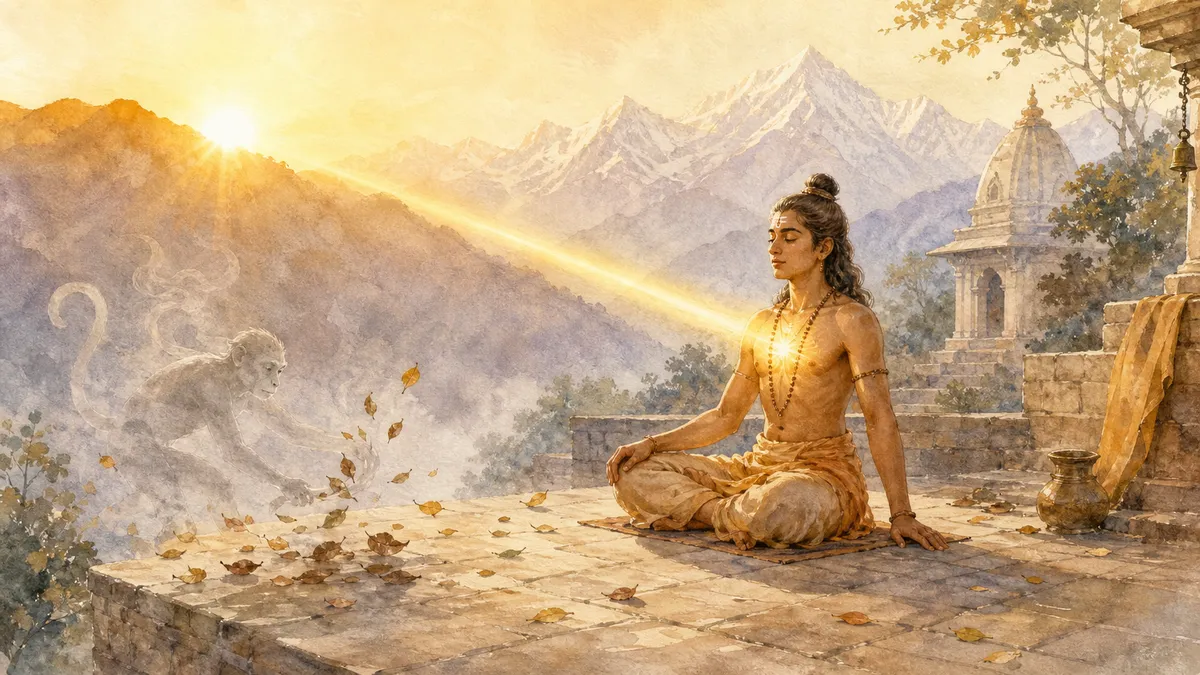
“I shall go there, where self-pacification will meet me, imperishable, unfading, where I shall abide forever. But the supreme path cannot be attained without yoga, and it is not fitting for the awakened one to be bound by deeds. Therefore, established in yoga, having left the fleshly abode, becoming wind, I shall enter the immense radiance of the Sun, for it does not perish, as Soma perishes because of the host of gods.”
Accepting the Great Decision and Renouncing Deeds
One can say that here the instructions continue in the spirit of the three golden rules. Although Shuka himself was not a beginner, he nevertheless needed the inspiration of the great rishi, the immortal Narada. Narada once again explained to Shuka the essence of the primordial state. Inspired, Shuka accepted the “great decision.” Again and again this principle is repeated here: accepting the “great decision,” entering into “great non-action.” Shuka says: “I shall attain that abode where nothing perishes (that is, I shall place my mind there). I shall renounce all doing, every sense of action, and leave behind all deeds.”
On the external level, from the point of view of Samkhya or the sutra tradition, the renunciation of action is connected with behavior. In our Anuttara Tantra, the renunciation of deeds is connected, above all, with the “great decision” and entry into “great non-action,” that is, with the complete renunciation of the egoistic sense of being the doer and of doing, and of attachment to the fruits and results of one’s deeds. When we act in this way, action ceases to bind us, and in general actions cease to be actions. What, then, do they become? They become play, creative self-expression. The external renunciation of deeds is not something genuine and natural, because action itself is not bad; it is a creative movement of energy. When action is in presence, it becomes lila, a self-liberating play. Then action is an adornment, an ornament, creative self-expression, manifestation, an emanation of shakti from the deity, which pours forth spontaneously. But in impure karmic vision, action enslaves like chains. It is connected with the one who acts, with the doer, with attachment to the fruits and results. Then lila disappears, cause and effect arise, karma. This is the meaning of renouncing deeds.
Of course, someone whose mind is very restless, who is very attached to the sense of doership, will need a prolonged renunciation of external actions as well. At some point he must become completely still, continuing his practice in retreat.
Here Shuka makes the “great decision” to enter deep samadhi, to move to the level of wind, and from the level of wind to make the leap to the level of the Sun, the god Surya. The Sun is the divine in the human world. One could say that it is the door to Hiranyagarbha, to the causal world. Although scientists have described the Sun from the point of view of physical processes, the Sun itself, from the standpoint of yoga theory, is a manifestation of a higher dimension in our human world — the world of Hiranyagarbha. Shuka decides to perform mahasamadhi, samyama on the Sun, fully entering into it in order to pass into the complete world of non-dual Brahman.
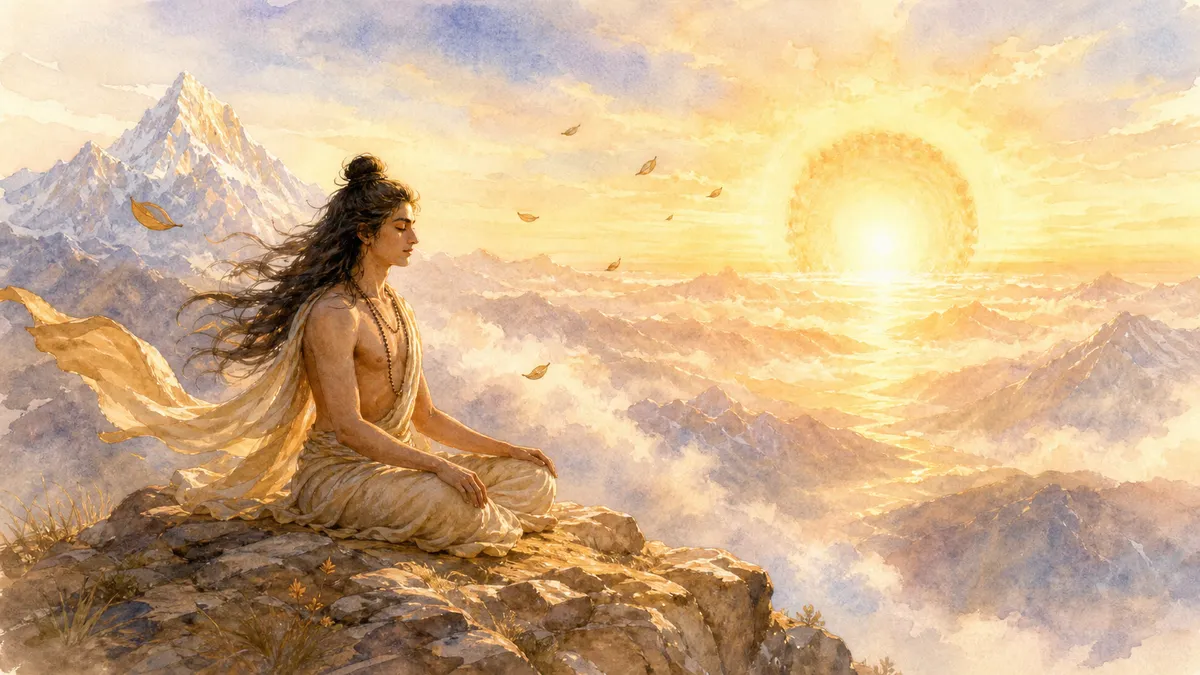
“Spilled by the gods, he falls to the earth and rises again. Soma always wanes and grows again; knowing this, I do not desire such repeated waning and waxing! But the radiant Sun illumines the worlds with its mighty rays; its disk is never diminished, and it gives strength to all.”
Perhaps it is not entirely clear here what is being referred to. Here Shuka reflects on Soma. Soma is the deity of the Moon. Unlike the Sun, which personifies the causal world, the Moon personifies the astral world, the world of the ancestors. The path of the moon (pitriyana) is the path of the astral body, the path of the spirits of magic and shamanism. In spiritual practice, the Moon is always connected with the astral world and the path of the ancestors. Here Shuka reasons: just as the god Soma is impermanent (he waxes and wanes, like the Moon, waning or waxing according to its phases), in the same way the path of the ancestors is unreliable; it is not complete realization.
In our human world, the Sun and the Moon are physical objects, categories of astronomy. But in Vedic philosophy, they are not so much objects as, rather, dimensions to which particular luminaries belong. It is in this context that we consider them. Two deities are associated with these dimensions: Soma and Surya. Soma is connected with the gods of passion, with the astral world. Surya, on the other hand, is connected with the supreme Brahman, with non-duality and the causal world.
Entering the Space of Surya-Akasha
“Thus, it is my wish to go to Aditya, blazing with power; there, with an unwavering inner self (antaratma), unconquerable, I shall abide. Casting off this perishable body, I shall enter the abode of the Sun with the sages, into the solar flame that is difficult to endure.”
Here Shuka speaks of a very lofty and very complex practice connected with jyoti-yoga, namely entering the space of surya-akasha.
According to the traditional classification, there are five main spaces: maha-akasha, tattva-akasha, surya-akasha, and so on. And one of the highest spaces is the space of the sun (surya-akasha), like billions of suns. When a yogin enters the highest state of samadhi, separating from the physical sheath, he enters this fiery-golden space, like a flame. And Shuka, having achieved very great success in yoga, decides to enter this space, inspired by Narada’s instructions.
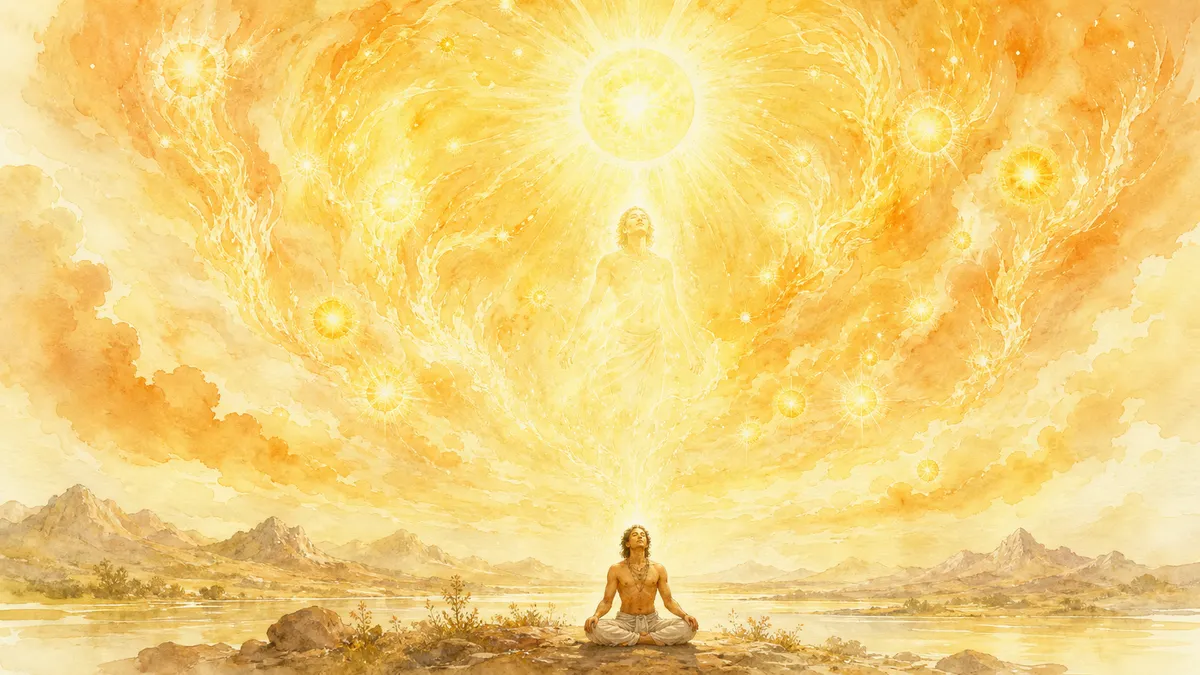
“I bid farewell to the trees, elephants, mountains, the earth, the directions of space, to serpents, rakshasas, pishachas, gandharvas, danavas, and gods. Into all beings of the worlds I shall undoubtedly enter — may the rishis and the gods behold my yogic power!”
Here Shuka bids farewell to trees, animals, people, spirits, gods, rakshasas, and others. In reality, he is bidding farewell not so much to some external beings as to his own dualistic vision. People, trees, stones, gods, spirits — all these worlds exist only as long as our conditioned vision exists, including the physical body. He decides to overcome duality completely, even on the relative level. It is not that he says farewell out of attachment and regret; he simply parts definitively with his residual karmic vision, where there still remained a subtle veil, a film of duality that allowed him to see something as separate. He says: now I will become the soul of everything, I will enter all living beings, having accomplished the ultimate samadhi.
Farewell to His Father and Departure for the Himalayas
“Then he asked the world-renowned rishi Narada to release him; released by him, he went from there to his father.
Bowing at the feet of the mahatma, the muni Dvaipayana Krishna, Shuka, having asked him to let him go, performed pradakshina. Hearing this word of Shuka, the pleased mahatma rishi said to him again: “Listen, my son, would you not stay a while today, until my eyes have had their fill of gazing upon you!”
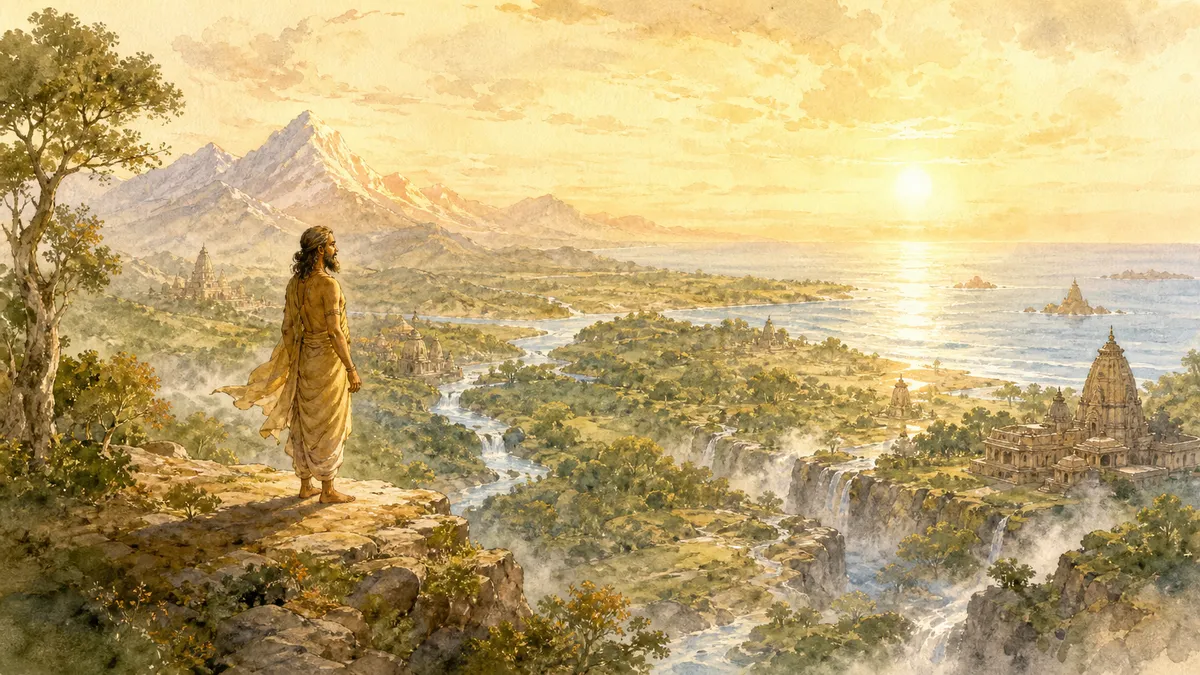
But Shuka, without weakness, so detached, free from doubts, thinking of liberation, set his heart on departure. Leaving his father, the excellent muni went to the ridge of bountiful Kailasa, inhabited by hundreds of perfected beings.”
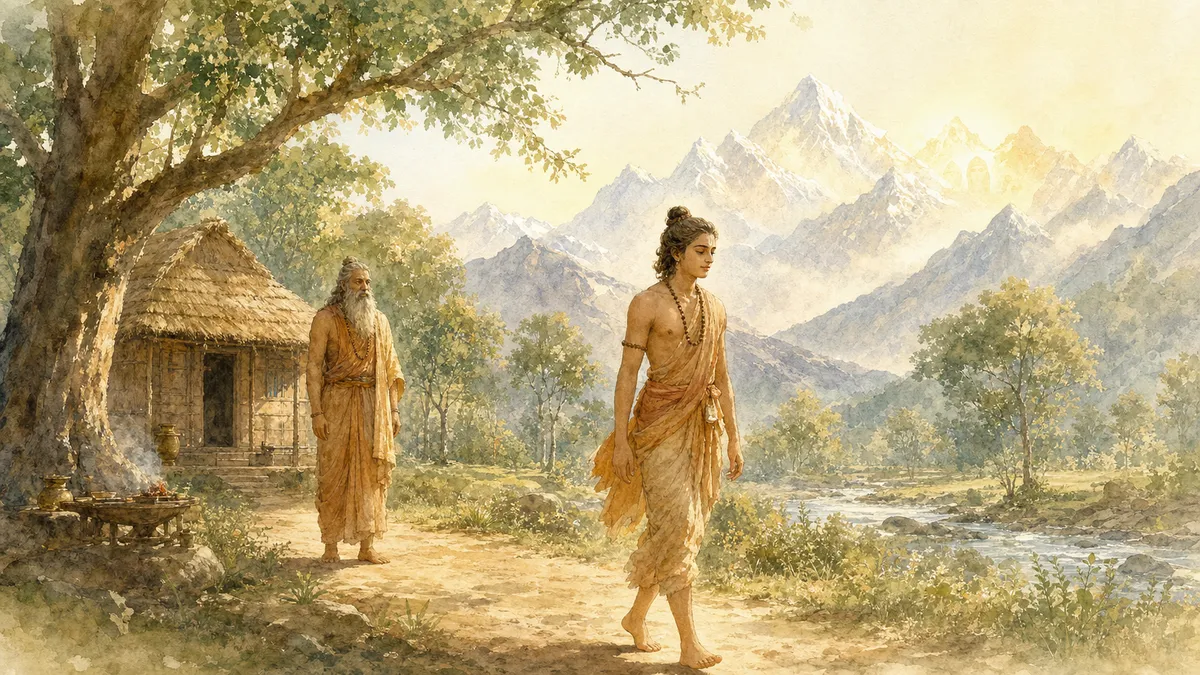
Shuka, having received instructions from Narada, visited his father and, asking for his blessing, left him. And although Krishna Dvaipayana Vyasa urged him to stay, Shuka, intent on liberation, set off for the Himalayas, inhabited by many siddhas. According to another version here, when he was already an adult, he leaves his father for the second time. And the first time he left him in childhood, at the age of six. And when his father tried to hold him back, he answered him roughly as follows: “There is much maya in you.” Vyasa tried to explain to him that one could practice here, that he himself was the Guru, but obviously Shuka, having the highest realization from past births, possessed very great self-sufficiency.
Entering samadhi and liberation from illusions
Bhishma said:
“The son of Vyasa, having ascended a spur of the mountain, O Bharata, in a desolate region on a secluded mountain platform, sat down and settled himself according to the rule of the lawgiving scriptures: all his limbs, beginning with the feet, he arranged in order, knowing the successive order. Then that knower, turning his face to the east, shortly after sunrise, sat as is proper for the exercises, drawing in his arms and legs.
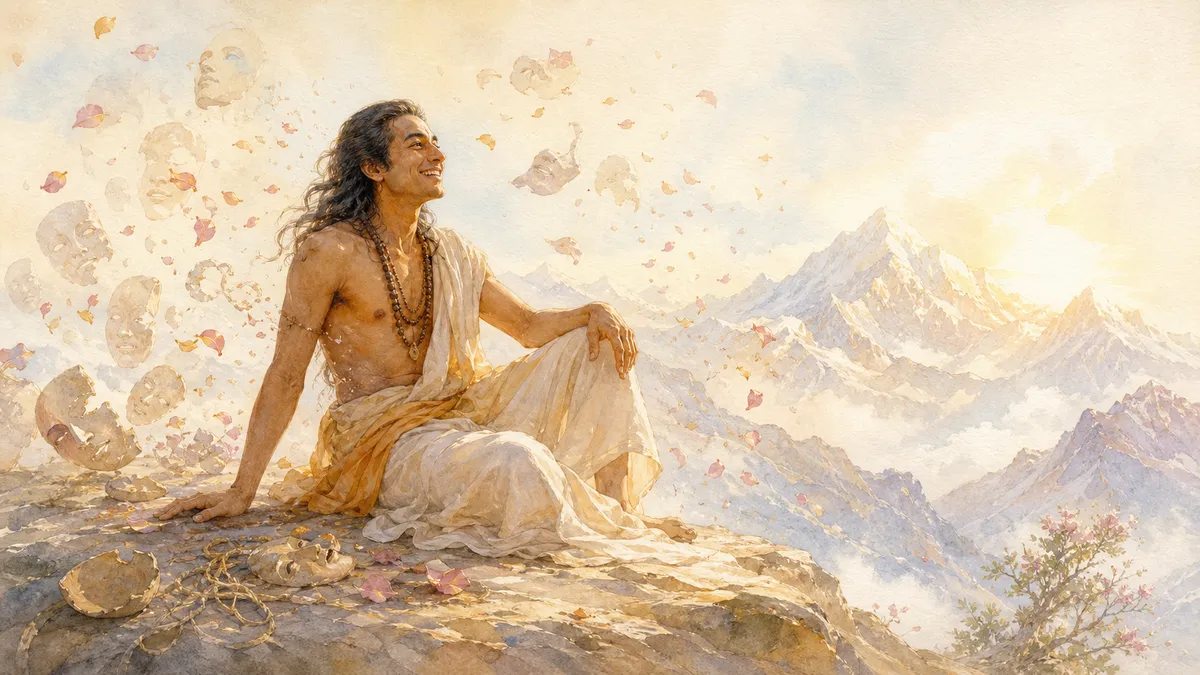
There birds did not fly, there was no noise, no distant view opened up; here the wise son of Vyasa performed the exercises of yoga. Then he saw himself detached from all bonds, and, having perceived the transcendent That, Shuka laughed with his laughter. For the attainment of liberation, established again in yoga, becoming a great lord of yoga, he rose into the air.”
Having entered samadhi and experienced nonduality, Shuka saw the residual illusions in which his mind remained. And when he was freed from them, he laughed just like a person who receives satori—a powerful experience of nonduality that shows the entire futility of his egoistic actions, all the pettiness of his clingings, all the illusoriness that he had previously considered real. At the end he laughed at his own remaining illusions. This is a sure sign that a yogin is progressing. The criterion is roughly this: if five years have passed and you do not laugh at your old self, the one from five years ago, then you have no progress. If you practice correctly, looking at yourself after five years, you see in what limitations your mind dwelt five years ago and how you have grown during this time. You trace the enormous distance that has been covered during this time. A completely new level of understanding appears in you. And this happens many times.
“Having performed pradakshina around the divine rishi Narada, he showed that supreme rishi his yoga.
Shuka said:
I have seen the path and am walking it; may there be blessing for you, great ascetic! I go along the desired path through your grace, radiant one!
Bhishma said:
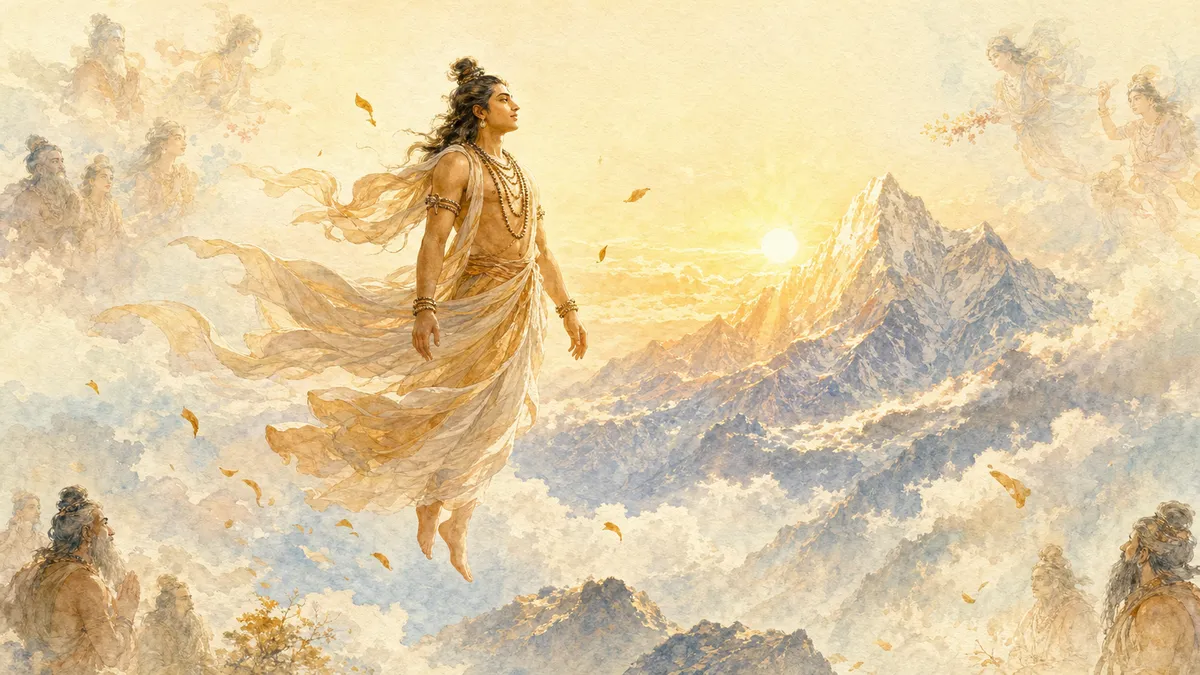
Released by Narada, bowing at his feet, Shuka, born of Dvaipayana himself, again immersed himself in yoga and rose into space. Flying up from the ridge of Kailasa, he ascended into the sky. Having become one who moves through the sky, the saint moved confidently, like the wind. All beings saw the excellent brahmin, comparable in greatness to the son of Vinata (Garuda), rising with the speed of the wind or of thought. Clearly penetrating all three worlds with his thought, he set off on a distant path, shining like fire and the sun.
All beings, moving and unmoving, beheld him, whose thought was concentrated on one thing and who was striving without fear. To the extent of their ability, according to the rule, they offered him worship, and the celestials showered him from the sky with a rain of flowers. Seeing him, the rows of gandharvas and apsaras were amazed, and the rishis (the perfected ones) were utterly astonished:
“Who is this, who has attained perfection through tapas, moving in the heavens? His body is straightened, his face raised, his eyes shine!”
Then the great righteous one, who had gained fame in the three worlds, walked silently, his face turned to the east, heading toward the creator of light—the Sun.”
Shuka, having entered saruba-samadhi, rose to the level of the wind. His subtle body became visible to the gods, spirits, apsaras, gods of passion, and even the rishis were amazed by his greatest spiritual power. But, without being distracted by their praises, he remained one-pointedly in deep presence, directing his mind toward the Sun. He performed the ultimate integration while abiding in sahaja-samadhi.
Meeting the Apsaras and the Testament to All Beings
“With jubilant cries, the hosts of apsaras seemed to fill the space on all sides as they watched his swift flight. O king, their hearts were shaken: he who wore the five locks (panchachuda) amazed them utterly, so that they opened their eyes wide.
“What deity has attained such a marvel, such a supreme path? How resolutely it comes here, as if liberated, free from desires.”
The radiance of Shuka struck the celestial maidens, the apsaras.
“Then on the mountain called Malaya he arose; Urvashi and Purvachitti always visit it. Both of them, in extreme amazement, met that son of the brahmarishi: ‘Ah, how deeply he has turned inward in mind while studying the Vedas, this twice-born one! In a short time he has ascended to the firmament like the moon; through obedience to his father he has attained such unsurpassed understanding! Reverently devoted to his father, the beloved son of his father, a stern ascetic—how could his father, thinking of nothing else, have left him?!’
Hearing the words of Urvashi, Shuka, fully knowing the highest dharma, looked in all directions, as if carried into ecstasy: into the firmament, the earth, the rocks, the forests, the groves, the lakes and rivers—then he penetrated them with his gaze. All the deities gathered and, with great reverence, looked upon the son of Dvaipayana, their hands folded.
Then Shuka, who knew the highest dharma, said these words to them: ‘If my father seeks me, crying out: “Shuka!”, then answer him all together; out of love for me, be pleased to do this.’
Hearing Shuka’s words, all the quarters, with their forests, seas, rivers, and rocks, answered him together: ‘As you have asked us, O singer, so let it be! We shall answer the summoning word of your father.’
The Final Merging with Brahman
Bhishma said:
“Having spoken these words, the great rishi, the exceedingly great ascetic Shuka, abided in perfection, having abandoned the four defects. Having left behind the eightfold darkness, he cast off the fivefold passions (rajas); then he cast off sattva as well. It was like a miracle! Then, in the constant, qualityless, signless place, he became established in Brahmo, shining like a smokeless fire.
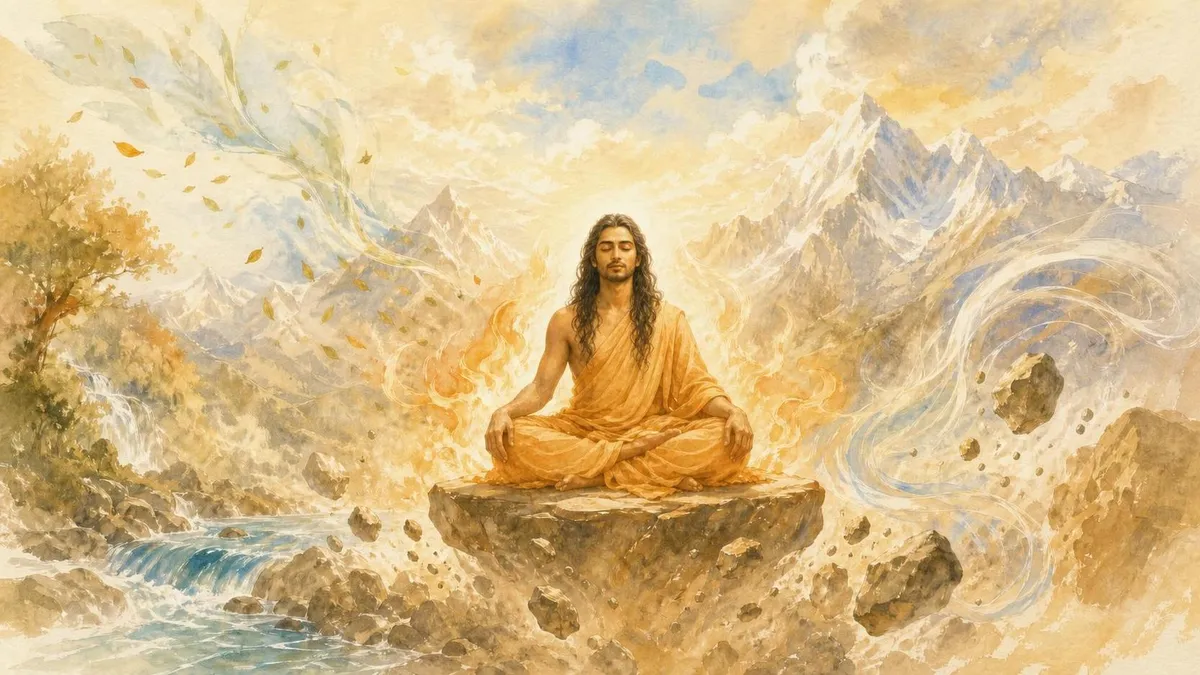
A fiery rain fell, the quarters of the firmament blazed with fire, the earth trembled at that moment; it was like a miracle! Branches fell from the trees, cliffs rolled down from the mountains. The ridges of Himavat split with a crash, as if being torn apart. The purifying fire did not burn, the thousand-rayed Sun did not shine. The seas, lakes, and rivers surged. Vasava poured down as rain delicious, fragrant water. A wondrous, fragrant, pure wind began to blow. With spurs rising wondrously, the pair Himavat and Meru, two converging mountains, white and yellow, beautiful as if made of silver and gold, O Bharata, a hundred yojanas in width, length, and height, shone on the northern side; he saw this.
Then, with an unshaken heart, Shuka ascended; at that moment the peaks of both mountains suddenly split in two. It was an unprecedented wonder, O maharaja, and between the two mountain spurs he swiftly passed.”
Shuka’s power of control over the elements was such that, when he entered such a great samadhi, the five elements seemed to rage. It is often described that when great yogins depart, various phenomena manifest, depending on which elements predominated in them.
Our karmic vision seems gross, but it consists of consciousness, and we all participate in sustaining it. But great saints not only participate in karmic vision, they influence it very powerfully. Unlike ordinary beings, the state of their mind has a very strong effect on the universe: such a saint can shift the orbit of a planet, cause cataclysms, alter the dimensionality of space, create global geophysical processes, because his mind extends to the deities who govern the planetary climate and physical constants.
“The highest mountains did not bar his way; and among the celestials a great commotion arose in the sky. The gandharvas, the rishis, those who dwelt upon the rocks, cried out when they saw Shuka soaring between the parted mountains. ‘Holy, holy!’—such a cry resounded from everywhere, O Bharata. The gods, gandharvas, rishis paid him homage, as did crowds of rakshasas, yakshas, and vidyadharas, guardians of knowledge, in multitudes. The expanse beneath the heavens was suddenly filled with wondrous flowers. Having accomplished his ascension, the great king Shuka reached the exalted, delightful Mandakini (the heavenly stream).”
Meeting Beings in Samadhi
When a yogin advances in practice and enters samadhi, he encounters various living beings that inhabit the world besides himself. He sees spirits, beings of hell, asuras, rakshasas, and gods of passion. Then, rising higher, he begins to see immortal celestials and holy gods. At first he sees them and enters into unhurried conversations with them. But as samadhi deepens, he passes through the lower beings very quickly: they flash before his gaze and disappear; he no longer pauses to speak with them. As his samadhi intensifies, he begins to meet higher beings (siddhas, immortals, rishis, and gods), who bestow blessings upon him. As the radiance increases, many of them show him reverence and make offerings. The practice on the path of divine pride develops in approximately the same way.
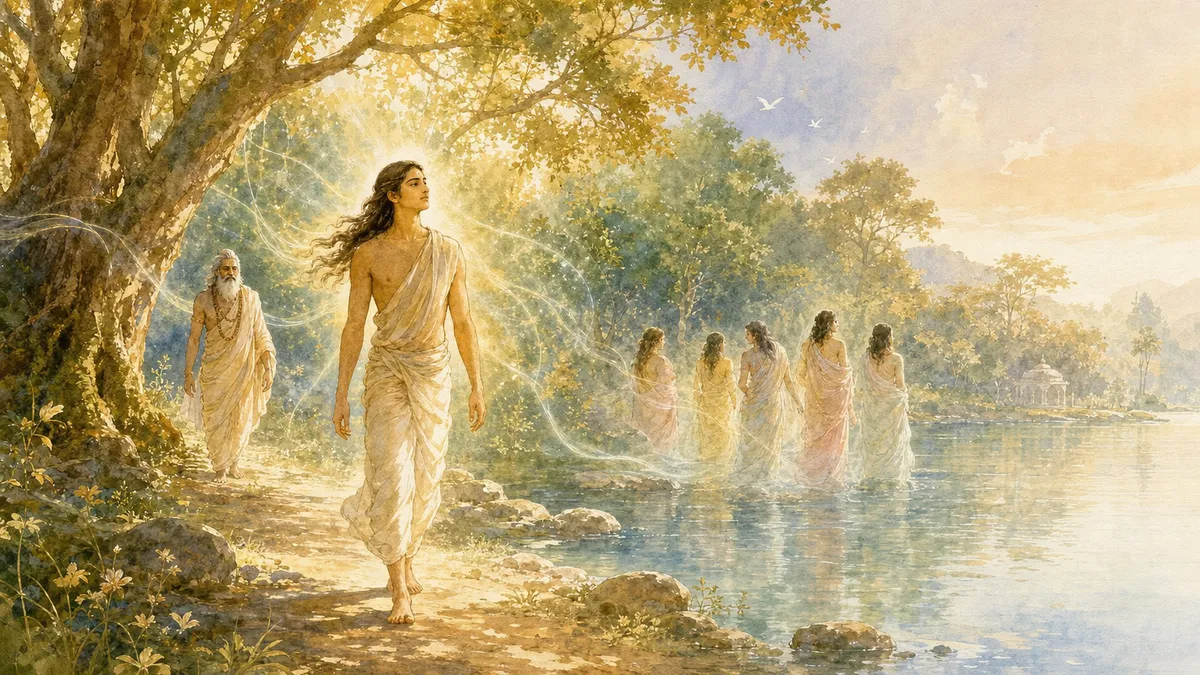
“Righteous Shuka saw flowering thickets of trees; in the river apsaras frolicked in a merry crowd. Naked and bodiless, they gazed upon the bodiless Shuka.
His father, filled with tenderness, learning that Shuka was ascending, followed behind his son, heading along the northern path. Shuka, with the upward wind, proceeded along the ascending path in the heavens. And he became Brahmo, manifesting his superiority, while the great ascetic Vyasa chose another path of great yoga. In a single instant he reached the abode of Shuka. He saw how Shuka had passed through, splitting the summit of the mountain. When the rishis praised the deeds of his son, Vyasa called out to him for a long time with the cry, ‘Shuka!’ The echoes of the father’s calls filled the three worlds, and Shuka, having become the soul of all, omnipresent, all-seeing, righteous, answered with the far-carrying cry ‘bhoh!’ When he shouted ‘bhoh!’, that monosyllabic cry, the whole transient world, moving and unmoving, responded. Since then and to this day, if one shouts a summoning cry in mountain caves, on mountain ridges, they answer for Shuka, as they did then.
Then, having shown his power, Shuka disappeared into beings.”
Vyasa, his father, followed in Shuka’s footsteps, trying to find him. When the celestial maidens were bathing naked, they saw Shuka and looked at him without embarrassment. But when Vyasa came there, these maidens immediately ran away. Vyasa asked:
“Why, when you saw Shuka, did you not run away but stood before him, yet when you saw me, you fled? After all, I too am a yogin, and there is no lust in me.”
They said:
“We do not perceive Shuka as a man, whereas in you something human still remains.”
Shuka began to merge with Brahmo, having completely left the human state behind. He reached the level of the creator god; his mind penetrated all objects of the universe.
Shiva’s Blessing and the End of the Story
“Having abandoned all qualities, sound and the rest, he ascended into the transcendent realm. Seeing the greatness of his immeasurably magnificent son, Vyasa descended onto a rocky ledge, reflecting on his son. Then, on the bank of the Mandakini, rows of playful apsaras were startled by the arrival of that rishi, losing their composure. Some plunged into the water, others hid behind bushes, and still others, noticing that excellent muni, seized their garments.
The muni Vyasa, realizing that his son was free while he himself was bound, was pleased and at the same time ashamed. Then the god, surrounded by gandharvas, revered by hosts of rishis, approached—the lord Shankara, holding Pinaka in his hand.
First, having encouraged him with a sign, Mahadeva spoke these words to Dvaipayana Krishna, overcome with grief and sorrow for his son:
“You once asked me for such a son, equal in power to fire, water, wind, and the sky. Then, with such marks, a son was born to you through the power of your tapas and by my grace—pure, possessing the power of Brahmo.”
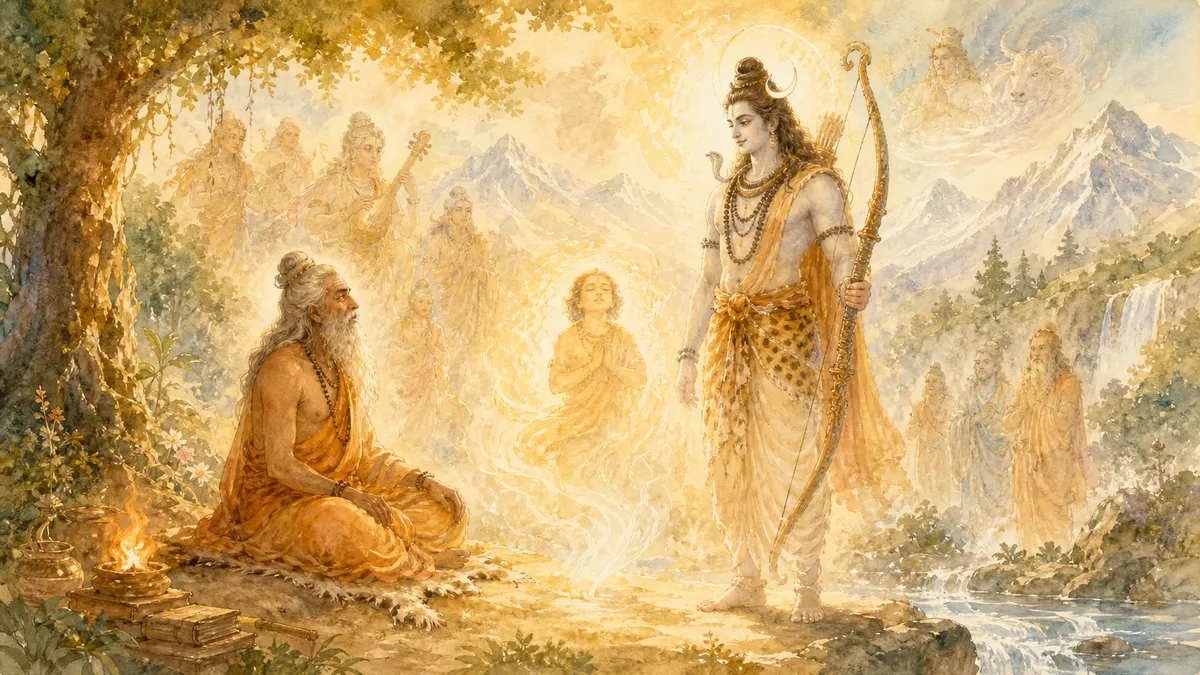
When Shuka departed, merging with Brahman, Shiva appeared to Vyasa and reminded him of his blessing. He said: “By your tapas you obtained from me a son of unsurpassed yogic power. Now you can see for yourself that it was precisely such a son you received.”
“He has attained the highest path, difficult to attain for one who has not conquered the senses, and even for the gods; why, then, do you grieve for him, O singer-rishi? As long as the seas surge, as long as the mountains stand, so long shall your fame and that of your son not perish. The reflection, the likeness of your son, always and everywhere, unfailingly, by my grace you shall see in this world, O great muni!”
Guided by Lord Rudra himself, O Bharata, beholding the light of his son and filled with great joy, that muni returned to his own place.
Thus, about the birth and also about the path of Shuka, as you asked, I have told you in detail. Once the divine rishi Narada told it to me, and also the great yogin Vyasa in conversations, word for word. If one striving for peace assimilates this pure true account concerning the foundation of liberation (moksha dharma), then he will follow the transcendent path.”
The prophecy of Shiva given to Vyasa came true. To this day, the glory of the great yogin Shuka has not faded, inspiring hundreds of thousands of yogins throughout the world, as has that of Krishna Dvaipayana Vyasa, his father.
