


Question: How can one avoid being captivated by this world while fulfilling worldly duties?
I can, of course, give banal advice: see God in everything, do everything as a game, live in the world but not of the world, be a hermit in the world, and so on. But I am afraid this will not work, because my words must be properly applied and lived through, since the world is the kind of thing that requires more powerful energies.
You will not be able to avoid being captivated by this world while fulfilling worldly duties. You will definitely be captivated by it; you must know this. But you can reduce this captivation. It is precisely with its reduction that your awareness will develop. It will decrease only if you become a master of contemplation, if you bring your art of contemplation to virtuoso mastery, if you become a super-professional in the practice of contemplative presence.
Therefore my first advice is to practice diligently from morning to evening the practice of contemplation while walking, while moving. It is impossible to become a great meditator in a month, but it is indeed possible to develop your contemplation even in a short time by practicing diligently while walking. As soon as you master the art of contemplation while walking, you will see how your captivation decreases, and then all you will need to do is bring contemplativeness into all your actions.
So, the most important thing is the development of your capacity for contemplation. This is the inner path. The second thing that helps greatly is that you need to invite higher energies into your life and enter into interaction with them. This is the principle of service. You need to open yourself to higher sacred energies and devote as much attention to service as you devote to worldly duties. This is very important. Of course, you need to find a form of service that is to your liking, so that it corresponds to your inclinations.
You will see how your destiny changes, how enlightening forces enter your life when you engage in service. Service is needed neither by the spiritual teacher nor by the monks. It is not a way to advance projects. To look at service in this way is incorrect. Service is needed first and foremost by you. It is opening oneself to energies and interacting with them; in particular, we open ourselves to the enlightening forces — Anugraha Shakti. Service is the acquisition of a higher meaning in life and in actions than providing for oneself or one’s family, and even than personal spiritual practice. Service is a way to go beyond the ego, to self-transcend, to come into contact with global forces that surpass your small “I,” and to benefit from this contact. True service should bring benefit in the form of an improvement in destiny. Regard it as a kind of magical ritual.

The “Shiva Purana” describes a ritual: if you want to improve your destiny, get rid of certain illnesses or obstacles, or gain wealth, you need to make a thousand lingams — symbols of Shiva. Whoever makes ten thousand will acquire certain powers and status; whoever makes one hundred thousand will acquire others. This happens because this action, like a magical ritual, attracts new forces into your life; you move onto another line of life, where new contacts, connections, and a new vision open up for you. This is how service works.
The third thing that is necessary is to organize your worldly life carefully. How can it be organized? Have regular sadhana and try to keep to the schedule you have adopted. For example, if you have decided to meditate for two sessions a day, one hour each, then you must stick to it. If you have taken on the commitment to do pranayamas or asanas in the mornings, keep to it without retreating for at least three years in order to obtain results. If you have decided to practice contemplation in motion for one hour every day, do it. If your schedule includes evening Mahashanti meditation, hold to this schedule so that nothing can distract you. A stable routine helps you avoid being captivated by this world while you fulfill your duties.
The fourth is that you need to constantly nourish yourself spiritually. Once, at the railway station in Nizhny Novgorod, I met a nun; she came up and asked, “Which parish are you from, Father?” I said, “From the parish of Laya Yoga.” She replied that she had not heard of such a thing. We talked about her monastic life, and she said this phrase: “It is very important, even if you are a hermit, to be spiritually nurtured somewhere.” The term “to be spiritually nurtured” for them means to receive spiritual nourishment, to be filled. Going to confession, to darshans with holy elders — this is spiritual feeding.
If you do not have such holy elders in your local Dharma center (we do not have elders at all), then you need to think about how to nourish yourself spiritually, for example by reading spiritual literature, so that you are constantly replenished. If you take on the commitment to read the Yoga Vasistha or the Tripura Rahasya for half an hour every day, you will be in meditation on this text, and it will always support you spiritually in life situations. You begin to look at the world through Vasistha’s eyes when you meditate on the text well enough. This text should not be read as though it were simply a formal absorption of knowledge, but should be approached precisely as meditation, when you connect to the information contained in the text. This is the fourth principle.

The fifth principle of how not to be captured by this world is to cut off everything unnecessary in it. If you are invited to a party where people will eat non-yogic foods and drink non-yogic beverages, do you need to take part in that party if you are a yogin? It is necessary to cut off everything unnecessary. I used to recommend to students: “Settle in a place where no one knows you, change your job, and live discreetly as a secret yogin, like the siddhas of antiquity.” Not all the siddhas of antiquity were monks; some of them were laypeople, settled on the outskirts of a village, worked, for example, as swineherds, potters, blacksmiths, and outwardly appeared to be perfectly ordinary commoners, but inwardly they performed tantric sadhanas, and no one even suspected who they were. They presented themselves as simple people, and when someone came and asked them about the teaching, they pretended not to know anything, saying: “I am an ordinary peasant.” Nevertheless, they realized the greatest attainment.
The sixth principle is: learn to keep your sadhana, your life, secret. Surround yourself with mystery; be somewhat hidden from this world: not from one another, not from your Dharma brothers and sisters, but from everything that conditions you. This does not mean being closed off, hating the world, arrogantly despising it, thinking: “I practice, while they are all in ignorance.” That is wrong. “Secretly” means keeping matters connected with spiritual practice and your life deep within yourself and not advertising them. In this way you will make your life unreachable, inaccessible. This is very important, because you will constantly suffer failures if you are accessible; other people’s thoughts will interfere with your subconscious, and it will become cluttered.
The seventh principle is: periodically go on retreats. Establish in your Dharma center or group the possibility of doing one-day or three-day retreats every month, or go out of town and do secluded practices there, observing silence.
The eighth principle is: always try to seek communication with those who are above you. You can communicate with those who are below you in spiritual level if you want to help and give instructions. In other cases, it may be everyday socializing, which is unwarranted. Communication with those equal to you may be interesting, but it is horizontal communication, where you will gain nothing from one another. But communication with those who are higher is a true jewel, and it should be sought as much as possible. Being in the company of saints, in the society of sadhus (satsang), is one of the main conditions for enlightenment. Therefore, if you try to communicate as much and as often as possible with practitioners who share samaya, with monks, high-level disciples, and spiritual mentors, you will receive simply enormous benefit. Through such communication, your karma begins to change. You can spend from one to three months a year in the monastery, in “Divya Loka.”
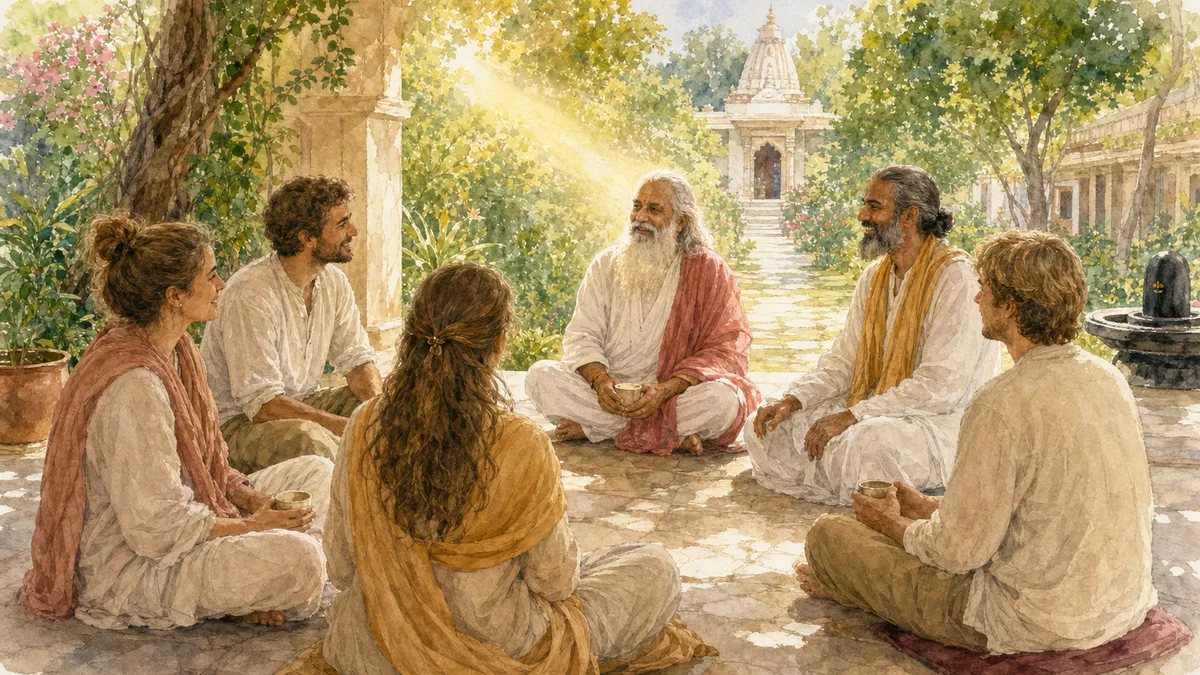
If you are able to observe all these principles, you can avoid being captured by this world while fulfilling worldly duties.
The Practice of Contemplation in Everyday Life
Question: How can one practice self-remembering in worldly life, in one’s activities, without appearing sluggish?
Yes, such sluggishness sometimes arises when you become too absorbed in atma-vichara, sankalpa, and begin to ignore the external world. This is called “the loss of action in awareness,” and if a person immerses himself in the principle of nonduality and loses external intention, then that is another mistake: “the loss of action in the View.” Often the View and the high philosophy of Advaita can indeed lead to a person becoming vague and losing his bearings, but this should not happen; it is a mistake. In the relative world, you must be sufficiently flexible, skillful, and resourceful.
In order not to appear slow or inhibited while doing so, it is necessary to constantly train in combining external actions with one’s own contemplation, to learn to contemplate in motion in all everyday situations, even when these situations are very dynamic.
When I was about twenty, I practiced atma-vichara while running after buses and trolleybuses if I was late for them. I thought: “Running is the perfect time for the practice of contemplation.” As a result, the practice of contemplation developed well. Then I simply began running while at the same time engaging in practices of contemplation and working with sankalpa; despite the body moving, the mind remains in a state of deep immersion in presence. It is a matter of training.

The siddhas have a saying: “Resourcefulness without attachment.” It best characterizes the principle of flexibility in the practice of self-remembering or other exercises in contemplation. To be in awareness and in contemplation by no means means walking around with a glazed look and saying: “All this is an illusion.” With such an approach, at best you will simply become a laughingstock for others, and at worst doctors may be sent for you. A true practitioner should never allow this. He must be very adequate, skillful, and flexible in everyday life. He must manage his consciousness and the situation in such a way that the situation always remains under his control.
If he wants to show his soul to another, he shows it to the extent he considers necessary. If he wants to conceal it, he conceals it. If he wants to show it halfway, he shows it halfway. If he wants to position himself as a worldly person, he presents himself completely as worldly, and no one will even suspect anything. That is, a practitioner of anuttara tantra is a very complex being; it is not easy to understand him at once, because his mind is very flexible and multivariate. He is like a deity. For example, deities can manifest in any way they wish: they can take the form of a human, a deity, or a beast; they can extend themselves into three or five bodies. They position themselves however they want. They are multifaceted, multilevel, complex beings. In the same way, a yogin is a multifaceted being who is very flexible and always adequate to the situation.
Self-Liberation and Purification
Question: If self-liberation is a kind of devaluation of everything (both good and bad), is it necessary to self-liberate the feeling of guilt for some misdeed, or is repentance needed?
If your self-liberation is so powerful that it manifests up to the level of pure vision, that is already enough; if it is not deep, then repentance is useful. However, everything must always be self-liberated. The feeling of guilt is a negative imprint in the subconscious (samskara) which, if it is not purified and self-liberated, can become the cause of a new birth. It certainly needs to be purified.
This can be done through repentance (a relative method): approach the altar, make an offering (an incense stick, fruit), sit opposite the altar, and silently recite: “Guru Dattatreya, root guru, saints, siddhas, and rishis, please accept my repentance.” Visualize what you would like to repent for; then visualize how light pours forth from the lineage and completely purifies everything. After that, make prostrations and recite the Refuge mantra. In this way you perform repentance if anything negative has been committed.
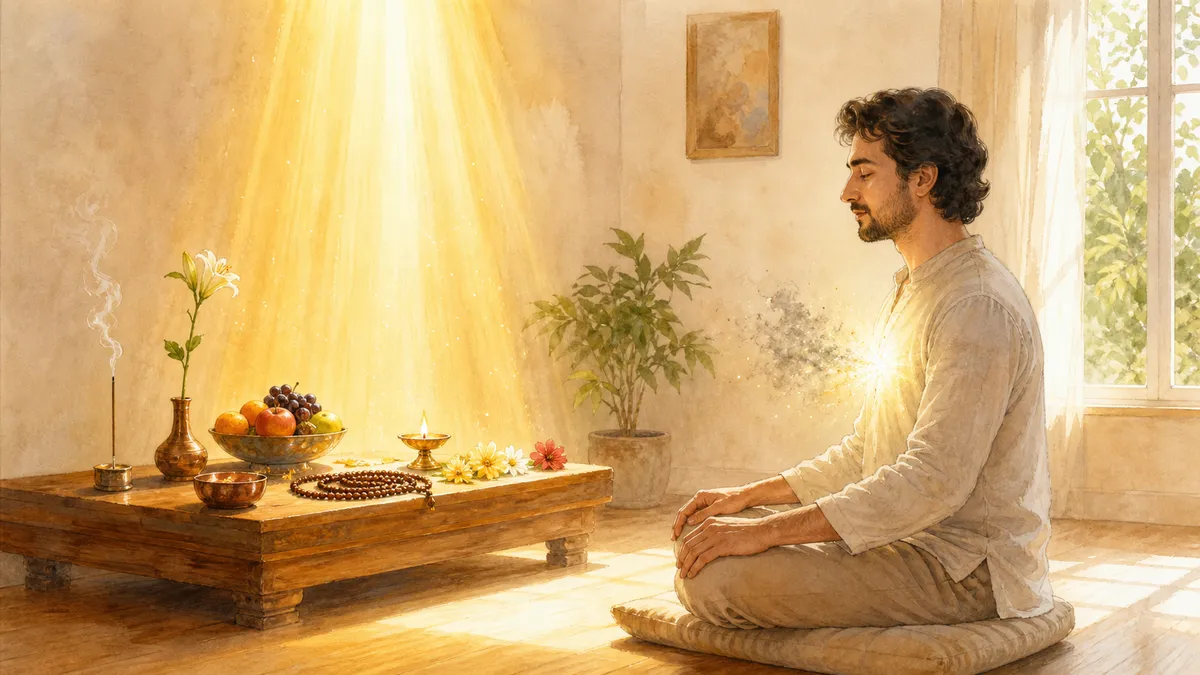
But if it is something not very serious, and you are a good contemplator, you do not need this; you can simply self-liberate it through the method of abiding in presence. This is done instantly, because when you abide in presence, you immediately enter a vision in which everything is always perfect, everything is always pure. If your level of self-liberation is sufficient, then you do not need special methods of repentance, or repentance takes place by itself through self-liberation, without invocations, mantras, or visualizations.
The question is to understand what spiritual level you are at, whether self-liberation is enough to erase certain negative imprints in the soul or not. Usually monks practice both methods together: on the absolute level they self-liberate everything; on the relative level, if necessary, they perform practices of purification or repentance. Such a purification practice is called “samskara-shuddhi” — the purification of samskaras. You enter the subconscious and review your past impressions. If you do not like something in these impressions, if you feel that in the past some impurity, negativity, anger, greed, or lust was admitted somewhere, and consciousness grasped onto it, you bring light and awareness there, perceive everything in pure vision, and dissolve it in the light until everything within you is purified and you feel that the negative imprints have left you. This practice (samskara-shuddhi) is conducted in the monastery once every three months.
Question: If something did not work out, if one failed to fulfill a duty, obligations, or promises, can this be self-liberated?
From the absolute point of view, one can answer as follows: if you dream that you failed to fulfill a duty in a dream, how should you regard it after awakening? In the same way as you regard everything in a dream, that is, it is originally unreal; it was only your delusion, you took the dream for reality. Therefore, everything must be self-liberated.
However, in the relative dimension, of course, we must understand our circumstances. Self-liberation means that we act wisely and competently in the relative dimension as well. If we understand that our actions of self-liberation may bring dissonance or harm, we must carefully weigh everything and think it over. A true master is limited by nothing when he self-liberates, but he will never do anything unnecessary, never allow a mistake, never introduce disharmony. Moreover, even if he decides to introduce disharmony, he will carefully think everything through and weigh it, and make a decision as to why he is doing it and what the price for it is. In the relative dimension, you must always manifest your clarity in order to liberate something or not; here you need to be guided by your own intuitive consciousness, because there are no instructions for every situation in life.

For example, Krishna promised the Kauravas that he would not fight at Kurukshetra, but would only be the charioteer on the side of the Pandavas. But then, during the war, a situation arose in which Krishna had to violate his promise a little. He neglected the duty of a kshatriya and revoked his word, thanks to which the Pandavas won the battle. He could do this because his vision was very deep; he knew what could be liberated and that the consequences of not fulfilling his promise would not bring serious problems.
Attitude Toward Material Well-Being
Question: For many laypeople, the topic of money is relevant. There are fears that turn into the certainty that there is none and never will be. Others are confident that for all God-pleasing actions (donations, trips), funds are always available, and therefore there is no need to worry about money.
Since you are not monks, you need material energy, because without it you will have problems. If you do not want to be involved with this material energy at all, not to have personal property, but to engage in practice and service, then, of course, there is no meaning in living in the world; it is better to become a monk. This is exactly how monks live: they have no private property, even when they use material energy. But if your choice is different — to be practitioners in the world — you cannot do without material energy.
If you have a lack of this material energy, there may be several reasons for this.
The first is the karma of greed, the returning karma of stinginess. That is, one must eliminate the karma of greed: be generous, make donations, offerings, give alms, even if you yourself have little. I often tell the monks: “You see, you do not have a separate hall for retreat, which means that in past incarnations you were stingy. Whom is there to blame here; if you do not have something, who is at fault for this except yourselves? You should have donated more in past incarnations.” In this incarnation you reap only what was there before. All of this is a manifestation of the karma of stinginess or the karma of greed.
When we are stingy and greedy, we broadcast to the Universe: “I do not deserve this shakti, I am unworthy of it, I do not need it, I cannot attract it.” We send such signals, and the Universe responds: “Everything is clear.” One should never have a narrow consciousness (riding buses, the metro, and so on without tickets), because by saving on small things, you will arouse the aversion of Lakshmi-shakti, the energy of material prosperity; it will avoid you. On the contrary, making offerings, being generous, opening up your consciousness means attracting the goddess of prosperity, Lakshmi, material shakti, to your side.

Denial of the World as an Obstacle to Material Well-Being
Another reason is the denial of the world. A yogin begins to practice and thinks: “This world brings only suffering; moreover, it is an illusion that holds me.” A negative attitude arises in him. The mass media impose their own vision; all of this constantly knocks him off balance, and aversion develops in him.
There is aversion to samsara as a positive factor, accompanied by entering monastic life—that is one thing. But if you have no plans for monastic life, if you have firmly decided to live in the world no matter what, then cultivating aversion to the world is at the very least unwise; that is, it is wrong to hate that in which you live. You need to rid yourself of denial of the external world and of such aversion; rather, it must be self-liberated, not allowed to exert its influence.
This also happens because a person’s mentality is very constrained; he feels: “I am unworthy of having material shakti.” If you have such a mentality, it is difficult to help. Such a mentality must be overcome by practicing divine pride, because deity is a feeling of surplus, prosperity, and abundance.
Practical Methods for Attracting Material Shakti
What can be specifically recommended?
Perform the practice of the Brahma mantra with the bija “Shrim.”
You can make a daily offering of water in a crystal vase, placing it on a table, on a bedside table, or on a windowsill with the mantra “Om Mahalakshmi Namaha.” The water should be changed every day; it can be poured under a tree or drunk. Thanks to this, you will be able to improve your material well-being.

The True Purpose of Material Well-Being
A practitioner needs material well-being in order to support his practice, to develop certain projects in service—precisely for this purpose. Therefore, the meaning of material well-being is to accumulate merit, to contribute to the development of certain aspects of service and giving, and not to accumulate billions. If you have this principle and you accumulate merit, material shakti will always bestow its blessings upon you.
In the monastery, the monks have no private property. All funds that appear, as a rule, go toward the construction of temples, the commissioning of sculptures, service, the dissemination of sutras, and the development of various projects. For the meaning of life lies precisely in serving the higher powers and placing everything one has in service.
