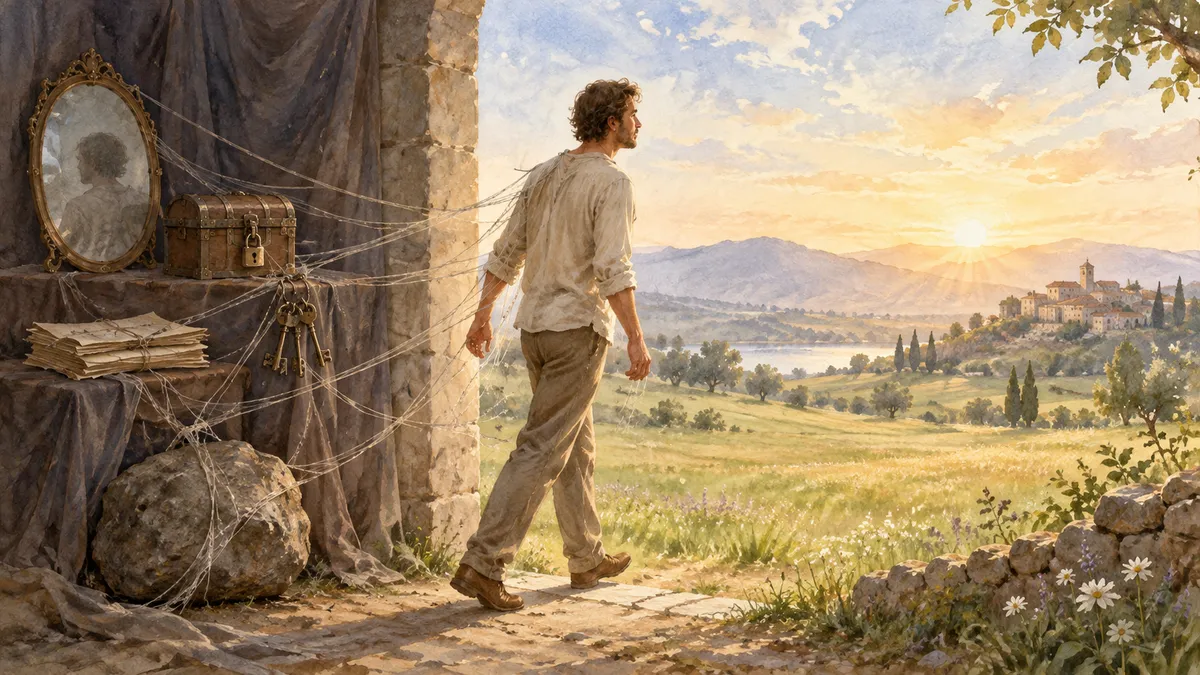
In the teaching of Laya Yoga, we say that it is not so much meditation that matters as becoming accustomed to the view. But it is important to understand what the view means. You can acquire a philosophical view by studying texts on your own, for example, Shankara’s texts, the text Vivekachudamani, Yoga Vasistha, Tripura Rahasya, but this is not the true view. It is an intellectual view that serves as preparation for the true view.
First, you need to understand the philosophical view of Advaita and become firmly established in it. If you do not understand the view of Advaita, it will simply be impossible for you to practice, because even if you practice awareness, it will be awareness directed toward something, a kind of dualistic awareness. And you will not be able to go any further.
The view of Advaita says that everything is Brahman and that this world is an illusion. And until you believe this, until it becomes your life motto, the symbol of your life and your view, it is impossible to move further toward realization, at least on the path of Advaita teachings. We do not attain Enlightenment simply because we do not believe in these things; we think they are an abstraction, a philosophy. When your belief is weak, it is impossible to practice. But if you begin to believe, you will see that miracles will begin to happen.
Faith in the Master and the Transmission of the View
Faith in the Master will inevitably lead to faith in his philosophy. This is not the worldview or philosophy of some particular Master, but the philosophy and worldview of all saints. If you believe in the Master, you need to go further. The Master is not an end in himself, nor is he merely a person; his purpose is to transmit something to you, something very valuable. He possesses it and can transmit it if you are in a state of proper connection.
What can he transmit? It is the view, a way of seeing the world, the universe, yourself and life. We call this “view”; it is also called “jnana.” The very habit of seeing the world differently is already a transformation. As practice progresses, your vision must change. And if it does not change, it means that we are not studying the view enough or do not believe in it enough.
The philosophical view is like a foundation. The world is an illusion. Everything is Brahman, the Absolute. I am the Absolute. These short phrases contain the view of Advaita:
Prajñānam Brahma
Aham Brahmasmi
Tat Tvam Asi
Ayam Ātmā Brahma
Sarvam Eva Brahman
Brahman Sat, Jagat Mithyā
Brahman is real, the universe is unreal.
To master the view, you need to perform analytical meditations on these sayings, either during retreat or continuously.
The View as Liberation from Problems
The view means that all your questions should fall away, at least on the level of consciousness. Perhaps problems on the level of the body or external reality will not disappear, but on the level of consciousness these questions must fall away. Because people ask different questions: about the world, about family, about relationships, about the path—but Advaita has its own answers. What are these answers? All of this is an illusion; at the level of the view, you should not seek information about it, but understand that everything is different, that the world is structured differently. You either accept this or you do not. If you accept it, you move on; if you do not, you remain with these problems.
If you want to solve problems, you need to get rid of problems. Problems cannot be solved; you can free yourself from them by changing your view of the world. But solving problems means constantly getting involved in them. This is not the path of liberation; it is not moksha. You want to solve problems with harmonious relationships, and you will be solving them forever. If that satisfies you, you will continue solving them in your next life. But if you truly want to solve the problem, you need to get rid of the problem itself; that will be its solution. What does it mean to get rid of the problem itself? To change your view of the world, to change your perception of the problem altogether.
The saints of Advaita speak radically: there are no problems; there is only our incorrect vision, an illusion. We mistake illusion for reality. We take what is illusory to be real. For example, if there is a rope but it appears to you to be a snake, then you need to solve problems so that the snake does not bite you. But if you understand that it is a rope, why ask questions about the snake at all and be afraid of it? Or if you see a bush in the dark, do you need to fear it or arm yourself if you are walking at night and think it is a person? But if you understand that it is a bush, you do not need any of this.
The Advaita view does not solve any problems; it simply cancels them. No problems can be solved until we change our view.
Nondual Vision as a Point of Control
Changes in the world, the harmonization of relationships, changing oneself, achieving success—it is impossible to solve these problems at the level of their ordinary interpretation. Because when we interpret problems in the usual way, we can never get rid of them; we occupy the same point of view as the problem itself. But any problem can be solved from a higher point of view. This higher point of view is the Advaita view.
You will not be able to control things or build harmonious relationships with other people while remaining on the same level as everything else. This is not a point of control over it, nor a point of harmony; it is a point of lack of control, a point of disharmony. You will not be able to solve the problems of the world if you are on the same level as the world. This is not the point of resolution where problems are solved; you need to rise to a higher vision.
For example, many people say that there is a world government, a Trilateral Commission, which secretly meets and decides the fate of the world, and that everything is under its control. There is a great deal of talk about this. I doubt it. Because in order to solve the problems of the world, one must possess nondual vision. This is the level of gods, siddhas, and saints, but saints have little interest in this world, to travel around in expensive cars and formal suits discussing where to crash the exchange rate and where to raise it. They have no need for this at all; they live in a different reality. But they can influence things invisibly, through the power of thought, without leaving their cave or cell. They act differently. You will never see or hear them.
The point at which any problem—including life, death, and limitations—can be resolved lies in the sphere of nonduality, where there is no subject and object. As soon as you descend to a lower sphere, you find yourself in the thick of samsaric problems, and it becomes impossible to solve them. You yourself become the problem; how can you solve problems if you are the problem itself? One problem cannot solve another; it can create two problems. Two problems can create all the remaining problems.
But when you rise higher, into the sphere of nonduality, where there are no subject-object relationships, you cease to be a problem. You become emptiness, the space of Advaita. You become a black hole, and then all problems that enter you dissolve and disappear. Light can enter a black hole and vanish; it cannot move within a black hole. Time disappears in a black hole. A black hole is a singularity that absorbs all the laws of physics; nothing can exist there. When you cease to be a problem for yourself, you cease to be a problem for others and for this world; you yourself become a source of harmony and happiness. Therefore, when we speak about the Advaita view and say that it liberates us, we are speaking about a transition to a different vision.
The Vision of Unity and the Divine Play
What is this vision? In the Advaita vision, there is only you, and there are no others. And when you understand that Brahman is one being and that you are Brahman, you can, for the first time, take responsibility for your life and for everything that happens in this world. In the Advaita vision, the entire world is regarded as an illusion. Ramana Maharshi said that there is no other path to liberation than learning to accept this view and work with it.
In the Advaita vision, nothing ever happens; nothing has ever happened. There is simply lila, the divine play of Brahman, the Absolute. The Absolute, Brahman, God—this is that which is beyond thoughts, beyond the mind, beyond concepts, beyond time, beyond space, beyond smell, taste, scent, and touch; the one who is never tainted, the one who depends on nothing. It is impossible to think about Him; it is impossible to perceive Him. He is the one who never acts, the inactive one. God, Ishvara, the Absolute, and Brahman are one and the same. He is the one who is always alone; there is no other within Him.
To experience it, you need to learn to place your consciousness in this point. Philosophy is not enough. It is good to read texts and study something from different religions in order to then go further. But it is impossible to enter this point until you leave everything behind, until you cast everything aside; a great renunciation of everything is required.
The Great Renunciation of All Concepts
In a sense, you need to renounce Hinduism, Christianity, Buddhism, society, culture, nation, gender—in fact, everything must be renounced, everything must be left behind. I am not saying that you need to deny anything; I am saying that you need to renounce it. Ethics, morality, philosophy, psychology, the laws of physics, all concepts—this is all mind. Until we go beyond these boundaries, we will remain on lower planes.
Culture, language, identification with a nation, with humanity, with humaneness, with non-humanity, with inhumanity, with any concepts, with subject-object categories. Good and evil, inner and outer, the inner world, the external world, bad and good, masculine and feminine—any polar categories are samsara, duality. All the diverse divisions among humanity arise because there is identification with something.

In some countries, religion and identification with religion are exalted; in others, state power, civilization, and identification with civilization are exalted. In some, culture and identification with national affiliation are exalted. In others, there is a cult of consumption and identification with the person who consumes. The so-called consumerist Western society.
Swami Abhishananda once put it well: “People in the West think that the whole world is one big shop.” India is a country of dharma, a country of spiritual culture. But from the perspective of Advaita, we must free ourselves from and leave behind any concepts. Because this too is identification, a connection of the mind and ego, a certain maya, an illusion. Only when we leave everything behind are we given pure, naked, bare consciousness, and do we come closer to the vision of Advaita.
When you feel that you are leaving everything behind, your ego may become frightened, or it may become sad or bored, or you may feel profound loneliness. But when you feel total loneliness approaching, it is only from that moment that your true spiritual path to nonduality, to the vision of Advaita, begins.
True Renunciation and Spiritual Nihilism
Leaving everything behind does not mean taking a negative position; it does not mean denying anything. There is a great temptation to take a nihilistic position, to become a spiritual punk. It goes like this: no teachers, no authorities, no sutras, nothing—I deny everything, I deny everything. But when you look deeper: do you deny yourself? “No, my dear, I do not deny myself”—that is not Advaita.
Leaving everything behind, renouncing everything, also means leaving oneself behind, including one’s desires, preferences, and ego. When this happens, we come a little closer to the vision, to the perspective of Advaita. We gradually enter it. We may discover that, within such a perspective, everything looks different.
From the perspective of Advaita, you are not you; you are Brahman. I am not me; I am Brahman. The entire world is not the world; it is Brahman. We are one being; there are no divisions between us. There is no division between you and the saints in the Himalayas. A holy sage sees a cat, a dog, a dog-eater, a scholar, a brahmin, and a saint with the same eyes—all of this is one. Why does he see this way? Because his vision is direct, pratyaksha. He does not see through the eyes of ahamkara, of the ego, but through the eyes of contemplative presence, which does not evaluate or pass judgment.
Direct Vision and Contemplative Presence
As we approach such vision, it itself leads us into contemplation and presence. This is not philosophy, nor assertions in which we take logical positions and substantiate them. It is awareness. It is the direct vision of God, when you do not need forms, temples, mantras, visualizations, or any intermediaries in order to perceive God directly. When you abide in such vision, you speak as God without a speaker, and God speaks with you. This is direct vision. The art of abiding in a state of awareness is to remain continuously in God.
Often, morality prevents us from being in God; sometimes ethics prevents us from being in God; sometimes philosophy, a mental construct, prevents us. None of these things are bad; they are necessary at a certain level. Sometimes sadhanas prevent us from being in God when we identify with them. Of course, it is not these things that hinder us; what hinders us most of all from being in God is the ego, worldly desires, attachments, tamas—all these various limitations, mental cells that restrict us.

But gradually, they all disappear, and we discern a very subtle, essential consciousness beyond the mind, thoughts, and body. When we discern it, we gain freedom from what held us back—from concepts, from past memory, from ideology, from the mind, from thoughts—all of this is mind. Then they say that sakshi, the inner witness, inner awareness, begins to arise within us.
Freedom from Experience and Memory
Our experience, our memory, does not allow us to become free, because we are conditioned by our memory; all our reactions stem from memory. We would be glad to attain moksha, but the mind remembers: “You are such and such, you were born at such and such a time, you have such and such connections and relationships, such and such habits,” and attachment to all this arises. This is memory, samskaras, accumulated experience.
Awakening to Advaita is the destruction of experience, going beyond experience. Or, if not the destruction of experience, then freedom from identification with experience. Experience does not allow us to see directly; it makes us judge from some position, some point of view. Whenever we pass judgments and evaluate based on past experience, we lose this point of Advaita.
Practicing the Amanaska State
So how can we find this point? If you become still for a while, stop the flow of thoughts, make your body motionless, keep your gaze still, and silently repeat to yourself several times: “Amanaska.” Amanaska means non-mind, a non-mental state. Then: “Niralambha,” unsupported. And simply listen to your inner “I,” which is behind the thoughts; little by little, it will begin to reveal itself. Amanaska, niralambha, non-mental, unsupported.
To open this state, you must trust yourself, trust your inner Satguru. You must have very great trust in yourself, very great faith. If you do not believe in the Satguru within, you need to go to an external Guru and ask him how to find the Satguru within, so that you can learn to rely on him, until everything becomes clear to you. And carry out, carry out, carry out your sadhana.
But when the moment comes when you have trust in the inner Satguru, you simply need to rely on him. If you do not rely on the inner Satguru, how can you become free? Morality, ethics, philosophy, and religion will immediately enchant and captivate you, take possession of your mind, and you will never belong to yourself. Thousands of people will be able to influence your consciousness in any way they wish. Inner demons, spirits, worldly devatas—anyone at all—will take possession of your consciousness. You will never belong to yourself.
But the path of Advaita is to belong to yourself—to yourself beyond ahamkara, beyond egoism, beyond the ego. For ahamkara, there is a great temptation to belong to oneself as a personality. This, of course, is a delusion. Ahamkara has no future; the ego has no future.
The Path to Absolute Solitude
When you are able to trust the Satguru within yourself, you will move toward absolute, total solitude. Neither your family, nor your children, nor your relatives, nor your philosophy, nor your ideology, nor your concepts will be able to go there with you. Nothing at all—only your consciousness. Even your yoga and your methods will not be able to pass into it. Because any methods that imply effort or some kind of structure dissolve before reaching this state. Awareness can pass there, bhava can pass there, formless consciousness can pass there, but nothing else can.
Name and form (nama, rupa) must be left behind in order to pass into this consciousness. Likewise, to enter this consciousness, one must leave behind the ego (ahamkara), egoism, which consist of evaluative judgments, reflection, hopes for the future, fears, and clinging to the past. This means accepting any situation that happens to you, without clinging to your entire past, and learning to live only through the essential layer of consciousness. The essential layer of consciousness in which there are no nama and rupa, no name and form.
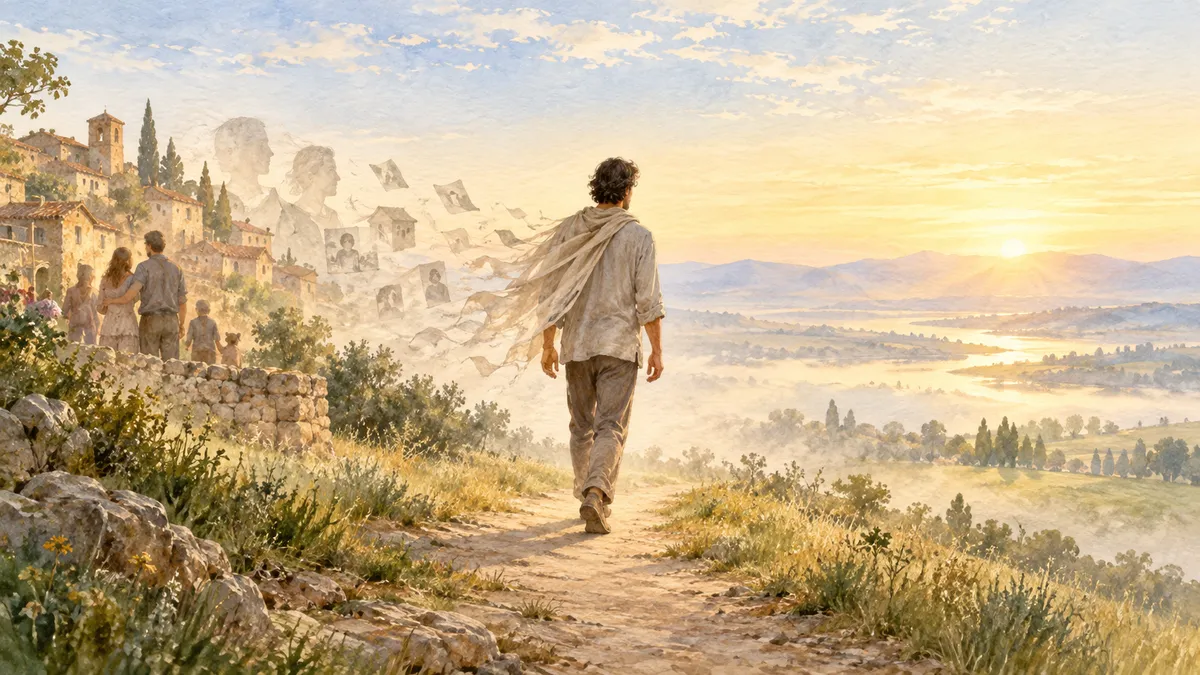
It is like approaching an abyss. At first, you may feel very lonely and very uncomfortable. But little by little, this abyss will begin to grant you darshan, to send you Anugraha, descending grace. And your freedom will begin to grow more and more.
The Vision of Complete Freedom
Your outer life may remain the same. But your attitude and your view of the world must change. Such a view of the world means that I am God, I am Brahman, and I am bound by nothing. Neither by race, nor culture, nor religion, nor philosophy, nor family, nor my ego, nor concepts, nor thoughts, nor ideas, nor perceptions, nor enjoyments, nor pleasures, nor the body. I am completely free; this is complete freedom. I may be anything, but I am attached to nothing.
You may live any kind of lifestyle, have a family or not have one, be a sannyasi or a layperson outwardly; we are not talking about outer life, but about your view of the world and your inner psychological state. This view is described in the texts “Viveka Chudamani” and “Yoga Vasishtha.” This is not something new; it has traditionally been celebrated for thousands of years. But attention must be paid to it.
Contemplation and Renunciation
And when you enter into such a view, your process of contemplation, your process of awareness, will begin. Awareness can arise only when you have left everything behind, only when you have renounced everything; this is total renunciation. Because if there is no renunciation, extraneous things will constantly enter your heart. They will compete with your awareness.
The outer world gives you a great deal of bliss, ananda, which is why it is so attractive. But receiving ananda from awareness is a great achievement; it is an art. You must become very subtle and highly sensitive to awareness in order to receive ananda from it. At first, your ego may not receive ananda. And during the process of purification, it may even become sad or bored. But as it becomes subtler, ananda will increase, and inner freedom will increase. This can be called the state of having a vision.
When we become accustomed to such a view and sustain it, this is called contemplation. This is not enlightenment; it is only the beginning. We have simply set out on the right path.
Purification of Samskaras and Karma
To attain enlightenment, it is necessary to purify a great many samskaras stored in memory. Although our mind has entered the right state, our memory will not let us proceed for a long time. There are many samskaras and vasanas, and they all demand expression; they all demand new connections, new people, and new actions—they must be fed. They are like hungry, unsatisfied spirits in the subtle body. There is a desire for perception, a desire for experience in the body, a desire for communication; all of this is contained in chitta.
The samskaras contain all our future lives; they have not yet been exhausted: all the connections we must enter into, all the illnesses we must go through, for some people the crimes they must commit, or the wealth we must acquire, the books we must write—all of this is contained within them; all our future lives have not yet been exhausted.
Karma is like a large container, and this container contains many disks with files that our consciousness has yet to open. But moksha, liberation, is the exhaustion of karma—the depletion of karma-phala, the results of karma. Karma-phala is the fruit of our past thoughts. What we thought about in the past, we receive now, because the mind creates through the power of thought everything that we receive. For example, this body, our marital status, our relatives, our nation, our culture—all of this is created by the mind. It will continue creating until karma-phala, the fruits of karma, are exhausted.
But we must exhaust this karma if we set moksha, liberation, as our goal. If we do not set such a goal, we may not exhaust it, but instead make use of the fruits of karma.
Three Types of Moksha
There are three types of moksha: salokya, sarupya, and sayujya.
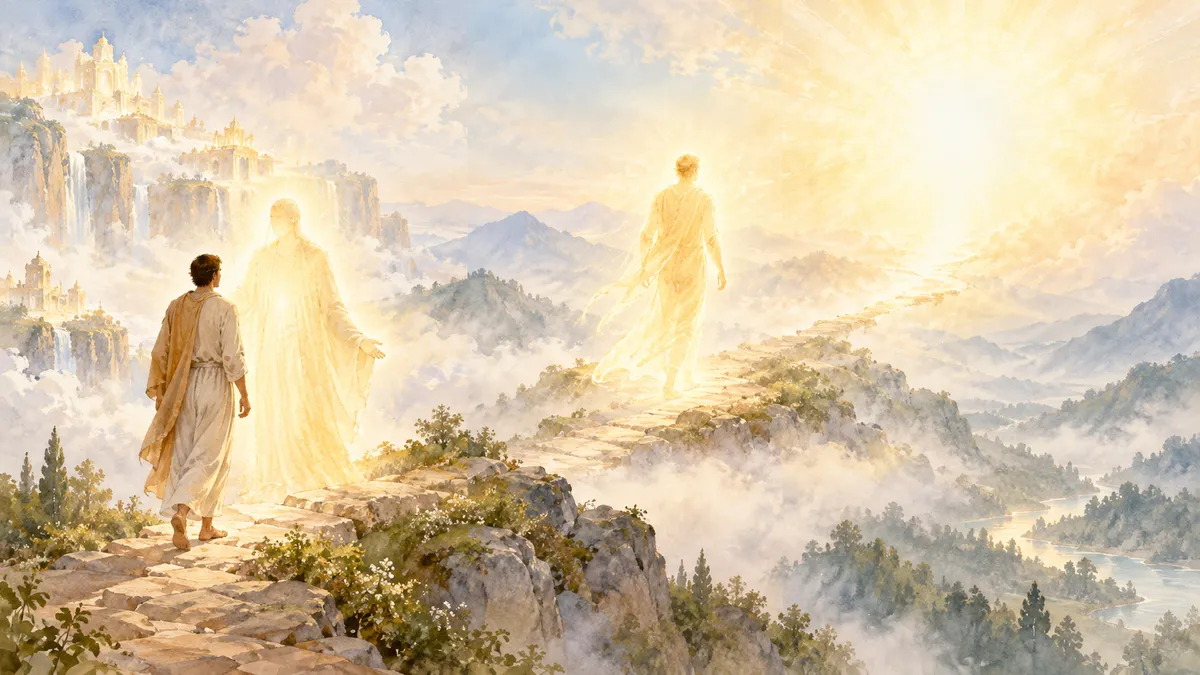
Salokya-mukti means being reborn in a higher dimension together with one’s ishta-devata, the deity one worships.
Sarupya-mukti means attaining a body identical to that of a deity—a body of light, divine and illusory. However, these two types of moksha are considered preliminary.
Sayujya-mukti is considered true liberation. Sayujya means merging, complete dissolution in Brahman.
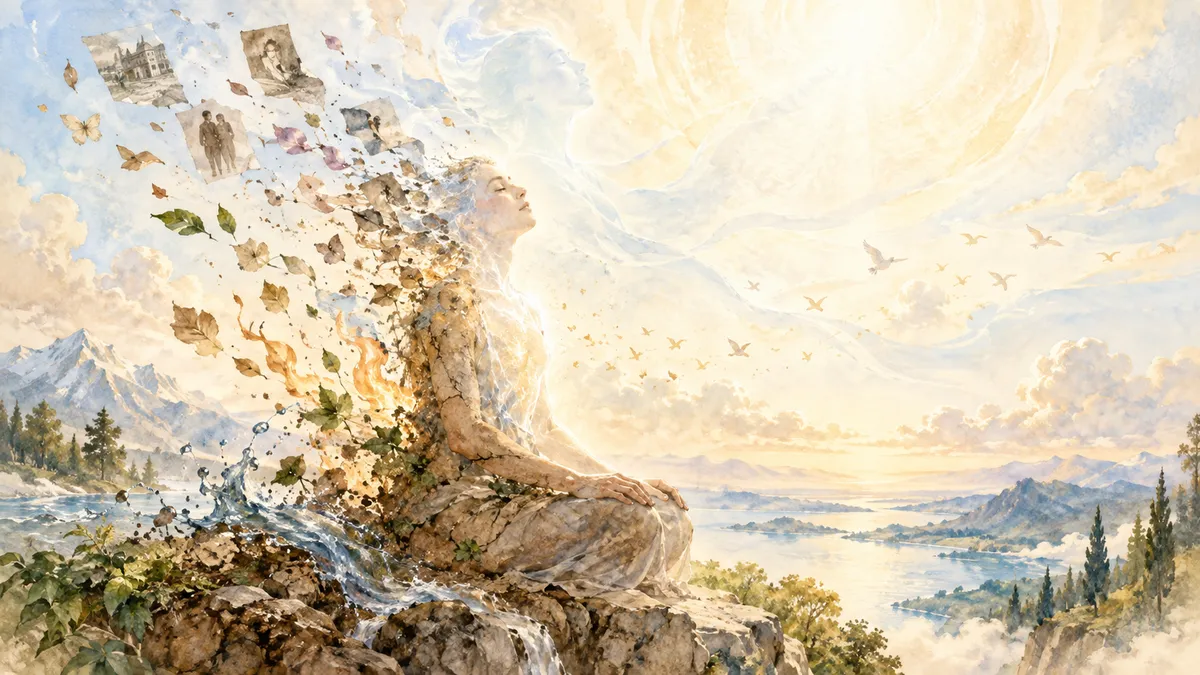
At first, our path unfolds in this way: through the practice of the nondual view, we ascend to a higher dimension. For example, in the next life we may live not in the human world, but in the world of Dattatreya, in the world of saints. Continuing to uphold this view, practicing contemplation, and purifying our conceptions, after some time we may acquire a body like that of a deity, for example, like Dattatreya or Lakshmi.
This body will be illusory, immortal, composed of light, able to travel through cosmic space and change its form as it pleases. This body will no longer contain intestines, a stomach, a brain, or bones; it will not fall ill, nor will it need to be fed, go to the toilet, or sleep. This body is immortal, made of light and subtle elements. But even attaining such a body is not yet the highest Liberation, sayujya-mukti.
Laya Yoga and the Dissolution of the Bodies
To attain sayujya-mukti, one must enter the process of laya, Laya Yoga. One must dissolve the subtle body, because the heavenly dimensions and the states of a deity are still experienced through the subtle body. The subtle body contains the ego; it includes reason, mind, manas, buddhi, ahamkara, chitta, and past memories.
Laya, liberation, is the process of dissolving the subtle body. Even when we have entered into a certain experience of nonduality, this is only the very beginning. This is because two types of laya must occur:
Antahkarana-laya-chintana — dissolution of the subtle body, the inner instrument
Panchabhuta-laya-chintana — dissolution of the gross elements of which this body is composed
First, we dissolve the subtle body. When contemplative presence, like space, permeates the subtle body, our memory, our false conceptions, and our dreams dissolve—all of this dissolves. We draw closer to the light, and this light grows. One who has dissolved the subtle body, that is, realized the process of antahkarana-laya-chintana, attains liberation immediately at the moment of death: the physical body is discarded, and they merge with the Absolute. If the subtle body has not been dissolved, they go to the worlds of the gods, to heavenly levels, but eventually they will still have to continue dissolving it.
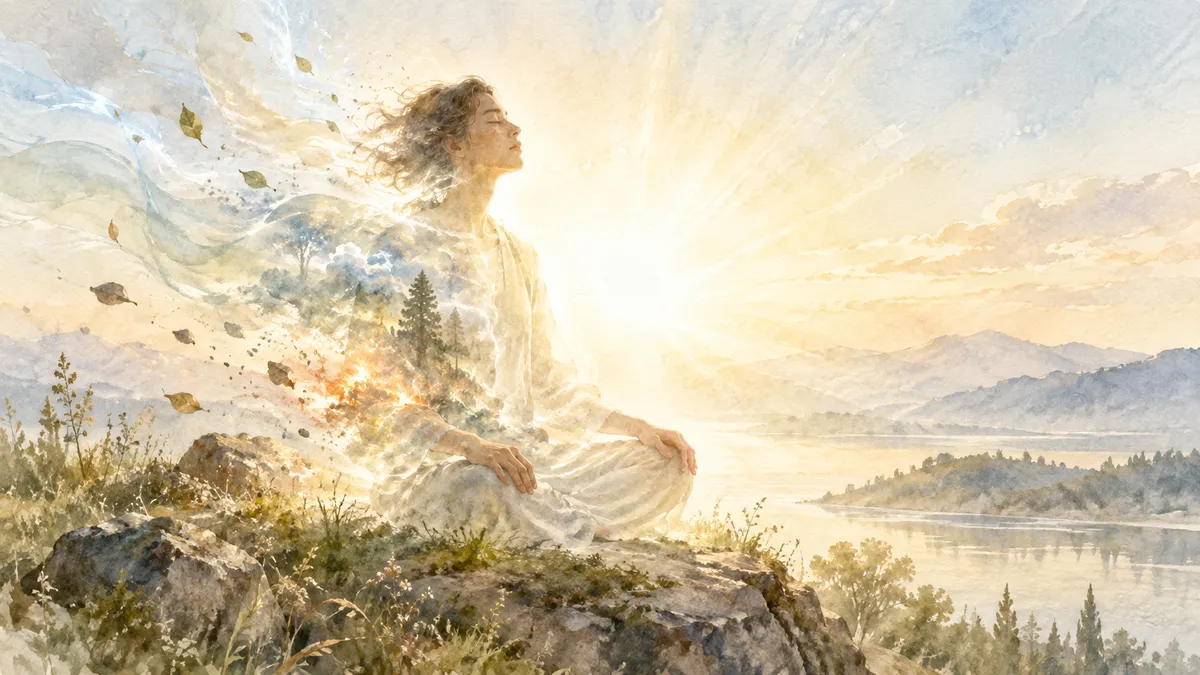
Finally, when the subtle body has dissolved, an even deeper process begins. It is called panchabhuta-laya-chintana, the dissolution of the five elements. Even when enlightenment has been attained, there is still a physical body; the body contains chakras and five elements, and the elements of the physical body must also be dissolved:
The Muladhara chakra, the earth element, flesh, muscles, and bones
The Svadhisthana chakra, the water element, bodily fluids, lymph, and so on
The Manipura chakra, the entire fire element, the digestive fire, and other types of fire
The Anahata chakra and all types of wind: prana-vayu, apana-vayu, udana-vayu
All of these must be dissolved. Udana-vayu is considered to be connected with turiya, while vyana-vayu is connected with turiyatita. All other types of wind are considered grosser, and they must undergo dissolution in the process of laya.
The Complete Path of Liberation
Thus, the path of liberation proceeds from the study of philosophy to direct experience, going beyond all nonconceptual awareness, then maintaining contemplative presence, dissolving the subtle body, and dissolving the gross elements.
Sometimes people simply stop at the level of philosophy. But the philosophy of Advaita and Advaita itself are not the same thing. One may discuss and interpret sacred texts, but this will not help in any way. There are other people who are more fortunate: they have gone beyond philosophy. They have gained the experience of realization—the experience of freedom of mind, the experience of non-conceptual awareness. Then they describe this experience, considering it the pinnacle, the highest point. But it is merely a vision, merely the pratyaksha of the view, direct seeing. It is not the final point. After this comes the dissolution of the subtle body; the subtle body must dissolve.
Combining the View and the Method
On this path, you may apply any methods, but the view is the main method, and abiding in the view is the main method. Sometimes a person abiding in the view says, “There is no need for any more methods. Everything must be discarded.” But if a person is not yet contemplating and discards everything, applying no methods, they will not complete their spiritual path. They will be left with nothing. The art here lies in combining the view and the method.
Sometimes, having heard lectures on the view, a person begins to ask: “If we are talking about practice, then who should practice? If I am Brahman, why practice?”
Questions arise in which the view and conduct become mixed up. Then I answer: “The one who does not eat, sleep, hear, smell, or touch does not need to practice. The one who eats, sleeps, goes to the toilet, smells, and touches—let that one practice.”
A person asks the question, “Who am I?” and then asks themselves, “Who practices, who strives for liberation?” and cannot understand. Here, one simply needs to distinguish the body from the higher Self. The higher Self is already free from the very beginning. It does not need to practice; it can remain relaxed and do whatever it wants. The higher “Self” expresses itself in the view. Let the ego, ahamkara, mind, and body—the one that eats, wants something, sleeps, and goes to the toilet—practice. Let the limited practice, while the unlimited remains in its natural, innate, self-perfected, pure, radiant, primordial, spontaneous state.

If we do not distinguish between these, there will always be confusion between the view and conduct. Once we distinguish them, everything will be harmonious.
Establishing Oneself in the View
There is no point in building relationships with others. There is no point in striving for anything without the view. The only worthwhile thing is to establish oneself in the view. This is the most important occupation. By and large, everything else is meaningless.
But once you are established in the view, you can do anything. It will already be a game; it will not be your action, and you will not be the doer. A game is simply a game; there is neither denial nor attachment in it.
Freedom is already inherent in us, but for some reason we want to limit ourselves. We want to because we confuse ourselves with the ego. We do not know whether it is the ego or us. Therefore, we often act based on the ego, following the ego’s impulses. This hinders us.
The ego possesses natural tamas, natural ignorance. It has various desires. Following it always means losing our freedom; indulging it always means losing our freedom. Whatever we indulge it in—whether attachment, the desire to possess, a sense of security, concepts, or clinging to anything at all—as soon as you compromise and allow the ego to bind you to something, you give it your heart; you lose your freedom, your innate natural spontaneity and awareness.