

Commentary on the text “The Great Yogi of Tibet Milarepa”
“Abiding in the state of empty awareness, one should sincerely dedicate the fruits of one’s attainments to the universal good. I realized that this is the supreme path.”
Motivation is very important in practice. We wish to attain enlightenment in this life, taking the short path, in order to help living beings most effectively. In other words, by entering the path of awakening, we connect to the universal Shakti, the enlightening power (Anugraha); we, as it were, resonate with it. This is the very energy of the absolute Mind. When monasteries open, monks and saints appear, and texts with the Dharma are printed, these are the lilas of this universal energy (Shakti).
“Just as food satisfies a hungry person, not thoughts of it, so one who wishes to realize emptiness must experience its meaning in meditation. I understood that, in order to attain perfect insight, it is necessary to constantly practice the accumulation of merit and self-purification in the intervals between meditations.”
Emptiness is realized in meditation, while at all other times we accumulate merit. Why is there the third jewel—the Sangha? Because if you do not have the conditions for meditation, you will never pass through all the stages, and if there is no object for the accumulation of merit, you will not be able to accumulate merit. By accumulating merit, we create new causes, open new channels, and enter another karmic vision. It is difficult to understand the mechanism of accumulating merit.
For example, to place a statue of Dattatreya means to open the channels of Dattatreya’s world, to begin entering his vision. To do some worldly thing means to open the universe of worldly desires, to enter that vision, to invoke that energy. Thus, any of our actions reverberates in the form of thousands of the finest interweavings of causes and effects. Only when we are deeply immersed in contemplative presence is each action like the accumulation of merit.
The Four Aspects of Realization and the Necessity of a Teacher
“In general, I saw that a meditator’s understanding of the emptiness of things, their unity, their indeterminacy, and their lack of distinctions constitute the four aspects of realization. In order for this knowledge to manifest in me, I gave up indulging the body, depriving it of food, subdued the mind, and attained calm when facing any obstacles, even in the face of mortal danger.”
The texts recommend learning meditation under the guidance of a Teacher. This is so.
Until a person has begun this, he cannot yet be called a spiritual seeker; even if he has some kind of search, that search is external. He himself does not yet understand what true seeking means: he begins one method and then abandons it, studies one teaching and then becomes fascinated by another. Nothing can deeply transform such a person. And this happens because of a lack of merit.
It is like a person who comes to a racetrack and first bets on a gray horse; then he changes his decision and, just before the race begins, decides to bet on a chestnut mare. And in the middle of the race he suddenly catches himself and says, “No, perhaps I will place my bet on that stallion.” And while he is constantly changing his decision, the racetrack employees come up to him and say, “Sir, the race is over. You never placed your bet on any horse, so your money is gone.”
The same thing happens with some spiritual seekers. In the end, one must mount at least some horse and ride forward. By and large, any horse is good. If you are a good rider, it will take you where you need to go; it is only a matter of practice. But if you have not yet mounted the horse and are not riding, then you should expect that your money may be lost, for the time of these races is limited. I never tire of repeating this to lay practitioners.
The Vision of the Dakini and the Teaching on the Transference of Consciousness
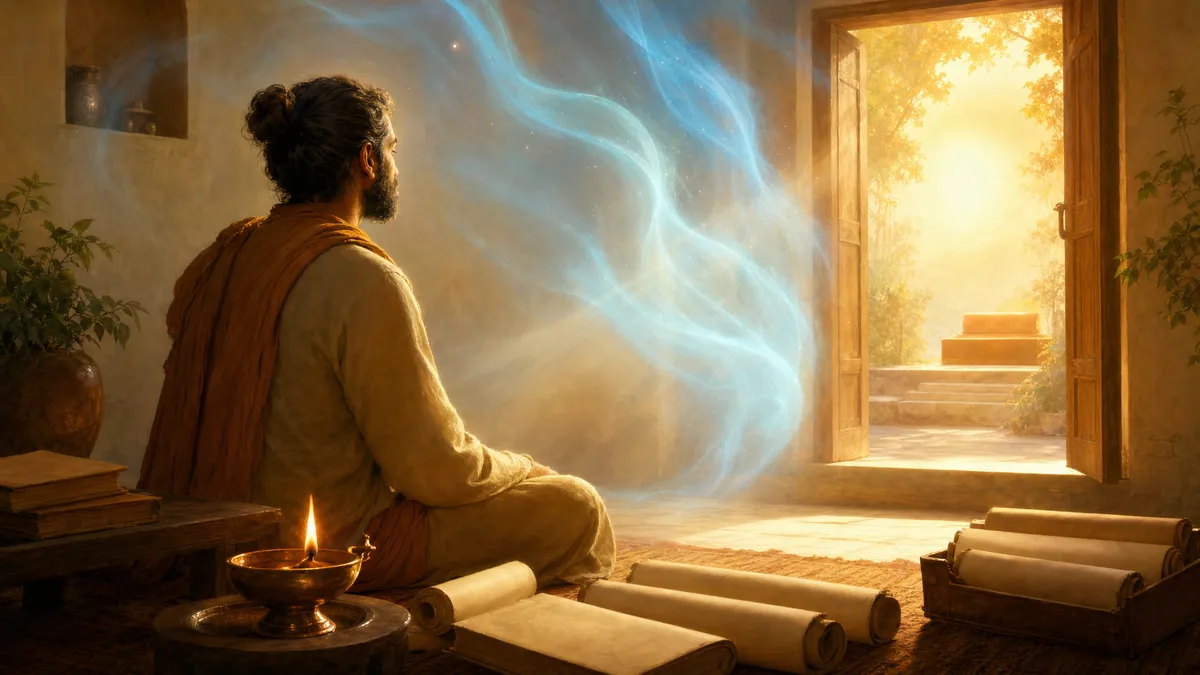
“At about this same time, the lama visited the northern district of Uru. One evening, after the ritual food offering in Marpa’s house, the dakinis explained to Lama Marpa a certain symbolic message conveyed by Naropa, which Marpa had not understood at the time. While the lama, at the command of the dakinis, was preparing to visit Naropa, a beautiful girl appeared to me in a dream, blue as the sky, with sparkling eyebrows and eyelashes, dressed in brocade garments. Addressing me, she said: ‘Son, you possess the knowledge of the teaching of the Great Symbol and the instructions of the six secret teachings, which can lead to supreme awakening through prolonged meditation. But you do not have the special teaching on transferring consciousness into a dead body. Ask to be given this teaching, by means of which one can immediately attain the state of buddhahood,’ and she disappeared. I began to reflect: ‘This girl was dressed like a dakini. What is this—a sign from the gods or a trap set by demons? I do not know, but in any case, my teacher is the buddha of the past, present, and future, and he certainly knows what this is. He knows everything; he knows not only how to become a buddha, but also how to glue broken earthenware back together. If this is a divine sign, I must ask to be given the teaching on transferring consciousness into a dead body.’ Having broken down the partition, I went outside and set off for my Guru, who cried out: ‘Why have you come out of retreat? This will hinder your progress. What have you done?’ I told him about the girl and what she had said to me, and asked: ‘Is this a prophecy or an obstacle? I do not know. But if it is a revelation, I ask you to give me the teaching on the transference of consciousness.’ The lama sat silently for some time, and then said: ‘Undoubtedly, this is a revelation from the dakinis. Before my return from India, my Teacher Naropa spoke to me about the transfer of consciousness into a dead body, but since I was already leaving, I may not have asked about this teaching. We must look for it among my Indian manuscripts.’”
