

View
Were there no view, all teachings would be merely aids, superficial instructions on behavior.
The absolute view consists in relaxing in the nondual.
The view is nonduality. In Laya Yoga, the view is the basis, the path, and the fruit. In Christian terms, one could say that this is our God. Nonduality, niralambha, the state without support, is the object of devotion, the ultimate goal of attainment and the method of practice, the supreme foundation of Being, the universal Spirit permeating all that exists, upon which we meditate.
All teachings lead to the realization of nonduality; however, why do we say that Laya Yoga belongs to the category of the highest practices? Because in Laya Yoga, it is not the coarse states of mind based on duality and the concepts of the conceptual mind that are used, but contemplation. This is a very subtle state of mind, the layer of mind that lies beyond ordinary notions, logic, and concepts: awareness.
One could say that in Laya Yoga there is one golden rule: to abide in the state where there are no rules whatsoever. There is one method: to remain in the state that is above all methods. There is one principle: to abide in that transcendent awareness which surpasses any mental principles. Therefore, this is a teaching of absolute freedom without any limitations.
Of course, this by no means implies that we can do whatever we please, practice however we like, or not practice at all, thinking that since there are neither teachings nor principles, we are already beyond everything. To hold such views means, at the very least, childishness. The teaching presupposes transmission from the Teacher with detailed explanations and a fairly strict process of training.
The teaching is beyond methods, but sometimes we practice methods and do not feel limited by them. We know that the methods of the relative dimension truly help us. We observe various rules of discipline and principles borrowed from the lower views of Kriya Tantra, Charya Tantra, and Yoga Tantra, since absolute freedom means that we are not limited either in methods or in principles while training in the relative dimension. Absolute freedom in awareness also includes the freedom to accept methods, principles, and rules of self-restraint for the purpose of disciplining the mind, the body, and the impeccability of energy.
However, when the question concerns our awareness specifically, we say that it is absolute freedom. This approach differs greatly from the approach in which we apply methods or certain principles and theories in and of themselves. When we apply them, our primordial, self-born Clarity looms dimly somewhere ahead and is always hidden behind the diversity of theories and everything else. Here, however, we immediately try to lay it bare so that it may shine like the sun. Through transmission or method, it begins to shine. Just as a fresh wind can change a stuffy atmosphere in a single instant, in the same way the stuffy atmosphere of our conditioning can change in a single instant if we lay bare clarity. The karmic vision of space changes at the very moment we reveal this radiance.
The True View and the Attainment of Confidence
The true view is free from the seer and the seen. The view is intended for recognizing one’s inner simplicity. If we have understood this, then meditation is abiding in naturalness, without holding on to anything. When we have gained confidence in the view, even if a hundred pandits tell you that you should doubt it, you will be certain that there is nothing higher than it.
I would translate “view” better as “vision,” while the more classical term, if not translated from Sanskrit, is “jnana”; some translate it as “wisdom.”
When we have mastered such wisdom, we have caught this “taste” of nonduality, which is beyond subject and object. We truly attain the state of genuine faith in that toward which we strive, and then such a state cannot be shaken. Even if a hundred scholars (pandits) tell you that you are mistaken, you will answer them: “Yes, of course. And who are you? The subject, and I am the object, or the other way around. This is duality. How can I acknowledge such a thing?”
This means that the object of your faith has gone beyond any mental constructs and scriptures, and has become your personal living experience. Before this personal living experience, not only any outsider, but even the gods will tremble, because if you are in non-duality, then there is neither subject nor object. The living experience of the eternity of the primordial “I” frees us from being bound by old notions, if they are based on logic or theoretical constructs. Now we perceive reality directly, clearly.
Freely abiding, penetrating, and widely open—these are the three main features of the natural state.
“Freely abiding” means that we do not fix our mind even on something as small as an atom. This is a state without any fixation. At the same time, we can practice concentration on a point, anapanasati, or perform other practices that lead to the opening of the mind.
If, however, we are speaking of the absolute state, we say that it is not fixed even on the smallest or the most global thing.
“To abide freely” means that you do not concentrate on anything as an external object. “To penetrate” means not clinging to anything as internal. Openness implies not clinging to anything between the external and the internal.
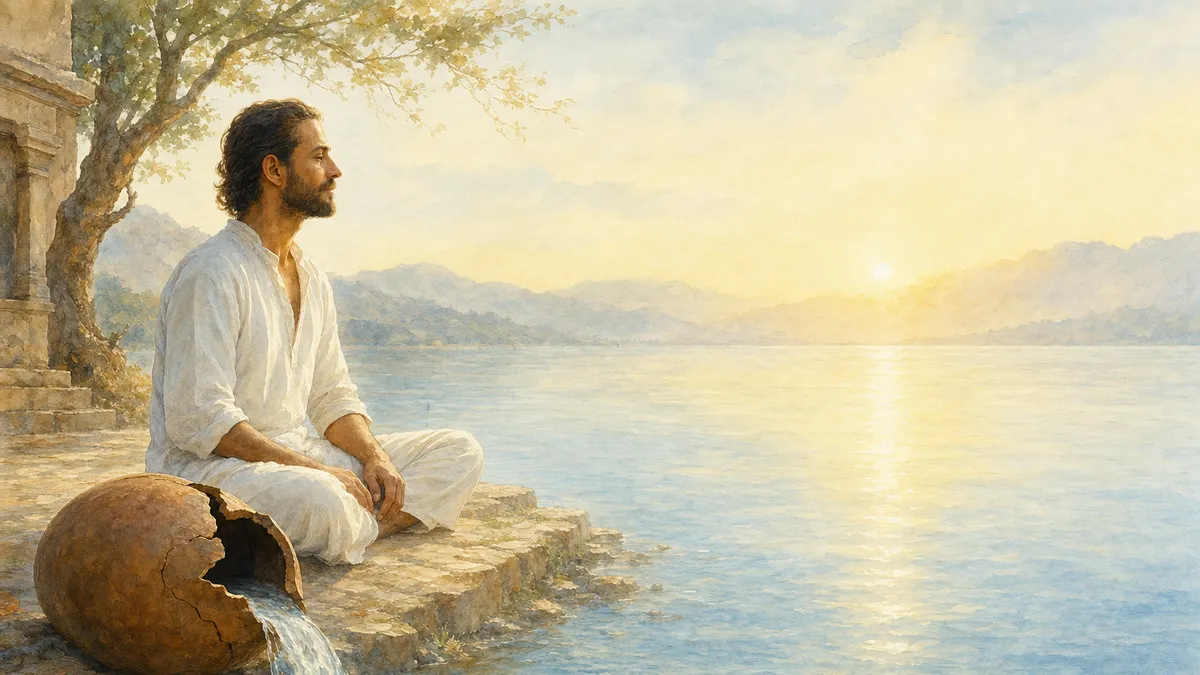
Usually, reality for us is divided into internal and external. It is like water inside a jug considering itself separate water because of the limitations of the vessel’s walls. When the jug is broken, the water merges with the ocean and discovers that it has never been separate from it.
The teaching of laya yoga is similar to Zen; however, the teaching of Zen is sutra, where the main method is renunciation, and everything is focused on the liberation of consciousness. The teaching of laya yoga is tantra. Tantra goes further: it is not limited to the liberation of consciousness, but also works with energy, channels, winds, behavior, and even the manifestation of the external universe in the form of subtle light and sound.
When we expose our self-born Clarity through direct introduction, it begins to shine. Following this, we practice self-surrender. In Vaishnava tantra there is the term “atma-nivedana,” which means “surrendering oneself to the Atman.” In Kashmir tantra there is the term “prapatti,” which means “casting oneself away.” However, the term “self-transcendence” is closer to us.
“Surrendering oneself” is closer to the philosophy of duality, dvaita or vishishta-dvaita, inherent in bhakti, when there is an object and one must give oneself to something. The same applies to “prapatti,” when one must cast oneself away before something. But in laya yoga we say that there is no external object before which one must cast oneself away; nevertheless, the breaking of the cocoon of individual perception occurs precisely through such casting away. Here, rather, our “self” self-transcends itself; it is as if it turns itself inside out, and at the moment of such unfolding it discovers that it is not the small “self,” but the great “Self.”
Proper Practice of Contemplation and the Feeling of Absoluteness
When, having received the impulse of direct introduction and achieved some stability in the natural state, we practice one-pointedness, that is, continuous immersion in the Source, then after some time, if we do this correctly, we become filled with a great feeling of absoluteness and perfection. Those who do this incorrectly sink into a kind of joyless clarity, as in Theravada satipatthana, when awareness is present, but consciousness does not yet know where to direct itself. They feel various experiences, such as confusion, clarity, bliss, or emptiness, while awareness wanders through the labyrinths of the great Universe, within and without. Sometimes they experience self-analysis and self-reflection, not knowing what they should settle upon.
If the practice of contemplation is correct, there will always be a feeling of absoluteness; therefore it is said that Guru Yoga and devotion are very important. The feeling of absoluteness means that however you contemplate, you come to the same ultimate Source, just as many small rivers flow into one great river. Even if you have had deviations in contemplation, after some time they are annulled by this practice of absoluteness. When you achieve continuous contemplation of absoluteness, this absoluteness begins to respond.
At first you were searching for the absolute Source; then you found it. When you continuously keep your mind on it, it is like the law of communicating vessels, when water flows from a higher vessel into a lower one. It is as though you have established a mystical connection, a contact, and then this great Source begins to send you its energy. When you receive it, you merge with this absolute energy.
If you constantly think about the sun, concentrate on it, then after some time you will establish telepathic contact with it. In Raja Yoga, in Patanjali’s Yoga Sutras, this is called “samyama.” You will begin to receive knowledge about the sun, about the deities inhabiting it, about its structure; you will begin to see it in dreams. And if your samyama is strong, many other unusual effects will begin to appear. Sometimes you may even think and feel that the sun has become part of you, or that you have become part of the sun. In the same way, when you direct your mind toward the Absolute, you sometimes feel that the Absolute becomes part of you, and you become part of the Absolute.
The Apostle Paul, a Christian saint, said: “Every day I rise and die in God. I no longer know whether I am in God or God is in me.”
Self-Transcendence and Recognition of the Source
The response impulse that completely unfolds our practice is an impulse from the nature of our Mind, from the very foundation of Being. Then the yogi recognizes this Source as himself. His cocoon of individual perception breaks like a pitcher shattering, and then the water flows out; self-transcendence occurs. But when the yogi recognizes this Source as himself, he discovers that he has always been this Source, that he has never lost it. It is not even a matter of whether he lost it or not, because in reality he has always been it. Then, from the height of this vision, he encompasses dozens and even hundreds of his past lives before awakening and sees that all of them were the play of this Source.
It is like water in a pitcher lying at the bottom of a lake, thinking of itself as separate from the water in the lake. The pitcher was not sealed, so the water was separated only by the walls of the vessel. When someone threw a stone into the lake, the vessel broke, the walls were gone, and suddenly the water discovered that it was part of a vast lake whose boundaries were even difficult to find. At first, the water in the pitcher thought that it had merged with the lake and had become the boundless lake. Then, having settled into this, the water thought: “What foolishness? I did not merge with the lake; I have always been this lake! It is just that some small part of me thought that I was in the pitcher. But that is simply some kind of joke.” Therefore we say that self-transcendence occurs. Our small “I” dissolves in the great “I,” and then we discover that even the small “I” itself is the very same great “I,” only falsely taken to be the small “I.”
The Perspective of the Small “I” and the Great “I”
Suppose, from the point of view of the small “I,” you are monks and novices striving for liberation. You may strive for liberation for various reasons, but essentially they are the same. The best among you, those seized by the highest idea of perfection, the great mystery and incomprehensibility of the Universe, wish to know the absolute Truth, the ultimate goal. Those who have more modest abilities fear death, suffering in samsara, and simply do not want to be bound by illusion. They want to purify themselves in order to be free of it, and that is not bad either. From the point of view of the individual “I,” people, novices, and monks are like a small amount of water inside a pitcher. However, from the point of view of the great “I” (the water of the lake or ocean), you are all the boundless Spirit, which has not been separated from itself for even a moment, which plays by manifesting in this way. It has conditional ignorance, which causes real suffering to the individual mind. That is, we can say that ignorance is conditional, but the suffering is still genuine, real. If your leg starts to hurt, you suffer for real. If you are not given prasad for three days, no one can say that this is conditional hunger; it will be the most genuine hunger.
Someone may say that both prasad and hunger are also conditional things. From the point of view of philosophy, one can say this; however, from the point of view of your stomach, it does not help. Therefore conditional ignorance brings quite real suffering. But, from the point of view of the absolute idea, both conditional ignorance and suffering are all the Absolute.
You are that very same universal Spirit or ocean, which plays in these bodies in accordance with prarabdha (accumulated karma) and merits, in the role of monks or novices.
The Practice of Non-Doing
In other words, one could say: do not imagine anything outwardly, do not concentrate inwardly, do not direct your attention toward some state between these two. If you do nothing of the kind, this is the view; this is enough. Do not imagine outwardly, do not concentrate inwardly, do not place your mind in the interval, and then nothing needs to be done; you have attained non-doing.
When we relax in this way and try to be neither outside, nor inside, nor in between, then there is naked, bare awareness, a certain clarity. Of course, this is not enlightenment or some final point. Rather, it is a moment where the world stops, where everything comes to a standstill. It is a way to step out of the spinning wheel.
The wheel is spinning, and we are on its rim. If we sit on the rim, then we constantly spin along with it. Along the way there are branches or stones, and when the wheel turns, the branches and stones strike us, and so we feel pain. This is what samsara looks like. But when we begin to move away from the circumference of the rim of this wheel and move toward the center, we leave the state of reflections, moving toward the state of the mirror itself. Therefore, one may say that at this time the ordinary world stops.
In the state of contemplation, we do not need to do anything, because such a state does not imply doing. Any doing means movement toward the rim, whereas we need to move toward the hub, toward the center. And we can move there only if we relax completely, abandon all activity, and allow our awareness to penetrate subtly inward.
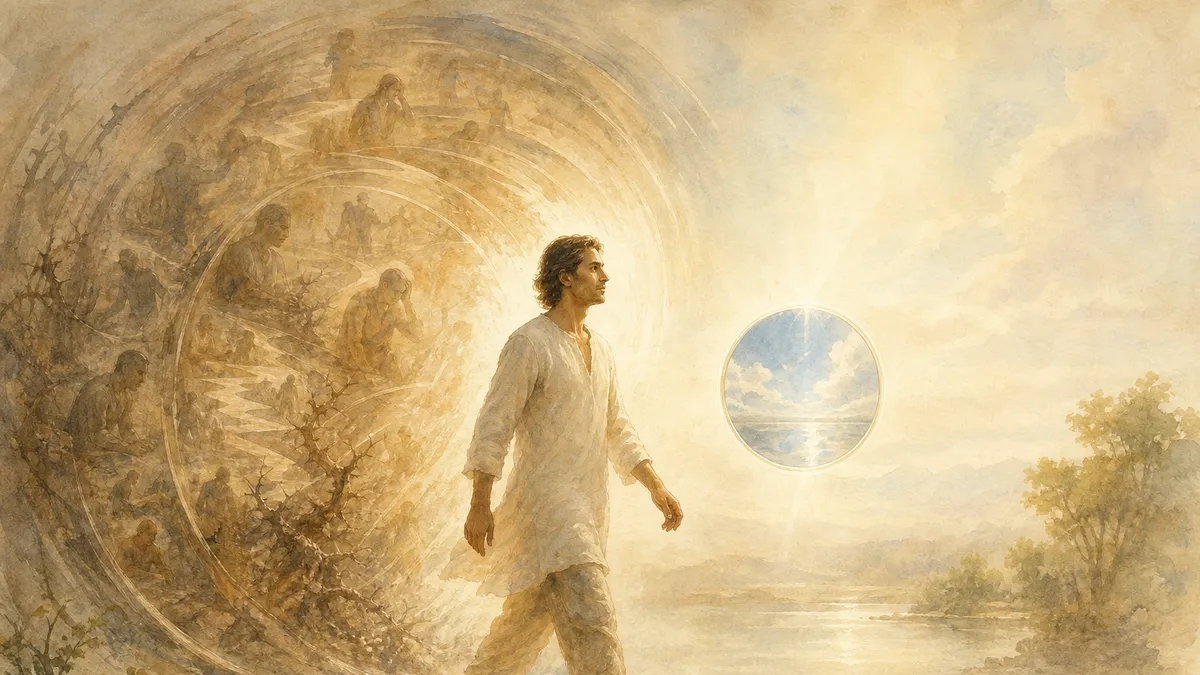
Gradually, this consciousness is noticed by us. It is still very unstable, but we begin to notice it and acknowledge it. Over time, we need to become rooted in it and trust it, to recognize that this is a door or a key to entering the dimension of non-duality. This is not yet non-duality itself, and many traps still have to be passed through in order to reach the very center of the wheel without loss, but it is an unmistakable entrance into the tunnel leading to this non-duality.
Obstacles on the Path of Non-Doing
On the path of practicing non-doing, we will have many doubts or deviations. For example, sometimes we will confuse non-doing with the practice of a method and think about how to combine them. Non-doing presupposes doing nothing, but we feel that non-doing does not particularly move us forward; at the very least, we need to perform many methods. Or we will confuse various subtle experiences of bliss, visions, heightened awareness. Or we will be unsure of this state. But when we recognize it as absolute and gradually gain trust in it, it opens ever more deeply, gradually spreading into external space and to everything we perceive. Gradually, it is revealed as the Guru, the Teacher who teaches us, and we truly understand it in this way.
This natural state is very subtle; it cannot be seized by force. If we try to take it by assault, with harsh forceful methods, it quickly slips away. If we passionately strive for it, desire it, it does not come. Rather, one must learn to lure it. The paradox is that it appears when we do not desire it. We need to attain it, which means we desire it, but if we desire it, we will not receive it; therefore, we must learn to desire without desiring, that is, to desire very subtly, not passionately, and while being completely unconcerned about attaining the desired. Of course, we do care about it, but in the right way. We care not with the mind that runs ahead, but with subtle consciousness. This means that our care consists in vigilantly maintaining it. We do not try to make it happen by force—any doing on our part only frightens it away.
At the same time, we understand that if we do nothing, our energies will not be purified, and the relative dimension will not be perfected. Much must be done in the relative dimension: yoga, concentration, sitting meditation, and so on. We diligently strive to do these things, yet we know that we do them not in order to attain the natural state. The natural state awakens only when there is no doer and no doing. Rather, we do this as service, as an offering, as practice in the relative dimension.
The natural state itself comes at the moment when there is no doer at all. This means that the hands are doing, while the head remains still; the mind does not strive anywhere and does not wish to do anything. It wishes only to abide in the state of contemplative non-doing, because as soon as we have discovered it, we have already arrived at the final point. Therefore, it is said that one must learn to do without doing. When we do without doing, the spirit within us returns to the Primordial Source.
The Unity of Samsara and Nirvana in the True View
Recognizing the true view is extremely important; at the moment of genuine recognition, the view is only the single bindu, the unified essence of the three bodies. The instant we recognize it, nirvana no longer appears to be something we must attain, and samsara no longer appears to be something we must abandon.
From the point of view of the sutra, nirvana is always presented as the fruit, the ultimate goal, the prize on a platter, the cherished culmination of practice. It is always unattainable, at least if we are not in nirvikalpa samadhi. However, when we are in naked awareness, when we have arrived at this natural point, nirvana is not something we strive for, because this state in itself is already nirvana, and samsara is not something we reject or fear, because at this point both samsara and nirvana are united. Having united the vision of nirvana and samsara, the true yogin possesses immense fearlessness. It is said that he lives with the confidence of an avatar who knows no fear of birth and death.
This is possible only when we have genuinely and deeply entered into this great abiding, when we have immense trust in it, when we have fully relied upon it. One could say that if there is any God, it is this, and we need to acquire complete devotion and complete trust in it. We need to understand that the Guru is this very state, that is, the outer Guru is its manifestation. Or one could say that the outer Guru is the Anugraha of the Absolute, which came forth, formed a body, and learned to speak. That is, it is your own state, only having a body and speaking.
Handing Over Power to the Great “I”
When we acquire this trust, we open to an understanding of the incomprehensibility and transcendence of everything, as if we were walking along the edge of an abyss. When we acquire great devotion to this incomprehensibility and transcendence, our small samsaric “I” merges with the great “I.” Sometimes it is difficult to say whether we abide in the small “I” or in the great “I,” because all of this begins to become equalized. When we are more attentive, we are in the great “I,” and when less attentive, we again slip onto the path of the individual “I”; doubt and confusion arise in us again.
Eliminating doubts is not the practice of methods, nor the study of concepts, nor purification rituals. The elimination of doubts and confusion in Laya Yoga is done in a very subtle way: we simply return again to the great “I,” we let go of ourselves and allow the great “I” to take power over us, we hand over the reins of governance to it. Then our spiritual strength, confidence, and awareness are restored once again.
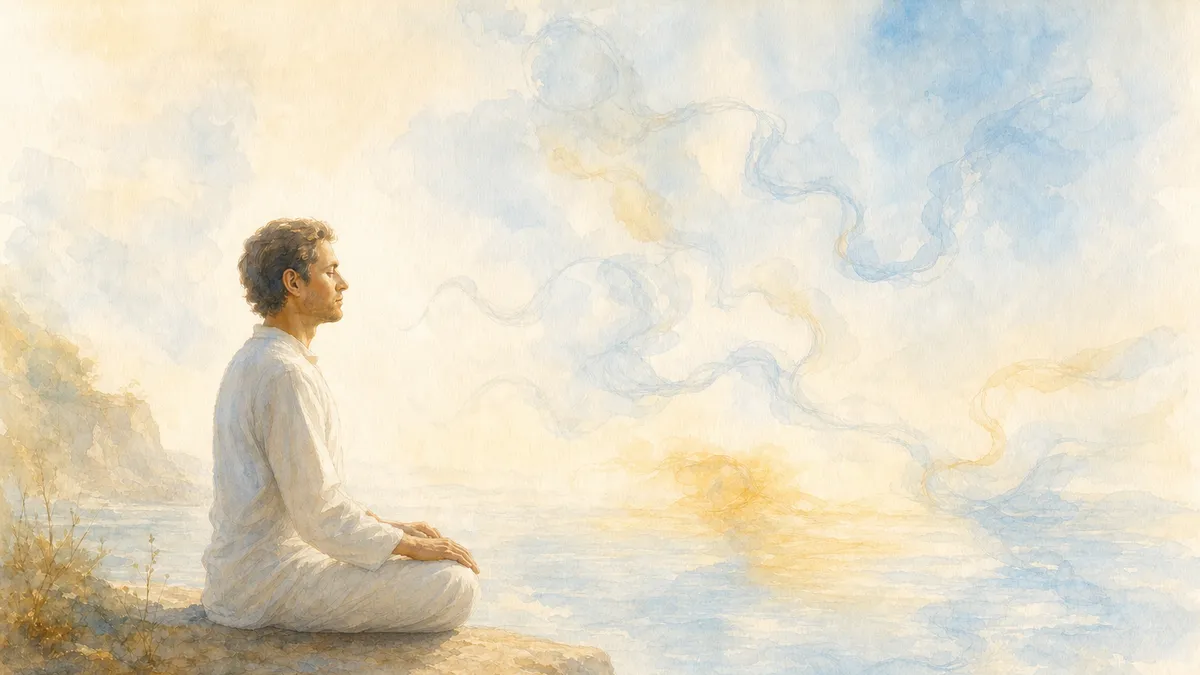
This ability to hand over power to the great “I” at the right time is like inviting a king into a palace, who instantly restores order. The king was absent, the servants and ministers began to rule disharmoniously, and then chaos ensued. They realized that without the king they could not come to an agreement, and no matter how they tried to restore order, summon soldiers, and issue draconian laws, it all turned out wrong. Then someone said: “Why are you doing all this? The mere appearance of the king will immediately restore peace and calm.” As soon as this king is invited, everyone instantly toes the line, all laws are obeyed, subjects pay taxes, and soldiers serve their cause without reminders.
Why does this happen? Because this primordial state possesses absolute power. It has power not only over our kleshas; it has power even over the creators of Universes, because it possesses total authority.
The moment of transferring authority from the individual “I” to the absolute “I” is called “self-surrender” or “self-transcendence.” In simple terms, it can be called faith. Faith means that you learn to constantly hand over authority to the king, and not to the servants and soldiers.
Thus samsara and nirvana flow in one channel and are contained within a single bindu. Undoubtedly, one must reject samsara and strive for nirvana, but how are we actually to rid ourselves of samsara and attain nirvana?
Of course, in a relative sense we must reject samsara and strive for nirvana. Otherwise, if genuine awareness has not been realized, we are left with nothing. Or, hiding behind beautiful words, we may think that we have become true practitioners of awareness, and therefore have no need to strive for nirvana, no need to reject samsara. But then we will simply accumulate ordinary karma.
The Danger of Stopping at Past Potential
One mataji had an experience of clarity. Meditating diligently, she experienced the fourth dhyana and reached a level of understanding beyond concepts. This is not bad, but she had shortcomings in understanding the instructions and studying the teaching. Then, when she entered deeply into the subconscious, the karma of her past lives began to manifest. Before that, she had been progressing very steadily in her practice.
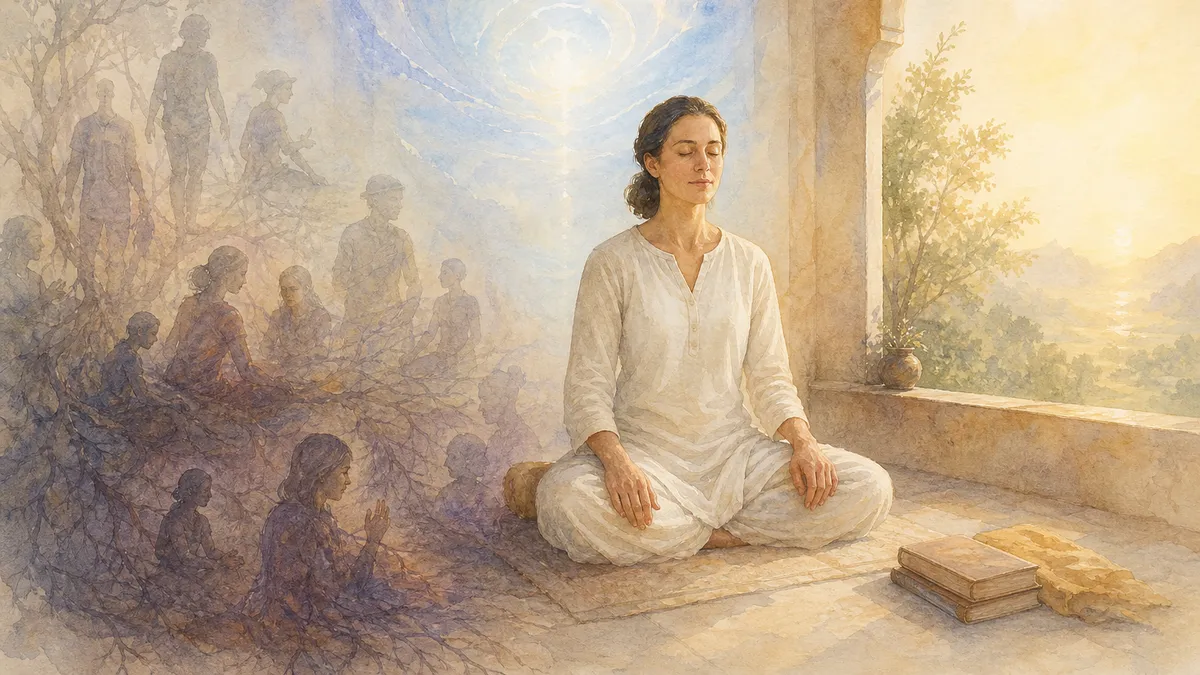
It is considered that in practice we all progress steadily until we restore the level of our past lives. Each of us, when beginning practice, possesses a certain potential. It is like bonus points from past lives. For example, if we are practicing now, it means that in past lives we were also monks and practiced, and therefore we have a certain potential of merit, bonus points, by means of which we can go further.
Someone came from the world of the gods of passion, and therefore pride, abilities, and intellect manifest in him; someone came from the world of the asuras, and therefore willpower, energy, free consciousness, and reliance on inner capacities manifest in him, by means of which he was able to break attachments. Someone, perhaps, came even from the worlds of the god Brahma, and therefore he has the qualities of a deva: he is constantly in dhyana, his breathing is rare, every word of his is a sutra, everything he draws is a masterpiece, mandalas, yantras, and other divine things come forth from his ears and eyes. Even if he wanted to, he would not be able to do anything unattractively, because he possesses the qualities of a deva, a deity. This is potential, bonus points from past lives.
However, we practice well, with great strength, without doubts only up to the level at which we again reach this potential. But when we reach the level of this potential and it is realized, we have a tendency to stop and congratulate ourselves, because in this life, with our past potential, we felt dissatisfaction, felt ourselves above all this crowd and bustle. When, through the practice of samadhi or concentration, we reach this old accumulated potential, we feel that we have arrived home, but in fact, this is not yet home. We have a tendency to stop and relax. We have restored our past status, and the old feeling of freedom that drove us toward practice has already been realized, so there is no potential to move further, but there is a desire to rest on our laurels.
Through her practice, this mataji restored her past potential, since in past lives she had been a goddess and possessed great inner pride. She said:
“I no longer know what I should do. It is such a state where there is neither samsara nor nirvana, where you believe in nothing—not in concepts, not in this, not in that.”
Such a self-satisfied, blissful, smiling state, proud and majestic, yet abiding in ignorance, in the same shell of individual perception. Then she said:
“I suppose I want to resolve such-and-such problems.”
I said:
“You have gone beyond concepts, you believe in nothing external, perceiving the world in a nondual way, so why do you believe in all these problems?”
She thought for a moment and replied:
“Yes, indeed, I did not understand this.”
When I pointed out to her several things she had not noticed, she said:
“It turns out everything is much worse than I thought.”
She considered herself, if not having attained, then at least very close to it, because she had restored her level from a past life.
When our dualistic mind is displaced by dhyana, by meditative experience, we no longer have problems. However, the unity of samsara and nirvana is much deeper. Here boundless self-giving and self-renunciation are needed, so as not to get stuck in the labyrinths of the cocoon of the individual “I,” not to sink into inner universes; otherwise one can continue wandering there from life to life.
Here it is appropriate to recall an important saying: knowledge of the One liberates all.
“Knowledge of the One” is the knowledge of the incomprehensible Spirit of the natural state. It is often said to be a place where no attachment is possible. The strongest attachment is the attachment to our individual “I” or to our will. At the moment of self-transcendence, we free ourselves from it, we allow ourselves to be emptied (not in the sense of energy, but in the sense of clinging), and surrender to the wave of that which surpasses us. Then our individual “I” dissolves completely; we cease to distinguish whether we are in the Absolute or the Absolute is in us.
