The Universe as a Reflection of Shiva: Understanding Reality in Kashmir Shaivism
11.09.2026
0 мин. чтения
0
Share
copy
search
add
share
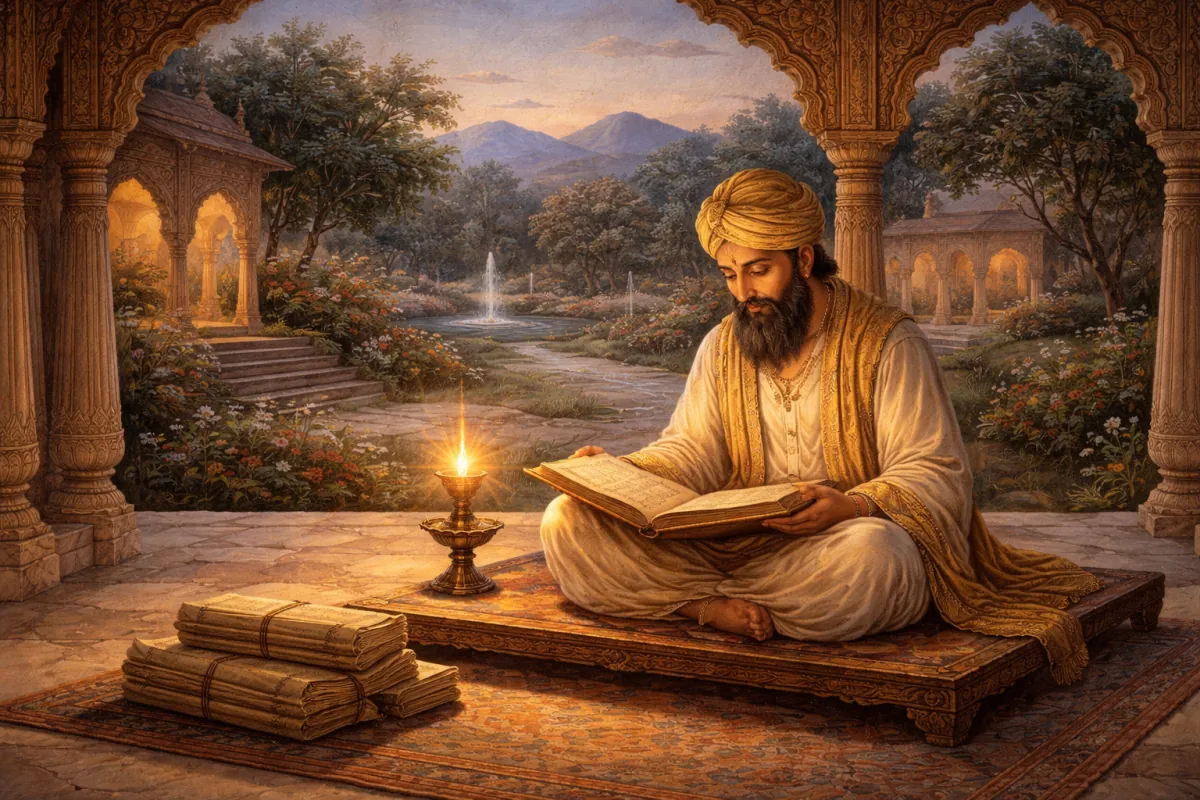
Another important text belongs to the Kashmiri tradition of Shaivism—Abhinavagupta’s “Paramarthasara” (The Essence of the Supreme Goal), with commentaries by Yogarajyanandanatha Guptasadhaka.
On Spiritual Protection
“I seek your protection, O Shambhu, Supreme One who abides beyond the incomprehensible world of maya. You alone enter the hearts of those who know and dwell within them, manifesting in all that moves and all that does not.”
Wise people seek protection in God, while foolish people seek protection in money, power, and worldly desires—both need protection. But some choose the right object, while others choose the wrong one. Protection is needed from the energy of samsara into which the soul has fallen. Protection is usually needed when one is exposed to danger or enters a harmful environment. Samsara is quite a harmful environment. As one writer, Yuri Alyoshin, I believe, said: “Life is harmful—you die from it.” It is quite a harmful, toxic environment: impure tattvas. A young child is born, and over seventy years becomes poisoned by karma; by eighty, the person becomes completely disabled and can no longer live; by ninety—these are the properties of samsara.
One must seek protection from such an environment. For example, when there is a radioactive environment, a radiation suit is made, the degree of radiation hazard is measured, and an antidote is taken. There is another antidote for samsara—“Om Namah Shivaya,” bowing before the altar. The principal antidote is God, which is why people seek protection in God. God is not merely the object of the fulfillment of our desires; He is not merely a dream or the path to liberation—He is also protection, real and practical protection, not something imaginary.
“I seek your protection, O Shambhu, Supreme One who abides beyond the incomprehensible world of maya.”
Why does God protect? Because He transcends maya; He is above the tattvas, the gunas, all five elements, suffering, and the limitations imposed by the energies of this entire material creation. He can grant strength, wisdom, and protection, and He can become a precious wish-fulfilling jewel; therefore, every wise person seeks protection in Him. Not to seek protection in Him is, at the very least, shortsighted and foolish, and at most, utterly contrary to the principle of life.
This is why compassion arises when you see your loved ones, those close to you, your relatives, or simply other people, and ask: “What is your relationship with God like? How is your protection, God’s grace, growing stronger?” They say: “We don’t believe in any of this at all”—and compassion arises within you. “We believe in money; we believe in advertising. We believe in television”—and compassion arises within you because people seek protection in the wrong place and seek the fulfillment of their desires in the wrong place—this is spiritual blindness. A sadhu purifies his heart in order to see God, first removing his own spiritual blindness and awakening his spiritual vision, and then helping others awaken their spiritual vision.
The Nature of Paramashiva
“You alone enter the hearts of those who know and dwell within them, manifesting in all that moves and all that does not.”
Commentary: Shambhu is Paramashiva, the supreme reality, and at the same time He manifests in all things and events; He alone is their cause. This is a pantheistic image and, at the same time, the absolute reality that transcends everything that exists. He is beyond and above the heterogeneous, defiled world of maya. This is the monistic Absolute and, essentially, the supreme deity in Kashmir Shaivism. Thus, the fundamental philosophical principle of Kashmir Shaivism is theistic absolutism of a monistic nature.
It may be called anything: theistic monism, monistic theism, monistic pluralism, monism with elements of pluralism, and so on. This does not change the essence of its incomprehensible nature. These are attempts by the human mind to describe what is incomprehensible, to somehow classify it and give it a name. Some people argue about this very meticulously, tenaciously clinging to definitions and to rigorously formulated philosophical expressions and concepts, but this is unimportant. It matters only when studying a specific theory. God is immanent and transcendent, as they also say.
Transcendent means beyond this world, while immanent means that He is within, He is within everything, He permeates everything, and above all He is in our soul; that is, there is a superintelligent deity in our soul—imagine that. Of course, we have heard this and perhaps suspected it, but it is difficult to believe that someone more intelligent than ourselves lives within us yet does not reveal Himself. He is very tolerant of us: “Go on, go about your business, work through your karma; I will not interfere”—but sometimes He may intervene.
That is why the Upanishads say: “Two birds live in one tree.” One bird pecks at the fruit and enjoys the berries, while the other watches. The first, which pecks at the fruit, is the jivatman, while the second, which watches and simply sits behind it on a branch, is the Paramatman. Our Paramatman is a superintelligent particle of the Deity within us.
This superintelligent particle of the Deity within us is always holy, always pure, always perfect; it always transcends the body, the mind, our level of education, our memory and intellect; it always remembers our past, knows our future lives, and always possesses purity, perfection, eternity, omniscience, and omnipotence, yet it does not interfere in anything. Such is its policy toward us and our karma. Why? Because that is the way of things, such is free will, and this superintelligent particle sometimes sends grace, inspiration, spiritual blessing, and help in response to our prayers, but indirectly, since the freedom of our lower parts—the antahkarana (inner instrument), buddhi, manas, and atman—must not be violated. It is such an independent observer within us. At the same time, He is both the goal and our essence; we read about Him and meditate on Him during Mahashanti meditation.
“Having passed through cycles of suffering from conception in the mother’s womb until death, the disciple approached Lord Adhara and asked him about the ultimate truth of all existence (paramartha).”
Commentary: the teacher told him about this by means of the Adharakarika. Abhinavagupta presents it in accordance with the vision of Shaivite philosophy. (Adhara is the name of the sage who authored the Adharakarika).
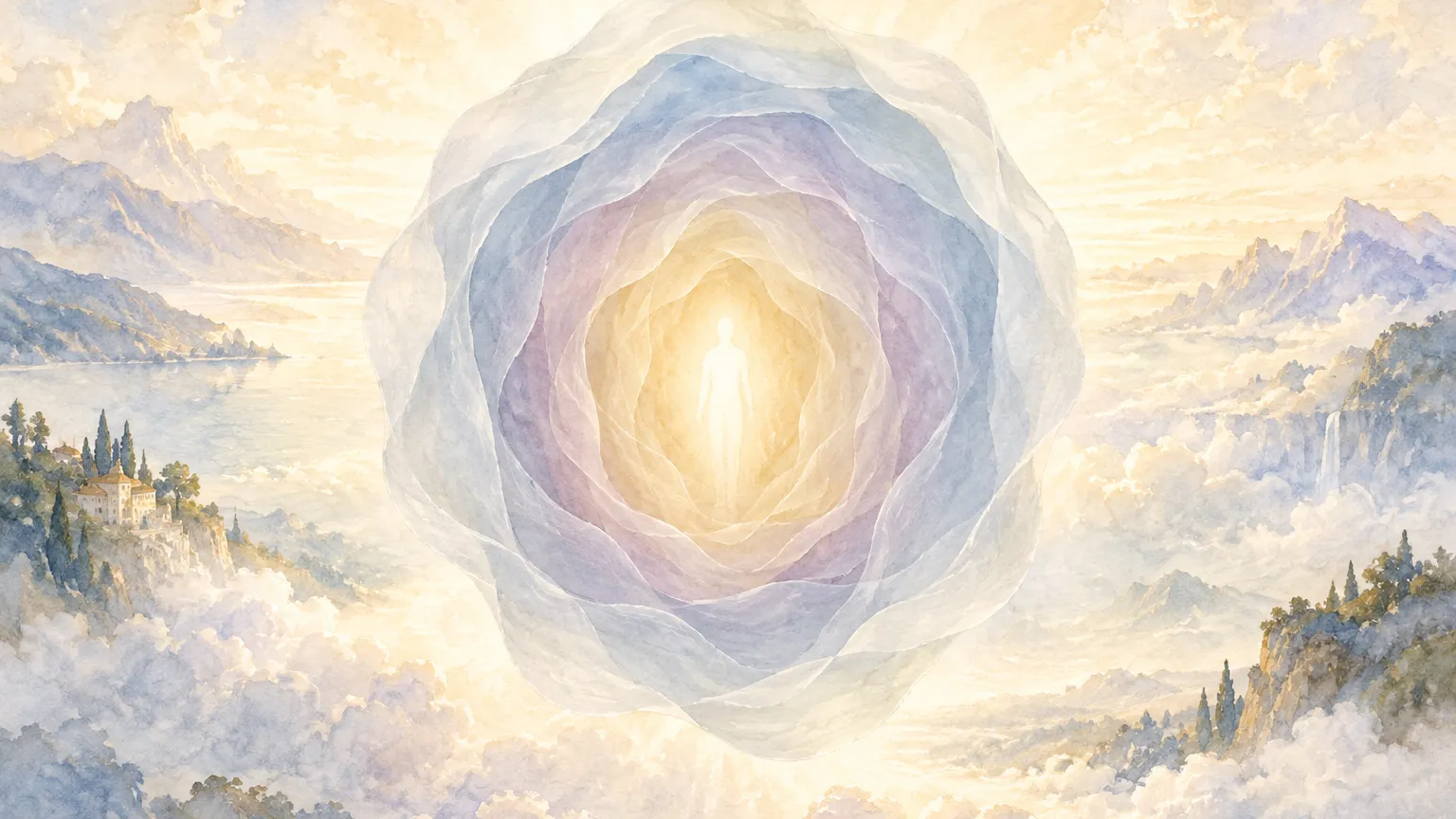
The Four Spheres of Creation. Andachatushtaya
“Through the abundance of His divine powers, the Almighty Lord brought forth four spheres: shakti, maya, prakriti, and prithivi.”
An anda is a sphere of manifested elements; it serves as a sheath that conceals the divine nature of the Absolute (paramartha).
These are the four spheres:
Shakti—the divine power expressing itself outwardly, pure creation. Manifesting multiplicity within unity, it conceals the complete perfection and unity of the Absolute God; it contains the four pure tattvas from shakti to pure vidya.
Thus, Ishvara produces four spheres. The first of them is shakti. Shakti (the first sphere) is associated with the four tattvas below Shiva-tattva. This sphere of the four lower tattvas below Shiva-tattva is called shakti, the first of the four andas.
Maya—completely concealing the natural purity and divine power of the Absolute behind five sheaths or limiting elements called kanchukas, it presents the Absolute as a finite entity called purusha. It comprises seven tattvas from maya to purusha.
Raga, and then onward to purusha—seven tattvas. This sphere is called maya—that which conceals the absolute truth.
Prakriti—conceals purusha and presents it in the form of physical elements, senses and organs, subtle material elements called tanmatras, the three gunas, and the four gross elements down to water. It contains twenty-three tattvas from prakriti to water.
Thus, purusha is a pure soul that is aware of its divine nature. It may be a deity, a spirit, or a human soul—any soul, enlightened, unenlightened, or half-enlightened. It is one who possesses some knowledge of its own nature, but whose nature is bound by the kanchukas. Purusha is Shiva confined within time, space, action, the energy of subtle desires, and so on—this is purusha; all of this is the soul, the spirit enclosed in the оболочка of avidya.
The twenty-three tattvas—all of this is the realm of Prakriti, the anda called Prakriti. Purusha is surrounded by various energies.
Prithivi is the anda (sphere) that conceals the Absolute within dense physical existence. It contains only the Prithivi tattva and consists of all the solid matter in the universe.
The realm of the solid universe is the realm of earth, stones, minerals, the solid elements of metals—everything solid in the universe. It is the last, thirty-sixth tattva, and this is the Prithivi tattva, the entire solid universe. Such are the four spheres produced by Ishvara. As shakti becomes increasingly fragmented, souls descend into ever denser layers of shakti and have less and less freedom for self-realization and the manifestation of their own shaktis, because external shakti, creation, begins to control them more and more. This is pasha—the bonds by which the soul is held—and the soul itself becomes pashu.
There is also Shiva tattva, which is situated above all four andas.
All four spheres mentioned above contain the 36 tattvas and cover pure and divine absolute consciousness in the form of the highest, subtle, gross, and material worlds. The Absolute God created them in the process of his own manifestation; they consist of his own reflections and conceal the true essence behind them. This creation is not a simple transformation: neither God himself nor his divine power changes as they manifest in the form of these tattvas, which reflect his physical light as well as his divine powers.
Thus, all four of these levels of creation do not obscure the principle of God; they emanate from him, they are energies, and they do not leave God. In other words, this universe manifests within Shiva, and all arising souls and all worlds do not leave the body of Shiva; this universe is the manifested body of Shiva, yet Shiva himself is not obscured. Shiva is not obscured from himself, but for us as living souls, Shiva is obscured, because the perception of living souls is limited; their power of consciousness and viveka is unable to see beyond matter and beyond the energies, to see Shiva himself directly. But as the power of consciousness increases, such an ability emerges.
The Universe as Shiva’s Play
“The universe comprises all that exists in the full beauty of its diversity of bodies, sensations, and worlds, where an individual limited being experiences joy and pain. In reality, it is God Shiva himself, who has assumed the form of a limited being.”
We think of ourselves as human beings and of other people as human beings; we classify people by race, nation, sex, religion, education, wealth, and social status—by many, many different divisions, levels of intelligence, character, personality, and so on. But in reality, it is Shiva himself who has assumed such a form, just as he has assumed the forms of gods, animals, and other beings. Why did Shiva need to do this? Such is his free will. He need not answer this question, because only he exists for himself; nothing exists apart from him. Souls may ask why he needed to do this, but for him no such question exists. Even within his sphere of perception, there is no one who could ask him such a question in principle—it is a play; that is, he amuses himself through the play of his energies. However, on lower planes, different levels of meaning emerge: one of them is the evolution of souls, another is the experience of the laws of karma, and so on. All of this is called niyati (divine providence)—in essence, the spontaneous, free, unconditioned, and unmotivated play of perfect Shiva.
Commentary: Shiva’s very nature is play through manifesting himself in limited beings (pashu) and in the changes that occur within the cycles of reincarnation. Pashus, like animals, are bound by the fetters of karma and by limiting elements, the kanchukas.
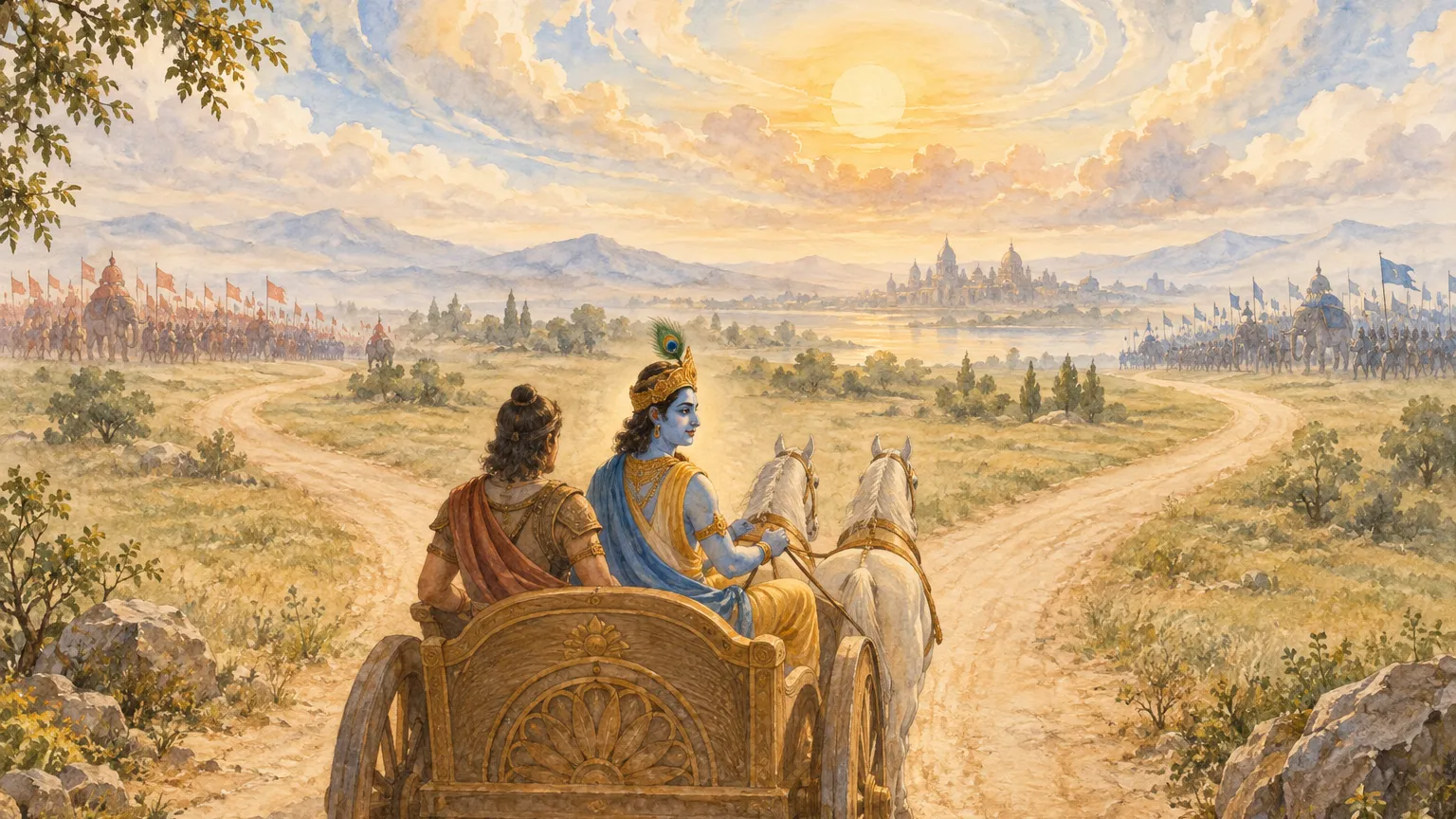
For example, Krishna played the role of Arjuna’s charioteer. At the same time, Krishna fought against Duryodhana, yet he gave Duryodhana his army while he himself sided with the Pandavas. It is difficult to comprehend such logic: he seemed to support Arjuna, but if he supported Arjuna, how could he give his army to the Kauravas? Because he had made a promise and could not fail to fulfill his duty either. If we look closely, Krishna supported everyone, and he fought everyone simultaneously—an absurd game. Yet how could he have acted otherwise if he lives in the body of every living being, if he is within the Kauravas and within the Pandavas, and has no preferences of his own? From Krishna’s point of view, it is logical, and for him none of this is a war at all, but simply a game—God’s amusement, which, moreover, is predetermined by time, which itself is subject to God, that is, to Krishna himself.
The human world is built on duality, on dualistic notions and identifications, but none of this exists for God. He plays according to his svatantrya (freedom of will). The more we come to know the nature of God, the more amazed we are by it, and it is very important for a sadhu always to be immersed in exploring the nature of God.
The Sadhu as an Explorer of God
One who immerses himself in exploring the nature of God is always amazed; he is like a scientist who fanatically investigates his object of study. For example, there are scientists who study the microscopic world—various bacteria, atoms, infusoria, viruses. There are scientists who study macro-objects—shimmering galaxies, the Milky Way, the sun, enormous stars, quasars, and so on—and they do not think about worldly things at all; they think about what they are studying, they are constantly absorbed in the object of their research, and they live in the world of their research.
In the same way, a sadhu has his own object of study—God. This is the greatest, most incomprehensible, most difficult to perceive, most elusive object of study. Here, a sadhu is like a scientist, but he has no telescopes or microscopes with which to study God; the best telescope and microscope is the body with its pranas and mind. When we sit in mahashanti or walk during chankramanam, we are like a researcher bending over his microscope or telescope: we attune ourselves to God and try to investigate what He is. God is within the nature of the mind, or so they say, at least—we must take a closer look at Him. As we walk, we investigate again through the sense of “I,” through shambhavi mudra; they say God is there—we must understand Him better, understand how everything is arranged there within God. When we look at a murti externally, we are also investigating: He is within Dattatreya, within Shiva, because samanya-vishesha-spanda is present there—we must determine what kind of spanda it is.
A sadhu is constantly immersed in exploring God. The very process of exploration is captivating and fascinating. If you are truly engaged in such exploration, eighty percent of your attention will be focused on it, while twenty percent should be enough for everyday tasks, daily life, communication, and so on. Even great philosophers demonstrated such absorption in their research. For example, Immanuel Kant loved to contemplate transcendental truths. Sometimes, when he returned home after his lectures, it was his habit to place his cane in the corner, sit down on the bed, and continue thinking about transcendental truths. Once he became so lost in thought that he himself stood in the corner, placed his cane on the bed, and remained standing there thinking for about four hours. Then he realized that something was amiss. He looked around and saw that he was in the corner instead of the cane, while the cane was on the bed, and that he had done it incorrectly. This is vairagya and absorption (dharana and dhyana), a great mind, the greatest of minds.
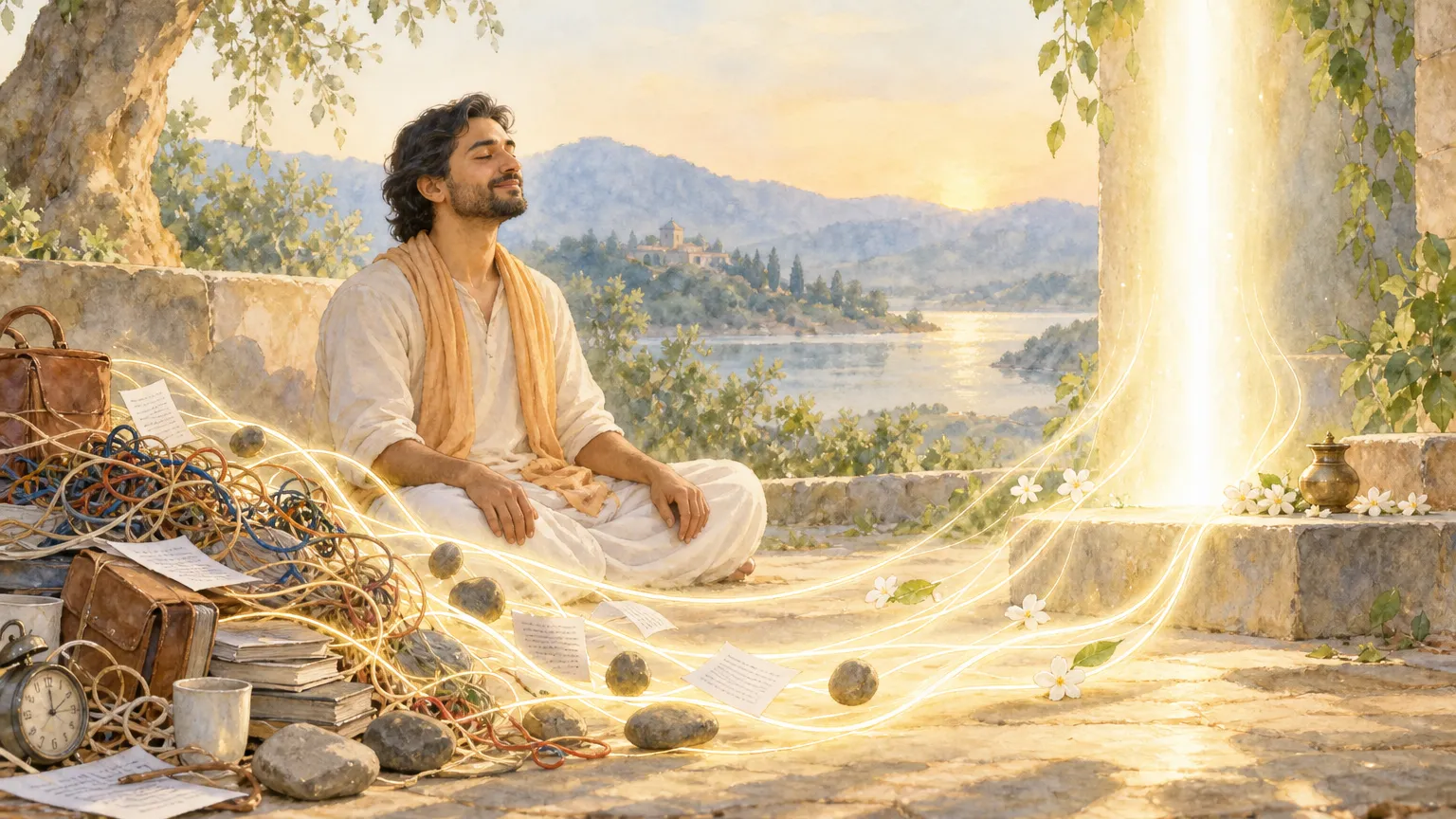
In the same way, a sadhu must constantly explore God, and when we explore God, vairagya naturally arises. Vairagya means detachment from this world, non-attachment to the ego, renunciation of the ego. When we playfully fulfill our duties, there are no attachments, no clinging—we are occupied with God; we are not occupied with quarrelling with one another. If we are occupied with quarrelling with one another, then we are very foolish: we simply do not pay attention to God and look only at what is right under our noses. We do not explore God, and we are not attached to the external world; we need nothing in this world beyond what is essential for serving the Dharma and helping others so that they too may explore God—this is vairagya.
These twenty percent should be enough for seva, concentration, providing for oneself, and understanding this world, but a sadhu’s main occupation is the exploration of God. Then worldly desires leave him, the ego leaves him, clinging and attachments leave him, and suddenly he feels happiness, because God begins to bestow happiness as soon as we are able to explore Him a little more deeply. He begins to send a wave of grace, and the arrival of this wave of grace as a result of exploring God and such devotion to God is a sure sign that the sadhu is on the right path.
Therefore, a sadhu who is absorbed in the exploration of God never has any problems; everything is always well. He cannot be unsettled or distressed; nothing can be taken from him or given to him. He is self-sufficient because he has found himself, he has found his path, he has found his beloved, and he has found his main occupation. He does everything playfully, and outwardly everything manifests because God guides him, God helps him, God protects him, and God blesses him. This is also called steadfastness of view and contemplation, because the view is always the view of being in God, while contemplation is the contemplation of God—this is nididhyasana.
True Nididhyasana and Devotion to God
It is not the contemplation of something else—breathing or some state or aspect of consciousness. These are all merely particular things, whereas true nididhyasana, both in Vedanta and in Shaivism, is always nididhyasana of Brahman, nididhyasana of Shiva, the Absolute.
Therefore, the best way to free oneself from difficulties in life, problems of the mind, spiritual obstacles, despondency and depression, and difficult, confusing tasks and relationships is simply to be absorbed in devotion to God and the exploration of God always and everywhere. Then God takes our problems upon Himself; He playfully solves our tasks and fulfills our dharma for us, doing so playfully, so that it seems to us that we are hardly doing anything, yet everything manifests. And even if we experience failure in the relative world, God takes upon Himself the fruits of our mistakes. We accept it easily, and it is easy for us, because we abide in God.
Divine Manifestations and the Nature of the Absolute
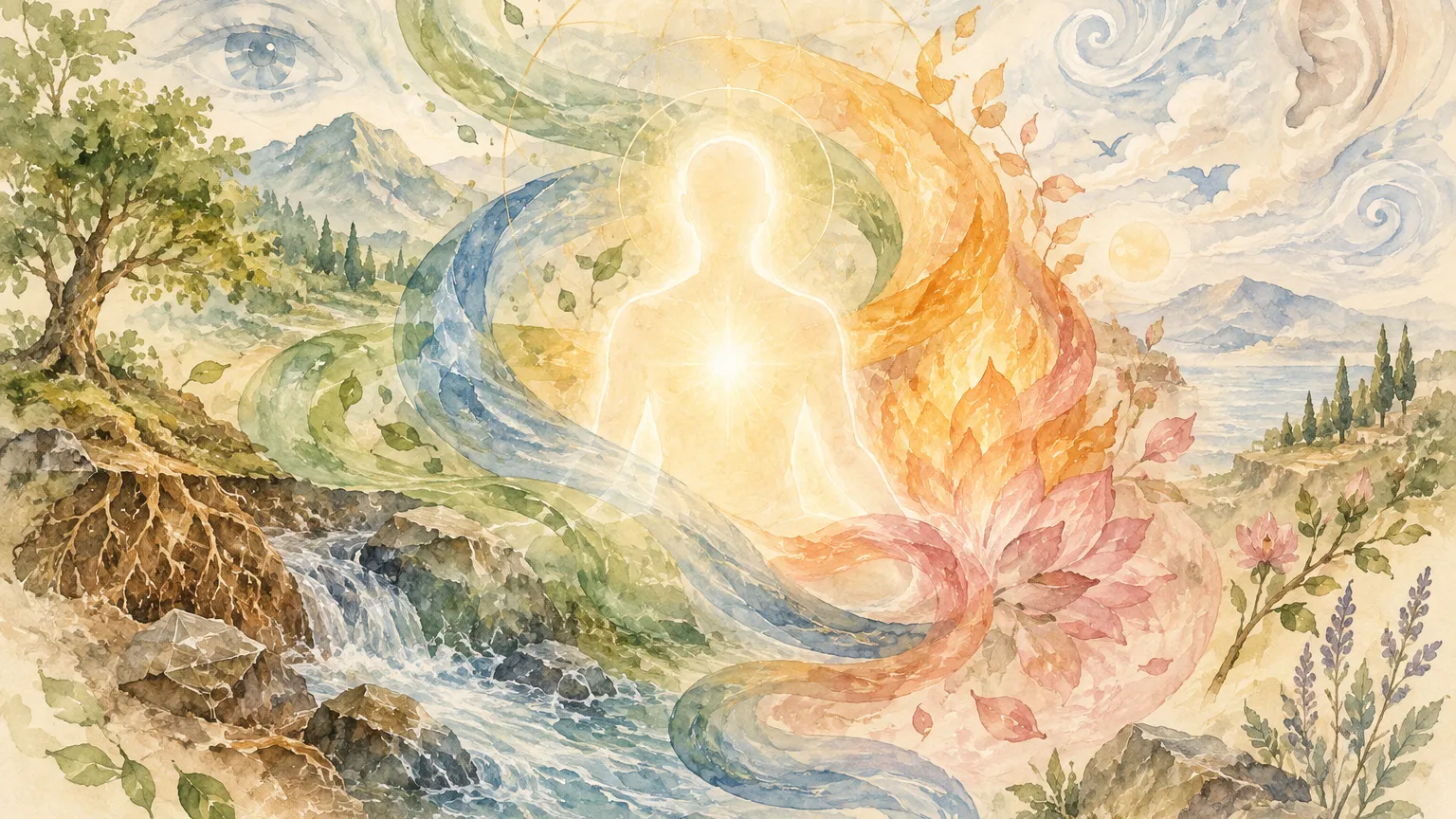
“The Lord assumes the forms of gods, humans, animals, and plants, just as a transparent and colorless crystal reflects various colors.”
Commentary: Although God manifests in various kinds of beings, He nevertheless remains completely unchanged; the creation He brings forth causes no transformations in Him or in His divine power. He reflects His powers outwardly into the divine prakasha, the spiritual radiance of His pure consciousness, and these reflections become all phenomena, created existence, and so forth. For this, He requires no external matter. The fundamental cause of all existence lies in His inclination toward play.
Creation does not occur because of any external phenomena, such as maya or avidya, or because of an inner entity such as vasana, as Advaita Vedantins and Buddhists respectively suppose. The cause of creation lies in the divine nature of the Absolute.
“The great Lord Atman manifests in a vast multitude of bodies, senses, organs, and worlds, just as the reflections of the lunar disc shimmer in flowing waters and remain still in calm waters.”
Commentary: The difference between the moon and Atman is that the former requires something to reflect its light, whereas the latter is independent and reflects its powers within its own spiritual light, thus manifesting in various forms. Moreover, such manifestation is not merely possible but is the very essence of Atman.
Nityam-svayam-prakasha—the eternal self-existent light. The eternal self-existent light requires no special energy or special sources in order to shine. It has no source other than itself. When we are meditating in the darkest room and dive deeply into meditation, we discover light—no one has kindled this light, no one has switched it on. It is always naturally present within as the nature of the soul. The ability to discover this light and immerse oneself in it is the sadhu’s art of meditation.
The Manifestation of Atman in Consciousness
“Although it is present everywhere, the Atman is visible only in physical forms through objective perception, just as Rahu is visible only on the disc of the Moon; otherwise, it is invisible.”
Commentary: Rahu is the Earth’s shadow, or a mythical demon with a similar function. It is always present but becomes visible only when it touches the disc of the Moon. The Atman, being infinite by nature, is omnipresent, but in the ordinary physical sensations of living beings it assumes the form of judgments such as “I saw this or that”; in such a judgment, it is the “I.” It does not manifest in this way in inanimate objects.
“The Atman shines in clear consciousness, purified by the gift of Lord Shiva’s shaktipat, just as a face appears clearly in a clean mirror.”
Commentary: The gift of God’s grace is known as shaktipat. It is the principal factor that directs a being toward the study of divine scriptures, inspires within them a powerful desire to know the truth, leads them to worship the Lord in their heart, creates a connection between them and a true teacher, and actively engages them in the practice of Shaiva yoga. Everything that purifies a being’s inner soul and enlightens it is the true divine nature of its perfect consciousness.
The Nature of the Absolute and Its Divine Powers
“The entirety of existence, consisting of the 36 tattvas, appears within the supreme reality and sparkles as the light of pure consciousness. It is perfect in every respect; it is the infinite happiness of depending solely upon itself. It is condensed in the form of will, cognition, and action (iccha-samvit-karanai), filled with infinite divine powers, free from all imagined concepts, pure and serene, and unaffected by decay or contingencies.”
Commentary: Bha (pure consciousness) is the spiritual radiance of pure consciousness; it is the fundamental form of the Absolute. Everything that exists abides within the Absolute in the form of pure consciousness, requiring nothing other than the divine power that acts within it and is the source of infinite bliss. The Absolute wills to manifest, illuminate, and objectively express that which is manifested; thus, everything divine is governed through three fundamental powers. The Absolute manifests through spiritual light, free from concepts, through intuitive revelation.
The true form of the Absolute is the pure, serene, infinite, eternal, and divinely powerful consciousness of “I”; it is the divine reality that is essentially the Deity and reveals its nature through the divine acts of creation and so forth, assuming the form of the universe through reflection. The Deity is the essence of the Absolute, but such theistic absolutism in Kashmir Shaivism does not require elements distinct from the Absolute to explain the manifestation of existence—things such as avidya in the later Shankaran Advaita Vedanta and vasana in Buddhist philosophy are not invoked. Even Gaudapada and Shankara acknowledged such an explanation of Brahman in their Tantric and religious-philosophical teachings, but this is often ignored by Advaita Vedantists. The general term iccha-samvit-karanai denotes three powers: iccha, jnana, and kriya. Vikalpa is the mental creation of concepts.
The Art of Being a Sadhu
The art of being a sadhu lies in always being guided by God, always serving God, always seeking to know God, and never departing from this. As life unfolds, many situations and states arise that are conditioned by past samskaras and may draw one out of the state of being guided by God and united with the divine will. The maturity and wisdom of the soul consist in always remaining, amid such situations, guided by God, contemplating God, serving God, and surrendering to God.
Shravanam means listening to the truth about God and then entering a state of contemplation of God. During manana, doubts must be cut off—there are always many doubts arising from the mind, the ego, and inner experiences, and these doubts must gradually give way to firm certainty, when no doubts remain—this is manana. In nididhyasana, we abide guided by the divine will; we abide either in self-surrender, self-recognition, or self-liberation; we abide illumined by divine wisdom, abiding as one with the divine qualities. Gradually, as the divine qualities increase, various forms of godlikeness manifest, culminating in becoming a Chakreshvara, that is, the lord of all inner shaktis.
The Principle of the Mirror and the One Taste
“The reflections of numerous objects in a mirror cannot be separated from the mirror itself, yet all of them—cities, villages, forests, and so forth—are distinct and separate from one another. Likewise, all phenomena are distinct and separate from one another and from the divine, perfect, infinite consciousness of the great Bhairava, almighty God, although in reality they are inseparable from him.”
The principle of the mirror and reflection reveals much to us. Viveka means discerning the difference between the mirror and the reflection. For example, things with different qualities may be reflected in a mirror—a Buddha, a peacock, a pig, gold, the sun, the moon, a person—and they seem to be completely different, incompatible things, but only as long as we look at the reflection. When we shift the focus of our gaze from the reflection to the mirror itself, we see that all these things are essentially the same. It is simply the mirror itself, the surface of the mirror—that is what unites them. From this, the one “taste” arises.
The one “taste” does not mean mixing things together and saying that they are all one; the one “taste” means discovering the nature of the mirror, which is distinct from the reflections, and seeing that all reflections are one at the level of the mirror. In this case, the mirror is the principle of nondual awareness, while the reflection is the diversity of objective phenomena.
When we speak of attaining the one “taste,” it means seeing everything with equanimity, realizing the wisdom of great equality. And how can this be done? It is impossible to mix diverse things together and say that they are all equal—it will not work. One must discover the mirror in which all reflections arise. As soon as we discover the mirror in which the reflections arise, the one “taste” appears naturally.
One mahasiddha in Tibet, while teaching his disciples, said, “My dear spiritual sons, the one ‘taste’ is something like this”—Milarepa, I believe—and thrust his arm into a rock up to the elbow. When a yogi is deeply immersed in the state of the one “taste,” hard and soft, one’s own body and the rock, cease to be different things—they are a single substance.
There was another master who bestowed blessings when stones were brought to him. People brought him stones, and he poked them with his finger, making small holes in them and turning them into amulets. There was also an occasion when two masters were walking on Kailash, and one of them playfully left the imprint of his palm in the rocks. Mahasiddhas sometimes like to amuse themselves in this way, leaving impressions of their feet or hands, their palms, in rocks as relics. The other one smiled and said, “What is this? Even my dog can do that,” then took the dog’s paw and left an imprint with it.
Krishna met a famous musician, Narada, I believe, and Narada played the vina with great skill. Krishna took a log and played it even more skillfully, because Krishna had realized the highest level of the one “taste.” Whether it was a vina or a log made no difference to him as an instrument for producing music, and his music was more beautiful than Narada’s. Narada acknowledged his musical mastery, although Krishna himself was not a musician.
Commentary: In reality, reflections in a mirror do not imply that phenomena exist inside it. Even though they are visible in it, they are distinct from it; it is their light that is seen within it. Likewise, all phenomena, shining with the spiritual light of the consciousness of “I,” are distinct from the subjective consciousness of “I,” yet in reality they are one with it.
Beyond Eternalism and Nihilism
The single “taste” differs from the subjective consciousness of “I” and from the objective; it transcends both the subjective and the objective. The single “taste” means that we have learned, that we have discovered the mirror of pure consciousness beyond the subjective and the objective. As we increasingly look at God through the mirror of the single “taste,” all things gradually become equal, become the same. For example, success and defeat, something joyful and something not so joyful, or what you like and what you dislike, what seems right and what seems completely wrong.
I am often amused when people tell me, “Guru, this is completely wrong,” and I laugh: “What do you even think is right and wrong? What are these ideas you carry around in your head? Who put all this into your mind?”—ignorance. To God, both right and wrong are equally illusory, and it all depends on how you look at it. You can look at it one way, or you can look at it another way; right and wrong are conditional, human notions. God does not live by human rules, and you, too, should free yourself. Otherwise, if you are too righteous, take care not to miss God altogether.
Of course, we must follow various principles, understand the Dharma and its rules, but this rightness is transcendent; it belongs to a different order and does not come from the mind, because if we perceive things through the mind, we will never understand the principle of the single “taste.”
All human notions of rightness are actually wrong in God’s world, completely wrong; that is, on the human level we may be absolutely right, while on the divine level we may be utterly, totally wrong. Therefore, we must always use these terms carefully, and even when we use them, we should add a kind of footnote: within the framework of the human world, within the framework of conditioned dualistic perception. We should not give what is right such an absolute status; otherwise, this is called eternalism, pure eternalism.
On the one hand, eternalism means blind faith in reality, blind faith in one’s delusions, in the patterns of the mind, and in all these external things. Sadhus, avadhutas, and Dattatreya destroyed such blind faith very radically and very easily; they paid no heed to people’s illusions, because these illusions prevent them from seeing God.
On the other hand, there is the extreme of denial—nihilism—when we say that nothing needs to be taken into account, nothing needs to be observed, and all energies are an illusion. Nihilism means that we adopt a stance of denial toward principles and rules: we challenge them, ignore them, behave destructively, and disregard everything that exists. This, too, is another extreme—nihilism. If we behave foolishly, disregard existing energies, and fail to take them into account, these energies may bring us problems, complicate our lives, punish us, or become activated in accordance with the law of karma. Therefore, a sadhu lives in the single “taste,” beyond eternalism and nihilism. He is not bound by notions of what is right, but neither does he deny relative truth; he follows the middle way.
The Self-Sufficiency of Divine Consciousness
Thus, all that exists in all its manifestations appears in the light of consciousness like a reflection in a mirror. There are only two main differences between consciousness and a mirror. First, a mirror is dependent and requires external objects in order to produce reflections, whereas pure consciousness—divine, powerful, perfect, and self-sufficient—manifests reflections of its own divine powers within its own spiritual radiance of consciousness and requires no external elements for this. Neither the avidya of Vedanta nor the vasanas of Buddhism are required. This self-sufficiency is a quality of divinity. The other significant difference is that a mirror is aware neither of itself nor of its reflections, whereas the consciousness of “I” can be aware of both.
The Single Taste of Divinity
Thus, when we discover the mirror, the single “taste” gradually begins to arise naturally. The single “taste” means the single “taste” of divinity. This is not the single “taste” of nihilism, leveling, or conflation—it is the single “taste” of purity, the equal holiness, equal sacredness, sanctity, and divinity of everything that manifests.
For example, you are walking along and see a vegetable garden and a greenhouse. If, when you see the greenhouse, you see the mirror in which the greenhouse exists, and most of your mind is directed toward the mirror, then going to the greenhouse is like going to a temple for you, because you abide in the purity of divinity, contemplating the mirror from which the greenhouse manifests. The greenhouse is divine; it is as pure as a temple. When you go to a temple, you also see the mirror from which beautiful images of saints and deities appear. The temple is divine and pure in its own way, just as the greenhouse is pure in its own way.
A single “taste” means that you discover the mirror of pure consciousness as the source of both the temple and the greenhouse, and you feel equally pure and holy in both places; however, you should visit temples more often and perform prostrations there. Why? Because, for the time being, this is what the Dharma prescribes for your category of beings, so that you may follow the Dharma and the logic of purification and liberation.
A single “taste” is not about fixing our minds on the phenomena of this world, but about discovering the mirror from which these phenomena arise; and it is the very fact of discovering the mirror as the source of all phenomena that endows every manifestation with holiness and purity. Therefore, such a yogi always abides in a pure dimension, wherever he may be and whatever he may come into contact with. Whether an experience is bad or good, whether he likes it or not, he perceives it all with gratitude and with a sense of holiness, sacredness, and sanctity. For him, there is nothing impure when he contemplates the mirror; there is nothing bad or conditioning—everything is holy, everything is pure. However, one must be very careful here not to lapse into nihilistic tendencies.
This theory of the manifestation of being through reflections is proposed in Kashmir Shaivism; it protects its philosophy from hypothetical assumptions such as avidya, which call the Absolute into question. At the same time, it does not impose the concept of transformation on Brahman. Thus, in Kashmir Shaivism, being unfolds through gradual manifestation, and its fundamental and primary principle is theistic absolutism.
“The Absolute God manifests in the five pure states of the tattvas—Shiva, Shakti, Sadashiva, Ishvara, and pure shuddha-vidya—through the projection of His five principal divine powers.”
One Taste
Kashmir Shaivism
Maya
Abhinavagupta
Shiva
Tattvas
Paramashiva
Mirror and reflection
Shaktipat
Author Гуру
Read 17 times
Articles
Vidya AI
Search
Lectures
November 2, 2026
Mantra of the day
ОМ САХАДЖАЙА НАМАХ ОМ Естественному – поклонение!
Auspicious Times(Rome)
Brahma Muhurta:
04:53 - 05:48
Abhijit Muhurta:
11:33 - 12:14
Sayam Sandhya:
16:44 - 17:25
Mokshada Ekadashi (6 November)
Ekadashi of liberation. Helps to achieve spiritual enlightenment.