

In this lecture we will talk about the view that exists in the teaching of Laya Yoga.
If we speak about structure, then in any teaching there is a basis, a path, and a fruit. The basis is what we orient ourselves toward in terms of worldview, or what we believe in. The path is our practice, the way we actualize our view. And what is the fruit? The fruit is the result, the final point, that which we hope to attain.
The basis of the teaching can be called Brahman or prajñāna, primordial awareness. That is, it is non-duality. The path is the practice of meditation, contemplation, and working with energies. This is the specific tradition of the siddhas, Laya Yoga proper. And what, then, is the fruit? The fruit is what we hope to obtain: realization. For example, to attain the realization of several enlightened bodies is the fruit. To attain the illusory subtle body (pranava-deha), to attain the immortal physical body (siddha-deha), to attain infinite consciousness, that is, the body of wisdom (jnana-deha), or to attain all these three bodies at once—all this can be called the fruit of practice, a specific result. To become a deity and create one’s own universe, a mandala, is also a fruit. Finally, simply to purify one’s mind of duality and realize the state beyond duality can also be called a fruit.
Tangible Fruits of Practice
When we speak of fruits, these are not some ephemeral fruits; they are quite tangible fruits. Of course, at first we may not feel them. At first we feel the small fruits of our practice. For example, we can say:
- “I had anger, but I overcame it through the power of awareness. I can control my emotions, feelings, and thoughts”

- “I was attached to something, I was torn apart by desires such as lust, greed, and other things, but I subdued all of it”
- “There were disease-causing energies in my body, and I regulated the state of my elements, so now I have lightness in the body and strong immunity”

- “I have attained an indestructible inner center that grants me a tremendous feeling of confidence and inspiration. This center is the ‘I Am’ awareness”
These are still small fruits of practice. Of course, this still cannot be called realization, but it is already something about which we can say: “Yes, these are the fruits of our practice.”
And when it comes to the fruits of practice, we see that the teaching is alive and that it is precisely with its help that we build our future reality. Our future will be created—or, conversely, not created—depending precisely on how we are able to integrate the teaching into our life, how we are able to apply it in our life. Everything is in our hands, because the teaching is like a precious super-device or supercomputer. If you are able to master it, it will bring you great benefit. If your qualification is insufficient, then, accordingly, the benefit will not be very great.
Time and Influence on the Future
Now there is the point of the present. But, as you know, the present is something transient. What is present now will be the past tomorrow, and the day after tomorrow it will move even farther away and the future will come. We do not live in one time, but in three—the past, the future, and the present. Perhaps in two hundred years we will all disappear, and all that will remain about what happened here will be a line in encyclopedias or in textbooks on the history of Advaita in Russia, saying that there was such a monk, Vishnu Dev, who spread Advaita in Moscow. Perhaps so. We live in time, therefore what was present yesterday becomes the past tomorrow. The future is constantly advancing upon us. At the moment when this future advances, we can no longer influence it, because the causes of this future were laid down earlier; it has already ripened. This future is what is called “karma,” “cause-and-effect connections.”
For example, while being at the point of the present, we can to some extent forecast the future and even influence it. For example, from the current point we can influence the future of around 2020, 2025. Perhaps we can no longer have much influence on the future of 2009 and 2010, because all the main causes and prerequisites have already been created. We are not able to influence it and can only passively state: “Yes, here it comes.” This is the so-called zone beyond our influence. But about the distant future we can say: “Yes, to some extent I am capable of influencing both my own future and, perhaps, some global future.” And how can we influence it? By the course of our thoughts, by the power of our consciousness. Our future in 2020, 2025, and 2030 depends on what status of consciousness we have now. This can be called the zone of effective influence. It is right now that the sprouts of this future are being created.
For example, we have already missed the point of influence on 2010. It may have fallen in 2001, or in 2000. That is, this point has already been passed. Causes and effects have already been laid down; they are like inexorable laws that have materialized. Connections and relationships are already operating, and we cannot particularly influence them, except perhaps at bifurcation points. Bifurcation is variability, a certain probability of choice at points where branching occurs. If you find such a point and press on it, you can change the balance of forces, connections, and relationships. But for the most part, we are not free to influence the future that is already approaching. The point of influence on it has passed; it was earlier. However, we can influence the future that is a little more distant.
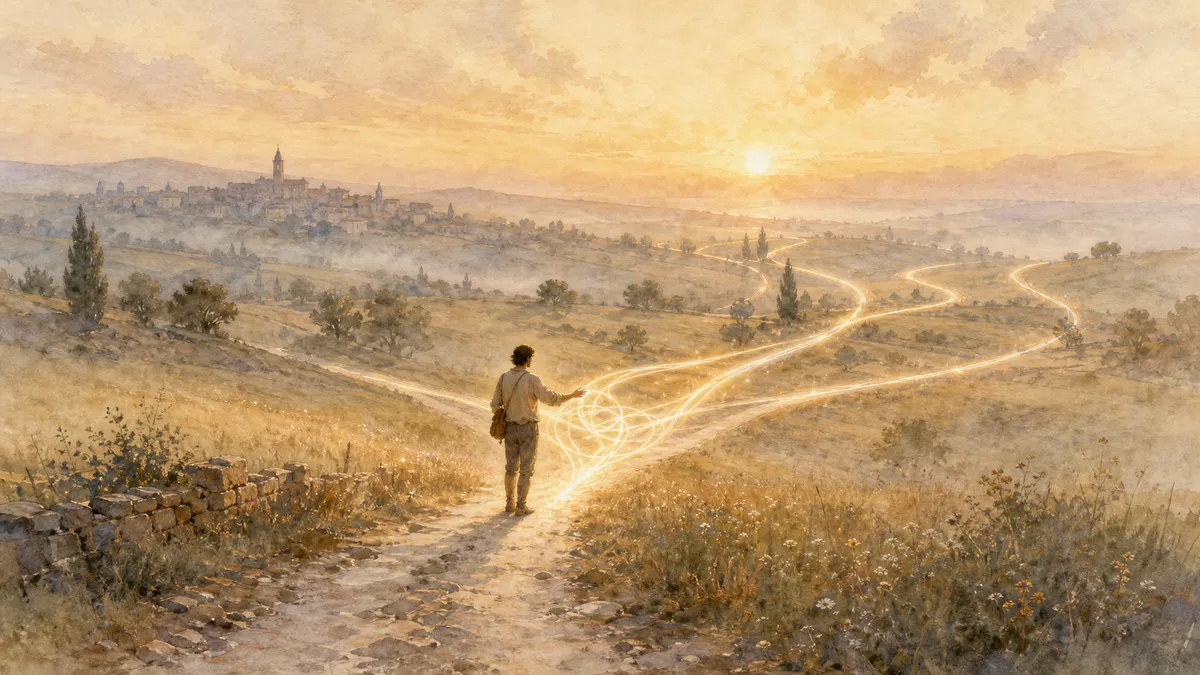
The future beyond 2070, 2090 is already the event horizon, that is, it is what is inaccessible to us. We can only fantasize about what the year 2100 will be like, where we ourselves will be at that time. But we can influence some nearer future. Based on the status of consciousness that we have, we can plant certain sprouts and determine the paths of this future. And while this future has not yet been determined, it is in a quantum state, it is probabilistic. Even the slightest changes in our mood can seriously affect this future. We can develop one chain or, by changing our state, activate a completely different scenario, create another variable universe. The teaching of parasattarka logic speaks about this in more detail.
The Teaching as the Key to the Future
So, when we practice the teaching, it is necessary to understand how important it is. The teaching is in fact the most important thing in the world, the most essential, because it is precisely this that has a very strong impact on our life, it is precisely this that determines our future. And our future, not someone else’s, depends on how well we understand the teaching, manage to integrate it into our life, and apply it. The teaching gives us the keys to shaping this bright future, the keys to managing it. If we use these keys correctly, then we can truly create it. We become the creator of our own destiny. But if we lose these keys, then nothing can be done.
For example, I consider the teaching and practice the most precious thing in my life. I believe that nothing can be more precious than it, because with the help of the teaching I can realize everything. I can remove everything that hinders me and create everything that I would desire. If I have the teaching, then I have everything; and if I do not have the teaching, then everything else is useless. Wisdom as such is the greatest treasure, valued both in the world of the gods and in the world of sages.
And when we study the teaching, it is very important to apply it practically, to understand how much it can really help us in life. We are not even speaking about such transcendent things as liberation and enlightenment. At least at the level of simpler things, the teaching helps us to be wiser and more harmonious in life, to understand our circumstances, our situation, our destiny, our prana, energy, body, and so on.
There is such a story. A king in India had a teacher (a sadhu, a yogin) who gave him instructions. The king listened, but half of it went in one ear and out the other. Since he was a king, he was inclined toward hunting, entertainment, and sensual pleasures: he liked to play dice, enjoy himself with dancers, drink wine, and wage war. And the sadhu saw that his sermons did not particularly have an effect on him, that the king remained as he had been. Yet at the same time he said to his teacher: “I want to attain liberation.” The teacher grew tired of this, and then persuaded a servant to help him. And one day the servant ran into the palace with a frightened face and said:
“My lord, something incredible has happened! Camels from all over our country have gathered around the palace and are climbing up the walls onto the palace roof.”
The king burst out laughing and said:
“You must be out of your mind. What are you saying?!”
And then the sadhu entered and said:
“My lord, there is nothing surprising in this. If you, indulging in distractions, sensual pleasures, and hunting, want to attain liberation, then why should camels not climb onto the roof of the palace? After all, that is just as incredible as what you want. Therefore, this too can happen.”
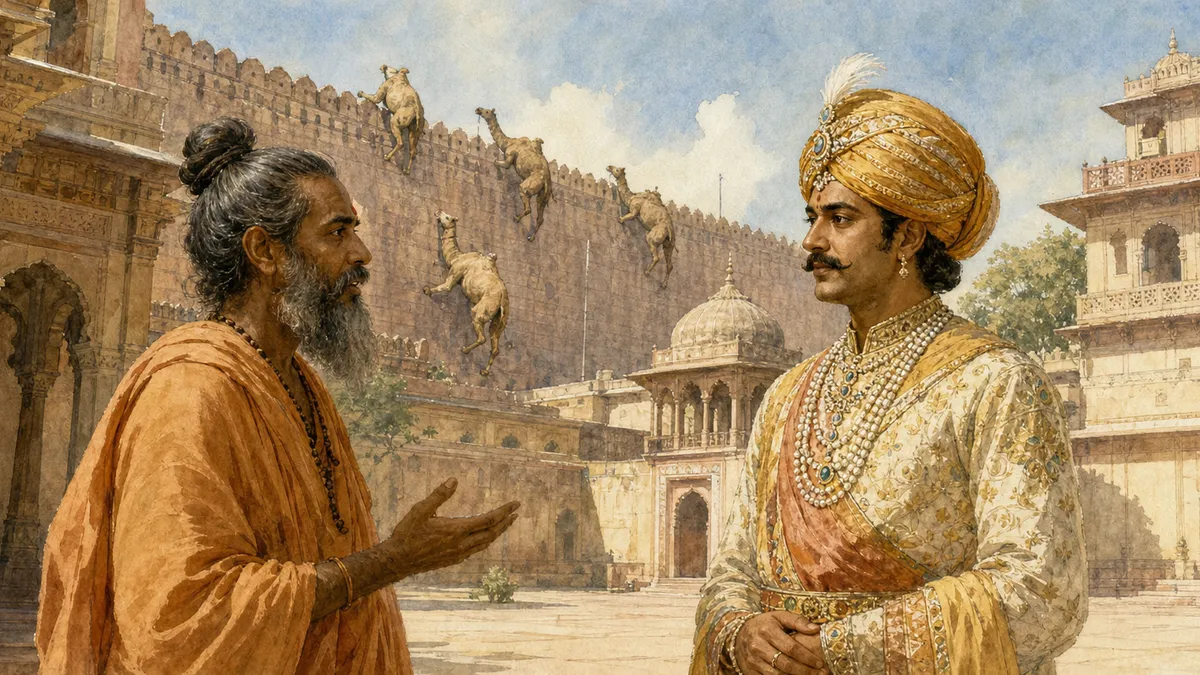
In the same way, when we receive the keys of the teaching, it is very important to practice, that is, to apply the teaching, so as not to become like such a king. Otherwise, for us, attaining liberation and enlightenment will be just as likely as camels climbing onto the roof of the palace.
There is another story, when Brahma asked the rishi Narada:
“What is the most amazing thing in the world?”
Narada answered him:
“I have seen three amazing things in the world of human beings. No matter how often I have been there, I never cease to be amazed. The first thing is when those people who are also destined to die weep over the dead, not understanding that they are in the same position. But they do not realize it. The second amazing thing is that everyone understands that obscurations (sins) lead to bad rebirths, yet they do not strive to free themselves from them, and this is amazing. And the third is that everyone understands that merit, good deeds, and the development of consciousness lead to well-being, to higher rebirths, yet they are not in any particular hurry to accumulate them. These are three great amazing things.”
A World Without Limitations
So, the teaching is what allows us to radically change our world, our future, and create the world in which we would like to live. And this is not necessarily a world on the scale of all humanity, but at least our own world, which we can create through the power of our teaching. And what kind of world are we moving toward by practicing the teaching? Toward a world where there will be no limitations in time, in space, in the universal course of things, or in energy.
There is such a saying in the Upanishads:
“When people roll up space like a hide, then they will become free.”
We are moving toward such a world where there will be no death, that is, toward a world of immortality. Toward a world where there are no limitations, where, for example, one can possess not just one body, but several. Toward a world where there is no conditioning by time (past or future), since when consciousness becomes rooted in the single “taste,” past and future become relative concepts. Toward a world where there will be no limitations in space. Toward a world where there will be no limitations connected with any national affiliations; there will be no Russians, Jews, Englishmen, or Americans, but one united divine humanity. Toward a world where there will be no limitations according to any religious divisions; there will be no Muslims, Jews, Christians, Buddhists, or Hindus, but one single awareness, which may appear in different ways, yet this awareness is completely transcendent, indivisible, because in the primordial nature of Mind there exist neither Russians, nor Jews, nor Germans, nor Muslims, nor Buddhists, nor Advaitins, nor Christians. Primordial awareness is simply freedom without concepts, without limitations.

And when we speak of the teaching of Laya Yoga, this does not mean that we are trying to limit ourselves in some way, thinking: “Here we are, Laya yogis, and this is exactly what we are like.” We say that it is simply a path that allows us to free ourselves completely from all limitations and create the future we want. We are moving toward such a world in which we ourselves act in the role of the creator god, the mandaleshvara, who can create his own universe, his own mandala. This is the sixteenth stage in the teaching.
And how quickly this future can materialize depends on the extent to which we are able to apply the teaching. If we accept the teaching with great strength, this future begins to materialize.
View, Meditation, and Conduct
So, we have spoken about the basis, the path, and the fruit. That is, the fruit is our future that we want to realize; the path is our practice; the basis is what we orient ourselves toward, what we take as our foundation (for example, non-duality).
Now we can speak in more detail about the path. The path is how we directly unfold the teaching and apply it in our life. The path itself can be described using the terms “view,” “meditation,” and “conduct.”
View is our way of looking at the world, our worldview. It does not necessarily have to be theoretical; it can be practical, like an experience. And we say, especially when it comes to Laya Yoga, that our view is not connected with concepts. That is, it is not a philosophical vision of the world, but a view that arises through awareness, on a non-conceptual level. In other words, I look at the world simply with naked awareness, without making judgments or evaluations, and this is my view, which I cultivate. This is usually what is meant by view in the teaching of Laya Yoga.
What is meditation? It is a specific meditative practice. You were given sheets where the sequence of practice of meditation in stillness and meditation in movement is laid out for twelve years. If you work with these methods, devoting one year of attention to each of them, you will definitely come to the point where the view begins to be realized in your life. That is, you simply adhere to a certain meditative technique and practice a specific method in order to gain experience. We have described all our methods, which are set out in the brochure “Fundamental Practices of Laya Yoga,” in a more convenient way. And now I hope that you will have a clear understanding of what to practice. Students often say: “There are many methods, but what exactly should one practice?” And in order to answer this question, so that you yourselves can navigate it, you can understand, by looking at this scheme, what to practice in which year.

At the same time, it is necessary to understand that the many different meditative techniques, sankalpas, and methods of contemplation are essentially one and the same. They are not actually different methods. They are simply different skillful means that help you deepen your main method even further — contemplative presence. Regardless of which sankalpa you practice: “Divine Pride,” “Space,” or “Atma-vichara” — all these sankalpas ultimately revolve around your awareness; they serve it, as it were. In fact, they are manifestations of one and the same natural state.
This practice, designed for twelve years, is an example of the “meditation” section of the teaching.
There is also the next section, which is called “behavior.” It is connected with our outward manifestation. It is how we apply the teaching in life. For example, there is behavior connected with the monastic code, behavior connected with tantric samayas, the etiquette of practitioners, such an area as service, interaction with external energies, and specific instruction on how to apply flexibility in everyday life — all of this can be referred to the section on behavior. Behavior is the way of embodying the teaching in specific relative circumstances.
When we have the view, meditation as a practice, and we can integrate our view and meditation into behavior, then it is said that we have become established as practitioners. All areas of our life are integrated into the teaching; that is, the teaching manifests vividly in our life and brings us enormous benefit.
The Importance of the View
And now we will speak about the view, since the view is the essence of the teaching. If our view, as they say, has not been established, then even if we do techniques or meditative practices, all of this will be shallow, and we will make some serious mistakes. Conversely, if the view is realized, then meditative practices will certainly grow, and we will move in the right direction. There is even such a saying: “The main thing is not meditation, but becoming accustomed to the view.” In fact, abiding in the natural state (sahaja-sthiti) is precisely the constant establishment in the view until the view becomes continuous.
In Dattatreya’s “Tripura Rahasya” and in the “Yoga Vasistha,” the example of a mirror is often described. We will try to use it to explain the principle of the view. I will speak with one female student, but try to imagine that I am personally showing the mirror to you.
— Look in such a way that you can see yourself. Can you see?
— Yes.
— Tell me, whom do you see there?
— What I am used to seeing.
— Yourself, probably?
— Yes.
— Tell me, is this your image, or that of a monk, or a layperson, or the god Shiva?
— Mine.
— Yours. Good. Now try to change it. Can you change it? For example, turn your head, change your hairstyle, or make a grimace. It will change, won’t it?
— Yes.
— And can you say that you are responsible for it?
— Yes.
The Principle of the Mirror and Reflections
Since this is your image, you can influence it. In a certain sense, it depends very much on you. You can create it by appearing in front of the mirror, and you can destroy it by disappearing from the mirror’s field. Right? In a certain sense, you are its creator-god.
— Good. That is, this reflection depends entirely on you within the framework of this example?
— No.
— No? Then on whom?
— On time.
— On time. Yes, even I need to think about that here. Let us suppose that our example takes place outside time. Let us say we have moved into a timeless state.
— Then also on your questions.
— On my questions.
— On mood.
— Good. Within the framework of this example, one can say that neither monks, nor other laypeople, nor gods from the altar have power over your reflection and do not interfere here. All of this is the result of your personal interaction with the mirror. Right? Try making a grimace. Can you influence the mirror?
— Yes.
— And if I make a grimace, will the reflection change? It still will not change, right? I will not be able to influence it, because this is your personal matter. This is your relationship with the mirror. If, for example, I turn away from the mirror, I will not be able to make the image disappear, because it is yours. Outsiders do not take part in this, because it is purely your subjective thing. That is, do you acknowledge that only you are responsible for your reflection?
— No, I do not acknowledge that.
— You do not acknowledge it?
— Because you influence my grimace every second. And everything here influences my reflection.
— I influence your grimace every second, yes? Good, let us put it this way: nothing can influence you.
— If I decide so, then yes.
— If you decide so, then only you are responsible for it. Good.
So, this is the example with the mirror that is used in symbolic transmission. And it is explained in the “Tripura Rahasya.” When we give an example, it is a certain ideal experiment in which we imply that this symbol carries some understanding with it.
So, in the mirror you see your reflection. It is you who are connected with this reflection, no one else. It is you who can influence it. You can even make it appear or disappear. And now consider that just as the mirror shows you, by reflecting, your physical body, in the same way the whole external reality, the whole external universe, is a reflection of your consciousness, a reflection of your higher “Self.” This is precisely your reflection, and no one else’s. It is you who can influence it or not influence it. It is you who have power over it as the higher “Self.” And the universe is the intersection of a multitude of such reflections.
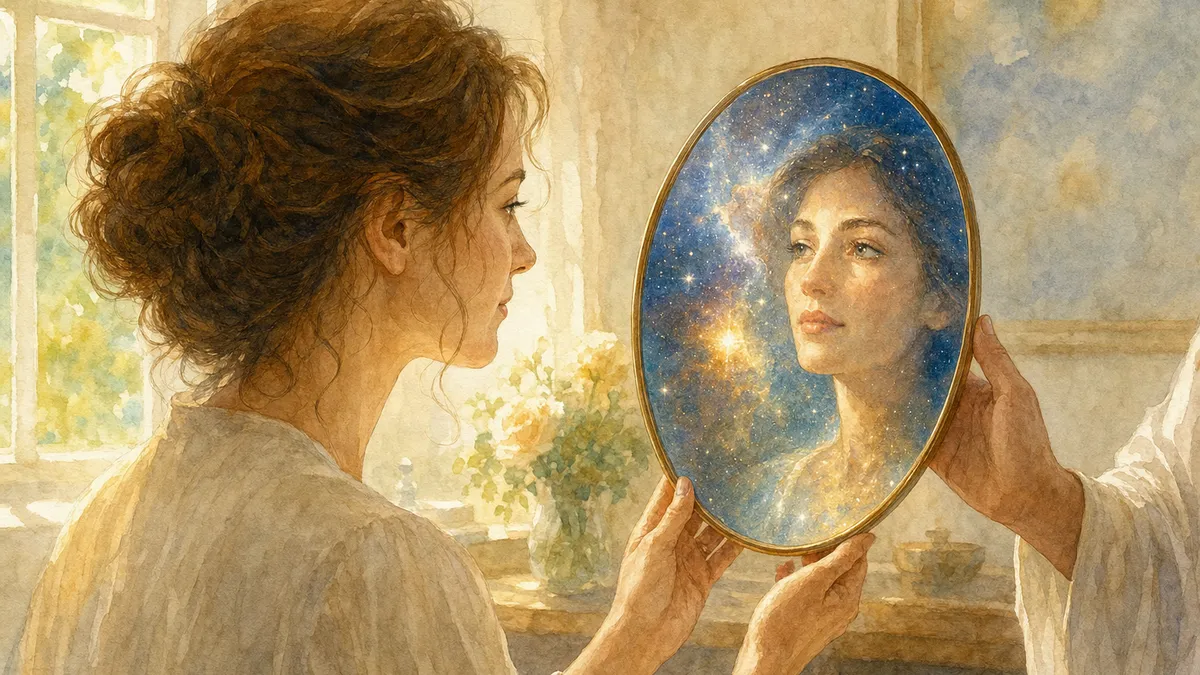
What we call the external world does not truly exist outside your consciousness. The external world only seems real; in fact, it is as real as a dream, as a reflection in a mirror. For example, if we reflect a rose in a mirror, it cannot be smelled. If you see an orange in the mirror, you will not be able to satisfy your hunger with the orange seen in the mirror. It is something unreal, like a mirage. In the same way, the entire external universe is like a mirage. It is unreal from the very beginning, although it seems astonishingly real to us. It is entirely a derivative of our consciousness, its projections. And we ourselves are responsible for these projections. Of course, not our small “I,” but our higher “Self,” with which we still have yet to reunite.
As for our body and our small “I,” these are also projections of our higher “Self.” Our higher “Self” has projected the body, the ego, personal qualities and characteristics, and we consider this to be ourselves. But this, too, is a kind of reflection created by our higher “Self.”
The Nature of the Mirror and Reflections
So, all external manifestation in the universe can be likened to reflections. All of this is various reflections flickering in the mirror. What, then, is the mirror? The mirror is our awareness itself; it is our nature of “I”; it is the nature of our Mind, or Mind as such. Reflections are temporary and changeable. The mirror, however, is eternal, unchanging, and not subject to reflections. For example, hundreds or even millions of reflections may appear in one mirror in the course of a day, but the mirror itself will remain the same; it will not become dirty, it will not get tired, it will not be stained; it is as if it is separate from all these reflections.
Sometimes an image of a deity may appear in the mirror—something exalted, beautiful, Dattatreya, the Buddha. Sometimes in the mirror one can even see a dog or a pig, something not very pure, as it seems to us. The mirror can also reflect a person. But the mirror itself will be unchanging, no matter what is reflected in it: a saint, a dog, a pig, or a person. For it, all these things appear equivalent, equal. They are simply reflections of different qualities.
In the same way, when hells and heavens, gods and demons are experienced in the stream of our consciousness, all of these are reflections, but they have no relation to the mirror itself. The mirror cannot be purified by the appearance of deities. The mirror cannot be defiled by the appearance of demons. The mirror is always by itself; it is always pure, because in principle it has a different nature. It is not connected with reflections; it is not conditioned by them and is not stained by them.
Thus, from the point of view of the teaching, it is very important to understand the principle of the relationship between reflections and the mirror. Reflections are all external manifestations, as well as internal ones, such as emotions, feelings, worldly desires, energies, and thoughts. The mirror itself is our higher “I,” primordial wisdom, prajnana, like space. Reflections appear and disappear, but the primordial wisdom of our mind is never stained, never changes.
This can also be compared to a screen in a movie theater. When you come to a movie theater, various events are displayed on the screen. There people may love, hate, or fight. But as soon as the light is turned on, everything disappears, and you see that there is only the screen. In fact, what was being manifested was not real from the very beginning. But if you do not see the screen, these images may seem real to you, strongly impress you, attach you, or even frighten you. For example, real cases have been described in which, during the showing of the first cinematic films, at the moment when a moving steam locomotive appeared on the screen, people ran out of the cinema hall in fear. These are real historical facts.
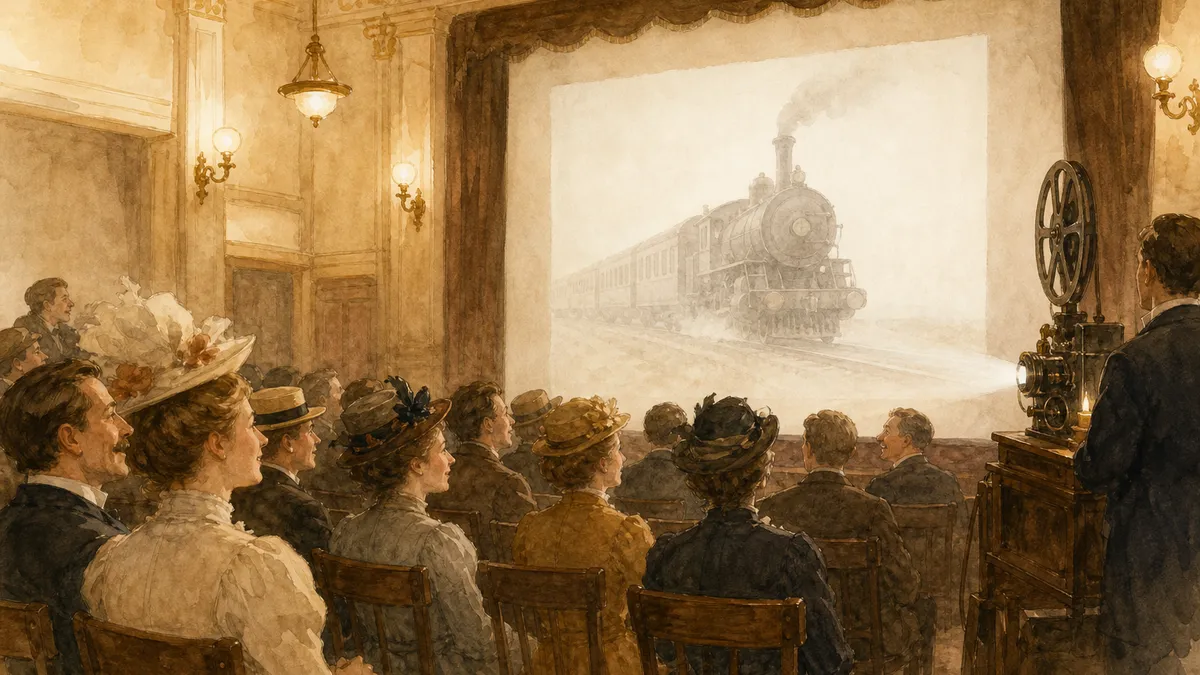
In the same way, when we regard the external world as something real, without understanding the principle of the mirror and reflection, we are like those same people. In reality, everything arises in the field of our consciousness, which is the mirror. The reflection is what appears in it, various manifestations of energy. And engaging in contemplation is precisely to distinguish the mirror from the reflections and to become established in the state of the mirror.
Contemplative Presence
What do we mean when we say “he contemplates,” “he is in presence,” or “he tries to be in the natural state, in non-duality”? We mean that the person does not follow the reflections; he does not pay attention to the reflections, but abides in the state of the mirror. What does it mean to abide in the state of the mirror? It means to be in naked awareness, without making evaluations or judgments, without paying attention to the external or to one’s own experiences, thoughts, emotions, and everything else.
There is also such an example. The mirror itself is very small, but in this mirror I can reflect a huge piece of the sky. If there were a moon or a sun in the sky, I could place the moon, the sun, or even an entire star system in this mirror, and you would be able to see them. Thus, the mirror itself seems small, but its possibilities are boundless. Spatial-temporal relations do not operate in it. In the same way, from the point of view of external matter, our nature of Mind can contain within itself such incompatible concepts as, for example, vast spaces.
There is a story about how Milarepa, during a snowstorm in the mountains, took shelter in a yak’s horn. And at the same time the yak’s horn did not become larger, and Milarepa did not become smaller. And when his disciple Rechung, fearing for Milarepa, looked into the yak’s horn, he saw that Milarepa had settled there well, that he was not experiencing any problems, and that it was warm for him there. He was very surprised, because Milarepa had the same size as usual, and the yak’s horn also had the same size. It was something incomprehensible, miraculous.
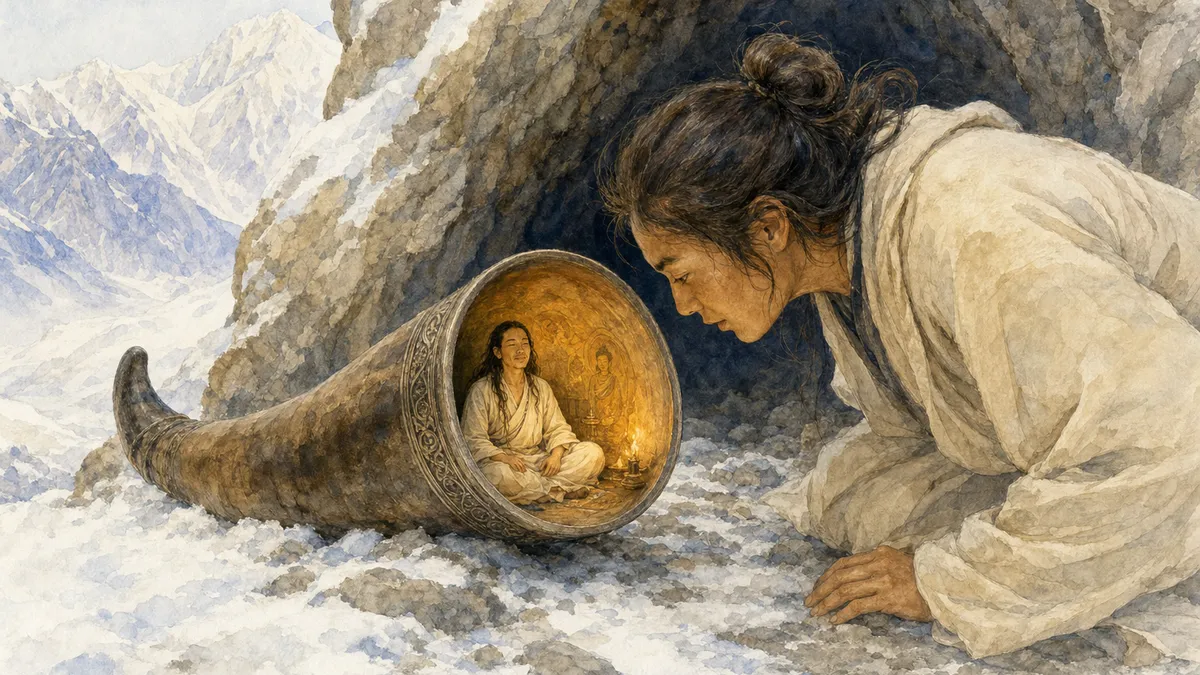
In the same way, when we enter the mirror, into the nature of our “I,” spatial-temporal connections cease to operate in it. Our consciousness can hold within itself countless billions of universes. Processes may take place in our consciousness that are not comparable in time with this world. All of this is a property of consciousness, because it is consciousness that is the creator of time and space, and not the other way around. Dattatreya and the rishi Vasishtha also speak of this.
The Subjectivity of Time and Space
Once I was driving in a car to “Divya Loka.” I was practicing concentration on the vishuddha chakra and meditation. Having entered a meditative state, I felt that about an hour had passed inside me. I thought: “Well now. How can the driver drive for so long?” The driver, however, had traveled perhaps five hundred meters during that time. Then I continued to concentrate on the vishuddha chakra, entering an even deeper state. And according to my subjective sensations, several hours passed, but during that time the driver had moved forward perhaps another twenty meters. I thought: “If we keep driving like this, it will be very tiring. When will we finally arrive at all?”
We drove on, and all this continued; I entered the meditative state more and more deeply. And the more deeply I entered it, the greater intervals of time I subjectively lived through. And when I came out, there was the impression that everything was beginning to come to a complete standstill. I thought: “We will never get there like this at all.” And there were about twenty such exits and entrances while we were driving, and we had to go perhaps five kilometers. And the last time, when I entered the deepest meditative state and subjectively lived through perhaps several days, at that time the driver was already opening the gate. And when I came back out, the driver was still continuing to open the gate. I thought: “This is some kind of nightmare! When will we finally get home? How much longer can this go on?” It was simply that I was then in another subjective consciousness, in which the temporal coordinates were completely different. And then I simply stopped the meditation by an effort of will, thinking that this was already too much. Like that one might never get home; time would stop and everything would freeze. How many billions of years would one have to wait then? Time began to flow differently, and I made it to my little house in “Divya Loka” in the usual way.
And although we know that the teaching speaks about this, when we experience it, it is always astonishing. Because time is a subjective factor. In the same way, space is also a subjective factor. A billion universes can fit on one of your fingers if your consciousness abides in the state of the mirror. This is the property of the mirror as our nature of Mind.
Liberation from the Enchantment of Reflections
And to be in contemplative presence means to recognize the mirror, to become rooted in it, and not to be enchanted by reflections. But what does an ordinary person abiding in ignorance do? He does not see the mirror and is enchanted by reflections. The reflections bewitch him. He thinks that the reflections really exist and begins to chase after them.
Let us say there is a story about a dog. A big black dog came up to a mirror and saw another dog there. It began to bark because it thought that another big black dog was standing there—its rival. It barked and became more and more agitated, because the other dog (the reflection) was barking at it too. In the end, all this began to take on an uncontrollable character. But in fact there was no other dog there at all; it was simply a reflection.

When we do not understand the interconnection of the mirror and the reflections—that the reflection is unreal and illusory, that the only reality that exists at all is the mirror, that the mirror is the principal governing element over all of this—then we often become like such a dog that barks at its own reflection.
What does it mean to “bark at a reflection”? It means to establish a connection with various manifestations based on attachment or aversion.
Gaining Power over Reflections
So, when we understand the principle of the mirror, it is said that we have gained contemplative presence and entered the natural state. We stop chasing after reflections. We know that all reflections are a manifestation of the mirror, that the most important thing is to be in the state of the mirror. And then we gain power over reflections. That is, previously the reflections had power over us. Cause-and-effect relationships, external events, and the world constantly spun us around: we were born, established connections and relationships, became attached, suffered, died. The reflections completely clouded us, and we chased after these reflections. But when we become rooted in the state of the mirror, the reflections no longer have power over us; on the contrary, we have power over the reflections.
For example, having reflected the sky in this mirror, I can change it by turning the mirror. Or, having reflected a large number of people in this mirror, with a small movement of my hand I can turn this entire image in another direction. This is possible because I control the mirror. But if I do not control the mirror, will I be able to turn the sky, this house, or all the people? Hardly, because I do not have the governing element.
In the same way, the supernatural magical powers of the gods seem to people to be something wondrous, extraordinary, incomprehensible, never attainable. Why? Because people do not know this secret. But the gods know that all supernatural magical powers, the ability to control the forces of the universe, arise from abiding in the state of the mirror. When we abide in the state of the mirror, all these reflections can be turned, rotated, directed in the necessary direction. Then the universal elements, the cosmic forces of the universe, the forces of creation, maintenance, destruction, concealment, the manifestation of the divine, and much more begin to respond to the impulses of our consciousness.
The Theory of Reflection (pratibimba-vada)
Thus, view as a category in the teaching is connected precisely with this example. And this example is very important. It is not without reason that Dattatreya gives attention to this example of the mirror. Rishi Vasishtha, in the “Yoga Vasishtha,” also describes the example of the mirror. And Rishi Vasishtha is one of the outstanding theorists and founders of the philosophy of pratibimba-vada — the theory of reflection. He says that everything is a reflection of your consciousness. Outside your consciousness as the higher “Self,” outside nondual consciousness, nothing exists. Everything that arises is only a reflection of your consciousness, and these reflections, in a certain sense, are illusory. Of course, this is real matter; nevertheless, all these material reflections are manifestations of the mirror of your mind. And in accordance with this, there is an important section in philosophy called pratibimba-vada (the theory of reflection), whose founder is Rishi Vasishtha.
When we acquire the view in the process of studying Laya Yoga, we gradually try to become rooted in the state of the mirror and not be enchanted by the reflections that arise upon it. To engage in contemplation means to constantly strive to abide in the mirror and to distinguish the real from the unreal, the reflection from the mirror.
The Path to Managing Reality
One can often hear a person say: “I want to be happy. I want to be rich, healthy, successful, immortal, etc.” In order to realize all this, one can give him advice: “Try to understand the principle of the mirror. If you can become rooted in the nondual nature of Mind, in this state of the mirror, then everything you want will be fulfilled, because you will find that governing element or that precious jewel which can bestow everything upon you. But if, without understanding this principle, you want to become successful, healthy, or rich — and even more so immortal and awakened to the Dharma — no matter how much you manipulate reflections, you will still not succeed in doing so, because the entire essence of all universal appearances lies in this very nature of Mind.”
When we master the principle of the mirror, it allows us to shape our own reality in accordance with sankalpa, intention. Now we cease to be dependent on reflections. Moreover, we can even create our own world and our own universe, at the center of which will be our own consciousness. Such a world in the teaching is traditionally called a mandala, and the yogin who creates it is called a mandaleshvara. And the yogin’s goal in the future is precisely to become such a deity-mandaleshvara who, while abiding in the state of the mirror, can create various reflections.
Taking Refuge
To take Refuge means to find support in something, a potential for further development, to make something very important, central in one’s life.
What is the principle of the Guru? It is the principle of the opening of your inner “Self,” in the process of which the small “I” discovers this principle within itself as the inner guru. At first, of course, we take Refuge in a specific teacher, calling him guru. But gradually we discover that the guru is consciousness, which itself, within us, guides us as our higher “Self.”
The principle of Dharma, in the external sense, appears as a teaching, a specific practice, a philosophy. But as we practice, we discover that Dharma is nothing other than discerning clarity, which grows over the course of our practice.
What is the principle of Sangha? At first it is seen as a specific community of like-minded people striving toward one great goal, brothers and sisters in the Dharma. This connection must be greatly respected and cherished. But if we deepen in our practice, we see that the Sangha is not only external people, brothers and sisters in the Dharma, but also the lineage of transmission, the saints, and ultimately the entire universe and all living beings.
It is in this understanding that we acquire Refuge.
Samaya Connection and the Sacred Lineage of Transmission
The practice of Refuge is an important practice that makes it possible to establish a samaya connection. To take Refuge means to enter into such a samaya connection, into a sacred lineage of transmission or into a power line of transmission. This is the meaning of the words we pronounce.
To take Refuge is like planting a seed that in the future will grow into a great tree of enlightenment. For this tree of enlightenment to grow, it must be watered and cared for in every way, protected, cherished, and cultivated. This is precisely what we mean by the sacred connection, samaya. That is why I always tell students: “Protect samaya as the apple of your eye, as the most sacred thing you have.” The one who honors samaya attains true realization.
