

Commentary on the text “Ishvara Gita. Chapter 6”
A bow is the relinquishing of plans, clinging, and hopes, together with fears. The Guru also bows to the disciples in his heart, because their nature too is divine. When we bow to the Ishta-devata, we must relinquish clinging, fears, hopes, attachments, and plans — that which is not us, although it seems to be us.
It seems that we are the body; we think: “I am the body.” But if “I am the body,” then why can I not control it? This is a big question. It turns out that I am not the body; the body belongs to material nature (prakriti), and I, as it were, rent it. But when we are strongly connected with prakriti (material nature), with dense nature, subtle awareness becomes obscured.
Then they say: “A person has a lot of karma.” “A lot of karma” means that he still has much to do in the material world, many connections to work through in order to realize something. A lot of rajas means that the ego must be manifested; much money, much power, much envy, much lust still have to be experienced. A lot of tamas means that much fear, much dullness, many delusions, much falsehood, and much anger still have to be experienced. And such people always feel that the spiritual path is difficult, because there is so much of all this; the spiritual path calls one to the heights, but it is as if a weight is tied to one’s feet — everything is difficult.
But gradually, if one develops faith and devotion, performs seva, and purifies, purifies, and purifies, then after some time all of this is purified. Otherwise there would be no point in spiritual life; one could then say: “You have too much karma, so don’t even hope!” But Milarepa, for example, killed thirty-eight people through black magic, and he attained liberation. That is, this is a terrible karma of hell, but nevertheless he purified it thanks to Marpa’s skillful methods. And there have been cases when shoemakers, those who were washerwomen, dice players, thieves, and hunters, under the guidance of holy siddhas, attained Liberation and themselves became Mahasiddhas. This means that even if there is a lot of karma, if purifying means are applied, it can be purified. But when there is a lot of merit, that is, of course, better. Therefore, do not strive to become those who have a lot of karma; it is better to be those who have a lot of merit.
Qualities of People with Merit
When people who have a lot of merit gather, the atmosphere around them simply shines, and they themselves shine, because they are so joyful, light, open, graceful, somehow brilliant, not attached to the ego, creative, always in deep awareness, because they perceive another spectrum of maya — the sattvic spectrum. And the sattvic spectrum is a luminous, spatial spectrum in which many exalted qualities already exist.
Therefore, if you feel that you lack exalted qualities, you simply need to pray, and they will gradually come, because karma is not something unequivocally given; it is something we can manage: suppress bad tendencies, and cultivate, attract, and develop good ones. That is, even a dull person can become an intellectual.
There was a man who had a poor memory; he did not know arithmetic, but he set himself the goal of becoming very intellectual. He was a worldly person, not a sadhu. He began to concentrate and concentrate. After some time, mental powers — manas-siddhis — awakened in him. He increased his intellect in the field of mathematics, began extracting roots in his mind, adding such fractions that even an ordinary mathematician cannot do. Siddhis developed in him; he became a phenomenon in general, began giving performances, and scholars even studied him. This is the result of concentration.
Or there were people who were frail from birth, for example, Suvorov. They were puny, constantly ill, and caught colds. As people say now, “with a weak immune system.” But he set himself a goal and cultivated such bodily strength in himself that he could cross the Alps and defeat everyone. This is the result of tapas and the directedness of the mind. In other words, if you lack some quality, you direct your mind in order to acquire it and obtain the corresponding siddhi. If you do this purposefully, then after some time it comes into your life.
The Power of Intention and Prayer
Most often, people want siddhis — for example, wealth. Therefore, there are many stories on this subject. Especially in America of the last century, stories were popular about how a person from the lower classes rose to become a millionaire, how he delivered mail and worked as a courier, and then began diligently building his career and rose to the very top. This, of course, is maya, but it simply shows how purposefulness can give the desired result, provided that you deliberately cultivate in yourself the quality of mind that you lack.
For example, if you lack sattva, you can pray for it. The most important thing is to believe that you can pray for it. Many people simply do not believe in this; they think: “There is not enough, something is missing, and that’s it, I am limited. Life has stopped at this point.” But the very least you can do is that you can desire it and pray for it, you can intend it. And the secret is that you can intend to receive what you desire. That is, you have iccha-shakti (the power of will, the power of intention), and you can call upon the blessings of saints in order to acquire something. This is the simplest thing of all.
But many people do not believe in this; they say: “I am poor, such is my material situation. I cannot even come to the ashram.” Then pray, and everything will be. But also work at the same time, of course. Or others say: “My intellect is weak, I cannot understand the Teaching.” Then pray to Saraswati and you will be intelligent, you will outshine academicians. But this must be done purposefully; one must believe that it is possible. Therefore a sadhu lives in a world where everything is possible; he does not live in a world of limitations.
The material world usually imposes strict limitations, but at least in his view, a sadhu believes that in reality, if the world is a manifestation of consciousness, then everything is possible. Another question is that everything has its price, and nothing will submit just like that; you must invest enough shakti. But in principle, if you want to place the Eiffel Tower in the middle of our square, if you want it very much (if we all want it), then it will stand there. But we do not need it. Sometimes, if you have a lot of merit, this can materialize very quickly, so one must be more careful with wishes; one must ask only for what is truly necessary.
A sadhu lives in such a world where everything is possible, therefore he possesses the power of intention; he can achieve what he asks for, provided that his mind is purposeful. But in reality, a sadhu should not desire much. And the only thing he should desire and strive for is not power, not siddhis, but above all devotion to God, realization of God, knowledge of Divine Wisdom. This is the most important power he should seek. But if for this it is necessary to add some qualities (there is not enough sattva, not enough concentration, logic, clarity, will), one can also ask for this; it is not a sin, it is normal. But all the desires of a sadhu are reduced to the realization of God, to pure relations with God. He does not seek to develop some overly distant qualities and distant egocentric things.
Therefore ask for the blessings of sattva, for there to be good karma, merit, for the consciousness to be bright, full of faith, love, joy, happiness, compassion, harmony, and purity. This is important for a sadhu.
The Principle of Blessing
For karma to be purified, one must turn to the Tree of Refuge, to the Ishta-devata, since they are the personification of these qualities. It is not for nothing that they are on the altar, not for nothing that they govern the Universe, not for nothing that they are the Lords of the worlds; they have an immense reserve of sattva, a reserve of piety. “Piety” is a somewhat patriarchal word from the eighteenth century. I would say, a reserve of the purest spiritual power of very high quality, which allows them to manifest various powers and wisdoms. And when we turn to them, we establish a connection with this inexhaustible reserve of the purest energy. The principle of blessing (anugraha) is built upon this. It is like when you plug a wire into an outlet, electricity flows. You have established a connection.
“Lord Skanda, the best among those who know Brahman, the commander of the army of the gods, eternally abides by the command of the Self-Born. The great rishis Marichi and others, the guardians of created beings, create various worlds by the command of the Supreme. The Goddess Shri, the consort of Narayana, who bestows incomparable prosperity, acts by My grace. The Goddess Saraswati, who bestows beautiful speech, acts in obedience to Ishvara. The Goddess known as Savitri, who saves all people from terrible hell, does this by the command of God.”
Here are listed the deities, rishis, siddhas, and saints of the Vedic Universe. We live in a Divine Universe — a complex, multidimensional Universe governed by Gods. At first we do not understand this, and it seems to us that we simply live on Earth among people. We do not see other worlds, other beings, and therefore our range of vision is very limited; we do not suspect how complex the Universe is.
If we are fixated on the material world of human beings, it seems to us that we know the material world of human beings and therefore know life. The question is: “What is life, and what does it mean to know life?” If a person believes that he knows life, one can ask him: “Do you know life in the subtle body, in the mental body, in the causal body, the life of the Gods, the life of the rakshasas, the life of the asuras, the life of the pretas, vetalas, bhutas, the life of the lower worlds (Bila-Svarga)? What do you know about life at all? You know nothing about life. Life is unfathomable!” Therefore, not a single holy sage will say that he knows life. Most likely, one can say, as Socrates said: “I know that I know nothing.”
Life is boundless. We live in a complex Divine Universe. And the gods are various energies of Ishvara. That is why it is said here that Lakshmi (the consort of Narayana), the great rishis, or Skanda, or Saraswati act in obedience to Ishvara. Because the gods are intelligent creative Mega-Personalities, Mega-Consciousnesses, corresponding to different tattvas, lower than Ishvara.
The System of Tattvas and Levels of Consciousness
Ishvara is the first, second, third, and fourth tattva, while the Gods described here are the fifth, sixth, seventh, eighth, and ninth tattvas. They personify certain levels and forces of the Universe. And since they naturally enter into the first and second tattvas (into Ishvara), they all enter into the body of God; they are, just like us, His manifestations, and therefore, of course, they obey Him.
For example, we as human beings are manifestations of Ishvara, His living cells. And the level of self-identification that corresponds to us according to the tattvas—what level is it? These are the tattvas beginning with the twenty-sixth tattva. The organs of action begin with the twenty-sixth tattva, that is, the karma-indriyas: hands, feet, tongue, anus, genitals. Then the sense organs begin, up to the seventeenth tattva. And we begin from this level. Then comes manas. We are all endowed with manas; therefore humanity is called manushya—“one who has manas.” This is the sixteenth tattva. We all have ego and, in general, antahkarana (the inner instrument). This is the fifteenth tattva. We all have buddhi (the fourteenth tattva). This is the approximate spectrum of our identification and our own perception; it extends up to this tattva.
One way or another, through reflection, people can reach both tamas and ahamkara and buddhi. Even psychologists roughly understand what manas is, what ahamkara is, and what buddhi is. Philosophers understand this. And we, through reflection, can intuitively perceive these things. But there are higher levels of consciousness, subtler ones, with which we do not yet identify ourselves: the subtle body, the mental body, the causal body. They correspond to the higher tattvas. We do not identify ourselves with them, but they exist. As they say: “Do you see the gopher?” “I don’t.” “I don’t see it either, but it exists.” We do not see the mental body, but it exists. We do not see the karana sharira (one’s own causal body), but it exists both in us and in others. And the mental body is already approximately the twelfth, eleventh, tenth, and ninth tattvas. The causal body (karana sharira) is the fifth, fourth, and third tattvas, the higher tattvas. And we are all particles of Ishvara.
But we are identified with the fourteenth tattva (buddhi), the fifteenth (ahamkara), and the sixteenth tattva (manas). Approximately at this level we identify ourselves.
Each of us is Ishvara! Do you hear my words? Each of us is Ishvara! So what? This changes nothing; we continue to feel ourselves to be human beings, just as we did before. Why? Because Ishvara is the first and second tattvas (Shiva-tattva and Shakti-tattva), and the fourth tattva, naturally. But these tattvas are unattainable. Our level of self-identification is not capable of grasping these tattvas. Therefore, even being Ishvara, His body, His cells, we consider ourselves human beings, because we are identified with the sixteenth, fifteenth, and fourteenth tattvas.
And the Gods, as it is said here, such as Saraswati, Lakshmi, Savitri, Skanda, Angiras, the rishi Marichi—this may be the seventh, sixth, fifth, or fourth tattva. These are also forces of Ishvara, but they are aware of themselves on a much higher level of the Universe. These are the super-intelligent forces of Ishvara that govern the Universe. And we live in such a Universe, inhabited by super-intelligent beings.
The Spiritual Path and the Multidimensionality of the Universe
To follow the spiritual path is to become aware of the diversity of such super-intelligent divine beings. At first, for us they are present only on the altar and look simply like a picture or simply like a sculpture, and we understand neither our relationship nor our connection with them, nor their place in the Universe. But as we practice, we begin to discover the subtle world, to become acquainted with its inhabitants—for example, with Pitri-loka—and then we begin to become acquainted with the gods of Svarga-loka.
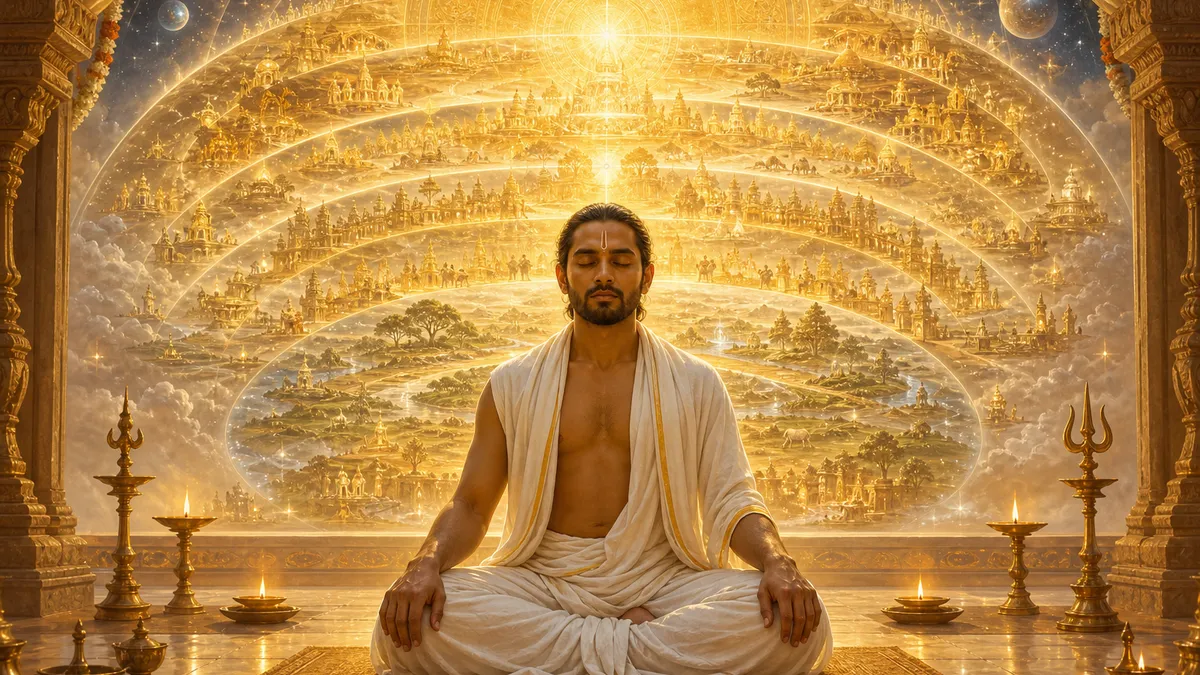
Those who have few merits may likewise become acquainted with Preta-loka, with ghosts and unsatiated spirits. But in reality this is not a very pleasant acquaintance. One may even become acquainted with the lower worlds (with Naraka-loka, with the hells), but it is better not to get involved with these dimensions, because your life becomes unsuccessful, and you experience only suffering.
Only strong sadhus with a great store of merit and in armor made of faith, love, devotion, and magical powers can descend into such worlds. One can descend there when one has a great deal of inner strength and magical armor: an aura that protects against demons and evil nagas; a trident commanding living beings to stop and not harm you; the Sudarshana Chakra — a discus that cuts off the heads of evil demons and nagas; Indra’s belt, granting stambhana-siddhis; the crown of the gods, protecting you with blessings so that you do not lose your mind from illusion.
Such armor is cultivated as a result of worship (upasana), in the Yoga of the illusory body. In the Yoga of the illusory body there is a special section for this. It is called siddhi (or laya-siddhi), when you concentrate on certain attributes, recite mantras, and invoke deities. For example, the “Uddhava Gita” describes ways to meditate on various attributes of a deity, transforming oneself into the deity. And then you can descend into such lower worlds.
But beginning sadhus should under no circumstances do this. And at the first signs of anything of this kind, one should pray and ask the gods and saints for this connection to be severed, for it to be closed. One should not experiment with this. That is, a sadhu should wish to have contact, if he has contact at all, only with divine worlds: the Upper Astral World, the Mental Worlds. One should not strive to gain experience of the Lower Astral Worlds.
Then we begin to receive experiences of divine beings, of the divine plane. They may come in dreams, in meditation, and bless us. And here we must possess the right view and the right contemplation, so as not to fall into illusion, not to fall into spiritual delusion, not to allow the mind to become attached, but to keep to our dharma, to keep to our path. That is, experiences should bless, but they should not confuse.
And the main principle here is: “What matters is not so much the experience itself, but our ability to be free from it, to know the essence of any experience, to dissolve it in natural awareness.” If we do not manage to dissolve an experience in natural awareness, this experience may become our problem, our difficulty; it may disorient us on the spiritual path and draw us in the wrong direction. Whether it is an experience of bliss, whether it is even an experience of clarity or emptiness, any experience that is not offered to God and not dissolved in the Divine Source is potentially a source of various delusions and deviations. One may become a nihilist, one may become a pralayakala, one may become attached to astral visions and lose action in awareness, lose one’s bearings in spiritual life. But when we abide in the view of non-duality, in right contemplation, any experience is integrated into our natural state. And therefore the principle of uniting with the natural state, of uniting contemplation, the integration of experience, means that we never leave non-duality at the moment of experience.
In Zen there is a story about how a monk was meditating, and when he was in the kitchen, some deity appeared to him — I think Manjushri. And this Deity said: “Do you want me to give you a blessing?” The monk swung a ladle at him and replied: “I do not need your blessings; I realize Zen on my own.” That is, in this way he manifested his Zen nature. We do not do this; among us it is customary to express reverence. But they have such a phrase: “If you see the Buddha, kill him!” What does this mean? It means: “Dissolve him in the experience of non-dual awareness.” That is, what you see may be an illusion of your mind. Do not give in to it.
The Subordination of All Beings to Ishvara
“Parvati, the supreme Devi, who gives the knowledge of Brahman, contemplated as the Ruler, also follows My words. The infinite Ananta Shesha, lord of the immortals, who bears the world upon his head, is likewise subject to God. Agni, who constantly assumes the form of Vadava, drinks up the entire ocean at the command of Ishvara. The fourteen gods who, extending their power in this world, preserve the offspring, are all subject to him. The Adityas, Vasus, Rudras, Maruts, the twin Ashvins, and other Deities all abide by My command. The Gandharvas, Garudas, Rikshas, Siddhas, Sadhyas, Charanas, Yakshas, Rakshasas, and Pishachas abide in obedience to the Self-born.”
A multitude of living beings fill this Universe. They all live in their own lokas. Each of them has its own proportion of sattva, rajas, and tamas. Each of them has its own character, its own personality traits. Each of them has a subtle-body structure consisting of elements inherent to its race. That is, we live in a Universe that is overflowing with living beings.
The gandharvas have vimanas; they are the best pilots of vimanas, in addition to being very musical and mastering the art of sound, singing, and dance. It is believed that many gandharvas are reborn in India, which is why every Indian film has people singing all the time, and if they do not sing there, then it is not an Indian film. A very melodious nation, a dancing nation. These are reborn gandharvas. That is, they do not stand still. Once I was at the Indian embassy, and the Indian ambassador to Russia said: “You Christians here are accustomed to worshiping God with sorrowful faces, while we like to sing and dance to the glory of God.” This is the dharma of the gandharvas.
Garudas are a class of divine birds with a strong element of fire, who serve as vahanas for the gods. Siddhas are a class of magical beings who control various energies; some of them were human beings in the past. Charanas are a class of divine poets who accompany the Deities as a retinue. Yakshas are magical semi-enlightened beings from the retinue of the god Kubera, who guard various treasures. Rakshasas are demonic beings with strong rajas, anger, very warlike, possessing magical powers. Pishachas are malevolent spirits inhabiting the subtle world and causing obstacles. And all of them abide in obedience to the Self-Born. They all enter the body of Ishvara. That is, being the fifteenth, sixteenth, or some higher tattvas (the twelfth, the eleventh), they all enter the first and second tattvas. That is, all lower tattvas enter the higher tattvas. They cannot fail to obey Him, because He is their essence.
Divine Energies of Time and Creation
“Kalas, kashthas, nimeshas, muhurtas, days, nights, seasons, pakshas, months, abide in subordination to the Lord of progeny.”
What does this mean? The smallest units of time, the ordinary units of time—all of these are also divine essences, divine beings. For example, there is a deity of one instant, there is a deity of one second, there is a deity of the year, a deity of the month, a deity of the day, a deity of kalpas, of cycles. These are certain energies of kala-shakti. They all likewise obey Ishvara.
“Yugas, manvantaras abide in obedience to Me, as do paras, parardhas, and other divisions of time.”
Mahakala, as great time, has its own emanations and manifestations. And all these deities of certain instants, of certain intervals of time, are the body of Mahakala, while Mahakala Himself obeys Ishvara.
“The four kinds of beings, moving and unmoving, exist through subordination to God, the Supreme Atman. Patalas, all worlds, other Universes—all exist through subordination to the Self-Born. By my command, countless Universes with their elements and actions have passed, and other Universes with the things inherent to them will arise thereafter by the will of the Supreme Atman. Earth, water, fire, wind, space, mind, buddhi—these essences of prakriti are governed by Me.”
We live in a Universe where divine energies operate, the chief of which are the energy of consciousness (chit-shakti), the energy of bliss (ananda-shakti), the energy of divine will (iccha-shakti), the energy of divine wisdom (jnana-shakti), and the energy of divine action (kriya-shakti). The entire Universe is a process that is expressed in tantra in three words: nada, bindu, kala.
And what is nada? Nada is the primordial vibration, spanda, the humming of the Absolute, when the Absolute, filled with the desire to create, hums. And OM is precisely His humming. He hums, full of potential; He is, as it were, pregnant with Creation, but He is not manifested; He simply hums. This is nada. And this sound at the end of OM expresses the humming of the Absolute.
And what is bindu? Bindu means that at a certain point a great explosion occurs, a singularity. This humming condenses, and a localized, mega-dense region of very dense radiance of Light is formed. This is bindu. This bindu explodes, and a new Creation manifests; from the first and second tattvas, the fourth, fifth, sixth begin to manifest, and so on up to all thirty-six tattvas.
But kala is the unfolding of the lower tattvas from the state of bindu. Bindu is the second tattva (Shakti-tattva), nada is the first tattva (Shiva-tattva), and kala is all manifested existence, everything that manifests further: Sadashiva-tattva, Ishvara-tattva, Sadvidya-tattva, maya-tattva, then the kanchukas, purusha-tattva, prakriti-tattva, buddhi, ahamkara, manas, jnana-indriyas, karma-indriyas, the five tanmatras and the five primary elements—everything that subsequently unfolds is all kala.
Therefore, according to Tantric views, creation is nada, bindu, and kala, and light, sound, and rays correspond to them. Nada is sound, bindu is light, and kala is rays. And this is not abstract philosophy. When we visualize deities, we reproduce the very same thing on our inner level, the same manifestation. For example, we visualize pure empty space. This corresponds to nada in the Yoga of the Illusory Body. Then we visualize the seed syllable Dram. This corresponds to bindu. The seed syllable (Dram or OM) is full of the potential to create; it contains within itself the higher tattvas, ready to unfold. And then manifestation occurs: from the seed syllable we manifest as a deity endowed with arms, legs, a head, attributes, and an entire mandala unfolds. This is kala. Various qualities and characteristics unfold from this state.
And the Deities described here represent the purest luminous part of this unfolding. Those that belong to the first five tattvas consist only of pure tattvas. Other deities consist of mixed tattvas (pure-impure), while we, as human beings, consist of impure tattvas.
The Nature of Maya
“Earth, water, fire, wind, space, mind, buddhi—these essences of prakriti are governed by Me. Maya, which is the source of the entire Universe, enchanting all embodied beings, exists eternally, subject to Ishvara.”
Once, a young disciple in one tradition, while speaking with his Guru, said: “I am not afraid of maya; I have surrendered to God.” And the Guru said to him: “But I am somewhat afraid of it.” Why? Because the Guru knew what maya is. Maya is the superintelligent body of Ishvara. And every sadhu treats maya with respect.
Once Narada asked Vishnu to show him what maya is. Vishnu asked him to bring a pitcher of water. Narada went, but when he approached the river, he met a beautiful girl. This girl turned out to be the daughter of a local resident, some merchant. Narada fell madly in love with her. They had a wedding, and children were born to them. And he completely forgot where he had been going and forgot about Vishnu. He lived a happy family life for several years, and then a flood occurred; that settlement was inundated and washed away, he lost his wife and children, and he himself was fighting for his life in the turbulent river. This river carried him back to Vishnu’s feet. Vishnu is standing there, waiting, and says to him: “Well, where is the water, Narada? I asked you to go fetch some water.” And only two seconds had passed there. And all of this had played out in Narada’s mind, yet it was so real.
And another time Narada was caught in this again. Vishnu liked to play such tricks on him. Narada came once and said that he observed brahmacharya much better than Shiva, for Shiva had not withstood it and had married, whereas he was a naishthika brahmachari (a brahmachari from birth). That is why he said it so complacently. Vishnu laughed at him; then, by the power of his maya, he created a city and placed Narada there. Narada became acquainted with the king’s daughter and fell madly in love with her. There was a svayamvara there (the choosing of a bridegroom), and Narada decided to contend for the honor of becoming this princess’s bridegroom. He did not know that this city was not real, and he fervently prayed to Vishnu, whom he had not forgotten, but his mind had already changed; he now wanted to marry. Narada asked for beautiful clothes. He was a sadhu, after all, and in order to marry, one had to look presentable at the svayamvara. And Vishnu gave him clothes. Narada got the impression that these were beautiful clothes for the wedding, for the marriage ceremony, but in reality Vishnu gave him the form of Hanuman. And when he arrived, all the guests began to smile and say: “Oh, the king of the monkeys himself has come to visit us!” Although it was Narada. And Narada could not understand why they were calling him the king of the monkeys. But when he looked in the mirror and saw what he looked like, he realized that Vishnu had played a joke on him and made him a laughingstock. Deeply offended, he came to complain to Vishnu. And Vishnu laughed at him and said: “The city, and the girl, and this entire ceremony—all of it is completely an illusion that was in your mind. This is maya. You were deceived.”
What is maya? It is the sixth tattva—the power of universal illusion in the absolute sense. The sixth tattva is ignorance.
“Maya is responsible for the patterns on the veil that conceals the true nature of Shiva; Maya turns God Himself into something filled with limitations. Maya-mala and karma-mala arise through the activity of maya-tattva.”
Likewise, maya is all the lower energies, for example, the seventh tattva (kaala), the eighth (vidya), the ninth (raga), the tenth (kalaa), the eleventh (niyati), the twelfth (purusha), and the thirteenth (prakriti). Prakriti is the level of manifestation in which the three gunas (rajas, tamas, and sattva) are in equilibrium. All of this is maya, and all of it is subordinate to Ishvara.
Maya can be defined as a certain quantum cross-section of being—not even an atomic or molecular level, but a luminous, quantum level of material nature. It is the source from which this material nature proceeds. Maya is material nature at a magical level, when it obeys consciousness and is directly connected with consciousness. Therefore, one who masters maya, or even prakriti-tattva to some extent, can control reality and manifest magical powers. For example, in the lower worlds there is the sorcerer Maya Danava, who is the patron of all magicians, sorcerers, and occultists. He lives in Talatala-loka. He is the Lord of all sorcerers. He is the holder of all magical practices, tantric practices, gupta-vidya (the secret knowledge of tantra), because he controls this tattva. Despite the fact that he himself lives in the lower worlds, this is accessible to him. Through tapas he realized it.
“Purusha, the god who supports the body, constantly acts within it as the soul, obeying Ishvara. Vidya, which manifests the supreme state by eliminating the influence of obscuration, acts in obedience to Mahesha. Therefore, what need is there to say much? The universe is the essence of My shakti. Everything is governed by Me; in Me it finds dissolution.”
The Correct Understanding of Maya and Non-Duality
And what do nihilists do? Nihilists, having absorbed the view of Advaita, say: “Maya is illusory. It does not exist!” But this is not Shankara’s view. In Shankara’s view, “All is Brahman.” Shankara was a brahmavadi. Maya, too, is Brahman; material energy is not illusory—it is Brahman. There is a great difference between “Material energy is illusory” and “Material energy is Brahman, but appears to be material energy because of ignorance.” That is where the illusion lies. The absence of viveka (aviveka) gives rise to illusion. And what does the nihilist say? “None of this exists; it can be ignored.” It exists, but it is empty; by its nature it is Brahman, and it cannot be ignored. We cannot ignore time, the tattvas, the gods, and various universal energies, because at this level of self-identification we are connected with them and completely dependent on them; but we can see them as Brahman, we can see their emptiness, yet not ignore them.
Nihilism is when there is no viveka, but merely ignoring under the pretext of the view of non-duality, under the pretext of the view of Advaita. But abheda (no differences) we accept in view, not in conduct. In conduct we accept bheda (difference). Deities are deities, people are people, and each is in their own place; these are different levels of energy, and they must be taken into account. And in contemplation we accept the principle of “bheda-abheda tattva”—there both is difference and there is no difference simultaneously, and this is incomprehensible. That is, we maintain awareness in which there are no differences, but we integrate with energy in which there are differences.
And to be a sadhu means to combine all three: in view, abheda (no differences); in contemplation, bheda-abheda (there both is and is not difference); and in conduct, bheda (there are differences). Then we are not nihilists. Take Sri Shankaracharya, for example. Sri Shankaracharya observed the rules of sannyasa. This is the principle of bheda. At the same time, Sri Shankaracharya worshiped Shakti as well, as evidenced by the texts he wrote, “Saundarya Lahari” and “Shivananda Lahari.” If he had said, “Everything is illusion,” why would he have written these texts? Is that logical? Why would he have worshiped? But he knew that in contemplation there is bheda-abheda (there are differences and there are no differences), and he revered Shakti. And in view he adhered to a completely non-dual view, which is why he was called a brahmavadi.
Supreme Knowledge and Liberation
“I am Bhagavan Isha, the Self-Luminous, the Eternal, the Supreme Atman, the Supreme Brahman, and apart from Me there is nothing else. Having known this supreme knowledge, spoken to you by Me, a person is liberated from the bonds of rebirth in samsara.”
To know God, to know Ishvara means to realize the principle called Vishvagrasa—the great dissolution of the causal body into the Absolute. Liberation is precisely Vishvagrasa. So when it is said of Ramalinga that he entered all the bodies of Creation, it means that Ramalinga realized Vishvagrasa. Lesser kinds of Liberation begin already from buddhi-tattva. That is, for this it is not necessary to attain the first or second tattvas in realization. Beginning from the level of the fourteenth tattva, small levels of Liberation already occur. This is called salokya-mukti, samipya-mukti, and sarupya-mukti. But final, complete, and supreme Liberation means that the yogin penetrates the causal body (karana sharira), and this means that he penetrates the fifth, fourth, and third tattvas and then dissolves them in the first and second tattvas.
Question: “Please tell us, what does ‘buddhi-tattva has been realized’ mean?”
Deeply realized. There may be an unrealized tattva, that is, it exists, but it is not conscious; it cannot bring you benefit. For example, every person has buddhi, and every person at some point acts on the basis of reason: makes important decisions, evaluates things, is guided by moral and ethical principles. In him, buddhi-tattva is functioning. But he does not think about God and the meaning of life, and this means that his buddhi-tattva is functioning at five percent. A realized tattva is when you have fully developed the dimension of buddhi through contemplation and entered the state of turiya, and then buddhi has become a conductor of the transcendental light of the Atman into the waking state.
The Nature of the Realization of Tattvas
To realize means to bring turiya into it. Imagine turiya as a bright light, as a bright lamp, and a tattva as a space, a room. And you take this lamp, bring it there, and it shines. That is realization.
Question: “You said that maya is the quantum level.”
Yes.
Question: “And what about nada, bindu, kala... Is nada the first tattva, OM?”
Yes.
Question: “Is bindu the second?”
Yes.
Question: “And maya is the quantum level. So what is it, light?”
Yes.
Understanding Mayavada
Question: “And what is mayavada?”
Vada means “knowledge.” Mayavada is the knowledge of maya. The term mayavada is used in different ways. And often the followers of Advaita Vedanta, of Shankara, are also called mayavada; his philosophy is called mayavada, although he himself did not call his philosophy mayavada. What did he call it? It is brahmavada. But others, because he spoke a great deal about the illusory nature of the world, began to call it mayavada. That is, mayavada means “knowledge of maya,” for example, that maya is Brahman.
And many understand mayavada as nihilism. We ourselves are against nihilism, but do not call it mayavada, and still less identify it with Shankara. I say to some people who are not from our tradition: “To identify mayavada with Shankara in the nihilistic sense is a delusion.” And to identify mayavada with nihilism is a delusion. Mayavada is precisely the knowledge of maya as Brahman. There is even such an erroneous opinion that Shankara was a special incarnation of Shiva who came in order to mislead people with mayavada.
The Energies of Shiva and the Teaching of Shankara
Question: “Is maya tirobhava-shakti in its pure form?”
Tirodhana. A special energy of Shiva.
“And anugraha?”
Anugraha is not maya. Anugraha is the higher tattvas: Sadvidya-tattva, Sadashiva-tattva.
“And how did Shankara interpret this?”
Shankara did not really consider energies. Everything concerning energy (shakti) is the terminology of Shaiva Siddhanta. Shankara was such an exalted person that he did not descend below the first tattva. Do you understand? That is the point of him! And Shankara’s Advaita is a very lofty soaring, the first and second tattvas at most, which is why it is very difficult to understand him. Other people cannot understand him because they are not able to rise to that tattva at once. They even find it uninteresting, boring. There are energies, there are gods—that is interesting! But “Everything is Brahman!”—and so what? Is that all? Shankara can truly be understood at the stage of enlightenment.
The Unfolding of the Tattvas and the Subjectivity of Perception
Question: “The unfolding through the 36 tattvas that you spoke about actually does not exist in Advaita, does it? It is all instantaneous, isn’t it?”
Yes.
Question: “That is, if we now lay everything out, then it does not exist in time?”
This does not exist for Shiva and for Shakti. But for everything below, there is unfolding. One must always ask: “For whom exactly does it not exist?” Because subjectivity is very important. What exists for one does not exist for another.
For example, there is a person before you who believes in communism or National Socialism, it does not matter which ideology. Does this ideology really exist for you as something that could become the object of your faith and commitment? Probably not for anyone. It would be ridiculous for a sadhu to believe in ideas lower than Advaita, lower than Dharma. For you it is ridiculous to believe in crude ideas. Or there is the idea of racial superiority. For you these ideas do not exist as something with which one can identify. That is, they are illusory; they are fabrications of the human mind.
In the same way, maya (all this creation), from the point of view of the deities of the higher tattvas, the Mahamandaleshwars, akalas, shambhavas, and shaktas, does not exist. And when Vasistha in the “Yoga Vasistha” says that none of this exists, that it is one Consciousness, from which tattva is he speaking? From the first or the second.
Classification of Tattvas: Pure-Impure and Impure
Question: “Are the pure-impure already from the point of view of beings who have forgotten God?”
Are you interested specifically in the mixed, pure-impure ones? The pure-impure tattvas are the seventh, kalaa-tattva (the first kanchukas, the idea of limited activity: “I am the doer”), the eighth, vidya-tattva (the idea “My knowledge is limited”), the ninth, raga-tattva (the idea “I lack something; I am not purnatva, self-sufficient”), the tenth, kaala-tattva (the idea “I am not eternal; I live for such-and-such a time,” the discrete perception of time), and the eleventh, niyati-tattva (the idea of separateness in terms of place: “I am here, and that is there,” for example, “If I am here, then I am no longer on Kailash”). Such are these false notions.
Purusha-tattva also belongs to the mixed tattvas. What is purusha-tattva? It is Shiva bound by the preceding kanchukas, the Absolute perceived through the mental body, one might say. And these mixed tattvas are maya-mala. Maya-mala creates the illusion of multiplicity, and this illusion of multiplicity in the form of the kanchukas binds the soul.
And what are the kanchukas? They are those very same divine energies, the five pure tattvas, reflected in maya. And when they (chit-shakti, ananda-shakti, jnana-shakti, iccha-shakti, and kriya-shakti) are reflected in maya, they become the five kanchukas. Here maya plays the role of a distorting mirror. These are all the mixed tattvas.
And the impure tattvas are already lower, beginning with the thirteenth tattva (prakriti-tattva), when densification is already taking place, and here karma-mala is active. That is, the mixed tattvas are maya-mala, while the impure tattvas are already karma-mala. And the sixth tattva itself (maya) gives rise to anava-mala, the very last mala, which dissolves last of all (anava is the illusion of false individuality, the illusion of limited individuality).
