

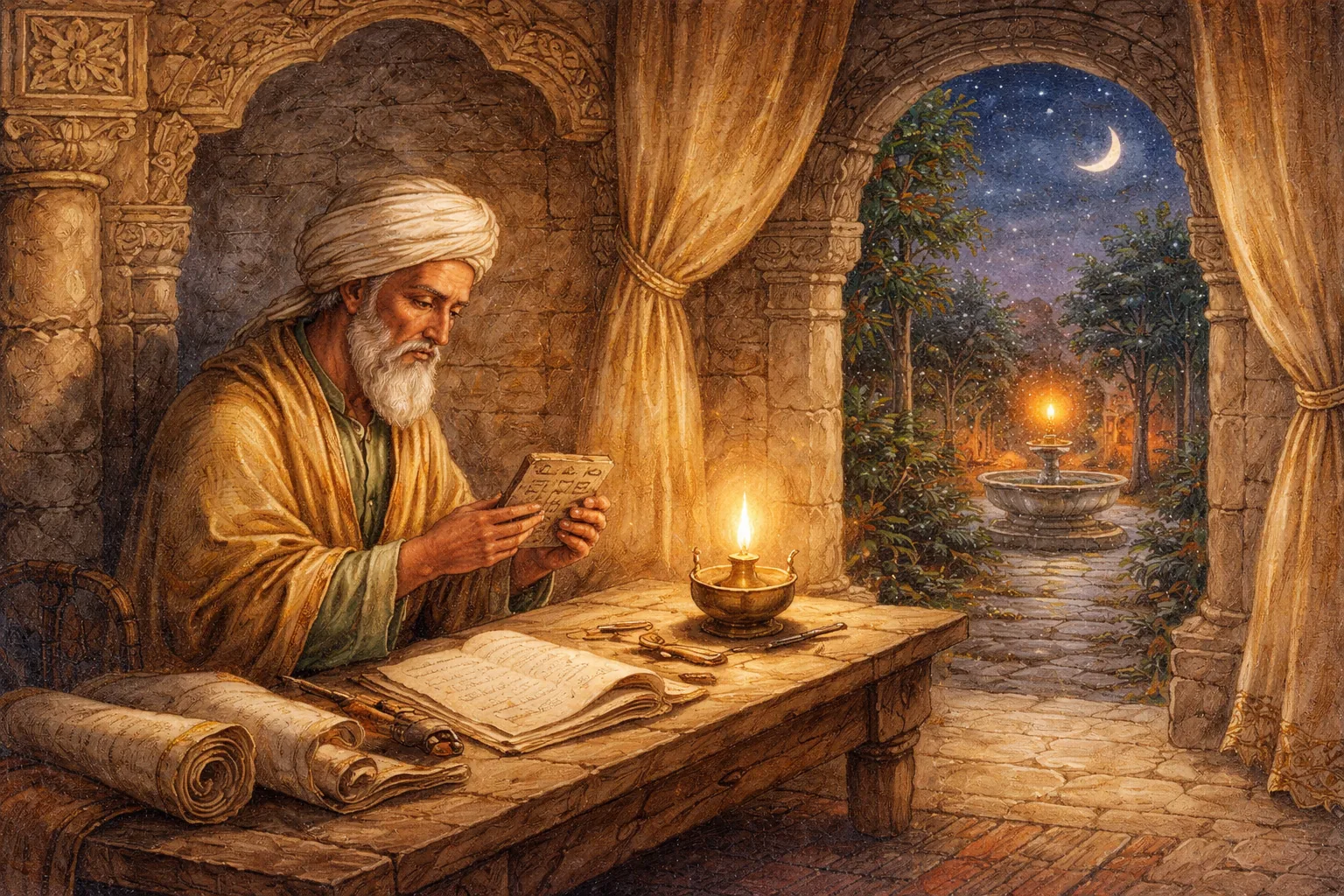
Commentary on the text “Tripura Rahasya,” Chapter 14 “Why the Universe Is Nothing but Mere Imagination; How to Acquire That Strong Will Which Can Create It; How to Attain the Highest Truth”
Having listened to the sage’s son, Mahasena began to reflect with complete clarity and seriousness.
He came to the conclusion that this world is like a dream, and he freed himself from his sorrow. As his understanding became ever deeper and ever stronger, the peace of his mind remained undisturbed.
Then he asked his companion: “Great and wise saint, you know both this world and that which lies beyond it. I do not believe there is anything you do not know. Please answer me now: how can you say that everything is pure imagination? However much I imagine, my imagination does not materialize, yet you created a universe by the power of your will. And still, in what way do time and space differ in these creations? Please tell me.”
When asked about this, the sage’s son replied: “Will conceives effectively or ineffectively according to the degree to which it is homogeneous or interrupted by indecision.”
“Homogeneous” here is better translated as “one-pointed.”
Do you not know that this world is the result of Brahma’s desire? It appears real and permanent because the original desire is so powerful, while the world generated by you is taken seriously by no one, and your own disbelief makes it futile.
What is Brahma? It is an exceedingly powerful consciousness that governs all the laws of this universe. It is a deity who, perhaps in past incarnations, was once a rishi, a siddha, a human being, but who, thanks to his developed and powerful consciousness, created a mandala as its mandaleshvara—the creator god. It is such a global and transcendentally majestic consciousness that the human mind is unable to encompass it. It is a consciousness that is multidimensional, can live in various vehicles, and lives for an enormous number of years.
According to the Vedic reckoning of time, Brahma’s lifespan is one hundred years (not human years, but divine ones). It is believed that the present Brahma of our universe is, according to this reckoning, in the fifty-first year of his divine life. There are also Brahmas—creators of other universes that have different dimensions, physical laws, and constants. Brahma is not the Absolute. One may say that this is merely a high position attained as a result of tapas, yogic development, and the attainment of siddhi.
The Absolute, Parabrahman, the Supreme Mind in our terminology, emanates from itself countless Brahmas—creators of various universes; therefore our Brahma is only one among many. Nevertheless, his consciousness is so incomprehensible that our entire visible and tangible universe, with the physical, astral, and causal worlds, with deities, hells, and heavens, was created by him as if through imagination.

Ways of Materializing Concepts
Concepts are realized (materialized) for the following various reasons: on the basis of natural activity, as in the case of Brahma the creator; through possession of living precious stones, as in the case of yakshas and rakshasas (respectively gnomes and demonic monsters—varieties of magical beings); by means of herbs, as in the case of the gods (nectar is considered to contain extracts of miraculous herbs); through the practice of yoga, as in the case of yogis; by the wondrous power of incantations, as in the case of certain siddhas; by the power of tapas (austerity), as in the case of some sages; and on the basis of granted boons, as in the case of the architect of the universe (Vishvakarma).
To make a new concept effective, it is necessary to forget old associations, and the new concept will continue only until it is blocked by the old ones. A concept is strong if it is not hindered by any preceding concept which would otherwise destroy it. It is effective only when it is strong and full of will. In this way, even great things become attainable.
When we want to materialize something, our mind must be directed, must move in that direction. We must cast aside everything that contradicts our attitude. For example, if a person wants to acquire a healthy, strong, robust physical body, he must constantly practice visualizing himself in such a form. He must suggest this to himself, meditate, believing that he will acquire such a body, that he is acquiring it and will possess it throughout his life. And since the physical body is a derivative of mental consciousness, a restructuring will necessarily begin to take place. New energies will be called into his life, and he will acquire such a body. Moreover, if his sankalpa is very strong, he will receive transmission from the deities, the holders of long life, attain the siddhis of long life or super-health and a super-enduring body, which in its capabilities will surpass an ordinary human body. But for this his sankalpa must be constant and very deep. At the same time, he must simultaneously cast aside everything that contradicts his sankalpa (thoughts of illness, uncertainty, anxiety, and so on), that is, he must believe in his concept.
Any other sankalpa is realized in the same way. Of course, if bad karma has been accumulated, the sankalpa does not materialize immediately, because some time must pass before these karmas self-liberate.
Experiments have been carried out in which a person was suggested to that his muscular strength was increasing twofold. As a result, he could lift a load one and a half to two times heavier than usual, without being an athlete.
In another experiment conducted in China, small children were shown Uri Geller, who bent spoons with his gaze. According to the design of the experiment, they were all told that this was perfectly normal, that each of them could do it too. And since the children had no formed experience or fixed ideas, almost all of them began to bend spoons. They believed in it. Fixed ideas and the burden of accumulated formed experience, unlike in adults, did not hinder them, and they began to do this even without any special training, simply through faith in their abilities, in their potential.

In the same way, when we have strong faith in a certain orientation of our consciousness, we can reveal this potential. If you believe that you are a genius, have no doubt — you will become a genius. If you say: “Oh, I have a weak intellect, I am dull. Probably, in past lives I stepped on sacred books, handled the tantras carelessly, and therefore in this life I cannot remember anything,” then you establish yourself in this more and more, and in the end you really turn out to be dull. But if you say: “What is the problem? Why should I experience limitations? I am a genius!” you attract a different astral energy, and over time genius abilities really begin to manifest. This is truly so, because the nature of the mind is the source of all karmas, siddhis, and manifestations.
Application of the Principle in Spiritual Practice
When we practice pure vision, we must believe in it unconditionally and exclude thoughts that contradict pure vision. Then, after some time, pure vision will begin to manifest. If we practice divine pride, we must also believe in it and exclude thoughts that contradict divine pride. For example, if during meditation you think “Aham Brahmasmi,” and after completing the practice you begin to belittle yourself or various thoughts about your own limitations appear, then you disrupt your practice.
Thus, for any intention of yours to materialize, you must generate a certain orientation of consciousness, believe in it absolutely, and exclude thoughts that contradict this orientation.
If you believe that your dharma is a jewel, and it truly is one, it will become for you the highest jewel that saves you. If you have a dualistic and half-hearted relationship with the dharma, that is exactly the result you will receive. If you believe that your guru is Parabrahman himself, that is exactly the result you will have in your relationship with the guru: the full completeness of blessings will be realized. If you regard him simply as a pandit, then as a result of your relationship with the guru you will receive the clarity of a pandit, but no more. If you regard him as an ordinary worldly person, then so be it — he will simply be a good friend to you. The meaning of Guru Yoga is precisely to receive the maximum benefit from the relationship with the master.

And this principle is contained in all spiritual practices.
Your concepts are not realized for the aforementioned reason; therefore, you must practice concentration of thought if you wish your own creations to take place.
Basically, this teaching pertains to prakamya-siddhi. The book “Prakamya-siddhi” is still only being prepared. But the meaning of the practice is that we meditate on the nature of the Mind, on the Absolute, on the natural state and on the bhava that it radiates—this is the most important sankalpa for us. If you become established in bhava, constantly invoke it, attune yourself to it, make it the essence of your life, it will certainly materialize.
Differences in Time and Space
Now I will tell you about the differences in time and space. You are not knowledgeable about the affairs of this world and therefore are intrigued by all this. Now I will explain the appearance of these differences.
The sun helps everyone to see, but blinds owls; water is the dwelling place of fish, but a person drowns in it; fire burns a person, but is food for the tittiri birds; fire is usually extinguished by water, but it reigns in the midst of the ocean during the dissolution of the world. Similar inconsistencies are observed everywhere. People and animals engage in actions with the help of their limbs and sense organs, while spirits do so with the help of the bodies of other beings.
Such cases are countless. Their explanation is as follows. Sight is inherent in the eye, and it cannot exist without it. A yellow eye sees everything as yellow, and a damaged eye creates a double image of a single object. Thus, incorrect vision is the direct result of abnormal eyes. It is said that the Karandakas, who live on the eastern island, see everything as red; likewise, the inhabitants of the island of Ramanaka see everything upside down. One can hear much stranger stories of this kind, which are caused by abnormal vision. All these distortions of vision can be corrected by appropriate treatment.
The same applies to the other senses, including the mind. The relationship between space and objects and between time and events corresponds to how you yourself assess them; there are no inherent internal relationships between them.
The teaching of parasattarka logic is based on similar shlokas.
If we understand the meaning of this teaching and create a stable sankalpa, we can change the course of history not only in the present or future, but even in the past, because the flow of time and the cause-and-effect relationship are derivatives of consciousness, of collective karmic vision.
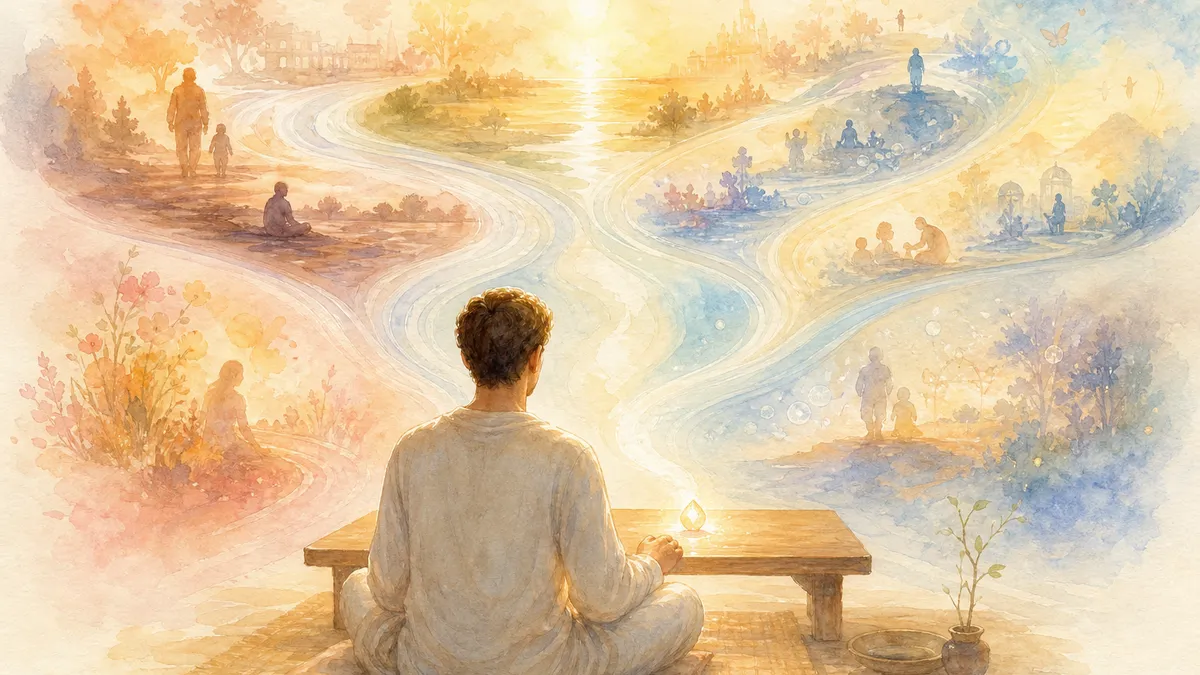
For example, if we all begin to think that Russia is the homeland of Advaita Vedanta and Anuttara Tantra, that from time immemorial our grandfathers and fathers practiced the teaching of Advaita, and our sankalpa is strong enough, then space and time will begin to obey it. Artifacts will begin to appear that truly confirm this on the material level. Archaeologists will find statues and sacred texts; ancient testimonies will appear which, as it turns out, had always been there. This seems like science fiction, but this is precisely how siddhas see the world.
Parasattarka logic says that the world depends on consciousness, and not the other way around. By the world we mean time (past, present, and future), space, causes, and effects. In other words, by changing our own consciousness, we can change the flow of time, causes and effects, physical laws or constants (provided that this consciousness is very strong).
In fact, heterogeneous streams of consciousness operate in the world. We are inscribed in the collective karmic vision of five billion people. Which particular sankalpa materializes depends on which vision dominates in the world.
Why is it difficult for the Earth to turn into a pure land? Because the common sankalpa of the inhabitants of the Earth, their collective karmic vision, does not correspond to this. Now imagine that the entire Earth is populated by saints, siddhas, and monks who practice pure vision. Then holy places and places of power will begin to open on Earth, gods will start visiting it, dimensionality will change, the flow of time will become multivariant, many will begin to manifest illusory bodies, the Earth will cease to be spherical and will become multidimensional, and the physical laws of the old world will completely disappear. That is, you will find yourself in an entirely different world – in the world of a pure land, where different laws operate. This will happen precisely because consciousness, the collective karmic vision, will create a completely different world. This is exactly how the liberation of a yogi takes place.
The Nature of the Supreme Essence
Having so far presented proof that objects and events occur only within, he proceeds to prove that there is nothing “external” to the supreme essence.
What people designate as external is simply the source and support of the universe, like a screen in its relation to the picture shown on it.
There could be nothing external to that “externality” except its own body. How can it be made external to “externality”? For example, when you say “beyond the hill,” the hill is set apart from the space surrounding it; it is not included in it. But the body is observed in space just like a pot. Therefore, the body must be external to the observer. That which is observed lies within the range of illumination; if it is outside these limits, it cannot be seen. Therefore, illuminated objects must be within the field of vision of the source of light. The body, etc., are illuminated because they themselves are objectified (are objects of consideration). The illuminated and the source of light cannot be one and the same.
Again, the source of light cannot be objectified, for is there an observer different from itself? And how can the illumination by means of which it sees exist separately from itself?
It is impossible to maintain the view that the source of light provides light and serves as an object existing separately from the observer. Therefore, the source of light cannot admit any external admixture within itself, and it is illumination in perfection – the only one, being the essence of all and everything.
The Karmic Vision of Different Epochs
One Western scholar put forward an idea that at first glance seems fantastic: the ancient tales about the Earth resting on three whales are not fairy tales; at one time the Earth really did rest on three whales, and it became spherical later.
From the point of view of parasattarka logic, this is not so fantastic after all. The point is that each generation of people corresponds to a certain karmic vision. And we may not even suspect what the karmic vision of our distant ancestors was like. In their karmic vision, there could have been completely different laws of physics, constants, cause-and-effect relationships, and many other things.

In fact, each epoch corresponds to its own, completely unique karmic vision. It can be said that there is no continuity in karmic vision between different generations of people. Accordingly, each epoch is a certain tunnel of reality.
If the karmic vision of the souls incarnating in the next generation changes radically, then the tunnel of reality can change so profoundly that it may affect the laws of physics, the flow of time, the dimensionality of space, cause-and-effect relationships, and much more.
Such things fully confirm the teaching of the “Tripura Rahasya” that time and space are derivatives of consciousness.
