

Commentary on the text “The Hundred Thousand Songs of Milarepa”
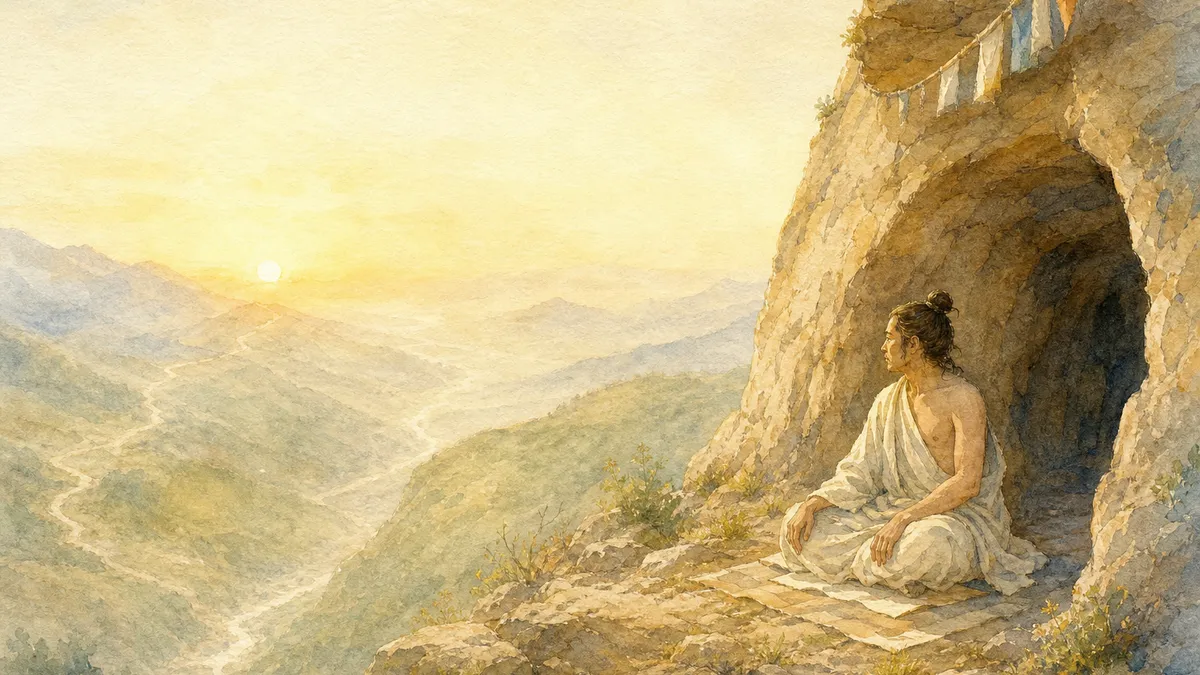
Once, Milarepa was meditating in a cave, and a bird adorned with golden ornaments flew in to him. It nodded to him, circled around him several times, and made a prostration. Milarepa was very surprised and thought that this was surely something not human, but some kind of divine sign. When he followed it, he climbed a hill and saw a handful of rice there. The bird took several grains and made an offering to him. Milarepa was surprised and gave it an instruction.
Milarepa, surprised and flattered, replied with joyful singing: “O my gracious Guru Marpa! In the depths of my heart is the memory of you! With the deepest devotion I meditate on you! Never to be separated from you is my request. The merging of one’s own mind with the Guru is truly happiness.
Here the principle of Guru Yoga is being discussed. Of course, this is not about the form or the external personality of the Guru. It is not that you merge your mind with the personality of the Guru. Here the Guru is regarded as the direct manifestation of the Clear Light, which manifests through a specific teacher of the lineage—this is the meaning of Guru Yoga.
“Manifestation as such is the essence of reality. Through the realization of this unborn Dharmakaya, I dissolve into the sphere of non-effort. I am indifferent to high and low views. In the skill of effort, I find happiness and joy.”
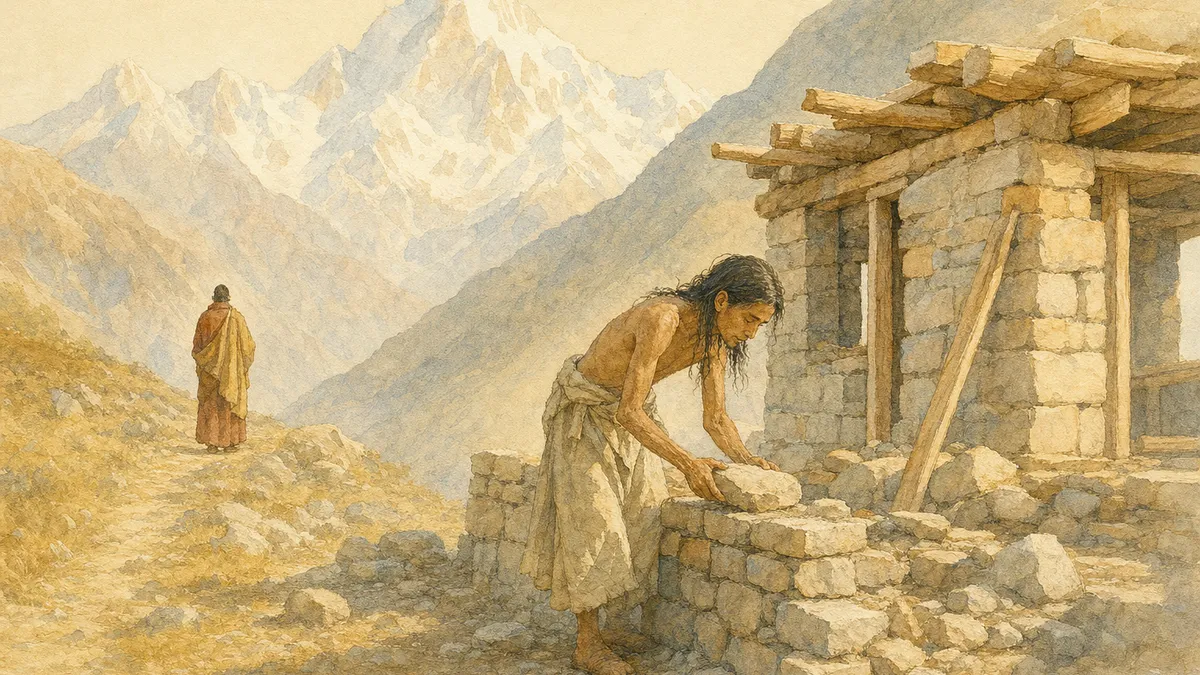
One can unite with the essential Clear Light, which manifests as the Guru, only when we have become completely empty. Your practice is very similar to Milarepa’s practice, even in the styles of approach. Milarepa did not end up in the cave right away: according to some estimates, for nine years he carried out very harsh instructions from his Guru in order to wash away the negative karma he had accumulated in worldly life. For such a long time, he received neither the transmission of the teaching nor instructions on practice. All he received were reproaches from his Guru and work so hard from morning until evening that sores appeared on his back. Marpa’s wife even had to secretly give him rags so that he could cover these wounds. On Marpa’s instruction, Milarepa built houses and then destroyed them. Thanks to such suffering and detachment from the ego, his negative karmas were washed away. One could say that he fulfilled the initial condition of formless practice—the cutting off of ego, hope, and fear—and as a result, his negative karmas were neutralized. Then he was able to receive the teaching without difficulty, shut himself away for a long time in a retreat cave, and gain clear experiences of the nature of Mind and samadhi.
When our mind becomes empty thanks to formless practice, experiences of natural samadhi occur effortlessly. It accompanies us continuously.
The Nature of Mind and the Single Taste of Experiences
“The nature of mind is light and emptiness. By comprehending the awareness of light and emptiness, I merge with the primordial state of non-effort. I am indifferent to pleasant and unpleasant sensations; with the mind of non-effort, I find happiness and joy.”
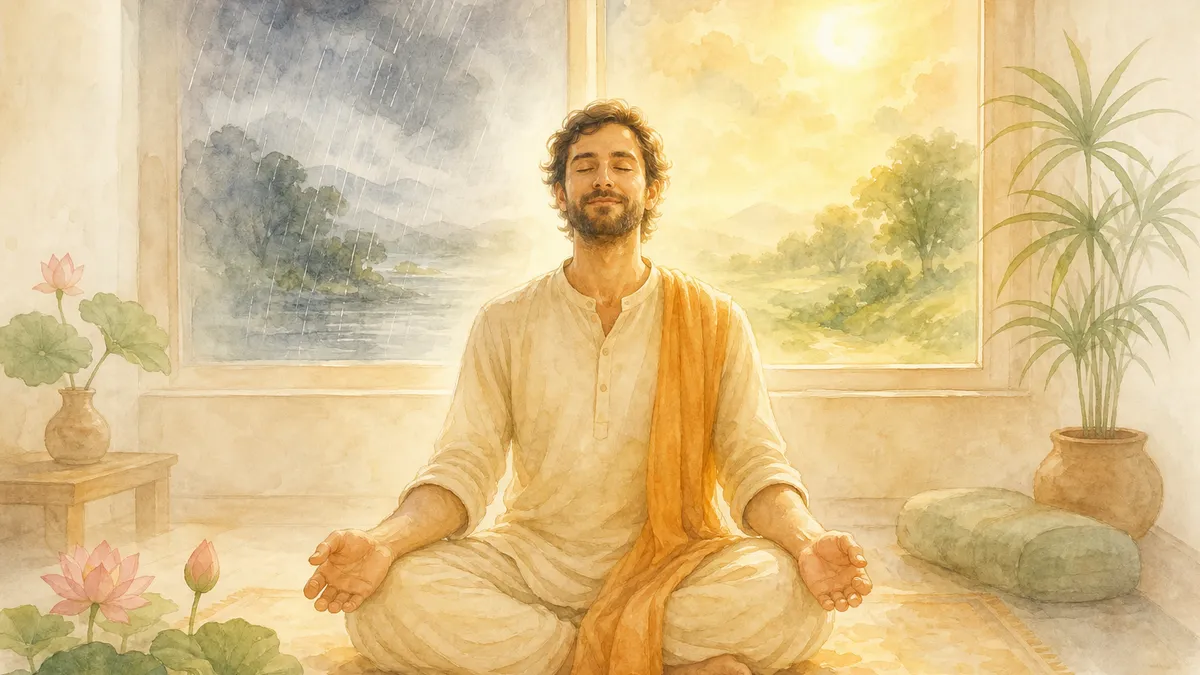
Indifference to pleasant and unpleasant sensations does not mean insensibility like a block of wood. Rather, it means the ability to fully experience both one and the other while remaining sensitive. However, while experiencing the pleasant and the unpleasant, thanks to abiding in the state of Clear Light, the yogi constantly balances them, constantly unites them with the Clear Light, and then any experiences become joyful. This may be difficult to understand. But imagine that a mother sees her child rejoicing and laughing or saying pleasant words to her. Tears well up in the mother’s eyes from this, her heart aches with joy, and she is happy. And if the child she is holding in her arms begins, playfully, to hit her on the cheeks or scratch her? Even though it hurts her, she still feels joy. She can endure it, thinking: “Let him play a little.” And even if it is unpleasant for her body, she will still feel joyful, because this is her child, who for her is the embodiment of all her wonderful hopes and dreams. One could say that, thanks to the karma of attachment, she has some idea of a single “taste,” when both the joy from the child and the pain are one and the same, although, of course, this manifests on the worldly level.
If we imagine the state of a practitioner, then his joy from contemplating the Clear Light is thousands of times stronger. And then he sees a joyful state or an unpleasant one as a manifestation of this Clear Light. That is, both states evoke a feeling of joy in him.
Therefore Milarepa says: “I am indifferent to them. I rejoice equally in negative and good experiences.” In what case is this possible? Of course, in the case where we are able to discover the Clear Light behind any situations. If we introduce every situation into the experience of presence, if we do not separate them. Of course, if we forget to lay the situation bare and do not introduce it into awareness, but simply take the experience as something pleasant or unpleasant, then we are left with nothing but experiences.
If we try only to lay bare the Clear Light and remain in presence, shutting ourselves off from all experiences—that is, if we build some kind of wall between ourselves and experiences, trying to freeze our consciousness and somehow secure it so that it is not pulled out of the Clear Light—then this too is considered one of the erroneous states of consciousness. In the true state, however, consciousness is not frozen, not seized by experiences. It openly contemplates, experiencing; nevertheless, all experiences are united with presence.
The Nonduality of Subject and Object
“The six senses and the objects of the senses dissolve by themselves into Dharmata where the non-differentiation of subject and object is realized.”
In the true state of the nature of Mind there is no division into subject and object. From this point of view, everything we may say, see, or experience is an error, an illusion, a delusion, a dream, something absolutely unreal, because in the true state there is neither subject nor object. One could say that this is an absurd and very paradoxical state. For this world, it is like madness. However, when we manifest in the relative sense, then even knowing this truth, we conventionally act or express ourselves as though subject and object exist. We do this for the convenience of being in this world, because since we have decided to still be in this world, even if we have experienced samadhi, we must take into account the laws by which this world functions. If a yogi has decided not to be in this world, but to be only in a subjectless and objectless state, only in nonduality, well, that is his choice, if he can do it. Letting go of his mind and body, he can completely enter the state of nonduality.
It is said that a yogi who has entered nirvikalpa samadhi for twenty-one days is very difficult to bring back to real life. Therefore, it is not recommended to remain in nirvikalpa samadhi for more than twenty-one days.
However, the saints say that when you have the opportunity to have a body and abide in the relative dimension, you should not do that. You must unite the relative dimension with nirvana and manifest your nonduality in the relative, simultaneously playing upon a subtle balance, falling neither toward the relative nor toward the absolute. In the Upanishads this is called “the path as subtle as a razor’s edge.” The subtlest balance, when samsara and nirvana merge. This is far more difficult than simply unmanifest samadhi. Sahaja is higher than nirvikalpa.
Therefore, a true yogi, even when he has had a deep experience of the state without subject and object, where there is no differentiation, manifests himself in the relative world as though subject and object exist. At the same time, his deep consciousness is not seized by subject-object relations; inwardly he knows that all of this is an illusion, a play, that in the absolute sense none of it exists. At the same time, he also knows that in the relative sense this nonduality has a tendency to manifest, that it always has energy, and that this relative energy exists endlessly as long as the universe exists. And since he has made the decision to abide in this universe, he takes into account the various laws of this world. Therefore, two different kinds of consciousness are present in him simultaneously: the absolute and the relative. An ordinary person has only relative consciousness, which is rigidly subject to the law of karma. But a yogi also has absolute consciousness, which is also called the View, or vision, and he continuously establishes himself in it. The yogi’s behavior is subordinate to the View and follows directly from it.
The Play of the Clear Light in Peaceful and Wrathful Forms
“I merge happiness and sorrow into one. I enter the primordial state of non-effort. I am indifferent to right and wrong actions. Truly happy is the mind beyond effort. The very nature of the dharmakaya is recognized through myriad forms; the myriad forms are the Buddha’s nirmanakaya. With this understanding in mind, whatever misunderstanding I may encounter, I am free in the happy realm of liberation. I do not long to return to the Buddha’s home. Truly happy is the mind of non-effort.”
When the mind, through presence, steadily perceives the Clear Light, then happiness, unhappiness, sorrow, and other states are things of the same order. It is like the peaceful and wrathful play of that same Clear Light. Suppose, if someone gives you a compliment, that is the peaceful play of the Clear Light; and if someone says something harsh or strikes you in the face, that is the wrathful play of the Clear Light. If you do not recognize this play, then you will fall into ordinary dualistic karmic states, which will lead you to the accumulation of new karmas. In the case of attachment to compliments, you will end up in the heavens of passion; and in the case of hatred or anger toward some person, in the lower worlds, in the hells. This happens because the stereotypical view of thinking does not allow one to recognize the play of the primordial Clear Light. But if you are aware, then you see the subtle play of the Clear Light, which manifests in different forms: either peaceful or wrathful. Sometimes teachers, in order to advance their students quickly, manifest wrathful forms, since they carry powerful energy and quickly shift consciousness, laying it bare. If a student has great faith and enough patience, then as a result he can advance quickly.
For example, Neem Karoli Baba constantly scolded his disciples, shouted at them, and called them names. Although everyone said that he was the embodiment of love, at the same time he mercilessly scolded them with all kinds of harsh words. His closest disciple even called him “the Master of curses.” But in reality, when Neem Karoli Baba scolded his disciples, he himself laughed at them. It was simply his form of wrathful play, of wrathful manifestation. He said: “When you see the true blessing behind my scolding, then your awareness will be worth something.”
Milarepa says here: “I do not long to return to the Buddha’s home.” Why? Because he is happy in the state of non-effort. If there still exists a dualistic mind that lustfully desires to return to nirvana, this means that the mind has not yet realized the state of non-effort. The very desire for anything, even nirvana, is a continuation of the same samsara, since the dualistic conditioned mind gravitates toward it. When the Clear Light is realized, it is itself nirvana, and in it there is neither desire, nor gravitation, nor samsara. Even samsara and nirvana are seen in it as dualistic concepts.
Meeting with Celestial Beings
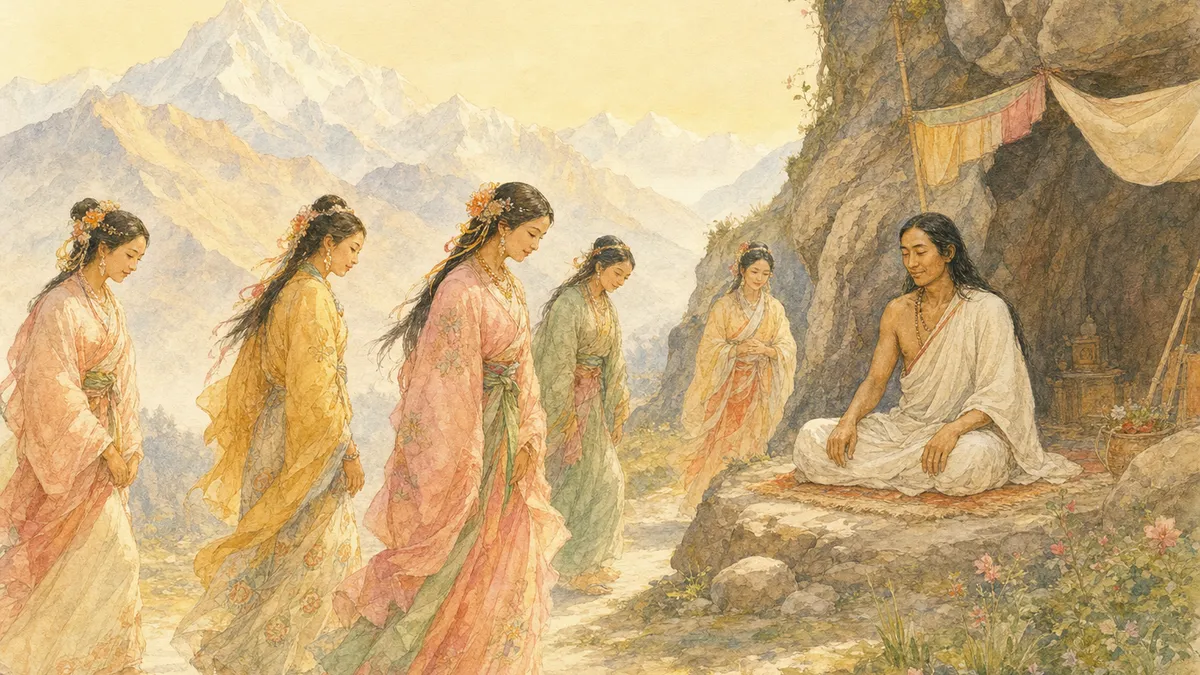
“After this, the dove with her seven companions flew closer to Milarepa; they all bowed to him and circled around him many times, as the first bird had done earlier. Milarepa thought: ‘These doves must not be human. I will ask them and see whether they will tell the truth.’ He said to the birds: ‘Who are you? And why are you here?’ The doves then removed the spell and appeared in their true forms, as female deities. Their leader said: ‘We are celestial beings. We have great trust in you, and so we have come here to learn the Dharma. We most humbly ask you to give us instructions.’”
Not always among people are those whom we see as people human in the full sense. There are spirits of place that can take on the appearance of people. Sometimes gods can descend and, by the power of their magical siddhis, create illusory bodies, manifesting as people. Lower spirits, and those who once lived on earth and now abide in intermediate states in the bardo, can for a time take on the appearance of people. Therefore, for example, when we meet people, they may not always be people, although they may have a physical body and seem human. Some of them may be spirits, some gods, some ruling spirits or deities of the place.
There was such a case. A man came to a Zen monastery and asked to be ordained as a monk. Two weeks later he was issued a monk’s certificate, and then he suddenly disappeared. They searched for him everywhere, and no one could understand where he had vanished. Then, after some time, a monk who had experienced samadhi said that he had met a spirit who said that he had taken ordination as a monk in that monastery, and that in appearance this spirit was completely like the one who had received such ordination. Then the Master understood that it was not a human being who had been accepted as a monk, but a spirit who also wished to follow the Dharma. But he could not maintain an illusory body for long, and so he disappeared.
Instructions to Celestial Beings
In response, Milarepa sang: “O wondrous transformation body of my Guru! I pray: graciously grant me the waves of your blessing! O eight charming celestial beings, who only just now were doves. Your magic was beautiful and fully in accord with the Dharma. If you, beautiful celestial beings, wish to practice the white Dharma of the Buddha, I ask you to remember the meaning of this song. Though worldly happiness and pleasures seem delightful and pleasant, they will soon pass. Though ladies of the highest ranks are proud and haughtily intoxicated with their own greatness, what refuge and shelter do they have? Life in the burning house of samsara sometimes seems pleasant, but for the most part it is sorrowful. If a well-provided-for beloved son does not respect himself and does not make independent efforts, his father has nothing left but to be upset. If a disciple commits evil deeds, he falls deeper into samsara, however magnificent his Guru may be. O celestial beings, sorceresses who appeared before me in the form of doves, it is easy for you to ask for the Dharma, but difficult to have deep trust in it. You must remind yourselves of the inevitable vicissitudes connected with worldly joys. You must regard the pains and troubles in this life as friends leading you to nirvana. As for me, I am very grateful for the troubles I have encountered. O my friends! Keep this in mind and act likewise.
The goddesses smiled at Milarepa and said: “We will act in this way.” Then they bowed and circumambulated Milarepa many times.”
When performing Guru Yoga, we look above all at the essence, because the Clear Light shines in the hearts of all mahasiddhas. Thus, we must completely change the idea of ourselves and transform it from the idea of ourselves as a limited human being into the idea of ourselves as holy consciousness. We must become accustomed to this new vision in order to be this holy consciousness continuously.
