


Types of karma:
“The consequences of killing for the being who commits it are a shortened lifespan or a long-term chronic illness.
Appropriating what belongs to others, regardless of the amount of wealth accumulated, results in poverty in the next life.
The consequence of adultery is hostility toward you and insults.
The consequence of lying is that people will speak ill of you and condemn your behavior.
Speech that leads to discord results in the loss of friendship and your friends’ distrust of you in future lives.
The result of uttering harsh words will be that you will always hear bad things said about you, and you will have a bad reputation.
As a result of idle talk, your speech will have no power, your words will not be followed, people will treat your words with contempt and will not heed them.
The consequence of greed will be that, no matter how hard you try, your desires will not be fulfilled and your goals will not be achieved.
Evil intentions directed against others will lead to your always finding yourself in an unfavorable environment: in a bad climate, for example, in dusty, foggy, and damp places. Or you will be consumed by anger and fear, afraid of attacks by wild animals and afraid of the laws of the country.
As a consequence of distorted and false views of Truth, you will be born either feeble-minded, or a simpleton, or an extremely dull person.
Such are the consequences corresponding to their causes.”
Usually, we speak of three types of karma—the body, mind, and speech. Speech refers not only to articulated language, but also to the energy behind speech. Speech is merely the fourth type of energy, expressed through articulation by means of words. In general, what is meant is energy or vibration. This vibration begins in the muladhara chakra; it is the primordial kundalini energy. It has four phases: uttama in the muladhara and svadhisthana, madhyama in the manipura, pashyanti in the anahata, and vaikharī in the throat. In other words, the kind of physical speech we hear is merely the fourth modification of prana rising from the muladhara. Therefore, speech should be understood as energy, as vibration itself.
Thus, when various actions are performed through the body, speech, or mind, subtle mechanisms of prana and mind are inevitably engaged—mechanisms of which we are not even aware. These subtle mechanisms constantly change depending on our actions. They leave imprints in the stream of our consciousness, whether we want them to or not. When such imprints accumulate sufficiently, they shape our future life and influence the quality of the body that is acquired, the environment in which it exists and that accompanies us—in other words, the ecological surroundings. They also influence our own inner tendencies.
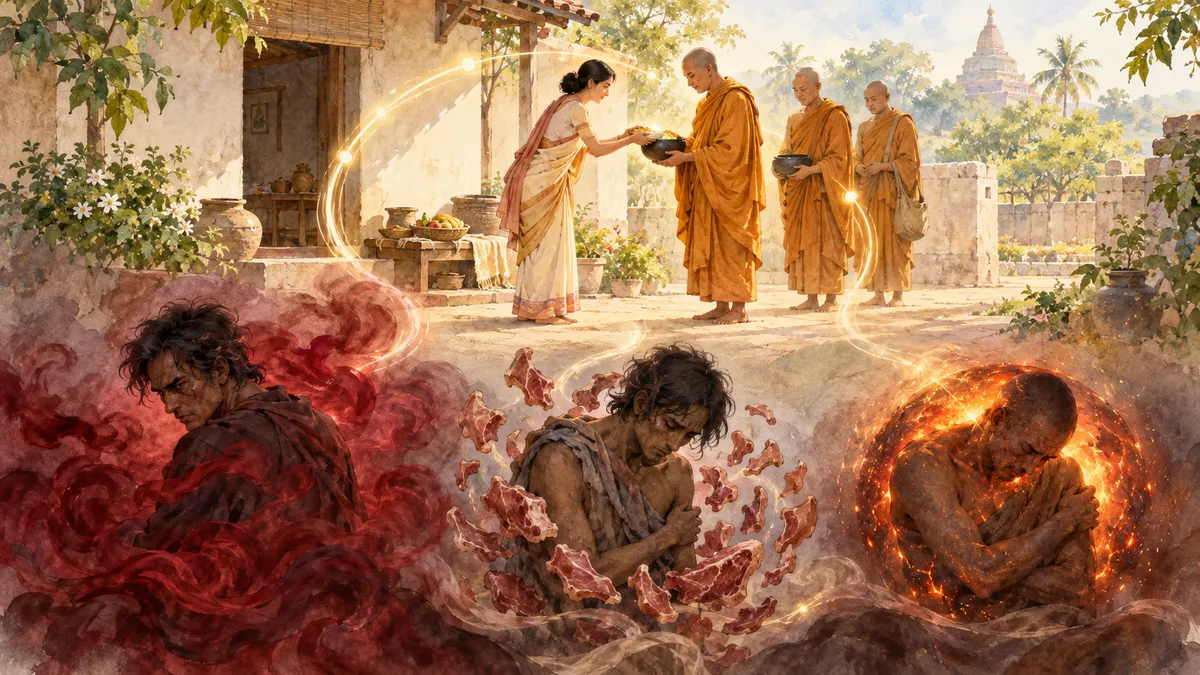
Once, during the time of Shakyamuni Buddha, there lived two women. When one wealthy woman came to visit the other, she saw four beings in her home who could hardly be called animals. The hostess said that these strange creatures were suffering greatly. They had appeared in her home in a mystical way, and she fed them from time to time. When the other woman secretly decided to feed these creatures and gave them food, she saw that, for one of them, the food had turned into blood and pus; for the second, into pieces of flesh; and for the third, into something glowing hot. This woman possessed mystical abilities and was able to trace their past lives. She saw that the hostess had been a devoted follower of the Buddha, while in their previous lives these beings had been her relatives—her husband, daughter, and son. One day, the Buddha came with his disciples to ask for alms. This woman gladly offered them shelter and food, but she was away for a while. Her husband, son, and daughter were not followers of the Dharma; they were adherents of worldly life. Then the daughter said, “I would rather eat blood and pus than feed these homeless, idle monks.” The woman’s husband said, “I would rather lick a red-hot ball than give them even a crumb of our wealth.” The son said the same. As a result of such a “blessing,” resonating with the absolute consciousness of the saints, they received retribution in the form of such bodies in their next lives. This is an example of an experience corresponding to its causes.
There is another story. A merchant donated a gold earring to the Buddha. When he wanted to make the offering, it turned out that this was the only thing he had with him. For several lifetimes, he was born with a gold earring in his ear. Then, after living these several lives with an earring in his ear, he was reborn in the heavens of Indra and later became one of the holy arhats. Thus, the blessing for making an offering to a saint was returned to him.
Karma returns not only as a consequence corresponding to its cause, but also as habits corresponding to the cause that was generated. In other words, a person acquires habits corresponding to the actions they performed in the past. For example, the consequence of stealing will be that a person becomes inclined to take things away and deprive other people of their property. A tendency to use harsh words and a love of idle chatter can all be understood as the result of having cultivated these habits in previous lives.
When we perform actions with our body, speech, or mind, the structure of our energetic and subtle bodies changes, and at the subtle level, space becomes distorted in several of our subtle bodies. Initially, our environment and the world are formed by the power of consciousness: various subtle dualistic states manifest from the Clear Light. Then these states become coarse, and the mind gradually distances itself from these manifestations of light. Upon rebirth, all the thoughts and actions we have accumulated manifest again as various subtle states of light connected with what was accumulated earlier. Finally, when the soul enters into resonance with these manifestations of light, consciousness is seized and reborn in a new womb.
Consequences for the Surrounding World
“Killing (meaning the killing of small insects) results in a poor harvest, and if a person is ill, medicines do not help them.
As a result of appropriating what belongs to others, a person is reborn in a place where droughts, floods, and crop failures rage.
As a consequence of adultery, they end up in a dusty, gloomy area where day cannot be distinguished from night and where there is no harmony with the elements.
As a consequence of lying, life will be spent amid filth.
If evil actions were committed through words that provoke discord, a person is reborn among steep rocks and precipices, or in a narrow ravine.
The consequence of using harsh words is rebirth in a country with places completely devoid of vegetation and water, where life is extremely difficult.
As a result of idle chatter, one is reborn in places where the four seasons are unstable and unpredictable: rain, scorching sunshine, and cold replace one another chaotically.
As a consequence of greed, one is reborn in a barren area devoid of energy and nourishing power.
If someone secretly wished harm upon others, they are reborn in a country where food does not satisfy, even though there may be plenty of it, because none of it possesses nutritional properties.”
Thus, when various incorrect states of mind and speech arise, they are imprinted in the stream of mind in the form of samskaras. Samskaras form vasanas—impulses that govern the behavior of the body in the next life. Consequently, it is necessary to understand how one should live one’s life. The imprints of samskaras also depend on the level of our prana and the degree of awareness. If the degree of our awareness is low, the imprint occurs one hundred percent. In other words, an accumulated action leads to a one-hundred-percent return of its result. If, however, in addition to bodily actions, there is a pure level of energy or a deep state of awareness, such an action may manifest not one hundred percent, but only halfway or even one-third.
From the perspective of anuttara tantra, consciousness ultimately plays the primary and decisive role, rather than actions. Actions play a secondary role. In other words, the primacy of consciousness means that if you are in a deep state of awareness, then even something that might otherwise bring you bad karma will not do so. The primacy of consciousness means that if you are in a deep state of contemplation, all your actions will be like the accumulation of merit. However, one should not become captivated by this theory until one has attained samadhi and continuous awareness. Because deep contemplation implies precisely these things. An ordinary person or an ordinary practitioner most likely does not possess a deep state of contemplation, but has ordinary dualistic concepts. Attachment, hope, fear, acceptance, and rejection habitually arise within them. If we speak of the fundamental difference between an ordinary practitioner and one who has reached the highest level, it lies in whether there are attachments, hopes, fears, likes or dislikes—in other words, dualistic states of mind—or not. Even if it seems that none of this exists on the surface, very subtle intentions may exist in the deeper layers of consciousness and the subconscious, where they may go unnoticed. These subtle intentions nevertheless continue to act against the practitioner’s will, and they still generate various subtle causes.

Everything we are dealing with now—our environment, physical form, level of practice, and spiritual attainments—is the result of such causes. We cannot change these effects until we generate new, subtler causes. For example, while sitting in retreat, one person experiences joy and bliss while in a state of dhyana, whereas another experiences suffering from pain in the knees and tamas. It can be said that under identical conditions, two monks have different experiences because different causes were generated in the past.
If you have the karma of the gods, you will enjoy yourself in any situation until that karma disappears.
If you have the karma of animals, you will be dull in any situation.
If you have the karma of hungry spirits, then where everyone else is enjoying themselves, you will find a way to become dissatisfied and remain dissatisfied.
If you have the karma of asuras, then where everything is favorable, you will find a way to fight with others or become envious.
Whether we want it or not, this is the law, because our consciousness radiates from the essential part of our “I” in the form of sphurana. Atma-sphurana is a subtle emanating energy, also called kala. These are microscopic particles of light radiating from our consciousness. This radiation changes and distorts the space around a living being. The term “distorts space” indicates that, as a result of this radiation, karmic perception around a person changes. In other words, each of us, besides being part of the collective karma of the world in which we exist (the loka)—for example, the collective karma of humanity—has our own individual karma, which can change within certain limits. This individual karma radiates precisely in those circumstances and places that correspond to it. When such a person approaches someone or something, they distort space in accordance with their radiation (sphurana), and then reap the fruits accumulated in their subtle bodies.
The Accumulation of Merit and Purification
At present, all we have is the law of karma and nothing but the law of karma. Until a living being abides in deep awareness, it rigidly reaps the causes and fruits of its past actions. Apart from the practice of contemplation, the only sensible way to live so that the next life will be purified is through the continuous accumulation of merit and continuous purification. When you perform prostrations, recite mantras, offer prasad, engage in practices, make namaste, make charitable offerings, tell others about the Truth, perform full-length prostrations, or listen to sutras—all of this is a continuous stream of purification that changes your karmic causes. And since so many such causes have been created, changing them is not easy. One must accumulate an equal amount or even more merit for new causes to manifest.

The law of karma is what describes our relative dimension. In addition to the inner practice of contemplation, we should always be attentive to the actions of the body, speech, and mind, especially when we embrace the spiritual path and monasticism. When our contemplation becomes truly continuous, liberation from all karmic traces takes place. This occurs at the level of pure vision. Pure vision means that contemplation has gained strength and can continue uninterruptedly, encompassing all twenty-four hours of the day. Then, suddenly, a very powerful positive potential of our radiance awakens within us. This means that even when we encounter something negative as a result of karma returning, we no longer react to it in a conditioned way. This potential of clarity is shakti, which arises as a result of contemplation. And just as the strong prevails over the weak, our pure and very clear radiance also begins to warp the karmic space around us. In other words, we warp or change the old karmic vision into a new, more purified one. In such a case, it is said that a person has entered the dimension of pure vision.
Pure Vision
The dimension of pure vision is not at all what we are accustomed to dealing with in everyday life. It is accessible only to a truly holy being. Such a saint, even looking at dirt, sees gold; even hearing abusive words, hears bhajans and the chanting of mantras. Looking at ordinary beings, he sees gods. Looking at impure, contaminated actions, he sees in them the divine play of the Absolute. It is at this level, when pure vision has been fully realized, that the law of karma ceases to operate, and every action becomes truly pure, like the accumulation of merit. Therefore, it is often said that in our relationships we should try to tune in to pure vision and generate it, even if we have not yet acquired it.
One who has strong faith and is united with the Source of Being always sees joy in everything. Such a person never experiences suffering, anger, or anything else of the kind. It is said that such a person sees the grace of God in everything. Whether something good or bad happens, he perceives it all as the grace of God. Whether something occurs that causes suffering or does not satisfy his ego, or whether something happens that brings him joy, he sees the manifestation of absolute energy in everything.
Pure vision also means that we extend it to those with whom we interact. We stop seeing conditioned men and women; we begin to see the subtle forms that stand behind the physical оболочку of a man or woman. For example, in every monk we see the Buddha, and in every word he speaks we hear a lesson for ourselves. When we perceive the living beings around us as divine, we understand what this ability of pure vision means. Then we enter such a dimension of pure vision that is called a mandala.

A mandala is considered to be an ideal structure within our consciousness; it is the principle of tantra, in which visualization, offering, and the saturation of space with various energies, the recitation of mantras, and other practices take place. Then the yogin creates a picture of the world for himself, at the center of which is a deity, and he himself plays the role of this central deity. He recites mantras and visualizes until he can see the mandala clearly. Then he tries to identify everything he sees with the mandala and think that the entire manifested world is nothing other than the mandala he himself has visualized. These are practices used in tantra. This is a tantric method of transformation, in which we purify karmic vision through such practice.
However, in the higher tantras, for example in laya yoga, the approach is different. We do not use any tantric methods of adornment, transformation, visualization, or anything else; and if we do use them, then only as supplementary methods, to a minimal degree.
Primarily, entry into pure vision occurs through deep contemplation. Contemplation is both a method and a means. Put simply, the principle is this: if someone has a high level of awareness, they are always joyful and clear, have good concentration, and do not have even a shadow of impure thoughts; their actions are impeccable. Because they constantly monitor themselves, they have a very flexible mind, are capable of integrating with any situation and responding to it appropriately, and always have a good level of energy. In other words, they reap the consequences of their attentiveness. Such a person is close to pure vision. Conversely, one who is inattentive has an inflexible mind, finds it difficult to be harmonious with others, to integrate with a situation and respond to it appropriately. They make mistakes, have a low level of energy, and find it difficult to concentrate during practices. One could say that their mind is still caught in the flow of impure vision.
By cultivating attentiveness, we overcome such impure vision and transform it into a state of pure vision. When we do not contemplate, the mind usually vacillates and is subjected to various experiences: some of them may be pure, while others may be impure. But once we have become fully attentive and purified ourselves through practices, everything becomes pure, correct, auspicious, and joyful; no contradiction arises anywhere. It is believed that when a yogin enters the state of the pure dimension, their body in this world begins to dissolve completely. It is not that their body disappears; it simply becomes spiritualized and manifests as a body composed of rainbow light, unless, of course, they have consciously decided to retain part of their impure vision.
Transformation of the Elements
The difference between living beings in the human world and deities is merely a difference in karmic vision. The former have various impure states in their minds, while the latter have only pure states. Pure states signify subtle levels of mind in contemplation and subtle levels of prana—not in the gross elements (mahabhutas), but in the subtle purified elements (shuddha-tattvas).
What does the “gross state of the elements” mean? For example, the earth element in its gross state is earth, while in the human body it is flesh and bones. The manifestation of the earth element in its gross state is one of the root poisons, such as anger. When the muladhara chakra vibrates, this manifests as an impure state.
What does it mean that “an element has become pure”? It means that in the physical body, the earth element (the muladhara chakra) has been purified, and the energy has also been purified. Then it is not anger, but the energy of wrathful deities. The earth element in the physical body is purified into a state of purity. When the element is completely purified, one can see a space of yellow light—this is the purified earth tattva, a very powerful and dense divine energy. The impure state of the tattvas is transformed into a pure one. The same can be applied to all the other tattvas.

Finally, when all our impurities and poisons contained in the body are transformed into five types of pure space, complete entry into the pure dimension takes place. Then the yogin, unlike an ordinary being who identifies themselves with the body, transforms into the five types of five-colored space, or into the five wisdoms:
The yellow space of the earth element, or the wisdom of equanimity
The white space of the water element, or mirror-like wisdom
The red space of the fire element, or discriminating wisdom
The green space of air (wind), or all-accomplishing wisdom
The blue space of ether, or the wisdom of the absolute space of reality
