

The Four Mindfulnesses as the Basis of the Spiritual Path
There are four themes for contemplation that are known to all of you: the preciousness of human birth, the law of karma, the sufferings of samsara, and impermanence. These themes should accompany a yogi throughout their entire life. Our further spiritual path depends on how well we understand these themes, which transform our worldview.
One can often observe a person who does not fully understand something in the Teaching, or wavers, or makes mistakes, and it is immediately apparent—they have not truly understood the four mindfulnesses; they have not contemplated deeply. Had they contemplated, they would not think that way, they would not act that way, they would not doubt, they would not waver, and they would not be distracted. For the four mindfulnesses would have shown them who they truly are and what this world truly is.
We must understand that we exist within a natural law—the law of karma. We must contemplate deeply on the law of karma, impermanence, and the sufferings of samsara, and from this, derive the principle of the precious human birth. Then it will be easy for us to change, to work on ourselves, and to remember. It is not difficult.
Why is it difficult to practice, difficult to change, difficult to remember? Because there is an entanglement, a continuous immersion into karmic reality. It is as if someone is casting a spell and enchanting you over and over again. Everything would be fine, but this sorcery spoils everything. You constantly see things incorrectly. You are constantly confused, making mistakes. This is the sorcery of Maya, of illusion. She casts her spell constantly, day and night; the influence persists—an entire tunnel of karmic vision affects our consciousness.
But as soon as you free yourself from this sorcery, great faith, great resolve, great aspiration, a great desire for transformation, and great self-discipline awaken within you. Many things become easy to accomplish. The four mindfulnesses disenchant the soul. This is a unique practice that removes the spell. It’s like a magic charm that clears everything away.
Understanding the Law of Karma through the Discrimination between Soul and Body
From the perspective of karma, we must realize that we are in a continuous flow of causes and effects. The law of karma is a fundamental law of nature. The soul is eternal, while the body is temporary. They are always distinct—the jiva, the Atman, and the body.
Sometimes our desires come into conflict with the laws of our physical body. The body ages every year; it matures and grows old. But the person themselves does not want this at all. The body is subject to disease, but the person does not desire this at all. And death frightens and shocks most people so much that they simply do not want to talk about it, or even think about it. Nevertheless, statistics exist. Consider how many people die in Russia every year. It is inevitable.
A person cannot even entertain the thought that a moment will come when they will live as a spirit and not as a body. But there are laws, and these laws govern our material body. The body ages and dies. When the soul accepts a material body, it is forced to obey these laws. But the soul itself has no relation to the laws of karma.
The soul never ages, never dies, and is not subject to any changes. The body is the doer, the actor. Но the higher Self is not the actor or the doer. Therefore, it is called akarma—that which performs no actions.
Meditation on the law of karma means, first and foremost, viveka, or discrimination—understanding what is the doer and what is not. Such contemplation will inevitably give rise to the discrimination and separation of the one who acts and the one who does not. For the one who acts reaps the fruits of karma and tastes them. The one who does not act reaps no fruits of karma and does not depend on them. One must understand what depends on karma and what does not.
The Analogy of the Body and the Car
The body is constantly occupied with various activities and undergoes all sorts of changes. Therefore, it is often called "karma"—that which works. The body can be compared to a car, and the driver of this car is consciousness, the soul. When someone sits in a car, the car moves. To the person himself, it seems as if he is not moving. But the automobile performs its work, wears out, and breaks down.
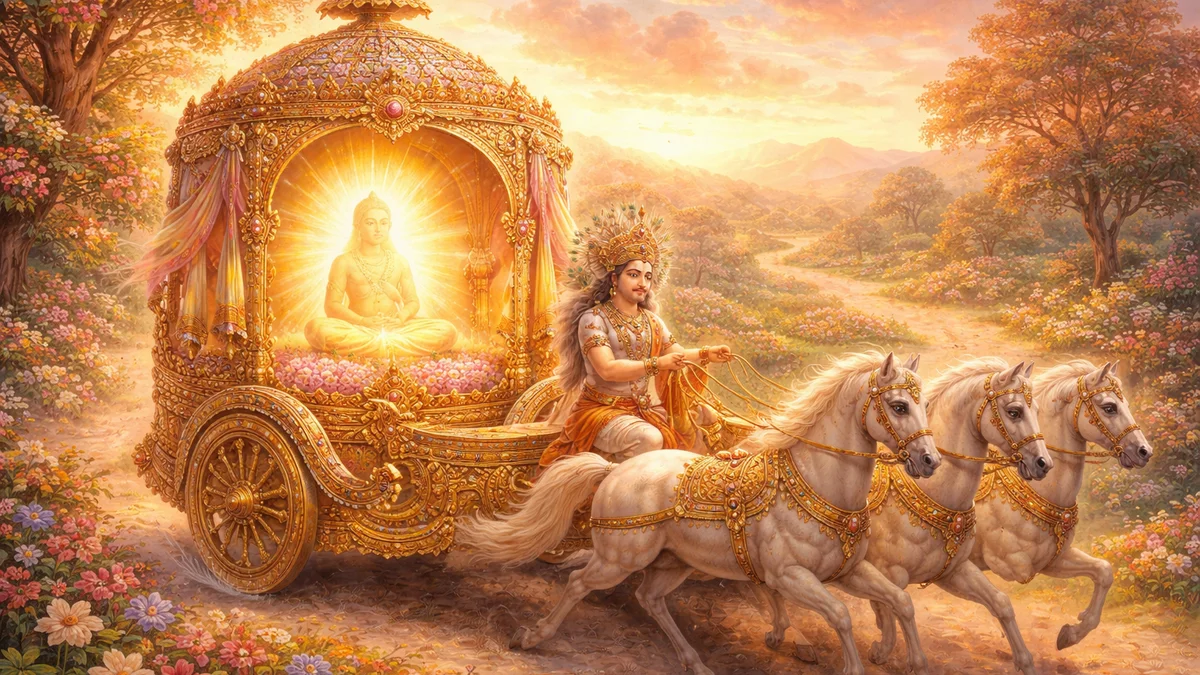
When the car wears out or breaks, the person sells it or throws it away and buys a new one. He changes cars. If a person has the means, he can scrap one car and buy another. Then he drives it for ten or twelve years and changes it again for a better model. He drives it again and changes it for an even better model or a similar one. But if he runs out of money, or has little money, he will buy a worse model.
Money represents merits, and the models represent bodies. Thus, the soul also changes bodies for better ones if its merits allow. If merits do not allow, it receives a poorer body. If the driver behaves incorrectly, does not earn, does not work, does not make an effort, and has little money, he is forced to buy a poor-quality used car. If he strives and moves up the social ladder, he can buy himself a luxury, premium, or executive class car. It is the same with the body. This is the law of karma.
A person wants to be happy, but the body constantly requires effort, and it steadily declines. What is the purpose of the body, what is the purpose of the body's actions? Its purpose is not to indulge it, but to deliver the driver to the destination. Similarly, our body must deliver us to the goal. That goal is spiritual existence, an awakened existence in the spiritual world.
Liberation is the highest ultimate goal, but the intermediate goal before liberation is spiritual existence, the transition into a mandala, a pure dimension. This is the so-called small, intermediate liberation. When it will no longer be necessary to incarnate again in the gross physical world or to suffer in it, being in ignorance.
Types of Karmic Activity
Karma is activity; sometimes it is translated as work. Such activity is carried out at the levels of body, speech, and mind. A person works to receive something in return, either on the subtle or the gross plane. The more developed the soul, the higher its needs to receive on the subtle plane. An undeveloped soul strives more to receive on the material, gross plane.

For example, it is useless to talk to a crude person about high ideals, duty, or honor. He will say: "Money, money. I'll do anything for money." But to a person of high principles, a developed person, money is of no concern. For him, his goals, values, and meanings are important. He may earn money or he may not, but he follows his ideals. The more elevated and developed a person is, the more categories such as ethics, honor, duty, principles, loyalty to ideals, faith, and values mean to him.
Karma for the body begins with the desire for some benefit. Since no activity or work can be performed without sufficient desire. For example, everyone wants to possess wealth, power, knowledge, strength, or beauty. Therefore, people are very active in achieving their goals in the world. They cannot stop for a moment. They manifest activity all the time to achieve these goals. This is karma.
But when they act, they lack viveka, the discrimination between the one who acts and the one who does not. And because they are identified with the body and identified with the activity, they receive the fruits and results of their karma. Thus, they acquire all the consequences of their activity. For instance, saints can act without receiving consequences—this is called play, lila. But ordinary people do not know how to do this because they lack discrimination between the actor and the non-actor.
The consequences of activity are also called karma, and it is they that determine our fate in the future. Even simple actions have their consequences. A cause gives birth to an effect. A new effect becomes a new cause for the next effect. Thus, all souls identified with the body live in a flow of causes and effects. In this sense, karma can be described as a vast current, a huge river of chains of cause and effect along which consciousness slides, clinging from one cause-effect to another. This current, this flow, carries the soul in a certain direction.
Karma in Ignorance and with Desire for Profit
Karma, as work, if performed in ignorance, brings destruction and misfortune. If work is linked to a desire for profit, it brings temporary fruits. But in reality, it can increase various vices, such as greed, anger, and pride. For example, often an undeveloped person, upon receiving wealth or power, only becomes worse. Because his egoism is strengthened and his delusions also increase.
Karma associated with following higher principles purifies consciousness, brings joy, a sense of happiness, and increases wisdom. For example, when a person lives for others or does good, their mind is purified. The principle of accumulating merit is built on this. He progresses in a spiritual sense. He does not degenerate but grows. The subtle contours of his consciousness constantly develop and are nourished. He becomes wiser and better. His mind becomes clearer and clearer. At the same time, he must be guided by pure, noble motives.
There is a painting by Vasnetsov called "The Knight at the Crossroads." It shows a rider with a spear, in chainmail and a helmet, with a stone before him, as in a fairy tale: go right, go left, go straight. Every person is at such a crossroads. In what style to act, what type of karma to choose, what type of behavior or activity. For each of us moves toward our destiny. Even when one does nothing, one still moves toward their destiny.
Auspicious Karma
The original meaning of the word "karma" is auspicious, virtuous activity, religious activity aimed at the benefit of other people. In Vedic society, precisely such activity was considered karma. If a person is engaged in such activity, they live a happy life. They bring happiness to others. After death, they rise to pure divine dimensions. This is the sure, correct path even for ordinary people—it is the path of how, having accumulated merit, to rise to the divine worlds.
It does not lead to liberation, but it leads to rebirth in celestial dimensions, in pure lands. Therefore, discarding selfish desires for enjoyment and discarding attachments to activity, one should simply benefit others. Simply try to help others, serve Dharma, serve the saints, and serve the highest law, Sanatana Dharma. Slowly but surely, the mind will be purified. This is a path of many lifetimes. But it is better than not doing it.
In the heavenly dimensions, living beings receive fruits and rewards. However, this reward is eventually exhausted. Therefore, this state of enjoying good karma in heavenly dimensions is not eternal. However, even to reach a heavenly dimension, one must try very hard. One must earn it. In the heavenly dimension, there are people who have accumulated a vast amount of merit. For example, in mundane society, a person with low income will not be allowed into an elite hotel. They will not be allowed into some luxurious five-star hotel. They will not have the means to pay for it. The same applies to the heavenly worlds.
Karma, or merit, in this case is like money. When the money runs out, one must earn it again. Therefore, auspicious karmic activity is a beginning, but one cannot be satisfied with this alone.
Vikarma — Selfish Activity
Besides auspicious activity, there is also selfish activity aimed at satisfying one’s senses. It is called vikarma. Vikarma is the case where a person is ready for anything for the sake of enjoyment, for the sake of satisfying themselves, for the sake of indulging their egoism and their senses. They may commit theft, deception, insults, and even violence against other people.
The fruits of such activity are suffering. The person will suffer—both the one who does it and those who are nearby and subjected to the actions. They will all fall under this influence. Because the impact of karma is always directed at the person who does it and at others who are near them.
Vikarma actually brings harm to oneself, although it seems to the person that by acting this way, they will bring benefit to themselves. This is the influence of Maya. Driven by the mind, ego, and desires, a person imagines they will benefit themselves. For example, a thief or a criminal. He desires happiness for himself; driven by his karma, he thinks that if he steals, he will be happy. As a result, he receives twelve years in a maximum-security prison. This is ignorance. If he knew, would he act that way? No. But he has such an idea that he will be happy by doing something. This is vikarma.
After death, a person always receives a bad, unfortunate birth if they act prompted by vikarma. For example, they are reborn in a hellish dimension. There are many hellish dimensions. They have their own punishing spirits and controlling forces. They see the records of the subtle body, everything the person has committed, and they will control the person as long as they deserve. Unless one of the saints frees them with their power. This happens when, for example, a very influential person appeals to some authorities and asks to free a person, taking them on bail. Then they are released. Но in other cases, they will work off their karma for as long as they have committed it. No more and no less. But when they are purified of bad karma, they return to earth and continue their actions again.
Akarma — Inaction
Besides karma and vikarma, virtuous and unfavorable activity, there is also akarma. Akarma is activity that does not bring a result. It is inaction. Akarma is when a person does not strive to do anything. "A" is a negative particle, meaning non-action. This is not the non-doing we speak of that is inherent in saints and siddhas, where a person makes a great decision to enter into great non-doing. This is ordinary inaction.
For example, a person sometimes does not want to perform what they should do due to laziness, apathy, or parasitism. Such a lifestyle, where a person becomes disillusioned with something, loses the taste for further progress, and has no will—they simply lead a parasitic lifestyle. This is all akarma. Such a person loses their creative power and does not realize their potential. They begin to gradually degenerate, and they are also not respected in society. After death, such a person can become a ghost, a restless spirit, a preta. They might become an animal—it depends on the tendencies of their mind.
A temporary cessation of activity is simply fatigue, when there is not enough willpower to continue the path of self-improvement. In human society, such people degenerate and are despised and rejected by the society of ordinary people. All of this is akarma.
Activity of Saints without Attachment to Fruits
As for saints and sages, they do not renounce activity; they renounce the fruits of their activity and the sense of being the doer. Thanks to viveka, they clearly distinguish what in them is the doer and what is not. Understanding the difference between consciousness, the soul, and the body. Then the fruits affect their body, but they do not affect their mind.
A Jnani knows that in this world, nothing belongs to him. He comes with nothing and leaves with nothing. Everything belongs to Brahman, the Supreme Source. Understanding this, he works, but not for the sake of enjoyment or accumulating wealth, only to develop spiritually. He does not try to enjoy for himself, does not try to appropriate the fruits of his labor, or act in the role of the enjoyer.
When we contemplate the law of karma, we begin to understand many subtleties and nuances—that we live within this law, and this law is fully operational, controlling us. It is very complex and multi-variant.
Ugrakarma — Destructive Activity
There is also ugra-karma. This is terrible, unfavorable, destructive activity. It is called ugra. Ugra translates as terrible or fearsome. For example, there is the deity Ugratara, the wrathful Tara. In her hands, she holds wrathful attributes, and she herself looks wrathful, with disheveled hair.
For example, sometimes people bring suffering to each other, warring with each other using black magic or conventional weapons. Sometimes, under the fear of death or punishment, in ancient kingdoms, slaves created various structures and great civilizations. Or they built cities. All of this is ugra-karma. The ruler who forces slaves to work and the slaves themselves are all under the influence of ugra-karma. The consequences of such karma cause thousands or millions of people to suffer.
Modern society sometimes also demonstrates examples of ugra-karma. For instance, when a person goes somewhere to work, but no one cares for them, they live in terrible conditions, they do not develop, they do not grow spiritually, they are treated poorly, and they have no opportunity to live a normal life. Many people in this world—in third-world countries, in developing nations, in large families where children get sick and die at a young age—are subject to ugra-karma.
A person can choose ugra-karma independently. For example, they could be in some gang—in China there is the Triad, in Japan the Yakuza, in Italy the Mafia—dealing drugs, controlling someone's business, bringing suffering to others and earning from it. This is also ugra-karma, karma through unfavorable, destructive activity. To such a person, it seems as if they have arranged their life. But in reality, their life is built on the suffering of others; this suffering will return to them and destroy their life sooner or later.
Consequences of Ugrakarma and the Influence of Maya
Those engaged in ugra-karma gradually lose their reason. Even if they had merit to some extent, it becomes completely exhausted. This happens because the person does not possess the proper knowledge; their knowledge is insufficient to choose the right course of action. Yet they think they will be happy in the future. This is the influence of Maya. But instead of true happiness, they have mirages—mirages of money, mirages of things. And in the end, chasing these mirages, they discover they have received no happiness and find themselves at a broken trough.
Prarabdha Karma: Manifested Karma
What is prarabdha? Prarabdha translates as "manifested." That is, what exists as a fact. For example, our body is our prarabdha karma. A seagull's body has wings, but we do not have wings—these are differences in prarabdha karma. We cannot be like a seagull until we change our body. A seagull cannot be a human. These are very large differences. The mind created causes, and they manifested, materialized. Prarabdha cannot be changed.
For example, in a family there are bad children and good ones—this is a given, an accomplished fact. If a person has a disease, they must take it into account, seek treatment, and visit doctors. This affects them. If they do not attend to this disease, it can destroy their body. This is the same as the influence of prarabdha karma.
The Trap of Karma in the Consumer Society
A person falls into the trap of karma when they think that because they have a body, they can bring themselves happiness by enjoying it. To enjoy, they need to perform certain actions. Then they begin to believe that their main duty is to satisfy their needs. This idea is very strongly ingrained in their consciousness by upbringing and society. Therefore, sages call modern society a society of consumers, a consumer society.
In this society, there are entire departments of advertising and marketing headed by very talented managers, PR managers, and sales managers who are taught in special courses and seminars:
- how to excite the senses
- how to maintain them continuously
- how to cause desires
- how to impose a product on a person
- how to convince them of it very elegantly and beautifully
Thanks to this, the economy is supported. The economy of the consumer society exists through a continuous race of consumption. A product is created, but the product must be sold. To sell the product, a consumer is needed—someone who will buy it. For this, serious marketing research is conducted to identify the presumptive group of consumers on whom this product will make the greatest impression.
For example, if someone releases a computer game, the target audience of the computer game is immediately determined—this is a game for girls aged ten to fifteen. Accordingly, the advertising department carries out a certain advertising policy. They think: "How do fifteen-year-old girls think? What interests them? Let’s do it this way, present it like this, use this image, in these places. Then our sales will increase. Let's launch this video." Then their sales increase.
Then they release another product. The target audience is pensioners. They think again: "What is their mentality, how can we influence them, what can we hook them with, what is important for these people?". Again, an advertising video is released, and corresponding captions are made.
Thus, a concern or corporation releases a multitude of products that may not be needed at all. But people think they need it—advertising convinces them because advertising continuously acts on consciousness now. This is a special enchanting action of Maya.
Sales increase, corporate executives receive super-profits and super-incomes. They put a part of these back into advertising. They know—advertising is the engine of trade. Desires must be constantly excited; they cannot be let off the hook, they must be on our hook. They must consume our yogurts, our Fanta, our Coca-Cola, our DVDs, our sneakers, our jeans. We cannot let them go.
Vast advertising departments led by sales managers and masters of PR technologies take this very seriously. This is only one area. It is the same with politics, social relations, and other mass media besides television. Thus, a special artificial information environment is formed. And this information environment has its own goals and meanings, and it imposes its values.
And where can a person go? They are subjected to this. They are not a Jnani; they build their perception, orient themselves in these information flows, and follow what is imposed on them. This is Maya, acting very sophisticatedly. This is all the trap of karma.
Then the person thinks that their main duty in the world is to satisfy the needs of the body; otherwise, they cannot live, otherwise they will die. It seems to them they cannot survive without this world, without this advertising, without products, without work, without stores, without everything—without cars, factories, plants, and politics. But as the saints say, an alcoholic also thinks he cannot live without alcohol, and a drug addict also thinks he cannot live without drugs. This is all Maya.
But if we look at how Christ spoke:
"Consider the lilies, how they grow: they neither toil nor spin; and yet I say to you, even Solomon in all his glory was not arrayed like one of these."
This is the principle of prarabdha karma. The principle of prarabdha karma is the principle of karma that is already acting, which cannot be avoided. Only if you develop consciousness can you move away from the influence of prarabdha karma. But developing consciousness under the constant action of Maya is very difficult. It is almost impossible.
Many people would like to practice. Many people write for years: "I want to come to the monastery to practice." Or: "I want to become a novice." Five years pass, and they write: "I still want to practice. I still want to become a monk-novice. I still want to take refuge." But years go by, and in the end, if they do not take a certain step, they remain at their level. Because over the years, this influence is imprinted deeper and deeper into consciousness. And it is already impossible to resist the power of karma, because this influence is stronger than the personal will, the ichcha-shakti of the person. One must be a strong person to free oneself from all of this.
Prarabdha karma and the body are connected with place, time, and circumstance. That is, a specific environment. Every person has their lifespan and lives as long as is destined by prarabdha. But if they perform long-life practices, they can extend their lifespan. If, however, they misuse their will, do something wrong, and attract the ill-will of wrathful beings, they can shorten their lifespan.
Aprarabdha Karma: Unmanifested Karma
There is another type of karma called aprarabdha. This is activity that we have performed, and this activity has passed into an unmanifested state. It has not yet manifested. It is also called sanchita karma. For example, just as a person eats food, and it is being digested, and it may manifest as a disease or, conversely, as strengthening the body. It has not yet manifested its result. Karmic reactions are not yet known.
In the same way, aprarabdha is hidden karma that does not yet possess manifestation. It is unknown to us how it will manifest yet. For example, our prarabdha now is to be human. Everyone knows they are not a duck, a goose, an elephant, a bear, a god in the heavens of passion, or a preta. They are human, and they have such a body. This is a clear, specific action of prarabdha. But aprarabdha, unmanifested karma, is unknown—only a practitioner, through meditation, can understand how aprarabdha acts. Hidden karma resides in the depths of the subtle body.
Ego as a Product of Karma
It is precisely karma that forces us to be who we are and to identify ourselves with the ego. The ego is a product of karma. When a person is very strongly attached to their ego, they cannot change themselves for the better. For them, it is very difficult. Sometimes it is easier for such a person to change everything around them than to change themselves. Then the person begins to think that the reason lies not in themselves, but in others. They become a revolutionary, a politician, a reformer. They want to change others. In reality, this is a delusion. Therefore, one must learn to change oneself.
But if a person is very egoistic, then even changing oneself is very difficult for them. It is not easy for them because they must tear themselves away from their old idea of themselves and give birth to some new idea. But since there is no witnessing consciousness, this is hard to do.
The Vulnerability of the Egoistic Person
An egoistic person is strongly subject to prarabdha. They are very vulnerable. It seems to them as if they are so strong, willful, and outstanding, but in reality, they are very weak. They are very vulnerable. Egoistic people are very weak and very vulnerable. They are forced to constantly prove their superiority to others, to constantly struggle out of internal insecurity and internal fear.
They lack humility because they feel that if they do not act this way, they will lose themselves; they will lower themselves in the eyes of others and fall in their own eyes; there is no confidence. There is no internal space to lean on. Therefore, such people often look aggressive or rebellious from the outside. The rebel's motto is: "I am bad and I don't intend to become good." In youth, many young people are rebels, challenging these values. But this rebellion comes from strong insecurity and strong vulnerability. Very strong insecurity, vulnerability, and being caught by the external forces them to behave this way.
Then the person cannot make concessions to others. Or they value their own opinion above all else because they love themselves very much. If they ignore their opinion and ignore themselves, they will feel very bad; they will feel very depressed. When a person cannot improve themselves, they turn this into a principle, pitting themselves against society. Such people are characterized by constant conflicts—in society, at work, and in the family where they live.
The Asuric Tendency of Consciousness
This is an asuric tendency of consciousness. A person who pays significant attention to the ego, increasing its strength, possesses the qualities of an asura. For example, the demon Hiranyakashipu did not want to change himself. He believed that the source of all his problems was Vishnu. He had a dream—if he defeated Vishnu, he would be very happy. Vishnu did not even take him seriously. He didn't even fight him. He said to Lakshmi: "Why should I punish him? He will punish himself. I will just wait, and his own karma will destroy him. Because with such mental tendencies, why fight him—he will destroy himself."
A person with negative, asuric mental activity eventually destroys themselves. The gods often do not fight with asuras. Although asuras love to shake their weapons and demonstrate their power and strength, the gods, seeing how uncontrollable their minds are and how rajasic they are, often do not even see them as rivals. They think: "Soon the rhythms and cycles will change. Time itself will come for them, and with such mental activity, they will not last long." One doesn't even need to fight them—they will fall apart on their own.
This is asuric mental activity. This is not wise consciousness. The psychology of rebellion. The psychology of rebellion without understanding is asuric mental activity. It is believed that qualities such as arrogance, stubbornness, and ignorance combine in this psychology.
Karma-bandhana: Karmic Fetters
What then is karma-bandhana? Karma-bandhana refers to the karmic chains or fetters that bind the soul. Each of us has such connections with living beings, with objects, and with various events. If there is little clarity and we cannot distinguish the one who acts from the one who does not taste the fruits of their actions—that is, the non-acting Atman—we are constantly entangled in these connections. The striving to figure all this out without jnana often only entangles a person further.
Sometimes people write letters to us at the monastery. Some people listen to my lectures and read the texts. They ask various questions: "You said this over there, but over here you said that. How can this be understood? Based on logic." They analyze from the point of view of logic, and a coherent picture does not form for them. They become even more confused.
When a person, not possessing jnana, tries to act, they are constantly entangled in their own karmas. They act at the level of the mind and concepts. The mind is a mechanism, a machine that sets karma in motion. It spins karma like a flywheel. The mind is the first link in the chain of karma's movement. You all know how this flywheel spins up.
The Mechanism of Recording Karma
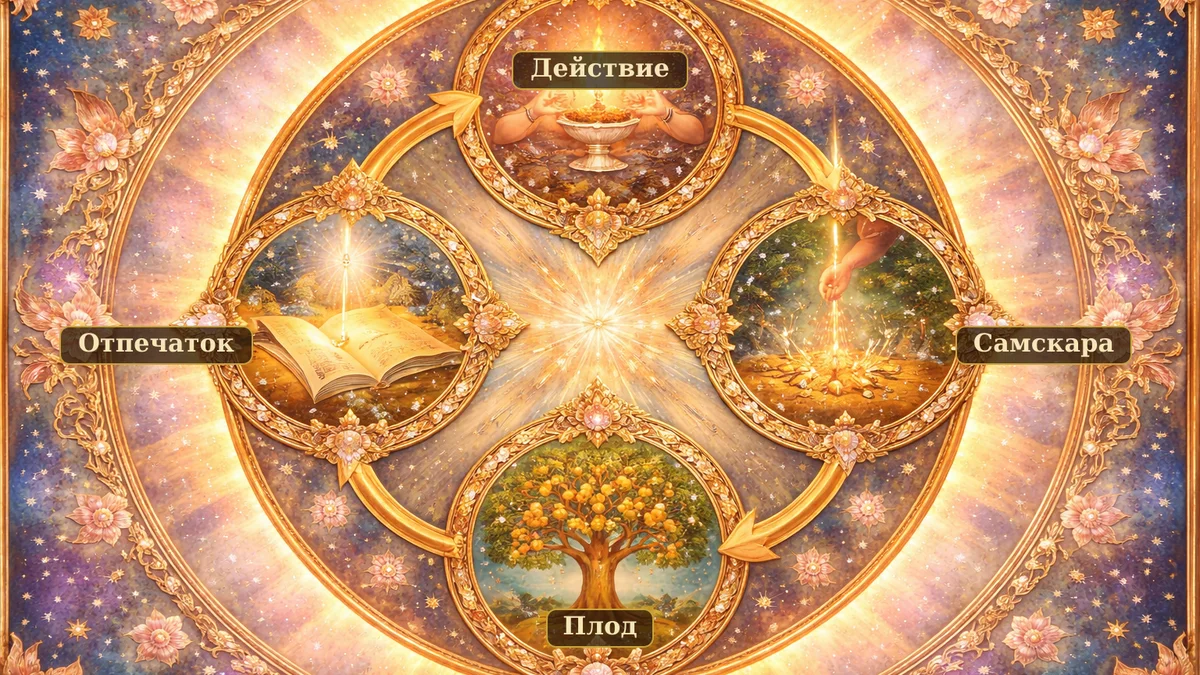
An action produces an imprint. The imprint remains in consciousness. An internal deity—Chitragupta, the internal censor—is responsible for this imprint. This internal censor is within us, and he is also in the great universe as an assistant to Yama, the secretary of the god who governs incarnation.
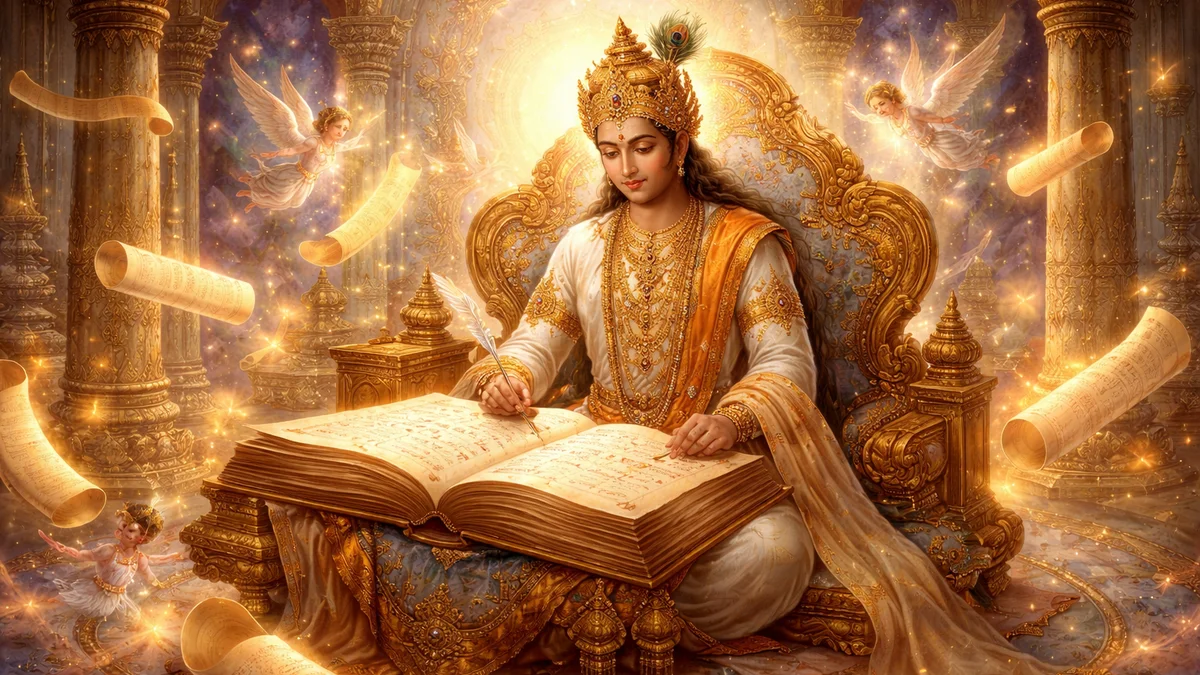
Chitragupta has many assistants—the shravanas and their wives, the shravanis. Various spirits, even domovoys (house spirits), can be his assistants. If Chitragupta even sees a record but doubts it, he will call this spirit and say: "Come, clarify, tell me—you lived nearby in the same house." And some house spirit will say: "Yes, that's how it was." Chitragupta will clarify it finally. But in reality, they all possess a very clear understanding of karma. They see the records in the astral archives of the chronicles.
This internal censor is constantly active. It is like a built-in movie camera that is constantly writing and registering. For example, now in Moscow, there are many movie cameras. If a person breaks traffic rules, it is all recorded on a disc. There is no need even to stop them and fine them. A bill will arrive in the mail—a fine for speeding. One can say that Chitragupta is the owner of such internal cameras that record non-stop.
In many commercial stores, there are cameras, and it says: "Smile, you are being filmed by a hidden camera." If a person wants to steal something, it will be visible. It can be replayed, and they won't be able to talk their way out of it. They will be told: "Look, that's your face." This is the same as Chitragupta's records. These are servants from the mandala of Chitragupta in the human world.
The mechanism of karma begins with a recording, an imprint, and the internal censor registers all this so that later, sometime, it can all be presented. Mental imprints, traces, samskaras—a continuous, non-stop recording.
A practitioner also cannot free themselves from these records because their mind is constantly creating imprints. Even if a person has mastered the Advaita view, the recording still continues. For example, a person holds the Advaita view; they walk into a store, steal a DVD, and are caught. The person says: "All is illusion, all is Brahman." But this will not convince the store's security service at all. They will say: "Yes, yes, now we will clarify what is illusion and what is not. You will still be held responsible."
Even if he speaks this way, it solves nothing because the law of karma operates. You must understand that everything is illusion much more deeply so that all the guards and all the records dissolve in light—then your view will work. But until then, you will still have to answer. Chitragupta's records will have an influence. This is also the law of karma.
Nishkama-karma: Selfless Activity
When a person practices karma yoga, they realize themselves as a servant of the divine, a servant of divine forces, a channel for divine forces, a minister. Simultaneously, they realize their involvement in brahma-bhava; they have discrimination—they clearly understand who is the doer, who is the non-actor, who enjoys the fruits of labor, and who does not enjoy or receive any karma. Then their life is a continuous offering, a continuous sacrifice to God, service in a state of pure divine love.
When a person acts this way, such activity is called nishkama-karma. Kama means mundane desire, material desire. And nishkama means action without desire, without material motives, selflessly.
For example, in the monastery, we try to follow nishkama-karma. Surely everyone knows—you definitely won't earn money here, no matter how hard you work. It’s the same for me. For my activity, I have earned very little—one could say zero. Except for spiritual capital, of course. Although I feel like a workaholic in service.
We do not try to indulge our senses through our activity. We do not need expensive things to gratify our senses. We can engage everything in service. For us, it is much more important not to indulge our body, but to serve higher values, higher ideals, to help others, and to contribute to the enlightenment of humanity.
The moral satisfaction and moral capital that arise from this are much higher than any money. I feel very wealthy, wealthier than any oligarch. This is not monetary wealth—it is moral wealth. The satisfaction that comes from being able to serve and help others is the most valuable and greatest wealth. You can serve divine forces. All of this is nishkama-karma.
When a person acts selflessly, their mind is very steady; they gain mental equilibrium and gradually become established in discrimination, viveka, learning to distinguish the one who acts from the one who does not. They do not grieve over losses and do not feel great joy from receiving something. They engage all of it as a principle of service. This is karma yoga.
The Example of a Bank Cashier
An example is given: a bank cashier. Large sums are often brought to him. He sets them aside. And sometimes he must issue large sums to others. But he himself does not consider that he is the owner of these sums.
Imagine if a cashier received the payroll for an entire firm or enterprise—many millions—and he thought it was all his and felt great joy. And then he has to give it out. And he feels he must give it away and suffers greatly; he has to part with these millions. This is the consciousness of a person who is attached to the results of their labor and wants to reap its fruits.
But the cashier is not deluded—he knows: all the money belongs to the bank, it is not mine, I am simply operating with this energy, it is just energy. He has no sense of ownership, and desires do not bother him, even if he operates with large sums. All of this is karma yoga.
Foundations of Karma Yoga in the Sangha
We begin in the sangha with karma yoga. It is very important to grow within ourselves a new attitude toward the world, toward actions, toward material things, and toward the sense of the doer. If we do not understand this, we will not be able to pass through the higher aspects of service.
Yajna — The Highest Aspect of Service
What are these higher aspects? A higher aspect is yajna. Yajna means sacrifice, an offering to God. This is already an action, life as a ritual of offering, life as a continuous ritual, as a continuous sacrifice. When a person dedicates every action, twenty-four hours a day, to the Absolute. When every action is like a ritual of offering.
Such thoughts arise when we contemplate the law of karma.
