

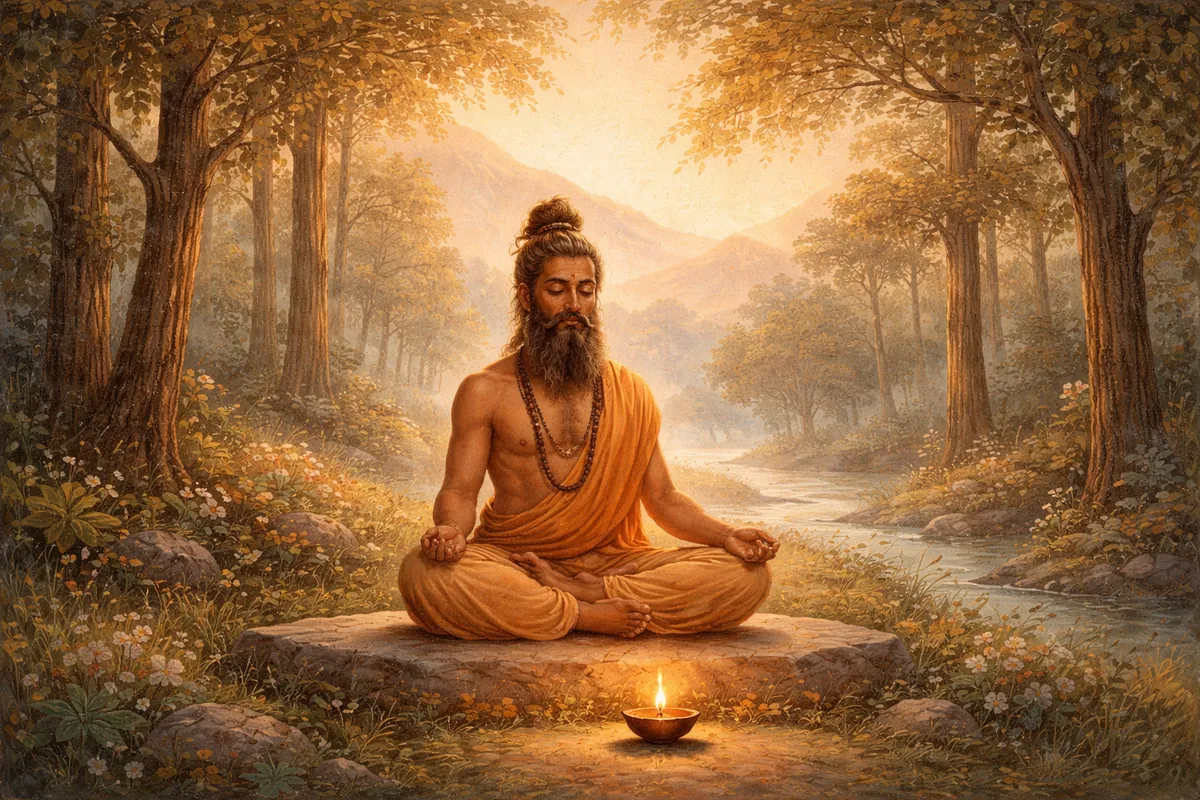
Offering the Body
When a Shivayogin—the embodiment of Shiva, who bestows grace upon all beings during worship—renounces attachment to his body, this is called the offering of the body. When a yogin offers his body to Shiva, then that body becomes a form of Shiva; there is no doubt about it.
To offer the body to Shiva means to recognize Shiva-tattva during all experiences of the body, all bodily acts. In the process of life, we have the experience of the body, bodily acts, the action of the body, that is, the actions of the karma-indriyas, the actions of the jnana-indriyas. Against the background of these actions, for a yogin practicing upasana, it is important to perform upasana. Not merely to perceive—to see, hear, smell, and touch—but at that very moment to perform worship of Shiva (upasana).
From the point of view of laya yoga, it is important to practice contemplation. Upasana means directing the soul toward God, toward Maheshvara. Contemplation means abiding in the state of Maheshvara. Upasana means directing one’s perception, the vector of one’s perception, toward the first tattva—Shiva-tattva; whereas contemplation means already abiding in Shiva-tattva, as if you yourself, as consciousness, are Shiva-tattva.
Contemplation means abiding in the fruit, while upasana means moving along the path in the relative. Contemplation points to absolute truth; upasana points to upaya (method) of action in relative truth. Contemplation means prajna; upasana means upaya. Prajna is wisdom, and upaya is method. Contemplation and upasana are like two wings of one bird, like wisdom and method.
During bodily acts, the yogin performs upasana—this means that he sees something, but at that moment he worships; he does not simply see like an ordinary person who sees something and becomes captivated. He hears something—at that moment he worships Shiva. He touches something smooth or prickly—at that moment he worships Shiva. He smells, and at that moment performs upasana to Shiva. This upasana at the moment of bodily experience is the offering of the body.
The second aspect of offering the body means that the yogin does something with his hands, feet, tongue, with all parts of the body, but at that moment performs upasana. He performs worship; that is, he directs it toward Shiva.
Thus, the action of the five karma-indriyas and the action of the five jnana-indriyas, when we direct the mind toward Ishvara—all of this is the offering of the body. This means that we give bodily acts and bodily actions to Ishvara during upasana. Upasana is the movement of consciousness toward Ishvara—this is self-surrender itself.
The Unity of Upasana and Contemplation
For example, I look at a conch, and I have the notion: this is a conch; this is the action of the jnana-indriya (sight). But when I look at the conch and my mind is directed toward Shiva, a certain bhava arises, and I simply connect the visible conch with divya-bhava. Upasana begins; there is movement in consciousness. I am no longer interested in the conch merely as a conch; I am interested in the conch that I connect with Ishvara. On the relative level, for example, I use visualization: how this conch sounds during puja, as an offering to Shiva—this is upasana; or I think about how to make use of it in order to sound it for Shiva—this, in the relative sense, is upasana.
But contemplation is somewhat different. In contemplation I do not move within Shiva-tattva; in contemplation, to move somewhere is a mistake. In contemplation, one is not supposed to move anywhere, because contemplation is the absolute state, where we do not single out a subject who must move, an object toward which one must move, nor do we single out a starting point and a point of arrival. All this is important and correct for upasana, because upasana is a method. A method always deals with the relative, but for contemplation, for jnana-drishti (the view of the teaching), we do not move anywhere; we abide in the absolute.
At that moment, when I look at the conch, I do not need to direct anything anywhere; it is enough for me simply to abide in naked awareness, in unity, even without any words, without any recognitions.
This kind of dual state—jnana-drishti and contemplation, abiding in the first tattva without movement, without offering anything to anyone, without division into subject and object, and at the same time the orientation of consciousness toward worship of Ishvara—this is the unity of brahma-aham-bhava and divya-bhava. In such unity we carry out both worship and contemplation. In the broader popular sense, this is bhakti yoga and jnana yoga. Bhakti yoga and jnana yoga (worship and contemplation) must go together.
The Dangers of a One-Sided Approach
What happens when there is only jnana yoga, such dry jnana yoga, such a dry Brahman-smarta, an Advaitin who says: “Everything is Brahman. I am Brahman; there are no more questions.” The yogin tries to establish himself in the first Shiva-tattva, and he abides excellently in the View, and he strives to contemplate the View, but the energies are constantly active, the jnana-indriyas are constantly working, the karma-indriyas are constantly working. The energies constantly tempt him, knock him out of this state, and he remains in a very exalted View, but in terms of energy he is always rather weak, always helpless, unless he is a very powerful jnani whose jnana blazes and burns up all energies.
His consciousness does not manage to redirect itself to the thought of Brahman, to jnana-drishti, and the power of contemplation is not sufficient to pull consciousness out of the energy of perception, out of the energy of action, because there is no upasana; there is only the static action of abiding in the first tattva.
Then disappointment arises; he feels a discrepancy—there should be such a great bhava, such a great View, and yet such a shameful constant identification with energies—a mismatch, because the energies are not being worked with.
But the principle of tantra is always the inclusion of energy, including bodily energies: sight, hearing, smell, touch. Such inclusion through upasana solves this problem, when I not only abide in the first tattva, I also actively direct all energies into this first tattva. I not only abide in the state of “Shivoham,” in the state of “Aham Brahmasmi,” but I also actively direct all objects of perception, offer and sacrifice them to this abiding in “Shivoham,” sacrifice them to God.
I do not merely contemplate the room, the sink; rather, I worship Ishvara through everything visible, continuously deify it, consecrate it, sacralize and transform it, extracting divya-bhava from everything visible. Whatever enters my field of vision—pure or impure—through upasana I consecrate it, extract divya-bhava from it, and transform it into sacred vision. Then divya-bhava and brahma-aham-bhava become a powerful unity that turns into mukti-bhava. Such is the path in anuttara tantra on the path of contemplation.
Why is it said that anuttara tantra cannot be practiced without initiation? Because initiation reveals the very essence, the Refuge, the connection with the lineage of transmission. It is impossible to perform upasana if there is no Guru, ishta-devata, and lineage of transmission—how will you perform upasana? It is impossible.
Offering Pleasures
The yogin should offer to Shiva—the embodiment of happiness and consciousness—all those pleasures that arise through contact with objects that delight the senses. All the pleasure that arises through seeing, touching, listening, smelling, and so on—all of this should be offered to Shiva.
In the body, in the mind, there are neutral, negative, and unpleasant experiences; there are also pleasures. The principle of tantra is this: everything can be offered, everything can be made into upasana. To offer means the experience itself. For example, a neutral experience can be made into upasana; pleasure too can be made into upasana.
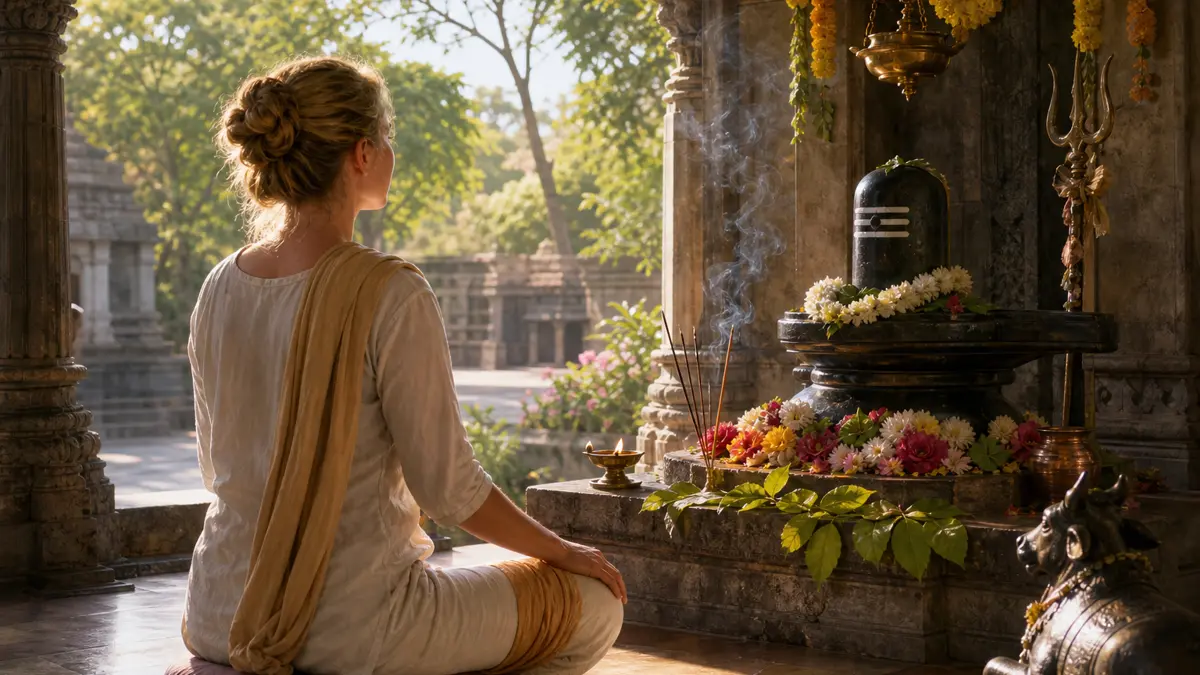
For example, if you smell the fragrance of incense or flowers and offer them to the deity, this is upasana. If you simply breathe in fresh air, neutral experiences—you can also offer them, make this into upasana.
If you are experiencing some unpleasant moments, for example, your shoes are pinching, you can make this into upasana. In ancient times, there were many well-known saints in different traditions who wore heavy chains, something very uncomfortable, chains on the body, as tapasya in the name of God, for the glory of God—they made this into upasana.
When something is uncomfortable for you, they imposed additional restrictions on themselves, wore shoes with nails in them, for example, bound themselves with chains, with something heavy, but for the glory of God; and then unpleasant experiences, on the contrary, become a method (upaya)—a way of worshiping. This is a very unusual view, and in tantra unpleasant experiences can be made into upasana.

For example, you have a nail in your shoe, an unpleasant experience; you think about how to get rid of it, it simply drives you crazy, but, on the other hand, if you offer it, you think: “Oh, this is my tapasya; if yogis stood on nails, then I am standing on a nail. In the name of God, I am making this an upasana.” Then the pain from the nail becomes a moment of recognizing bliss every time you step on it, and you receive vajra bliss in the right foot, in the ring toe, and it directly awakens the muladhara chakra, so that the pranas are introduced into the central channel. Since you experience it with a great purpose, it becomes a real practice—this is the principle of tantrism.
Finally, enjoyment can also be made into upasana. Usually the attitude toward enjoyments is such that the soul strives for them and becomes absorbed in them; it becomes a captive of enjoyment, a slave; a person is simply seized by them. Another type of attitude toward enjoyment is that it is something sinful and must be avoided, since it lowers the soul downward and binds it to matter.
The principle of tantra is that properly experienced, measured enjoyment can be made into upasana; it can be offered, one can worship through enjoyments. Various types of enjoyment are described, for example:
- Manas-tushti-bhava (mental enjoyment), for example, imagination, visualization
- Rasasvada-ananda-bhava (enjoyment connected with taste), when you eat prasad, consecrated food
- Enjoyment connected with sound, when you listen to beautiful music and make it upasana
- In general, any enjoyments that enter the field of your consciousness
Instead of becoming conditioned and attached, you offer the enjoyment to Shiva, simply providing Him with your body as an instrument. However, such enjoyments must be proper, dharmic, sattvic, and measured, and must not violate the yogin’s samaya.
In the life of a yogin, what enjoyments can there be? Good prana, the joy that prana is moving through the channels, in the upper chakras, the state of ananda. The ananda from a powerful state of prana when the winds enter the sushumna can be made into upasana; it can be offered to Shiva.
Also bhajans—the enjoyment from singing bhajans. It is often said: “When you sing, do not enjoy the bhajan yourselves,” that is, there is a way of singing a bhajan in which a person simply enters ananda, but this ananda is of a lower order.
It is the same ananda that a person experiences at a rock concert—there, too, people engage in improper upasana; the energy rises, but is God there? There is no God there. Consciousness appropriates ananda for itself; there it is akin to intoxication, drug addiction; there is bliss, energy moves. This delights me, but at that time I do not remember God, and I do not give away this bliss, therefore it is said: “Do not enjoy the bhajan yourselves. God enjoys it. First you give it to God, but you may enjoy the bhajan after God has already returned the enjoyment of the bhajan to you in the form of grace; then your enjoyment will be correct. It will not be the enjoyment of the bhajan itself, of the melody—it will be the enjoyment of divine grace as a result of upasana during the bhajan.
All that joy which the Atman experiences through the body, the yogin sacrifices to Lord Shambhu, and thus attains purity.
Ways of Offering Through Upasana
So, how does one offer while performing upasana? There are different ways depending on which method you practice.
The simplest is the recitation of the japa “Om Namah Shivaya” and the performance of dhyanam—meditation on the form of Shiva. This is when, at the moment of an experience, enjoyment, a negative state, or a neutral one, you combine japa and visualization.
If the practice proceeds as the yoga of the illusory body, then transformation into the illusory body is performed, along with japa and visualization of the deity in the chakra with which the experiences and pleasures are connected. For example, when you experience bliss from music, you transform yourself into the ishta-devata, with one head and two arms, recite the mantra, and in the anahata chakra, which is connected with sound, you visualize Shiva and offer Him the bhajan. You concentrate on Him and engage in the visualization of offering goddesses who perform the bhajan, the upasana to Shiva. The same applies to any chakra connected with smell, touch, taste, and so on. This is the tantric method through visualization and transformation.
The method of anuttara-tantra is direct abiding in divya-bhava, bypassing names and forms, when you attune yourself to divya-bhava, meditate on Ishvara, and unite divya-bhava with the experience of enjoyment, a neutral state, or even a negative state.
In the scriptures (Agamas), the sacrifice of the organs of perception is called the binding of all the senses to Shiva, the highest of the high. Experiencing pleasure from the objects of perception, the yogin dedicates all his senses to Shiva; therefore the yogin is called “one who has sacrificed his sense organs.”
When the joy arising from the perception of the sense organs is not sacrificed to Shiva, such a person is called a thief. The joy of perception that has not been sacrificed enslaves; a person becomes a slave to the joy that comes from perception. He is, as it were, stealing from Ishvara what belongs to Ishvara, and punishment follows. Punishment in the form of karma, of identification.
Why do people suffer from the law of karma? Because they constantly steal from Ishvara — impressions during perception, impressions during actions, impressions during thoughts. Punishments follow theft. The punishments are not carried out by Ishvara himself; they are carried out by Prakriti — Shakti in the form of Prakriti (material nature), which controls all these processes.
She says: “Ah, you took perceptions from me, but did not give them to my lord, while everything here was created by my lord; I myself belong to the lord, and you, insignificant human being, decided to appropriate this for yourself. Very well, then here is karma for you, here is the karma-phala (fruits and results) of your perception. You performed actions, but both you and I, and your action, are the will of my lord. But you decided to appropriate the fruits for yourself; you stole from my lord. Very well, then you will have to bear responsibility for these actions.”
Thus the law of karma comes into effect when we steal from Ishvara and appropriate to ourselves the authorship of actions or perception — this is called karma-mala. But when, in the process of upasana, we offer to God all our actions, all our perceptions, the law of karma does not operate; at that moment it does not work. Everything that is dedicated to Ishvara does not become our karma, and then what happens is that, through dedication to Ishvara during upasana, a stream of divine grace descends, and divine grace fills us — this is the proper way of life.
The improper way of life is stealing from Ishvara. All living beings suffer constantly because they steal and appropriate, and do not receive divine grace. They do not nourish themselves with divine grace, they are not filled with divine grace; instead, they fill themselves with perceptions, with their karmas, and after this they inevitably receive karma-phala (fruits and results). Prakriti, as it were, rewards them with their karma-phalas because they appropriated them for themselves. She rewards them with responsibility for their perception and for their actions.
Question: Guruji, does such sacrifice not work without contemplation?
They must go together; it is not a matter of it being without contemplation. It must always be with contemplation, of course.
Subduing the Mind and the Senses
The inner organ of perception, consisting of consciousness, intellect, and mind, is an elephant driven mad under the influence of the notions of “I” and “mine.” The Shiva yogin who has managed to tie this excited elephant to Shiva as to a post is a true hero who has attained all perfections. The mind is foremost among all the sense organs. When it is subdued, held in Shiva, what then is there to say of the other senses, which are subordinate to the mind? Control of the senses is called non-involvement. When all the senses are directed toward Shiva, how can they drown in samsara? When all the senses are under control, peace arises, which, like an axe, cuts through the poisonous thickets of samsara. It is precisely through the organs of perception that sins and virtuous deeds are born. When perception is sacrificed to the Lord, whence can there arise bondage by actions, by karma?
So, when perception is sacrificed to God, whence can there arise bondage by actions, bondage by karma? Prakriti (material nature) ceases to reward with the fruits of karma, with karma-phalas, at the moment when we stop stealing from God what belongs to him; then we stop appropriating and identifying. When we give everything away, we are honest workers.
There are workers who pilfer at a company, in a warehouse, in a store; they take something for themselves. In Soviet times, this was generally the norm. If someone worked as a cook, then it was normal to bring a little home for one’s own; it was not even considered shameful. Someone works at a candy factory — it is normal to carry candy away all the time; after all, we have plenty of it.
This is roughly the same thing: we live in samsara, and we are constantly pilfering. There is so much of everything here, so very much — perceptions, smells, touches; why not take something for oneself? But gradually this habit grows stronger, and we completely forget that it is not ours, that it must constantly be given back. Not given back physically, but given back in a mental sense, given back in the sense of not appropriating it to one’s soul, because the soul belongs to God and all of material nature belongs to God.
It cannot be said that it is forbidden to experience pleasures, or that it is forbidden to experience perceptions — to hear, to see, to smell, to touch. What is forbidden is appropriation. When we stop appropriating and begin to give — karma ceases to act upon us. It turns out that the sufferings caused by karma for the soul are a consequence of its appropriation, a consequence of stealing from God.
When the soul thinks: “Why is God punishing me?” — for theft; you should not have stolen. You should not have appropriated what never belonged to you; you confused everything, you confused the entire course of life in this world. As soon as the soul stops appropriating, stops taking from God what does not belong to it, karma will stop punishing it.
Four Stages of Relationship with the World
There are different relationships with the world, and the first, the most initial one, is a relationship with ignorance, in ignorance. For example, I think that this situation is right, and I consider myself right, but for some reason I suffer. I think the situation is right, I am right, but I suffer — this is the first way. But since I suffer, it means something is wrong, something does not add up; I cannot suffer if I am right and the situation is right.
Then the soul begins analytical work, begins to reflect, and it understands: “I understand that the situation is wrong, and I understand that I am somehow wrong in the relative sense” — and here there is no longer suffering, but an attempt to figure it out.
Finally, the third stage is the stage of a sadhu. Sometimes the situation is wrong — I am right. Sometimes the situation is right, but I am wrong. But in general, both the right and the wrong are already present here — this is the state of a sadhu.

For example, sometimes we are in the right state, but the situation happens to be wrong — someone behaves incorrectly, or we practice dharma and someone treats us incorrectly, does not respect us, or we behave with restraint while someone behaves without restraint; it happens in different ways. But when we are in the right state, in humility, in pure vision, in calmness, in harmony, in faith, then we can say: “Perhaps all this is wrong, but I myself am in the right state” — and we have no problems, even if the situation unfolds toward us incorrectly, as it seems to us.
Wrong means somehow disharmonious, destructive. Sometimes the opposite happens: the situation is right — I am wrong. Around me are calm monks, sattvic karma-sannyasis, while in my soul there are devils, and dogs are eager to bite everyone, to get angry, to spill something out, and I understand: “In general, this is not good, but I can do nothing, because I am wrong, and everyone around is so right” — this is also a mismatch.
This happens when some spirit gets to heaven, and he very much wanted to get to heaven, but then, having arrived in heaven, he sees that everything is not so, that heaven is not outside — it is within, that he has no heaven inside, and that people live in heaven because they have a sattvic state within. They unite and live in communities of angels or devas. They form heaven because their inner state allows it, and even having entered a heavenly world, he understands that there is no heaven within him; therefore he cannot live in heaven, because his inner disorder, inner disharmony and conflict reject heaven. This state — the situation is right, but I am wrong — is the state of a sadhu, when the sadhu observes all this.
Finally, in the process of purification, attainment comes — this is when the situation outside is right, and inside I am also right, and there is harmony both inside and outside. I agree with everyone, everyone agrees with me — there are no problems. Outside there is purity and love, and inside there is purity and love. From this situation liberation already comes; following this, the barriers between the inner and the outer are broken. I and the situation are one; inside I am Shiva, outside is also Shiva. Then the inner and the outer are broken down; I and Shiva are one.
Often people stop at some preliminary stages and for a long time cannot proceed to them. Worldly people almost always live like this: “I think the situation is right, I think I am right, but I suffer, I cannot understand why” — this is a vicious circle.
The state in which the situation is right and I am right is the state in which all actions of body, speech, and thought become upasana, when all of them are offered to Shiva. This is the only way to correct this wrong situation, to stop stealing from God, to begin giving, and to establish total, complete harmony, the total unity of the inner and the outer, when I and the situation are one.
The Fire of Consciousness and the Offering of Perceptions
When the fire of consciousness shines within and without in the form of the world, a person offers all objects of perception to this fire and becomes free.
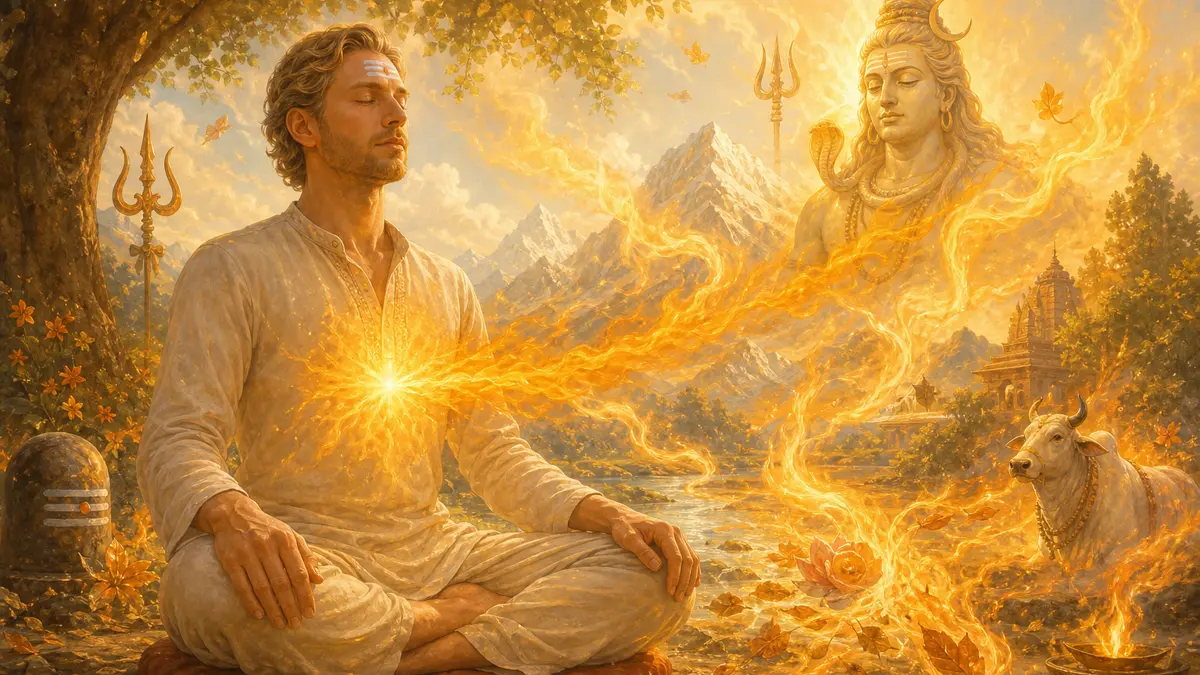
“The fire of consciousness shines within and without in the form of the world” is a very difficult phrase to interpret. In order to discover the fire of consciousness within and without in the form of the world, we must reach the dimension of turiya. We must immerse ourselves deeply in shambhavi mudra, in krama mudra, and see this fire. This fire is the light of the Absolute, which stands behind all names and forms. In the process of contemplation, we gradually begin to discover it.
So, first we must discover this fire of consciousness, and then learn to sacrifice all objects of perception to this fire. After this comes liberation, and here the three “S’s” are embedded — self-liberation, self-surrender, and self-recognition.
At first, we discover this fire of consciousness through self-liberation. Another way of discovering it is through devotion, self-surrender, through divya-bhava, through upasana. One way or another, we must discover it. Without self-liberation on the subtle level, this fire of consciousness cannot be discovered. If there is self-liberation, you will certainly discover it as pure consciousness. On the other hand, without devotion and without upasana, you will not discover it as divya-bhava. If there is devotion and upasana, divya-bhava will begin to manifest as a pure, elevated feeling.
The Principle of Self-Surrender
After this comes self-surrender, when you begin to offer all objects of perception, the objects of the sense organs, to what has been discovered, to that which you have discovered. In self-liberation, we discover; in self-surrender, we give. This is what distinguishes self-surrender from self-liberation.
In self-surrender, we already experience this fire of consciousness, but we have karma, we have experiences of the senses, we have pleasant feelings of enjoyment, we have negative feelings, and our task is to give, give, always give, everywhere totally give. Self-surrender means giving, appropriating nothing for oneself. As soon as we appropriate something, problems begin. But when we give, there is nothing but grace.
To God one must give one’s karma, one’s kleshas, one’s joys, one’s enjoyments, one’s merits, one’s neutral states, and give everything that exists. The one who gives is always happy; the one who does not give encounters difficulties.
The problem of giving or not giving lies in the fact that a person has not discovered the light of this consciousness, does not understand where to give and how. What to give is clear — one’s ego, one’s anger, one’s lust, one’s greed, one’s envy, one’s pride, one’s plans, one’s notions, one’s patterns of mind, one’s ideas, one’s identity. This is clear — to give what we are, because what we are is karma. But how to give, where to give, if this mechanism is unclear, then it is difficult to give.
In the highest sense, one should discover the light of consciousness through self-liberation, contemplative presence, and give there. If the Guru points to the natural state, the disciple grasps the natural state on the fly, has it verified by the Guru, and then everything becomes clear. The Guru says: “Give there” — it is just as if the Guru said: “Here you have one hundred gold coins — give them to him.” “I understand everything; I give and give.”
Instead, you have karma — merit, good karma, bad karma. The Guru says: “Give it there. You experienced the awareness of nonduality — yes. There was an open mind — yes. You experienced luminosity — yes. Give it there.”
But while this experience is not deep, the disciple forgets this and at some stage stops giving, and then he says: “I haven’t given for six months already.” The Guru says: “And what is the matter? Why did you leave it for yourself like that? This is where theft begins.” And if one has not given the good, then the ego simply begins to flourish, the ego simply begins, pride appears: “I am very good,” because one has not given for a long time. “I am very great. I am very intelligent. I am very powerful. I am very loved by everyone” — something begins to flourish. This is a sign that one has not given for a long time; merits of an egoistic nature have accumulated.
But if these were not merits, but something negative, then it is the opposite: “I am bad, I am weak, I am worthless, I am obscured, I am stupid, nobody needs me, I am incapable.” The Guru says: “But why? I told you where to give it; why are you carrying this around, why didn’t you give it? You have accumulated so many obscurations and are appropriating them for yourself.”
It is just as if you were carrying manure, and you were supposed to pour it somewhere into a pit, or into someone’s vegetable garden, but instead you stopped and began pouring it into your own room again and again. You say: “It smells bad here. I’m all dirty.” What foolishness; it should have been delivered to its intended place, to the proper address. This is the principle of self-surrender. Self-surrender means sacrificing all these experiences, non-appropriation. To appropriate manure is utterly foolish; merits, gold — that one can still understand, but this...
Practical Methods of Self-Surrender
It often happens because the yogin does not know where, to whom to offer, and if the disciple has not revealed or become established in the natural state, he is a beginner, and everything below the fourth stage is all beginners. At the fourth stage this is not so simple, so the Guru says: “Here is the name, here is the form, here is Shiva, here is Dattatreya — offer there. Name and form — offer to the murti, offer to the saints. Here is the Tree of Refuge — give to them,” implying, according to the principle of the Vedic tradition: we look at the small — we imply the great; we look at a small murti — we imply the great Shiva.
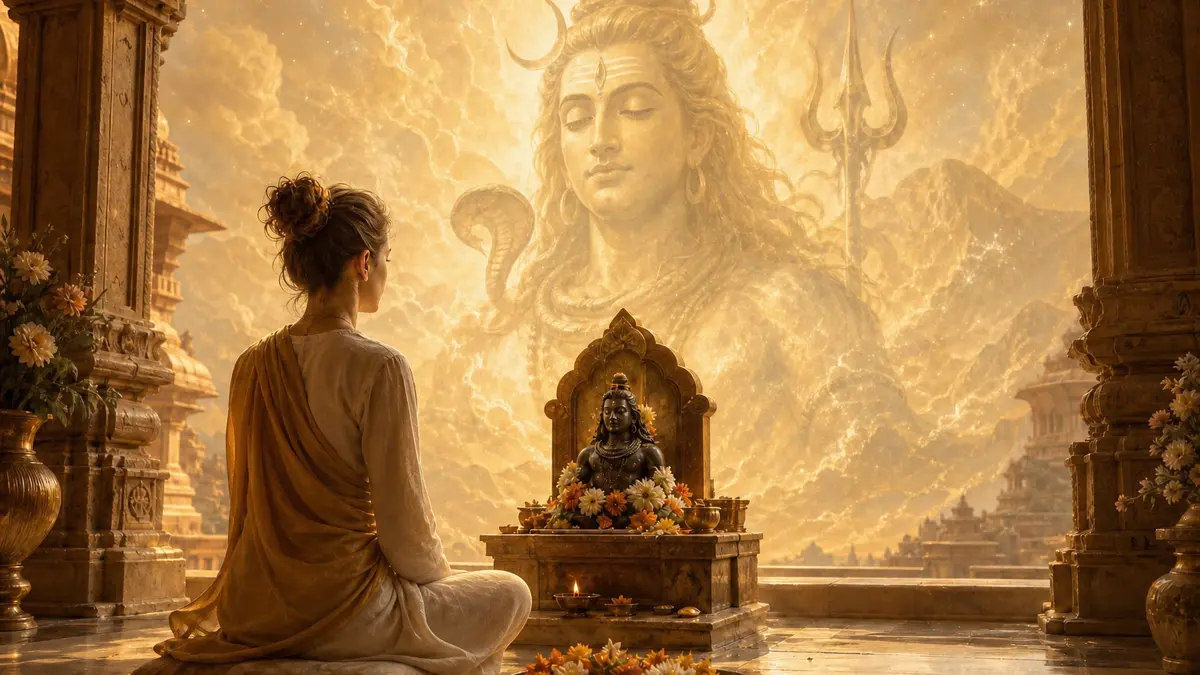
Murti means that we look at the small, while implying the great — this is the principle of upasana. We look at name and form — we imply Brahman; we look at Shiva — we imply Ishvara, who creates billions of universes.
Question: It is still not very clear how to transform and offer manure so that it is sattvic.
It is too early to speak of transformation now; it simply needs to be offered.
Question: But we do not offer manure on the altar.
Not on the altar. We must offer it through divya-bhava within us, when negative states arise: for example, recite a mantra, direct our mind to the visualized image of Shiva, to feelings of devotion, so that the feeling of devotion, the exalted bhava, may seize and transform our kleshas, our obscurations. It is not we who transform them, but divine grace, while we only help a little. Divine grace itself has the natural property of transforming when we have a great deal of it, and we only direct it a little. Of course, there are rituals, visualizations, and practices, but we are not speaking about that now. We are speaking precisely about the principle itself.
Offering Mental Images
Whence can the sufferings of rebirth arise for a person who offers into the fire of consciousness the mental images generated by the world? The light of the Atman, having the nature of Consciousness, is awakened by the vital breath (prana).
So, the world generates mental images. When the yogin does not appropriate mental images, he offers them — offers them to the fire of consciousness. If the fire of consciousness is open, such offering must certainly be performed. One who has opened the fire of consciousness but does not know it must understand this, because if he does not understand, then he will try to become established in contemplation, but at the same time he will appropriate mental images and images from impressions. These are two contradictory, mutually exclusive types of action.
If, however, he offers to the fire of consciousness all mental images generated by the world, then no fear, no confusion, no despondency, no ignorance will arise in him.
Usually the one who suffers is the one who forgets to offer, who does not give. Whatever may appear in our life — anger, fear, attachment, ignorance, envy, greed, dissatisfaction, discontent, disagreement — we must immediately offer it to God.
When offering takes place, in response to such offering there comes a descent of divine grace; it certainly comes. It cannot fail to happen, because the divine Source itself is precisely the source of divine grace. It cannot be that we have performed self-surrender and in response some kind of boomerang comes and hits us on the head — no. Self-surrender performed sincerely, with love, in the right state, always elevates the soul, because it fills it with divine grace.
Those who always offer are always joyful and happy, because they are filled with grace. It is precisely those who do not carry out such self-surrender, or those who do not know how to carry it out, who remain in confusion, joylessly, without grace, without joy, unhappily.
The Mechanism of Self-Surrender
Here one must again and again examine the mechanism of such self-surrender, so that self-surrender becomes a habit. This self-surrender is either through contemplation or through devotion and love, through divya-bhava or brahma-aham-bhava; ideally, they should go together.
But for such self-surrender to take place, one must always see directly, clearly, and vividly the one to whom we perform self-surrender. For example, in order for you to transfer money to someone, you need to see the person or know his address where to send it; you must know clearly: to this person. You must know his card number or something of that sort, how to transfer it to him. You must not doubt this person, and you must not doubt his account number; then self-surrender will work.
If it is something like: “To some person, he has some account, send it somewhere there” — it will not work. You must be sufficiently convinced of this. You must have no doubts, and if you have not become convinced of this through contemplation, then you must do it through upasana.
Upasana is good because even if you have no contemplative experience, but you do have faith and devotion, it is a good address. At least you know japa, how it is performed: “Om Namah Shivaya.” You know who Dattatreya is, who Shiva is, and you do not doubt that this is the addressee—this is the address to which to offer. When your soul feels bad, you go to the temple—there is the addressee. The method of self-surrender is a bow, japa, everything; self-surrender takes place on the condition of sincerity, in divya-bhava, which is present.
Once a parcel was being sent to us; we had bought a murti of Dattatreya, and in Delhi, in an apartment that belonged to Babaji’s ashram, there was a certain prabhu there. We left Dattatreya there and agreed with this manager from the ashram that he would send him to us in Russia; we could not take him with us. Then a parcel notice arrived, and it said: “Russia, to Ilya”—I could not believe that in the twenty-first century such a thing could happen, in 2010. There was not even his surname: Russia, Ilya, and it reached us; Dattatreya reached us.
It is just that in India people can quite easily send you a parcel like that; the funniest thing is that it arrived, Dattatreya arrived even with such an address. You see, if you have devotion, that is enough. You come and need to offer something, and you say: “Center of the universe. Shiva”—that is all, enough, and it will arrive. If you have divya-bhava, it will arrive, and grace will come as well.
