

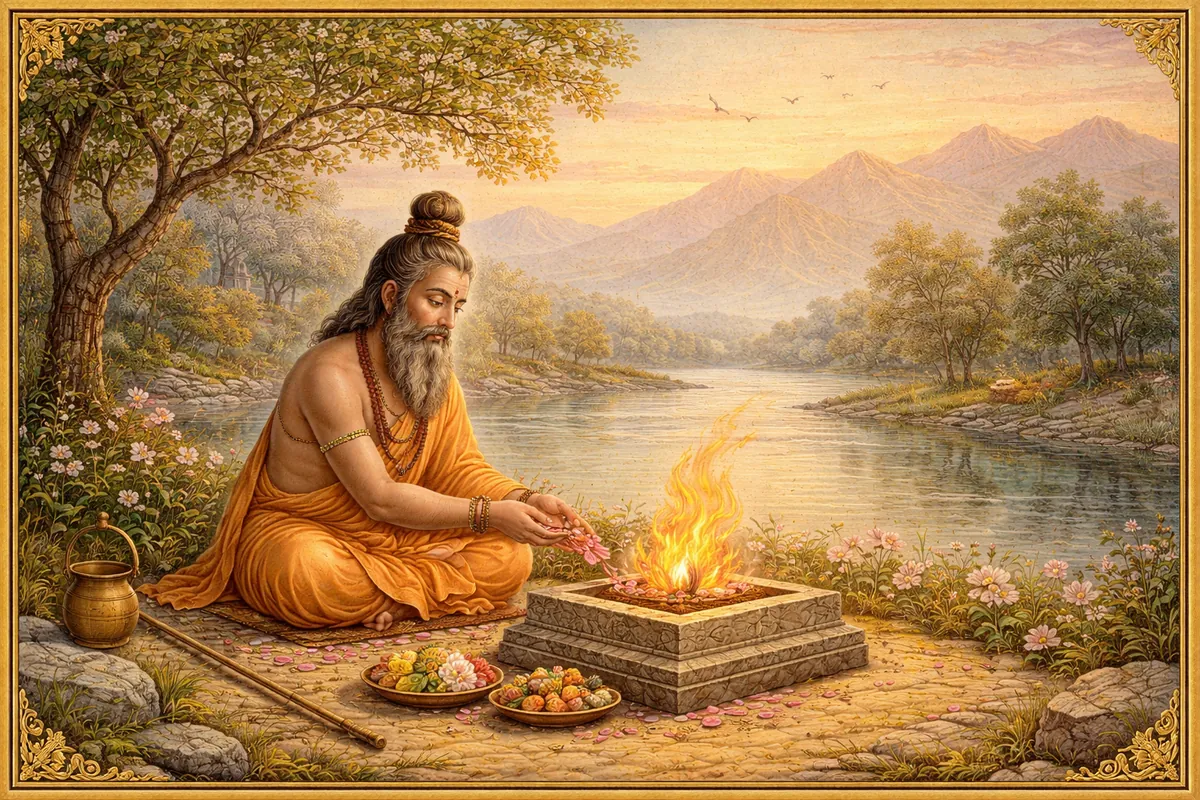
Commentary on the text “Sri Siddhanta Shikhamani,” Chapter 17, “The Offering of Inner States”
In this life, the soul has a chance to develop awareness and devotion to God. It must be used to the fullest. Awareness and devotion will burn up all karma if they become radiance, a flame. Karma is like firewood; awareness and devotion are like a flame. If the flame is strong, karma burns up. If the flame is weak, the firewood smolders and crackles but is in no hurry to burn, and the whole question is how to strengthen our flame of faith, awareness, and devotion.
As those who have realized the true state of Shiva say: “The offering of inner states, bhava, is the devoted dedication to Shiva of all states”.
Liberation from the Control of the External World
When we have learned, as we said at the previous satsang, not to steal perception from God and to offer Him all the objects of the senses that we experience through the indriyas, through the body, all actions, fruits, and results, then the external world ceases to control us. The external world controls us as long as we appropriate the perception of the external world for ourselves. As soon as we appropriate perception, the external world immediately begins to encroach upon our perception — this is logical. It is like if you stole something from someone, then other thieves also begin to encroach upon what you have stolen. If you carry something with you, there is something to encroach upon; but if you carry nothing with you, there is nothing to encroach upon.
The external world ceases to control us when we give everything to God, when we appropriate nothing — this is the law of a sadhu. When you receive something from the external world, it is not yours; it simply is not yours. Many people are mistaken, and because of this there exists an entire phenomenon of consumer culture, wars are waged, material culture has become very deeply rooted, and all of this is due to false notions that this belongs to someone. But this contradicts the fundamental principles of the universe and creation.
The fundamental principles of the universe say that the universe is the body of a single living being; we live within it. Creation is directed by the intelligent will of a single living being, and it is expressed by the concepts of iccha, niyati, rita, dharma, and Sat.
When we live in accordance with the will of the single living being, a person attains happiness, moksha, and godlikeness. Such a life is dharma, or moksha-dharma, while contradiction is adharma. By following dharma, a person attains moksha. Dharma is expressed in divinely revealed scriptures. This single living being constantly sends its messengers, representatives, to convey its will to people; that is why the Guru is here — for this reason, not for any other reasons. Why texts are published, why seva is performed — to convey this message to people. The texts say: “God manifests to His devotee in the form of the Guru.” These are fundamental principles, and the task of the Guru is to tell the disciple: “All of this here is not yours; it belongs to God. You yourself are not your own either; you too belong to God. Do not try to seek happiness in this.”
The Laws of Creation and Their Application
Based on these fundamental principles, there are laws, for example:
- The law of transformation: “What you think about, you become”
- The law of the magical nature of the world: “The world is a manifestation of consciousness. The world becomes the way you conceive it in your thoughts”
- The law of the materialization of intention. All of this is described in the “Yoga Vasistha” literally word for word: “Wherever and whatever consciousness conceives, then there it manifests”
- The law of correspondence: “As below, so above,” that is, what is kriya for Shiva is rajas for the jiva; what is sattva for Shiva is jnana for the jiva
- The law of retribution, the law of karma
When the soul understands the principles according to which creation is built and the laws by which it works, it can take them into account, follow these laws, and move toward happiness. When it does not understand this, it has a difficult time, as they say: “Ignorance of the law does not exempt one from responsibility.”
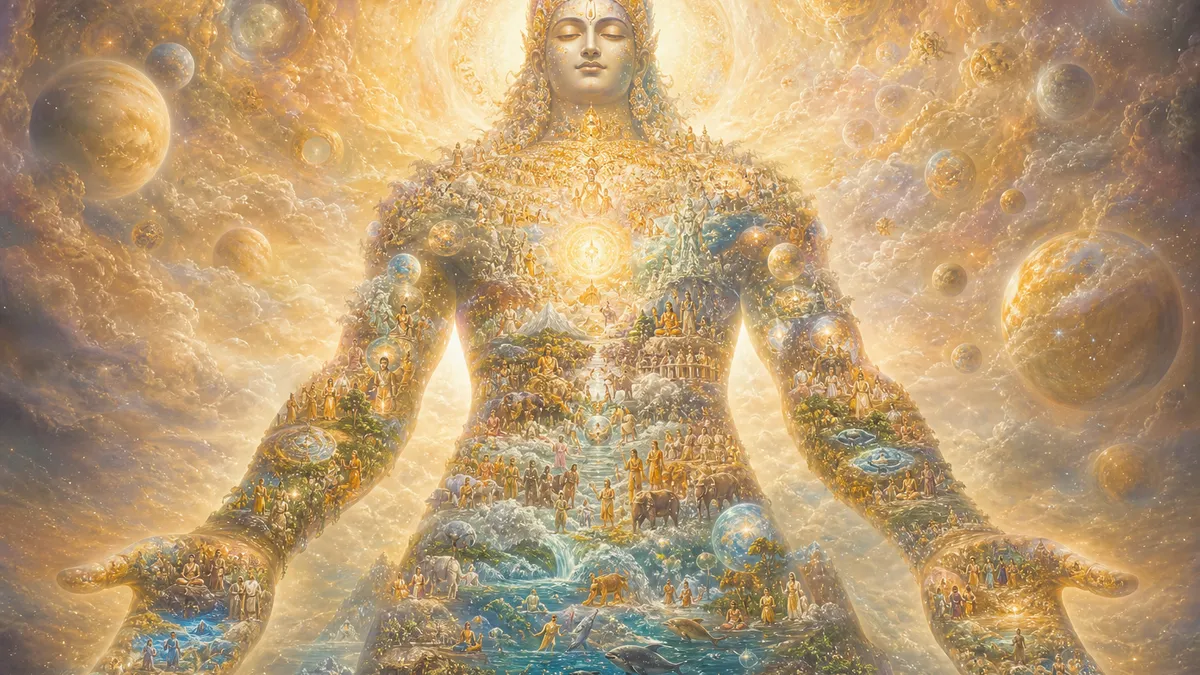
It is often said: “The whole problem lies in the practice of applying the law,” that is, it is not enough to know the law; one must understand exactly how to apply it. Abstract knowledge of the laws of creation and the principles of the universe will help very little. It does, of course, shape one’s worldview; the whole question is how to live and apply them every second, every instant, guided by all these laws and principles. Therefore, a spiritual Teacher is needed, the shastras are needed, a lineage of transmission is needed, and sadhana is needed. Specifically, one of the ways to follow these principles is offering, self-surrender.
The Offering of Inner States
The offering of inner states, bhava, is the devoted dedication to Shiva of all states.
Sacrificing inner states means a constant renunciation not only of perceptions of external objects and the understanding that all this is not ours — it does not belong to us. But also a renunciation of inner objects. Inner objects may be, for example, inner states, negative states, neutral ones, good ones, inner images, inner representations, thoughts, various moods, inner desires conditioned by the imprint of past samskaras and vasanas — all this is also not ours.
A disciple, studying the dharma of Vedanta and Shaivism, gradually comes to the conclusion, thanks to the guidance of the Guru and independent reflection: “Yes, the material world is not mine. I renounce it. I am learning to sacrifice everything.” But he begins to meditate, to practice dharana, inner experiences arise in him, and then he thinks: “Perhaps my desires, my inner moods, my representations, my thoughts — this is mine.” Here the Guru comes again and says: “All this is not yours. Do not identify with it, do not try to appropriate it for yourself. Do not steal from God either. As soon as you appropriate it for yourself, you will have to answer for it. You will have to become bound to it, identify yourself with it. You will have to bear responsibility for it — and why do you need that? You need freedom, not karmic responsibility, not karmic retribution.”
If it is not difficult to detach oneself from material attachments, then detaching oneself from inner attachments is very difficult, since it is equivalent to detaching oneself from that old self with which we identify ourselves. Here again and again the Guru says to the disciple: “All this is not yours. Learn to sacrifice inner states:
- There is pride — sacrifice pride, do not appropriate it
- There is attachment — sacrifice attachment, do not appropriate it
- There are ambitions — sacrifice ambitions, do not appropriate them
- There are fantasies — sacrifice fantasies, do not become attached
- There is meditative experience — sacrifice meditative experience
- There are siddhis (magical powers) — that is excellent, sacrifice the magical powers
- There are abilities, high intellect, clarity, organizational abilities, charisma, various talents — do not become attached, sacrifice all your abilities
- There is strong will, the ability for tapas, vira qualities — sacrifice strong will, the ability for tapas, and vira qualities
- There is despondency, melancholy, dissatisfaction — excellent; what could be more beautiful than sacrificing all gloomy states to God? Do not appropriate them
- There is joy, intoxication with divine bliss, ecstasy — splendid, divya qualities, but do not cling; sacrifice them to God”
The Consequences of Appropriation and Sacrifice
Everything that is sacrificed purifies, and everything good that is sacrificed remains in its very best form. What is not sacrificed is fragile; it comes and goes. Divine ecstasy may be replaced by despondency, abilities may be lost and replaced by dullness and stupidity. Every time the soul appropriates any things and does not sacrifice them to God, it faces the fact that after some time everything changes, and it is cruelly disappointed. This is the consequence of appropriating inner states.
Not only is this impermanent, but one will then have to bear responsibility for many things, that is:
- When we appropriate pride, karmic responsibility arises in the next life in the form of rebirth either in Asura-loka or as a samsaric deity
- We appropriate bliss — in the next life karmic responsibility arises in the form of rebirth as a samsaric god
- We appropriate clarity — responsibility comes in the form of rebirth as a god of the upper world of forms
- We appropriate formlessness, emptiness, spaciousness — karmic responsibility comes in the form of rebirth as a formless deity of the causal world. Although it is a very exalted state, it is not moksha.
The Art of Self-Surrender and Viveka
The art of self-surrender includes the sacrifice of all inner states and viveka (discernment). We must discern who the object is to whom the sacrifice must be offered; we must clearly understand what it is that must be sacrificed, and who it is that sacrifices. The sacrifice, the sacrificer, and the object of sacrifice — all these three must be understood.
In the case of material objects, last time we established that the sacrifice is material objects, as well as objects of perception (jnana-indriyas). The object to whom the sacrifice is offered is Ishvara, Shiva. The one who sacrifices is the soul (jiva). The jiva performs maha-yajna (the great sacrifice) to Shiva through the eyes, ears, nose, mouth, hands, feet, and other things, dedicating everything to God.
The sacrifice consists of inner objects: moods, siddhis, meditative experience, various experiences. The one to whom they are sacrificed is the same object — Shiva. The one who sacrifices is the jiva. We must generate viveka, in which the jiva does not try to appropriate anything and gives everything to Shiva. For this, it must precisely understand where Shiva is within it, and what it is that must be sacrificed.
The inner state (bhava) is a modification of the mind. Dedicating to Shiva the experience of all images stored in consciousness is the offering of inner states.
The Practice of Offering Inner States
The offering of inner states, the offering of inner bhavas, may look as follows. In the waking state you experience certain perceptions, or in the states of waking and dreaming sleep (jagrat-svapna) you experience fantasies or images. But instead of appropriating them, declaring them your own, clinging to them, and bearing karmic responsibility, you detach yourself from them and decide to give them to God.
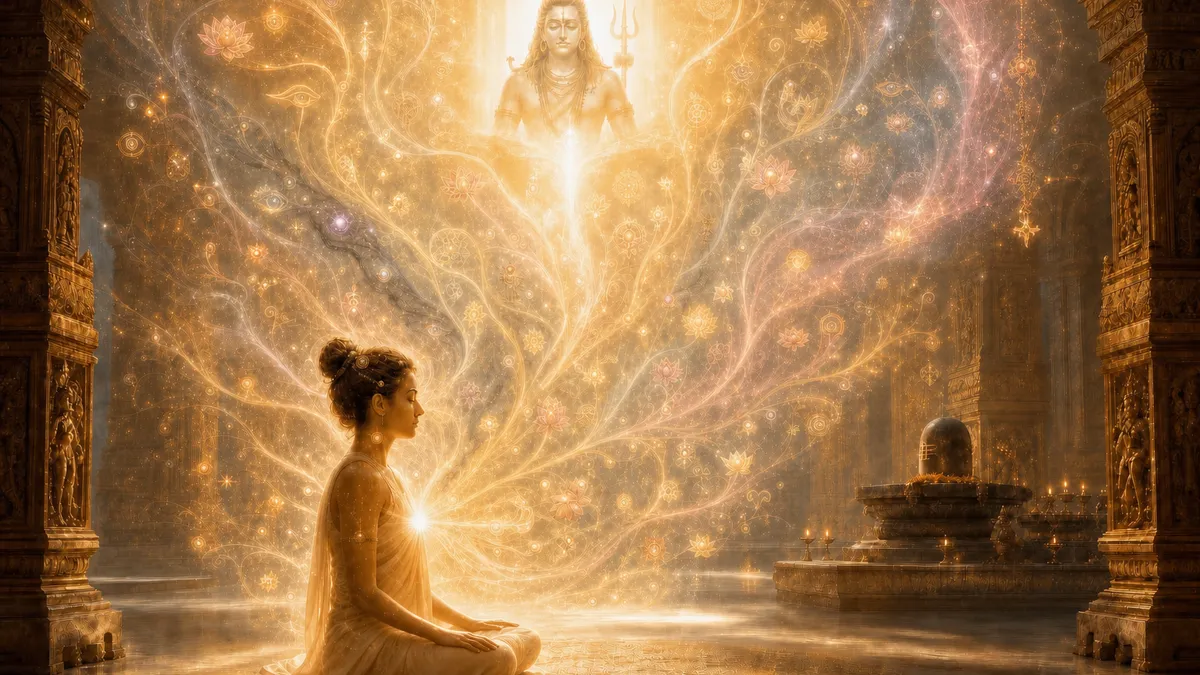
God, Shiva, Shiva-tattva is the first tattva, the boundless consciousness of Ishvara abiding in turiya, in turiyatita. As much as possible, at the moment of perception, you attune yourself not to the bhavas themselves, not to the moods themselves in the subtle body, but to Shiva himself, and create the intention: “Please accept this, please take it away. You yourself know how best to do it. I express only the intention, and you yourself will take everything.”
In this way you do not become attached to the mood, to the image, or to your fantasy. Thinking comes to you again, conceptual thinking, theories, ideologies, various thoughts. How can all this be offered? You again attune yourself to Shiva, who abides in the first tattva, who abides in the dimension of turiya. Again you express the intention: “Please take this away. This is not mine. This is yours. I do not want to appropriate anything.”
You meditate again—a beautiful mystical experience comes, a blue space appears in the ajna chakra, a lotus unfolds, and on the lotus a beautiful deity arises by itself; it gives you a staff, a chakra, a mace, a white lotus, places a garland around you, and gives a prophecy. What should you do with this experience? The deity praises you and predicts your future birth in pure lands as a lord of dharma. A beautiful experience, a beautiful prophecy, a beautiful vision, but here there is a very great temptation for the soul to appropriate it. Instead, the yogin says: “Shiva, I offer this beautiful experience to you. If such is your will, then I will accept all the necessary attributes, signs, and future destiny. But I do not appropriate it. I do not cling to it.”
In ancient times, one sadhu practiced standing on a pillar, such tapasya on one leg. Food was brought to him on a string, and he accepted this food. As a result of the tapas, after several months he began to see deities and saints who appeared to him, and he even saw heavenly gods and angels who came to him in a celestial chariot. They said to him something like this: “Among humans you have already attained perfection; the lord of the divine kingdom invites you to be transported in his chariot to his heavenly dimension.” He had already placed his foot, had already lifted one leg, but then he thought: “I should first give this to God and check how real it is.” When he gave it to God, all of it dispersed, and his foot was lifted over emptiness, over an abyss; that is, if he had stepped down, he would have fallen.
The Danger of Subtle Attachments
If we do not know how to give God our meditative experiences, our moods, our states, we inevitably become captives, hostages, or even slaves of inner experiences, meditative states, and various clarities. This slavery, this captivity, can be far more serious than material attachments, since even worldly people can free themselves from material attachments by showing a little willpower. But it is very difficult for many spirits to free themselves from the subtle clinging of subtle captivity, of the subtle body, even over dozens of lifetimes.
Every soul in the subtle body beyond earthly life has its own love for that toward which it has a predisposition, and it cannot resist it. Its predisposition manifests directly and openly, shapes its body and surroundings, and it cannot detach itself from its subtle predisposition. Therefore the soul assumes the same form, the same environment, the same course of thought that fully corresponds to its predisposition, because its predisposition is energy; no one can go against their subtle energy.
If this energy of subtle experiences is not given to God, it forms the predisposition, the soul’s love, and becomes the soul’s next life; the tendency becomes the next life. The ability to give inner experiences to God is self-surrender itself.
For example, you experience the state of infinite space, an astonishing experience; all material attachments fall away from the one who attains the experience of the fifth dhyana, and he lives as space. But there is a subtle clinging to space, and the consequence of this subtle clinging may be an aversion to the experience of form: everything that has name and form is even unpleasant to look at. Space inspires, while everything that has name and form is like something limiting, and the soul develops a rejection of name and form. It gravitates toward space, strives to become established in space, but rejects names and forms; a subtle dualistic aversion develops in it.
Attachment and love for space become its next life, where it is reborn as a formless god. Having been reborn as a formless god, the soul lives for a long time as space — this too is a form of pralayakala. But this is not the realization of liberation; after some time, life in the form of the god of space is exhausted, and consciousness begins to be seized by the movements of the gunas and material attachments, and rebirth occurs again. Duality, dislike, and aversion were not overcome — and why? Because, in due time, the experience of the fifth dhyana was not sacrificed to God, was not offered up. The soul became enchanted with the fifth dhyana; therefore it is said that the trap of emptiness is the strongest — the trap of the fifth, the trap of the sixth, the trap of the seventh dhyana.
Renunciation of the Ego and Complete Self-Surrender
Sacrifice to God means that we renounce the one who wants to appropriate anything for himself. We do not acknowledge the desires, motives, and claims of that ego, even a refined one, which wants to appropriate achievements in meditation for itself. We do not recognize its right to possess anything independently, and we do not recognize its right to self-existence without God, even in exalted dhyanas and exalted states.
It often happens that, over the years of spiritual practice, a yogin strengthens mental power, concentration, and energy, and powerful tools for satisfying the ego and the senses come into his possession. As one practitioner told me: “The world becomes easy prey for your worldly desires.” Powers develop; by the power of the mind, one can attract any event. By the power of concentration, one can achieve any goal. By the power of will, one can fulfill almost any limited desire, obtain fame, wealth, power, honor, and influence.
Then the soul begins to think: “All this is not bad at all. Before, I could not even dream of such things, but now all of it can easily be at my disposal — why not make use of it?” It is precisely here that great difficulties await it, because as soon as it begins to use this without God, karmic responsibility awaits it; that is, it will have to experience all the karma that all this carries.
Or another soul, which has blissful meditative experiences — why not make use of the happiness that meditative experiences bring? The soul thinks: “If I offer it to God, perhaps it will not be my happiness. As usual, I will give everything to God, and nothing will be left for me. Let it stay with me for a little while.” But when the soul decides to make use of the happy meditative experience of dhyana, it immediately establishes a connection with the world of samsaric gods, if it experiences joy and happiness without God.
If the soul, without God, experiences the upper world of forms, the experience of dhyanas, the experience of clarity, beautiful worlds, beautiful experiences of the illusory body, beautiful journeys to heavenly abodes, but this experience is not sacrificed, it creates the prerequisites for birth as a god in the upper world of forms. Perhaps it is a low level of mukti, salokya-mukti; perhaps it is not even mukti, but a short-lived birth in the upper world of forms as a deity — but this is not the liberation of which the saints speak.
The cause is the appropriation of experience for oneself, being seized either by worldly desires, ambitions, and ego, or by bliss, clarity, and emptiness. The principle of sacrificing inner states is the absolute opposite. Complete self-surrender means that we leave nothing for ourselves; we give everything to God.
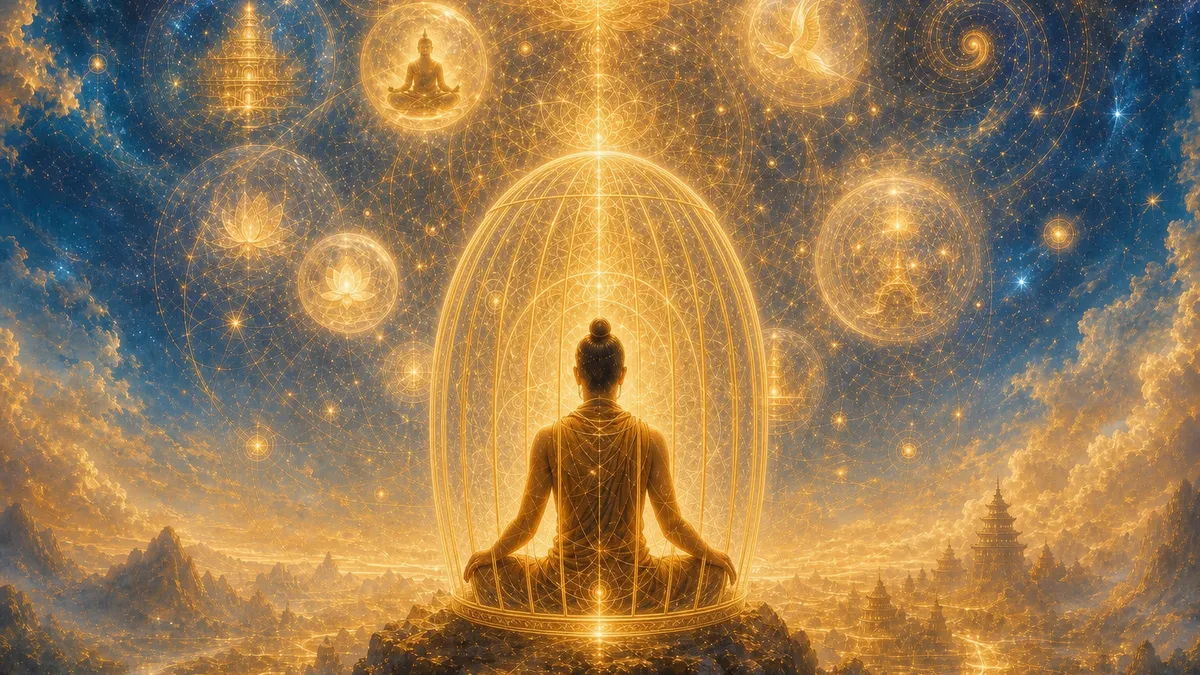
It is precisely the inner feeling (bhava) that is the cause of the bondage and freedom of all beings. When the inner state is pure — this is Liberation.
The Nature of Bhava and Its Influence on Consciousness
Bhava is an inner feeling, an inner worldview. For example, there may be brahma-aham-bhava (“I am Brahman”), divya-bhava (the state of devotion, divine love, and divine majesty), manushya-bhava (the state of a limited human being), or ghrina-bhava (“I am a poor little thing”). The spectrum of bhavas is countless, and living beings are distributed along the ladder of social hierarchy precisely according to their inner mindset, their inner worldview.
Any energy, thought, or perception is also charged with a certain bhava — it is the carrier of a certain bhava. For example, you read a book; the book carries a bhava, because the book has been transmitted or written by a consciousness that abides in a certain bhava. You read Leo Tolstoy’s “War and Peace” — you experience Leo Tolstoy’s bhava, you perform Guru Yoga with him. You read Nietzsche — you become charged, saturated with Nietzsche’s bhava. You read Kant — you experience Kant’s bhava. You read Shankara — you experience Shankara’s bhava. You read the “Yoga Vasistha” — you experience Vasistha’s bhava. In the same way, other experiences carry bhava.
Sacrificing everything to God means renouncing all lower-order bhavas and always choosing in favor of divya-bhava and brahma-aham-bhava. When these two facets of a single bhava are chosen by you, it means that you are following the path of mukti-bhava. The path of mukti-bhava is precisely jnana-marga and bhakti-marga. Mukti-bhava is generated by jnana-marga and bhakti-marga.
When you do not sacrifice inner states, it means that bhavas penetrate your subtle body, remain inside you, and you keep them, you appropriate them. An appropriated bhava, any feeling, has a tendency to intensify at any moment, especially during periods of negative astrological influences. Having intensified, it can form a new life. But what has been sacrificed, what has been given away, is no longer yours; you are not responsible for it, and it does not affect you.
Otherwise, it is wandering in the wheel of rebirths, bondage. The pure inner state is called the conviction “I am Shiva.” But if a person is convinced of the opposite, of duality, how can suffering be avoided?
This entire world, moving and unmoving, is the enjoyer, the object of enjoyment, and the one who directs toward enjoyment.
Thus, the enjoyer, the object of enjoyment, and the one who directs enjoyment. Viveka means understanding the interconnection and distinction of all these three.
The Path to Shiva-bhava through Upasana
A person who feels that all this is forms of Shiva truly becomes Shiva.
The yogin feels that the world is an illusion and always remembers Shiva, Being — Sat, Bliss — Ananda, and Consciousness — Chit, which are beyond the world. How, then, can the yogin be bound? All actions are worship of Lord Shambhu, all words are hymns in His honor. When a person perceives this, how can karma bind him?
For our actions to become worship of Shambhu, for all our words to become hymns in honor of Shambhu, we must constantly abide in Shiva-bhava. To constantly abide in Shiva-bhava, one must direct one’s mind, perform upasana, Shiva-upasana. As a result of Shiva-upasana, filling occurs — filling with divine grace. As a result of being filled with divine grace, self-surrender becomes possible.
Shiva-samavesha is possible for those who are continuously focused on Shiva. It is impossible for those who are focused on the worldly, for those who are focused on the jiva, for those who are focused on thoughts, on external objects — this is impossible. Whatever consciousness focuses on, whatever consciousness gives attention to — that is what it becomes filled with.
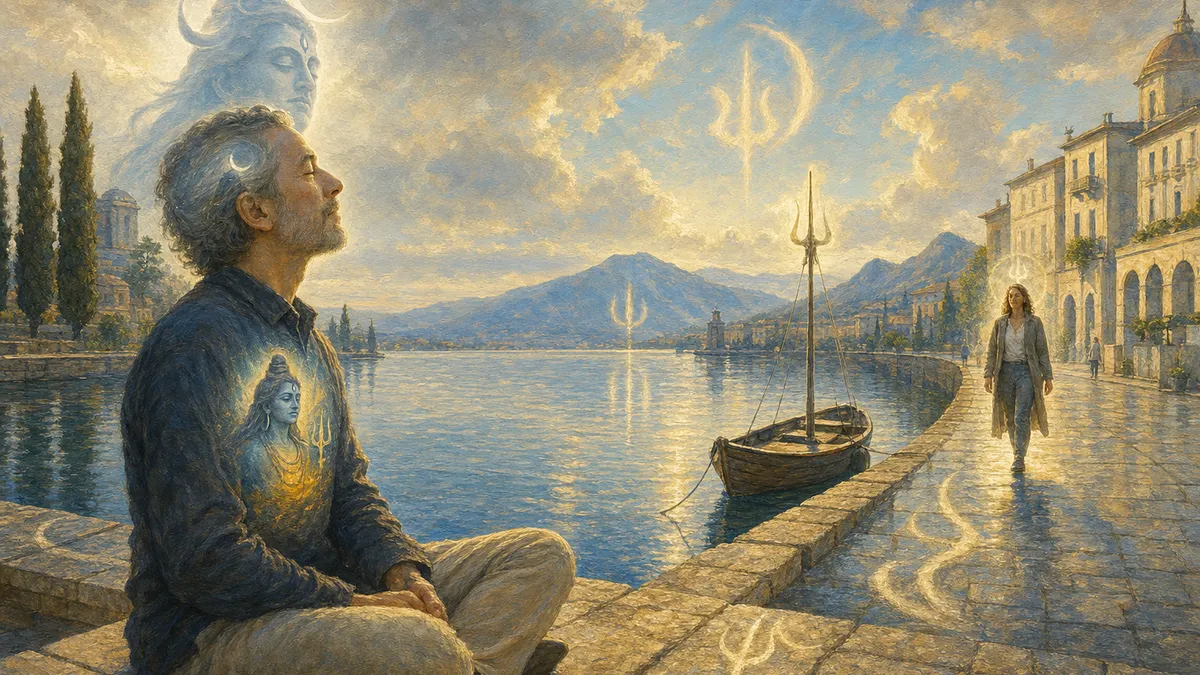
For example, if you focus on prasada simply as food, then prasada will be in the consciousness; there will be no music in it. If you focus on the logic of the scripture, the logic of the scriptures will be in the consciousness. But something else will not be there; what arises in consciousness is what we focus on. The art of self-surrender consists in always focusing on Ishvara as the highest object, despite the fact that the indriyas and the mind perceive material reality.
All joys and sorrows that are experienced through the action of the sense organs are the product of karma. The yogin who dedicates all feelings to Shiva becomes liberated while living.
To dedicate all feelings to Shiva means to contemplate Shiva against the background of any feeling, to perform Shiva-upasana, that is, to direct one’s mind toward God, toward Brahman through contemplative presence and devotion.
When, against the background of your attachment, you contemplate Shiva, Shiva-bhava must overcome the attachment, and the attachment must diminish and then dissolve. If it does not diminish, does not dissolve, it means that Shiva-bhava is weak, while the bhava of attachment is strong. When, against the background of pride, you contemplate Shiva, Shiva-bhava must overcome pride; then pride must either turn into divine majesty, be transformed, or completely depart. When, against the background of lust, you contemplate Shiva, lust must depart, and Shiva-bhava must prevail; lust is transformed into bliss, the winds are drawn from the svadhisthana chakra into the sushumna nadi, and lust disappears. When, against the background of despondency, you concentrate on Shiva-bhava, despondency must depart.
This is the first sign of proper concentration on Shiva-bhava. Despondency must always depart, any bad moods must always depart, dissatisfaction, confusion, all lowered bhavas must depart. But for this, one must perform Shiva-upasana every moment, every second.
Question: And if the bhavas are positive, do they also depart?
All positive bhavas, if you make offerings of them, do not depart; they simply gently resubmit themselves to the divine will and become a good, finely honed instrument of service.
Thus, the sacrifice of inner states is an entire mechanism: it is Shiva-dharana, Shiva-upasana, that is, concentration on God, worship of Shiva, then Shiva-samavesha (being filled with Shiva), then Shiva-anugraha (the descent of divine grace), and Shiva-prapatti (complete self-surrender). All this constitutes the sacrifice of inner states. The sthala “Sacrifice of Inner States” is completed.
Developing the Capacity for Sacrifice
But what should one do if the capacity to sacrifice inner states is not so strong? If Shiva-dharana is still weak, if Shiva-samavesha does not occur, if ananda does not come and there is no certainty that one is sacrificing, and it is not entirely clear where, after all, one should sacrifice, and the mind still resists and does not want to sacrifice? What should be done in this case?
In this case, one must build up one’s capacities for Shiva-dharana, for Shiva-dhyana, for Shiva-upasana, for Shiva-samavesha; without giving up, one must invoke divine mercy, and without giving up, continue one’s attempts again and again. The soul passes through a stage when it sacrifices ineptly and tries to sacrifice, but nothing happens.
At first the soul does not even know that it must sacrifice, and it does not want to sacrifice—this is the lowest state. But when it knows this, it tries to do it, but ineptly. It is not sure that it is truly sacrificing, not sure that it reaches the intended destination, and not sure that it even has the right to do this, that it has enough strength to do it. For example, during perception, the perception so seizes the soul, and it doubts: “Will I be able to sacrifice this perception?”
It must cultivate and nurture within itself the strength for such sacrifice, for the offering of inner states. Again and again awakening within itself the capacities to sacrifice, engendering discriminating wisdom, expressing such an intention, clarifying for itself the object of the highest sacrifice, this capacity will increase.
As the capacity grows, Shiva-samavesha (being filled with God) will increase, the descent of grace will increase, ananda will increase. When they increase, shakti (power) will appear in the soul. The power to give to God means the capacity for self-surrender. It is very great vigilance, when the soul is one hundred percent guided by the divine will. When it is so humble that it does not take a single step without the divine will, it does not allow itself a single word, a single perception, a single experience, a single action without the divine will. As a result, its absorption in God deepens, and Shiva-samavesha, the natural state of being filled with God, arises.
Liberation from the Karmic Tunnel
In such natural fullness with God, the soul leaves the dark karmic tunnel of reality in which it had dwelt, consisting of ego, evaluations, judgments, attachments, the mental layer, the layer of the astral body. It leaves all the layers of its subtle bodies, breaks free into the freedom of the causal body, and from the causal body it directly contemplates the Atman.

Thanks to the freedom of the causal body, it becomes established in ananda, because the causal body is ananda-maya (the body consisting of bliss). Thanks to this, its concentration and ability to abide in God increase extraordinarily, because it no longer experiences negative states; nothing prevents it from being absorbed. The capacity for samavesha, for Shiva-upasana, increases extraordinarily, and at this stage a period of the descent of grace begins.
Having broken free from the fetters of the physical, astral, and mental bodies, having drawn out its consciousness and established it in the causal body, the soul begins to bathe in an ocean of happiness, love, joy, and elevated emotions. It never again descends into the spectrum below joy. Contentment, constant peace, happiness, joy, delight, bliss, ecstasy, praise, glorification, divine revelation, and the experience of different levels of divine majesty become its everyday bhavas.
It forgets what anger, attachment, greed, pride, and envy are. It forgets what despondency is; it forgets what suffering is. Life in love and devotion becomes its ordinary state — this is already close to holiness, the beginning, the entry into holiness. This is still the very beginning, but it is already the door, and those souls that forget all this look at others who suffer and think: “How unhappy they are, how can they be helped, how they suffer,” and it even becomes astonishing how people can suffer when here is an ocean of joy, happiness, and bliss. Such a soul wants to say to everyone: “Put aside your toys and meditate properly, and give everything to God in order to abide in happiness.”
The Stage of Offerings and Divine Visions
Its fullness with God increases, divine mercy fills it more and more, and this is called the stage of offerings. At this stage the soul experiences the blossoming of all its qualities. All the qualities that existed begin to blossom. On the physical level this may manifest as the blossoming of the material; on the level of abilities, as the blossoming of abilities. On the level of mystical experiences, it may manifest in the fact that all mystical experiences mature and signs of realization come. On the external level, this may be expressed in the manifestation of respect. On the level of the subtle body, visions arise, offerings from divine beings, gandharvas, and pitris.
The soul begins to have subtle divine visions, where gandharvas offer garlands, deities offer attributes, scrolls transmit teachings, and many other souls show it reverence.
If the soul follows the path correctly and continues to sacrifice all inner states, these visions are exhausted. If it becomes attached to them, it may be reborn as a deity in the sphere of form or in the sphere of desires. But the spirit of self-giving leads to the state of bhava-nishpatti (the exhaustion of all inner states).
When all inner states caused by past experience come to an end, there is pure, unmixed divya-bhava; in the depth of divya-bhava there is pure, unmixed, detached, transcendent brahma-aham-bhava. In this sense, brahma-aham-bhava expresses the principle of prakasha, the principle of Shiva. Divya-bhava expresses the principle of shakti, the principle of vimarsha, and such a sadhu bears within himself two energies, two tattvas — Shiva-tattva and Shakti-tattva.
Brahma-aham-bhava is Shiva-tattva; divya-bhava is Shakti-tattva. Vibhuti, when applied, the tripundra — this is the principle of Shiva; kumkum, when applied, the bindu point — this is the principle of Shakti, the first and second tattvas. This is brahma-aham-bhava and divya-bhava, therefore when a sadhu performs sandhya-upasana in the morning, he applies ash, he sanctifies himself with brahma-aham-bhava and divya-bhava, he invokes the blessings of Shiva and Shakti.
