

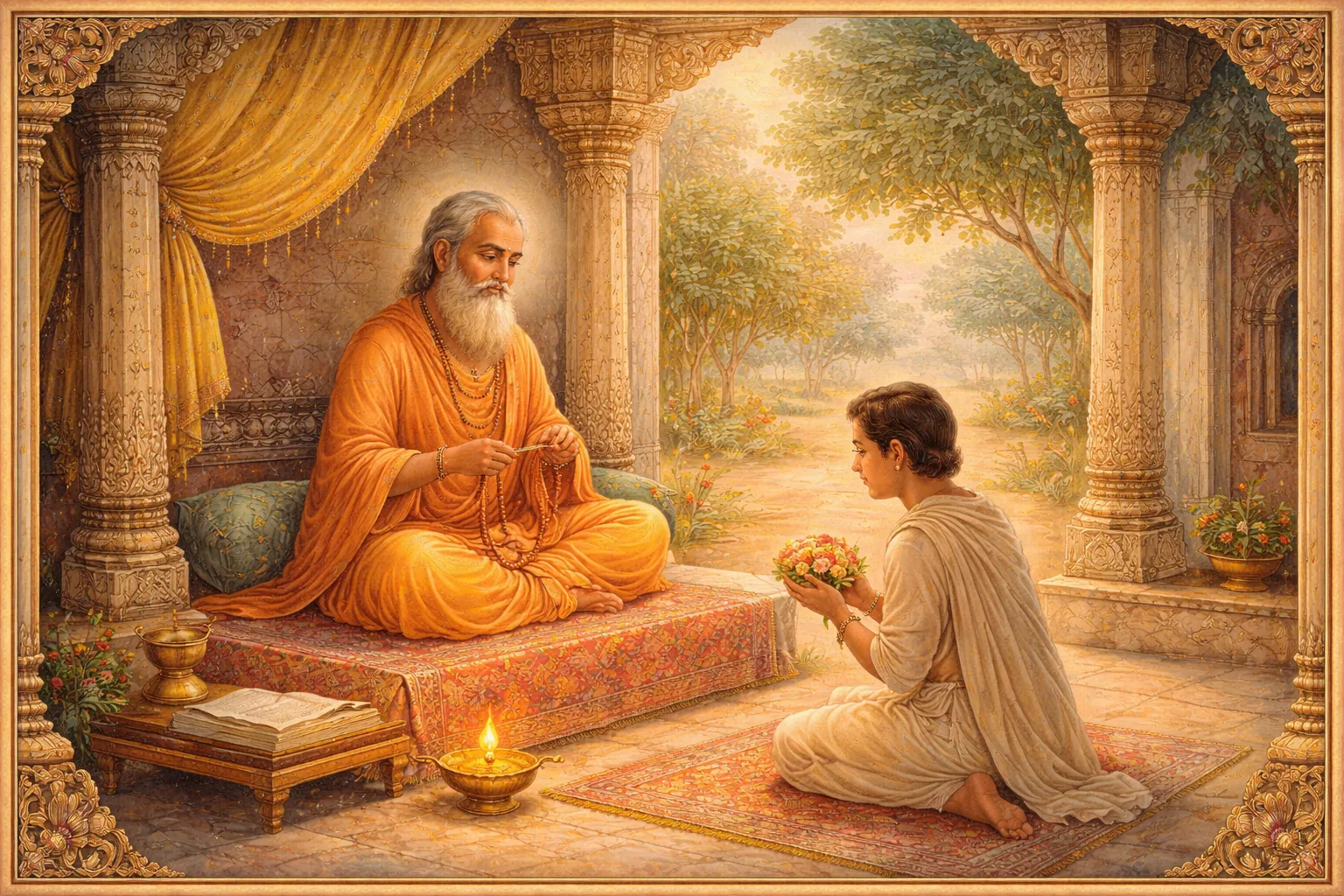
In Hindu and Buddhist Tantrism, the principle of the guru is a fundamental concept. In tantra, guru yoga, the principle of the guru means worship, the perception of guru-tattva in one’s root guru, the veneration of the saints of the lineage in pure vision, when the guru is regarded as a manifestation of the deity with whom we unite, whom we worship, or whom we visualize.
In Anuttara Tantra the approach is somewhat different. We do not separate ourselves from the guru; the principle of the guru is pure consciousness, with which we unite in nonduality. It is important to understand these differences in guru yoga between ordinary tantra and Anuttara Tantra, since we apply the methods of both ordinary tantra and Anuttara Tantra.
There is a saying: if you have a root guru, you need no other Buddha. This means that if you have strong faith, you receive all the blessings, the same as from all the awakened ones. Here it is important to regard the guru not as a human being, although he is a human being, but in pure vision. Do not limit the concept of the guru in your mind.
Vapu and Vani — Two Aspects of the Perception of the Guru
We can think that there are two concepts: “vapu” and “vani.” Vapu is the principle of the relative dimension. For example, the guru’s nationality, where he was born, where he lives, what clothes he wears, what he eats, what his social status is, what his form is, and so on. Vani is, above all, the teaching. Vapu is the material way of seeing the form of the guru, while vani is the principle of the teaching. And the principle of the teaching presupposes an understanding of the teaching, an understanding of the single samaya of contemplation, guru-tattva, and nonduality.
Guru yoga presupposes that we move from the principle of vapu to the principle of vani, the teaching. The guru is represented in the teaching much more vividly than in his relative physical form; this is natural.
The Three Births of the Disciple
There are a great many instructions on how to recognize guru-tattva, what the guru-disciple relationship should be; this is a very important part of the culture of Tantrism, Hinduism, and Buddhism, both in the Vedic tradition and in the Tantric tradition, especially in the tradition of the siddhas. It is believed that all blessings come through the disciple’s guru yoga, if he has faith, devotion, and self-surrender.
Ultimately, the disciple, by uniting his mind with guru-tattva, must discover the satguru within himself. He must awaken his own guru-tattva. When he awakens his own guru-tattva, awakens the satguru within himself, he is born for the third time. This is his final birth.
The first time he is born from his mother’s womb through his parents; the second time he is born in the spiritual sense during diksha, initiation, receiving the guru mantra and name. And the third time, when he attains a certain level of Enlightenment, he gives birth to guru-tattva within himself. In simple terms, he becomes a new Dattatreya.

Dattatreya as the Embodiment of Guru-Tattva
Since Dattatreya embodies guru-tattva, since he is the guru of all gurus, is Ishvara, the ancient teacher of all teachers, for us Dattatreya is the embodiment of guru-tattva. Dattatreya embodies guru-tattva in two aspects, vyashti and samashti. One of them is the principle of universal guru-tattva, which permeates everything. The second is personalized guru-tattva, which manifests through a specific body, a specific personality, specific actions. We must manifest, in the end, having realized universal guru-tattva, and awaken personalized guru-tattva within ourselves through guru yoga.
Mantra with Transmission and Without Transmission
Is initiation necessary for the practice of japa? The most precious of all Shaivite mantras, the Namah Shivaya mantra, may be freely sung and recited by anyone and everyone. Mantra diksha gives permission and empowers one for japa yoga. Without this initiation, repetition of the mantra has a lesser effect.
Anyone may recite the mantra Om Namah Shivaya, but it is better to receive it from the lips of the root guru. This is how it is considered.
The Panchakshara mantra is the word of God, the name and deepest essence of Shiva. But simply chanting Namah Shivaya and chanting Namah Shivaya while being empowered to do so is like writing a check without having money in a bank account, and writing a check while having enough money.
The teaching of anuttara-tantra is always connected with guru yoga, the principle of transmission, the Refuge Tree, and direct introduction. This is a feature of anuttara-tantra that distinguishes it from the teaching of tantra, or from the teaching of sutra, or from the Vedic teachings. It is considered to be the quintessence of all spiritual traditions. This feature is always connected with the principle of transmission.
The principle of transmission means that when we meditate, engage in contemplation, we establish a connection. A connection through the guru, the param-guru, the ishta-devata with the Supreme Source. This connection is the source of grace and blessings, anugraha. Through it, shaktipata, spiritual inspiration, descends. It is through this connection that we fertilize our meditative and contemplative practice.
For example, how does the mantra Om Namah Shivaya, the maha-mantra, work when you recite it without transmission? You recite and listen to Om Namah Shivaya, trying to evoke certain associations: perhaps it is Shiva, perhaps it is something boundless, perhaps it is something beautiful. But for now you are in doubt. Your mind remains in a scattered state, because there is no connection, and you do not receive the descent of grace through the mantra.
When you receive a mantra as diksha, no matter which one — the guru mantra, the seed mantra, the Brahma mantra, Om Namah Shivaya — a connection is already established in your mind. When you recite Om Namah Shivaya, the process of this connection arises in you, diksha arises, and you establish a connection through the guru with the entire Refuge Tree. In a natural way, the mantra initiates your connection with the entire Refuge Tree. Every uttered mantra evokes a response from the subtle world.
Because, through the subtle world, you have a connection with all the saints of the refuge, who are already sending their wisdom in your direction. Saints always radiate wisdom. The Refuge Tree, the gods, Ishvara — but one must come under the stream of their grace, enter the channel of their sacred fire, one must activate this wisdom. A mantra received as transmission, as initiation, activates the descent of this grace.
Mantra Chaitanya and Mantra Shakti
When you recite it, you feel as if you have connected to a power line. The principle of mantra is precisely that mantra chaitanya, divine consciousness, is revealed, and then mantra shakti acts. First we reveal pure consciousness as the essence of the mantra, as its seed, and then energy descends. In order to do this, no particular effort is needed, apart from attunement and the recitation of the mantra within the Lineage of Transmission.
God Shiva, Dattatreya, the Absolute possess an inherent inner holiness, an inherent inner ananda. And this ananda, the radiance of their grace, prakasha, does not require any special effort from us. It emanates naturally. But we need to establish a connection. A mantra received in transmission establishes the connection, and when we recite it, we immerse ourselves in and deepen this connection and begin to feel this grace.

The Meeting of Shiva and Shakti in Practice
This grace, descending, fertilizes our contemplative practice, and then the signs of realization manifest. Our meditative contemplative practice and the grace descending as a result of guru yoga, upasana, and mantra recitation must meet. When they come together, Shiva and Shakti meet. As a result of their meeting, our inner child of awareness awakens and is born. Or our divine illusory body comes into being.
The Three Spaces and the Three Divine Bodies
Each of us must bring forth three such bodies in the form of seeds. And these three bodies correspond to three spaces. Chidakasha in the space between the eyebrows, hridayakasha in the center of the chest, and daharakasha in the lower abdomen. These are our inner Shiva, inner Vishnu, and inner Brahma. The inner Shiva, inner Vishnu, and inner Brahma are our inactive, pure spaces of consciousness.
When we receive the blessing, the descent of grace, three female deities are also activated. Inner Saraswati, inner Lakshmi, and inner Parvati, Durga. They are also called Brahmi, Raudri, and Vaishnavi. Jnana shakti, iccha shakti, and kriya shakti. As a result of their union, our spiritual body awakens.
For the spiritual body to fully awaken, awareness and energy are needed. The inner Shiva is needed, and the inner Shakti is needed. Then the immortal body of wisdom is born in this realm. The immortal, divine, illusory body is born in this realm. The immortal body capable of manifesting perfection is born in the realm of daharakasha. This is precisely the three awakened dimensions and the three awakened bodies.
Signs of the Awakening of the Divine Bodies
How are they born? There are tantras in which the signs and processes are described in detail, but practice, and these signs will gradually manifest. If one speaks a great deal about them, it only creates unnecessary worry and provokes the curiosity of the mind. One simply needs to practice, and you will feel how they are born.
For example, you meditate, recite a mantra, transform yourself, prana enters the sushumna nadi, and you see the five signs of day, the five signs of night. Each sign means that the corresponding winds have entered the sushumna. Then the eleventh sign manifests: in the area of the forehead you see a radiant divine form in the appearance of the ishta-devata. This is the prototype of your illusory body, from which your divine or empty illusory body, consisting of light, must one day be fully created.

This is how the signs manifest. Then, by practicing mantra yoga, japa, and shakti kriyas in a special way, you work with this prototype until it gains full strength. Or you meditate, and in the center of your chest an infinite space of pure emptiness and light opens. This is the arising of jnana-deha, jnana-kaya, the immortal body of wisdom. Or you practice, and powerful energy arises in the lower abdomen. Such a body may first arise as consciousness or as energy.
All of these are signs that the three kayas, the three awakened bodies, are arising within you. Jnana-kaya, maya-kaya, and siddha-kaya. One of the ways such awakened bodies arise is through mantra japa, mantra yoga. The instructions of the siddhas are that the rosary should not cool from the warmth of your body when you practice intense mantra sadhana. Your rosary should always be with you, and the mantra should be recited in the free time apart from meditation or contemplative walking.
The Gate into Yoga through Namah Shivaya
Namah Shivaya is the gate into yoga. Consecration or initiation, diksha from an orthodox guru, is given after preparation, training, and the attainment of a certain level of purity and devotion. The guru grants the authority to repeat Namah Shivaya. After initiation, the devotee is obliged to repeat the mantra regularly, as he was taught. This reinforces the constant connection of the shishya, the disciple, with the guru and his spiritual lineage, the sampradaya.
Repeat it; take the simplest mantra commitments. The very simplest. There is no need to take on difficult ones. If you take on difficult ones, for example, reciting sixteen rounds, or reciting ten rounds, or even one round, a moment will come when you do not fulfill them. Since commitments must be fulfilled, this will not be very good. If you take on the simplest one, you will always fulfill it.

The simplest thing is to recite the mantra eight times. To maintain the connection. More is allowed, as much as you like, but less is not. It is possible, but the connection will weaken, and the mantra will no longer bless. But for the mantra to bless, always recite it eight times every day.
Eight times the guru-mantra, if you have received diksha, karma-sannyasa; eight times the mantra of Paramguru Brahmananda; eight times the seed mantra of Dattatreya; eight times the mantra Om Namah Shivaya, the six-syllable mantra; eight times the Brahma-mantra; eight times the mantra Om. Someday the Shakti-mantra, if it is your destiny to practice the Shakti-mantra. But for now we are speaking of six mantras. Eight times—that is your minimum. You may do more, for example, one round of each mantra, ten rounds of each mantra. That depends on your capacity. But not fewer than eight times, so that the connection is always maintained.
The process of inner development is set in motion. From the lips of my Satguru Nath I received the Namah Shivaya mantra, and it has always been the core of my life, the power and fulfillment of destiny. The secret of the Namah Shivaya mantra lies in hearing it from the right lips at the right time. Then and only then will it be the most powerful mantra for you. The Shiva Samhita confirms that only knowledge received from the guru, from his lips, is powerful and beneficial. Otherwise it becomes barren, weak, and very painful. Om Namah Shivaya.
