Knowing as the Only Reality: The Path to Nonduality
03.10.2026
0 мин. чтения
0
Share
copy
search
add
share
Commentary on the text “Tripura Rahasya”
“Although people know about space, they still do not know it, for they are captivated by the objects existing in space.”
There are many instructions and teachings on how to nurture vital energy, how to combine foods according to the concept of “vata-pitta-kapha,” which colors to choose so that they harmonize the elements, how to build temples and houses, how to arrange things auspiciously so that they harmonize space, how to take the signs of the zodiac and temporal cycles into account, how to take the svaras and lunar and solar channels into account, calculate the time of their most favorable activity, and attain what one desires. There is knowledge of how to achieve physical immortality with the help of magical potions. There are many such types of knowledge, some of which you will receive at the monastery. This knowledge is countless, yet all of it is particular.
Ultimately, knowledge is needed in order to reveal the single space into which all objects are immersed. This knowledge is like servants, while the great knowledge of the single space is like a king. If you master this king, then all the other types of knowledge naturally serve you, since they are subordinates.
Why is anuttara tantra considered the highest teaching? It is not because every teaching beats its chest, asserting its superiority over other religions. The highest teachings have no need to assert themselves. It is the lower teachings that assert themselves, striving somehow to elevate their prestige in relation to others, whereas the highest teachings have no need even for that. They know their own worth. The highest teachings are called highest not because they seek to assert themselves in the eyes of others or in their own eyes, but because they are connected with the most transcendent reality, with the direct immediate perception of nondual truth itself. And any experienced yogin easily understands this when encountering the highest teachings. Therefore, when we speak of nonduality and contemplative presence, we touch upon the very heart of the Dharma, beyond which there is nothing higher. It is also called “the heart-blood of the dakinis,” “the heart space.” Accordingly, one’s attitude toward the teaching should be the same.
It is believed that only people with a fortunate destiny are capable of mastering it. People with a very fortunate destiny are capable of encountering it, let alone practicing it. Those capable of receiving its result immediately are also people with a very fortunate destiny, since this teaching presupposes instantaneous realization. That is, as soon as we see the primordial space, we unite with it, while the rest of our life—all the remaining one hundred and sixty or three hundred years—is intended only to deepen this space.
The Interrelationship Between Knowledge and Knowable Objects
“The world consists of knowledge and knowable objects. Of these two things, objects are not you and are perceived by the senses. Knowledge is evident. In the absence of knowledge, there is no world. Knowledge is direct proof of the existence of objects, which therefore depend on knowledge. Knowledge depends on the knower for its existence.”
The world is as it is because we exist. We exist because the world exists. These two aspects are interconnected.
There was a philosopher named Berkeley who once asked himself the following question: “If a tree falls in a forest, but there is no one to hear it fall—if there are neither people nor animals in the forest—will it make a sound?” A sound can be perceived only by someone’s ear, but what if there is no ear? How can one say that there is a sound? Then there is no sound either. The world changes immediately. There must be someone who can say that a tree has fallen and that they heard it. But what if there is no subject? Then there is no sound either. Not only might it fail to hear the sound; it might also fail to see the tree, and therefore the tree does not fall and will never fall. It never fell in the past, is not falling in the present, and will never fall in the future if there is no one in the forest who could see it. A subject is required for this. Then the words of the saints become understandable: no one has ever been born, no one has ever died, and the universe was never created, never existed, and never dissolved. Because such perception requires a subject. But if we discover the illusory nature of the subject and enter nonduality, the entire illusion disappears in one stroke.
The world exists only because we exist—the evaluator, the one who labels, interprets reality, and creates it. We create it through our vision. When the evaluator disappears, the world accordingly disappears as well. This does not mean that everything vanishes and a vacuum appears; it means that the world of duality disappears and the world of non-duality manifests—a new world, completely different. It cannot be called a world; one cannot say that it manifests; it cannot be called new, since there is nothing old with which it could be compared. Nevertheless, transcendent consciousness arises. This is an absolutely free, spontaneous, incomprehensible, perfect, infinite state whose essence is absolute freedom, creativity, purity, and perfection.
The Knower as the Only Reality
“The knower requires no verification whatsoever in order to know of his own existence; therefore, the knower is the only reality standing behind knowledge and objects. Only that which is self-evident and requires no proof is real. All other things are not something real.”
The knower is the deep consciousness that exists within the subject and relies solely on itself. This is the only reality. At first, we think that the knower is connected with the personality; we think: “The knower is me. I am this and that.” As practice progresses, we separate the personality from the knower and see that the knower is pure, empty space consisting of light, where there is no individual “I.” Nevertheless, this knower is not separate from the individual “I”; it can manifest as the individual “I.”
There is one mataji (Sundari Devi) who cannot resolve the question of whether individuality remains after enlightenment or not. And she says: “If this is the all-devouring mouth of the Absolute, where my individuality will be lost, then I am afraid of such enlightenment.” During a consultation, I reprimanded her very harshly for failing to clarify basic questions after nine years of being a lay disciple. I did not even know that one could torment oneself with such questions. It is actually a very funny question.
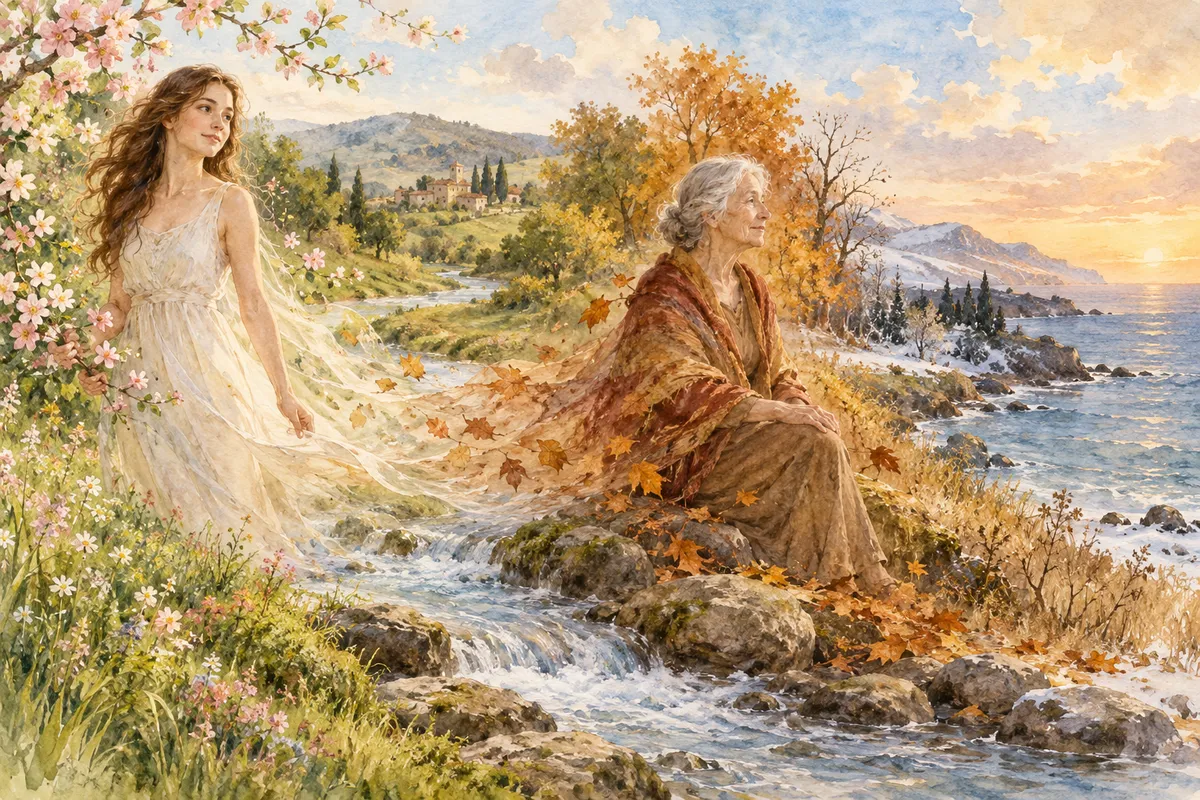
First of all, what needs to be understood here? If something is impermanent and can be dissolved, then that is exactly where it belongs, because it cannot be relied upon. At the moment of death, will individuality not dissolve? Will a new one not be created? Individuality is not something permanent. Are you the same person you were seven years ago? Individuality is a fiction, an illusion. There is nothing permanent. The world is fluid. If one looks at a hunched and unattractive ninety-year-old woman, it is very difficult to say that she is the same attractive girl she was at seventeen. Where is that girl? There is no girl anymore; she has disappeared, and what exists is the fact of an old woman. What kind of continuity of individuality can one speak of if everything is constantly changing? One could say that the girl died and disappeared while still alive, and an old woman appeared in her place. Individuality is not something permanent; it is fluid, so it is foolish to cling to it. This very clinging is the foundation of samsara. The universe is fluid; everything flows from one opposite into another: life into death, summer into autumn, pralaya into manvantara. Such is the law of the universe.
The pitiful clinging, the desire to fix oneself in something static, to secure oneself, to create some little world for oneself, to establish one’s personality, the desire to have a family, money, status—this is precisely the evil spirit that prevents us from responding adequately to the processes of the universe, prevents us from being flexible, fluid, and spontaneous. And then death finds such a person, since everything is subject to destruction. His illusion of security is immediately destroyed. Therefore, enlightenment is the state in which we understand that the very nature of life in the universe does not tolerate clinging. To be in harmony with the universe and with the cosmic law of rita, we need to learn to be equally flexible and fluid. And this clinging to the personality is precisely what keeps us in samsara, what makes us mortal. In essence, we ourselves—as consciousness, as energy—are immortal and eternal. But when clinging to the personality and the ego arises, that is the mortal state, because the immortal part is ignored while the mortal part is affirmed.
When a person attains enlightenment, they lose nothing; rather, they change their perspective. Attachment to the mortal part falls away, and the infinite and immortal part is revealed to them. As for the temporal personality, it remains upon the realization of nonduality. Moreover, it receives a great impulse and flourishes. All its finest qualities manifest because the ego and personality draw all their qualities from the Clear Light. In other words, intelligence increases, clarity and abilities improve, and so on, but at the same time, all of this becomes secondary. Moreover, the Supreme Source is capable of creating as many personalities as it wishes. It is no longer confined to a single personality and is capable of emanating from itself tens, thousands, millions, and billions of personalities in different worlds. In other words, this is absolute fullness. That is why one saint said: “What you gain is so priceless, so eternal, that what has been lost is not even worth remembering.” In other words, what is lost here is ignorance, identification with the ego, the body, and so on. The functions of the mind are not lost; the functions of the ego, memory—all of this only flourishes. If anything is lost, it is only the ignorance that identifies itself with the personality. One should always wish to lose such ignorance.
But it is always the case that a drop begins to tremble and doubt before falling into the ocean. It dreamed so much of enlightenment, but when this doubt suddenly comes over it, it thinks: “My goodness! What will remain of me? Have I gone too far?” The ego is always afraid because, for it, nondual Brahman, the Absolute, is so incomprehensible that it feels it has not a single chance. And this is normal; every saint experiences this state. The biographies of saints describe their feelings of self-abasement, doubt, and humility before God. This is normal; the soul simply trembles before God. It has nothing else left to do when it comes into contact with this infinite mystery. However, a practitioner differs from an ordinary person precisely in that they learn to tremble while continuing to live like a monk, to smile through their tears until their ego completely dissolves, and therefore there will be no one left to shed tears. They will smile, but it will no longer be the smile of the ego; it will be the smile of eternity. That is why one master said: “You must become a living corpse. While living, be absolutely dead and do whatever you wish. Everything will be fine.” This means that all your old identifications must die; you must become completely empty.
It is just as Christians say: the old man dies, and a new, eternal, imperishable man of immortal life is reborn.
The Nature of Reflections in Consciousness
“Whoever denies knowledge has no foundation whatsoever, and in that case there is no possibility of conducting any discussion. The question of knowledge is settled, and then the question arises of the existence of objects in the absence of knowledge of them. Objects and knowledge of them are merely reflections in the eternal, self-luminous, supreme consciousness, which is identical with the knower and which alone is real.”
Visible things and perceptions are merely reflections of the primordial Foundation. The primordial Foundation alone is real, while everything else is simply its radiance. For example, you see a dog, but the dog is not real in itself; it is only a reflection of the Absolute. It is the Absolute that has assumed energy and is playing in this body, portraying itself as a dog. If, in deep presence, you look at two dogs, you will not see dogs but simply shakti frolicking in two bodies, playing with itself. If, in deep presence, you look at two people communicating with each other, arguing, or cooperating, and look at them with a pure, empty gaze, you will see simply the play of two energies of the Absolute—in other words, the play of one energy and one consciousness in two bodies.
The Absolute has divided itself into many bodies for the sake of its own lila, and for the sake of dynamism, vitality, and excitement, plays in different bodies. In one body it plays the executioner, and in another—the condemned; in one body—the soldier of one side, and in another—the soldier of the opposing side. Sometimes it engages in fierce games, and sometimes in peaceful ones. In one body it plays the role of a husband, in another—that of a wife; in one—the Teacher, in another—the student; in one—a deity, in another—a bhakta; in one—the god Yama, in another—the one being sentenced and transferred to one of the worlds at the moment of rebirth. But in reality, this is one consciousness that assumes many forms and energies. Those who do not understand this remain in duality, taking the dog, the soldier, the executioner, and the god Yama for reality. And this happens because they take themselves for reality, in which case all the laws of samsara come into effect. If you have taken yourself to be a soldier, then please fight, be wounded, and suffer. If you have taken the god Yama for reality, then go to hell; if you have taken your wife for reality, then get married, fulfill your family duties, and so on. That is, the whole of samsara begins to operate.
When we realize nonduality, it means that we stop taking anything within duality for reality and begin to look at reality beyond duality. When this happens, it is said that we have mastered vision. Nevertheless, knowing that prarabdha karma and the laws of this world still exist, we should work extensively on developing nonduality. We conditionally accept this relative dimension, its games and laws, knowing that we must also relate to them appropriately if we want to work with them. Nevertheless, by accepting these laws, we are no longer bound by them. This is the rule of the game of universal energy. It is similar to the rules of the road.
All the troubles of a living being arise because it does not know this secret of nonduality and takes subject-object relations at face value.
Once, the Guru was a very ardent proponent of nonduality and did not even want to acknowledge anything apart from nonduality. When we discover nonduality, the experiences are very powerful, especially if you practice without consulting a Teacher. It can literally turn your entire worldview upside down. That is why Tilopa said: “At first, the yogin’s mind cascades down like a waterfall; then it flows like a full-flowing river; and after that, it is like the boundless ocean.”
At first, when we discover nonduality, the world is turned upside down. We do not want to deal with any kind of duality at all. We want to be guided only by nondual consciousness, while everything else seems not to exist at all. This period is called the period of nihilism. Then, when we become firmly established in nonduality, we suddenly see that nothing can condition us, and that even what we considered samsara and duality is simply the play of the Absolute’s energy; therefore, we have nothing to fear and nothing to reject. And we fully accept these games of the Absolute’s energy. We become like a wise old man watching children play in a sandbox. In the end, we deepen nonduality to such an extent that we not only accept these games but also generate them ourselves—we ourselves become the Absolute.
Time and Space as Reflections
“The doubt lies in the fact that the reflection should contain all objects simultaneously, without regard to time and space, contrary to our experience. It should not arise, because time and space themselves are cognizable concepts and are likewise reflections.”
Time and space exist as long as duality exists. They exist in relation to a particular subject, the bearer of karmic vision. When karmic vision changes, time changes as well. There are places on Earth where karmic vision can change if you happen to enter them. If someone enters such a place, they may return two hundred years later, although it will seem to them that only an hour has passed. They will recognize nothing in this world; their body will remain just as young, but everything on Earth will have changed because they have entered another sankalpa, where time flows differently.
The One Foundation of All Objects
“The characteristic nature of all these reflections is the reverse side of an object discovered in space. Therefore, realize with a peaceful mind your own true nature, which is one, pure, undivided consciousness underlying the restless mind from which this entire universe in all its diversity is composed.”
The One Foundation of all objects is the Supreme Source, the pure Essence upon which one should meditate, which one should worship, with which one should merge, discover within oneself, clarify, and contemplate. This is the Foundation that one should not lose sight of, about which one should read texts, with which one should identify oneself, and which one should recognize as one’s own “Self,” since it is not something external. If we believe that it is something external, like God in dualistic religions, then this is a deviation called eternalism, duality. Duality always presupposes a difference between the bhakta and God; it contains no satisfaction in attainment, but always involves duality, albeit a very subtle one, and therefore duality does not lead to liberation. At best, dualistic practices lead to rebirth in the heavens of the world of form.
Establishment in the Supreme Essence
“If someone has become established in this fundamental principle of the universe, that is, in the Supreme Essence, then they become the creator of everything. Understand and realize sleep with a peaceful mind, the state in between sleep and wakefulness, the interval between recognizing one object after another, or the interval between two perceptions.”
When we become established in the nature of Mind, all our creative powers also become activated. A yogi established in the nature of Mind can create universes. At first it is a micro-universe, then increasingly more. They themselves are a great creative power. Khemalekha gives instructions on how to discover the nondual nature of the “Self” using the methods of tantra.
First, if you carefully become aware of the interval between sleep and wakefulness, you come into contact with nonduality. If you enter it, try to become established in it and maintain it, you gain a certain taste, the rasa, of the natural state.
Second, there is an interval between recognizing one object and another, that is, the space between two perceptions. When you have perceived something and your mind has become attached to it, and then you shift your awareness to another object, there is an interval between these shifts, an empty space. If you remain in this interval as alert awareness, you discover the natural state. For example, you were on retreat, and then you leave the retreat, and something new becomes clear to you. Or you go out to collect donations. When the situation changes, that is, the mind has detached itself from one object but has not yet attached itself to another, this is precisely such a state. These are intervals in which there is pure consciousness and no nourishment for the ego. If one enters this state deeply and realizes it, it gives a powerful taste of the natural state, the rasa.
Abiding in Truth and Delusion
“This true Supreme Essence, abiding inseparably in which, a person is no longer deluded. Without realizing this truth, people become heirs to suffering, which becomes their inherent quality as a result of their delusion.”
If one abides inseparably in the Supreme Essence, one will no longer be deluded. There is always the possibility of abiding in the Supreme Essence and not being deluded, not considering oneself an ordinary person, not considering perception to be perception, not considering visible objects to be objects, but considering everything to be one with the Supreme Essence. The other possibility is to forget the Supreme Essence and consider everything as it appears: to consider bees to be bees, oneself to be oneself, walls to be walls, and the sky to be the sky. When we consider objects to be objects and ourselves to be ourselves, it is said that we have become distracted, that we have no vision, that we are not contemplating. Then everything ordinary is ordinary, we are who we are, the world is solid and real, and concepts, emotions, and events hold sway over us.
When we remain in vision without distraction, the sky is not the sky, a person is not a person, and we are not ourselves. Everything acquires a single taste—the taste of the Absolute; everything begins to breathe God; everything becomes majestic, absolute, sacred, and situations become the play of the Absolute. Gradually, we penetrate into pure vision and then even beyond it.
Pure vision does not truly arise as something artificial. It awakens naturally when we abide in the highest Essence. Those who do not realize this truth become heirs to suffering. Suffering becomes their inherent quality as a result of delusion. At a certain stage, a very deep understanding comes, and suddenly something extremely bright flashes in your consciousness. You understand that failing to remember this highest Essence comes at too high a price, because a powerful desire arises within you never to be deluded again, to be in truth, to be in spirit, and never to lose yourself again. If previously you allowed yourself to do so, then once you have reached a deep level of contemplation, as a true yogi you will no longer allow yourself to be outside the spirit for even a second. From this, true impeccability is born. Such a yogi no longer experiences either doubts or major illusions. Only subtle illusions arise, and attachments do not arise. Such a yogi breathes God.
Having received instructions from Khemalekha, Hemachuda entered a very deep state of nirvikalpa samadhi.
Consciousness
Nonduality
Contemplation
Enlightenment
Samsara
Absolute
Illusion
Tripura-rahasya
Author Гуру
Read 35 times
Articles
Vidya AI
Search
Lectures
November 5, 2026
Mantra of the day
ОМ ЭКАЙА НАМАХ ОМ Единому – поклонение!
Auspicious Times(Rome)
Brahma Muhurta:
04:56 - 05:51
Abhijit Muhurta:
11:33 - 12:14
Sayam Sandhya:
16:40 - 17:21
Mokshada Ekadashi (6 November)
Ekadashi of liberation. Helps to achieve spiritual enlightenment.