

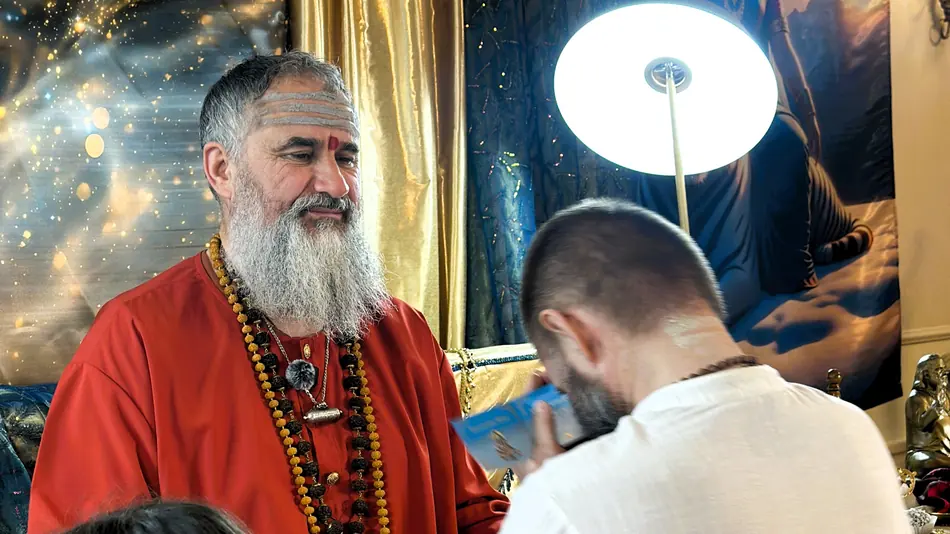
Spiritual training begins in the divine dimension. God comes to the disciple in the form of the Guru—because the disciple is the soul karmically connected with the Master.
I. How to Become a Disciple
The First Step
Accept the Guru as one’s root teacher. Open one’s heart and cultivate faith and samaya—a sacred spiritual bond. Becoming a disciple is incomparably more than enrolling in a course. It means accepting the Guru as a messenger of God, seeing him with pure vision, and making him one’s Refuge.
“Accepting the Guru is far more significant than getting married. One must overcome doubt, pride, and selfishness, and become a true, faithful, diligent, devoted disciple.”
What the Path of Discipleship Entails
- Regular daily sadhana: meditation and upasana;
- Participation in sangha events and activities;
- Service—seva, contributing to the tradition through action;
Accepting instructions and performing the lineage practices.
Details: The Path of Discipleship: Connection with the Guru and the Foundations of Spiritual Practice
II. Take Refuge
The First Ritual · Sharanagati Samskara
This is the formal entry into the tradition: accepting the Five Jewels, taking vows, and becoming a member of the sangha through the Sharanagati Samskara ritual.
Refuge is a living connection with the Absolute through the Master, the Teaching, divine forces, and the spiritual community. After the ritual, one becomes an official member of the sangha.
The ritual is conducted by an authorized monk, either in person or online. It requires studying the Creed and having a sincere intention.
What the Ritual Includes
- Accepting the Five Jewels—Pancharatna;
- Reciting the Creed before the altar;
- Taking the Five Vows—Pancha Mahavrata;
Access to restricted materials and the inner life of the sangha.
III. Receive Diksha
Initiation · Ashta-Avarana Diksha
Eight protective veils, a spiritual name, and the transmission of the Mahamantra from the Guru—a direct initiation into the parampara lineage.
Diksha creates subtle spiritual imprints, purifies, sanctifies, and inwardly transforms a person. Ashta-Avarana Diksha follows Refuge and creates a protective structure—a mandala of eight elements.
One must first take Refuge. The ceremony is conducted by the Guru or an authorized monk at seminars and special ceremonies around the world.
What Is Transmitted During Diksha
- Eight avaranas—the protective veils of Shiva;
- Nama Diksha—a spiritual name from the Guru;
- Mantra Diksha—the Mahamantra, whispered into the ear;
- Daily commitments: linga puja and 108 repetitions of japa.
An Alternative Path: Becoming a Sannyasi
The Monastic Path · The Juna Akhara Order
This is not the next rung on the ladder, but a separate calling. Life in an ashram and complete dedication to the Dharma are for those who hear this call.

Sannyasa is not the logical culmination of the worldly path. It is a separate calling that one either hears or does not. One can remain a grihastha—a lay practitioner in the tradition—for one’s entire life, and this is a complete spiritual path.
Swami Vishnudevananda Giri is a Mahamandaleshwar of the Juna Akhara Order. Admission to the order takes place with the Guru’s blessing after many years of preparation and training.
Required Preparation
- Study at the Rishi Vasishtha Institute—from the fourth level onward;
- At least 3–5 years of active practice within the tradition;
- The Guru’s personal blessing.
Upcoming Refuge Ceremony
Sharanagati Samskara
The first formal rite of entering the tradition: accepting the Five Jewels and taking vows before the altar. It is conducted by an authorized monk, either in person or online.
Refuge Ceremony sign up →
Initiation Schedule
Receive Diksha
Upcoming events:
September 10 · India · Avadhuta Siddha Ashram
October 22 · Italy · Shiva Prem Sagar Ashram
“To accept a Guru is to open your heart, see the Guru as a messenger of God, cultivate faith and devotion, and make him your Refuge by establishing a sacred spiritual bond with him—samaya.”
— Swami Vishnudevananda Giri Maharaj
Rishi Vasishtha Institute
Systematic Spiritual Education
A twelve-year program for those ready to follow a systematic spiritual path. It includes 12 courses, monastic stages, and a Sanskrit department.
