

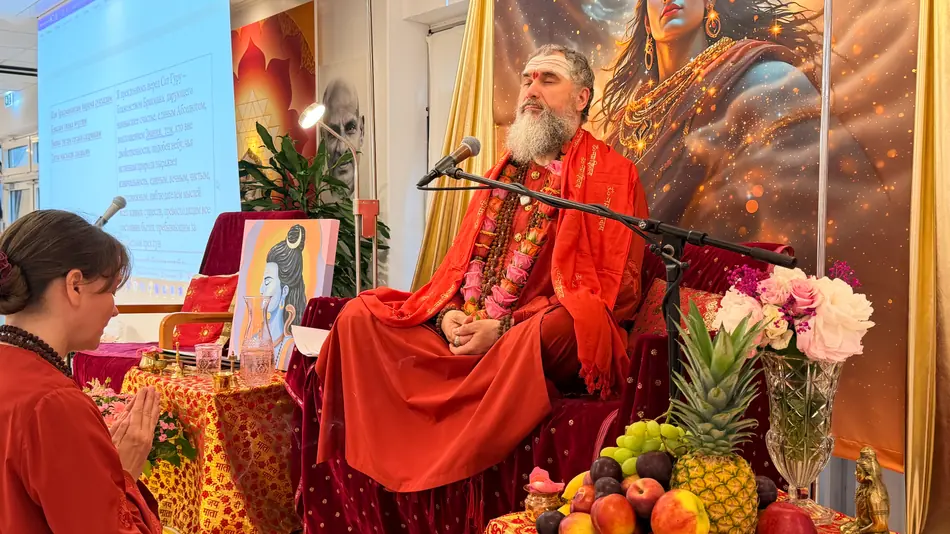
On the spiritual path, there is a blind spot that one cannot see on one’s own: one’s own mind is incapable of being an impartial judge of itself. One may practice for years, read the shastras, reflect — and still move in circles, mistaking a subtle illusion for realization. For such a situation, the tradition of Sanatana Dharma has the Guru (Sanskrit: guru). According to one traditional interpretation, the word is composed of two roots: “gu” — darkness, ignorance, and “ru” — the one who dispels. The Guru is the one who dispels the darkness of ignorance.
Why the mind cannot guide itself
The mind is so constituted that it is both an instrument of knowledge and the main source of delusion. It builds theories, interprets experience, explains failures — and does so convincingly even when it is mistaken. It is almost impossible for the practitioner himself to distinguish where genuine insight is at work and where there is a subtle admixture of ego. An outside perspective is needed: experienced, rooted in tradition, free from the very delusions in which the student himself is entangled.
Swami Vishnudevananda Giri has repeatedly emphasized that any practice requires a Guru — just as any skill requires a teacher. In India, even a dance instructor is called a “dance Guru”: an expert who knows the subject from within. The difference lies in the scale of what is at stake. There, movement is refined. Here, the destiny of the soul is decided.
“A Guru is an expert, a specialist, first and foremost, who can say: this is the right path, this is the wrong one.”
— Swami Vishnudevananda Giri
Three dimensions of the Guru principle
Tradition reveals the Guru as a principle that unfolds on three levels: adhibhautika, adhidaivika, adhyatmika.
The first is adhibhautika, the physical level. Here the Guru is a specific person: someone who has walked his own path, possesses spiritual authority, and knows the scriptures and the lineage of transmission. People turn to him, learn from him, and ask him questions.
The second is adhidaivika, the divine level. On this plane, both the Guru and the disciple are perceived as devatas — divine beings. Subtle relationships arise between them, called samaya. At this level, the disciple receives a blessing — a transmission of a much subtler order than ordinary human support.
The third is adhyatmika, the spiritual level, the level of the Atman. Here the Guru ceases to be an external figure and is revealed as a principle dwelling within the seeker himself. The disciple’s path is an ascent from the first dimension to the third: from perceiving the teacher as a person to discovering the same principle within oneself.
What the Guru is not
Beginners often approach the subject of the Guru with distorted expectations. One option is to perceive him as a magician who will solve the disciple’s problems for him, take on his karma, and bring him to liberation with a single touch. Another is to see him as a coach from whom one can “beg for a technique” for quick results, or as a professor whose lectures are enough simply to listen to.
Neither corresponds to reality. The Guru never violates the disciple’s free will — this, according to tradition, is a universal law that neither gods nor siddhas transgress. The mentor can offer advice, give instruction, and point out the direction. No one will do the spiritual work for the disciple himself: one cannot eat honey for another, one cannot walk the path to God in someone else’s place. Guru yoga is contact with the dimension of grace, which unfolds through the disciple’s own trust and living practice.
The lineage of transmission and the preservation of purity
In the tradition, profound teaching is preserved behind the seals of samaya. It is not a matter of secrecy — without proper transmission, it loses its power and purity. The process by which the teaching preserves its purity is called transmission, and the chain through which it passes from teacher to disciple is the lineage of transmission, the parampara. Therefore, in the Vedic tradition, a mantra, initiation, or instruction is received through the Guru: a teaching assembled from fragments in books lacks this purity.
“A spiritually awakened teacher, or satguru, is important in order to know the Transcendent Absolute, and equally important are personal discipline, righteous conduct, purification, pilgrimage, the striving for self-knowledge, and meditation.”
— the catechism Dancing with Siva, Satguru Sivaya Subramuniyaswami
Grace and the inner Satguru: a complete picture
If these three dimensions are brought together, the picture becomes whole. On the physical level, the Guru is a teacher and expert who points out the right and wrong path. On the divine level, he is a source of grace (Guru-kripa), which is revealed through the disciple’s pure vision and trust. On the spiritual level, he is the principle identical with the inner Atman, the same Satguru who abides in the seeker from the very beginning.
Therefore, in a deeper sense, the question sounds different from “whether a Guru is needed.” It is more correct to ask: how does the seeker move toward that inner Satguru who already exists within him? The external teacher, the lineage of transmission, the instructions of the shastras — all these are steps in this movement, not a substitute for it. Without external support, it is almost impossible to discern where one’s own projection ends and genuine discrimination begins.
Practical Significance for the Beginner
For someone who is only entering the path, simple guidelines follow from this teaching. The Guru should be seen as an expert who checks the direction of practice, not as an all-powerful savior who removes another’s karma with a single touch. The only condition under which the transmission of grace is possible at all is pure vision: the ability to perceive in the mentor something more than merely an extraordinary person. Responsibility for one’s own choice and effort remains with the seeker himself. The Guru points the way. One must walk it independently.
Words of the Teacher
“The Guru is not only a person; it is a principle that guides the disciple along the spiritual path, blesses, inspires, and teaches. In the end, we must discover the Guru principle within ourselves.”
— Swami Vishnudevananda Giri
