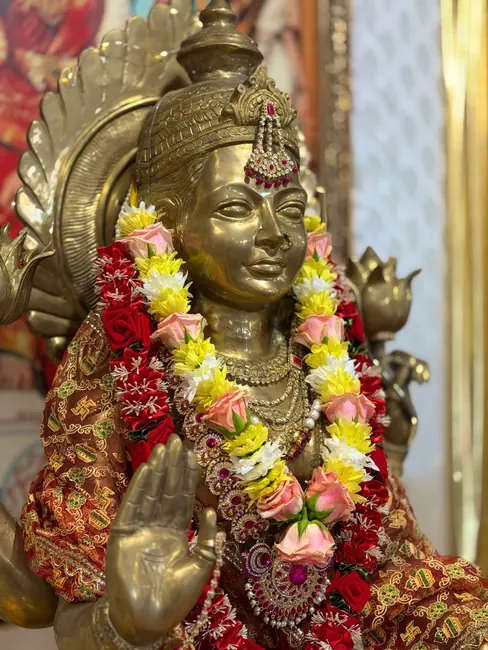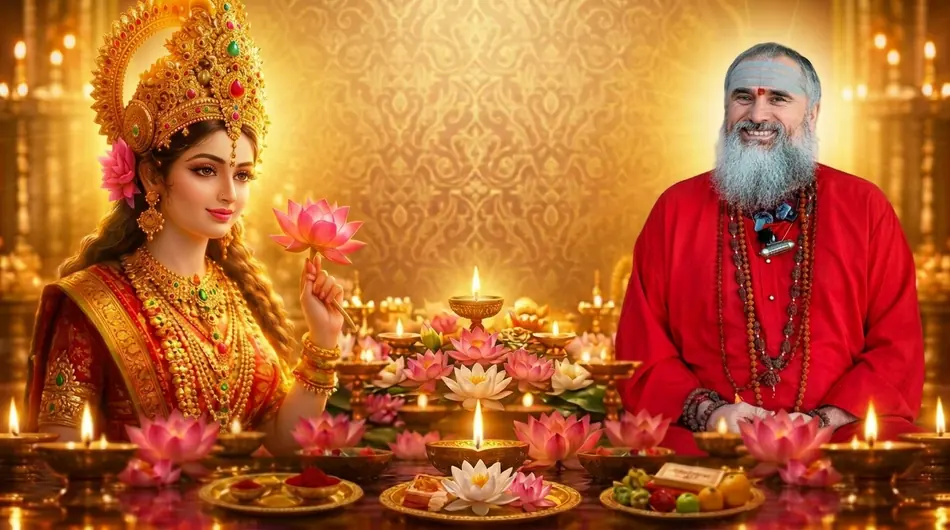
From November 8 to 15, 2026, the ashram “Shiva Prem Sagar” will host a series of daily Lakshmi homas and Lakshmi pujas dedicated to the eight traditionally revered aspects of the goddess Lakshmi. Shri Guru Swami Vishnudevananda Giri Maharaj will participate in the events.
Participation is possible both in person and online (times are given according to Rome time).
Lakshmi homa — daily at 08:00;
Lakshmi puja — daily at 16:00;
The Eight Aspects of Lakshmi
November 8 — Adi Lakshmi
Adi means “primordial” or “original.” Adi Lakshmi is revered as the primordial aspect of the goddess, the source of auspicious power and spiritual support.
Within the framework of practice, this day is associated with inner peace, mental stability, and establishing a foundation for serious sadhana — regular spiritual discipline. Reverence for Adi Lakshmi reminds us that, in the traditional understanding, external prosperity is inseparable from inner balance and adherence to dharma.
November 9 — Dhana Lakshmi
Dhana means “wealth,” “treasure,” or “property.” Dhana Lakshmi is associated with material resources, the fruits of honest labor, stability, and the responsible use of resources.
The practice of this day is dedicated to prosperity that cannot be reduced to accumulation. Wealth is regarded as an opportunity to support one’s family, engage in charity, preserve independence, and pursue spiritual practice without hindrance. In the traditional context, freedom from greed, honesty, and generosity are of particular importance.
November 10 — Gaja Lakshmi
Gaja means “elephant.” The image of Gaja Lakshmi is associated with regal dignity, strength, protection, respect, and stability.
In Hindu symbolism, elephants often represent power, stability, and grandeur. Therefore, reverence for Gaja Lakshmi is associated not only with social success, but also with developing the ability to govern one’s own senses, speech, and mind. Inner authority is understood as self-control rather than domination over others.
November 11 — Dhanya Lakshmi
Dhanya means “grain,” “harvest,” “food,” or “nourishment.” Dhanya Lakshmi embodies the abundance of the earth’s fruits, health, sustenance, and the ability to support life.
Reverence for this aspect expresses respect for food, agriculture, nature, and the labor through which human society exists. In spiritual practice, it is also associated with attentive care for the body, moderation, and recognition of the body as a necessary instrument of dharma and sadhana.
November 12 — Santana Lakshmi
Santana means “offspring,” “continuation,” or “succession.” Santana Lakshmi is revered as the patroness of the continuation of the family, children’s health, and the well-being of the lineage.
In a broader spiritual sense, succession also means the transmission of knowledge, preservation of tradition, and the responsibility of teacher and disciple. For a practitioner, this may be expressed through raising children, supporting the family, transmitting spiritual values, and developing qualities that become the fruits of sadhana.
November 13 — Vira Lakshmi, or Dhairya Lakshmi
Vira means “heroic,” “courageous,” or “valiant”; dhairya means “steadfastness,” “patience,” or “self-control.” This aspect of Lakshmi is associated with the courage necessary to overcome difficulties and remain faithful to dharma.
Spiritual discipline requires constancy, the ability to overcome doubts, and the strength to resist inner inertia. Vira Lakshmi symbolizes not aggression, but moral courage, patience, and the willingness to continue along the path even under unfavorable circumstances.
November 14 — Vijaya Lakshmi, or Jaya Lakshmi
Vijaya and jaya mean “victory” or “triumph.” Vijaya Lakshmi is associated with success in righteous endeavors, overcoming obstacles, and achieving one’s intended goal.
In spiritual terms, victory is understood above all as overcoming ignorance, egoism, attachment, and other obstacles that hinder a clear perception of reality. Such victory does not set a person against those around them, but strengthens their ability to act responsibly and in harmony with dharma.
November 15 — Vidya Lakshmi
Vidya means “knowledge,” “learning,” and “understanding.” Vidya Lakshmi is revered as the patroness of education, sciences, the arts, wisdom, and the ability to distinguish the true from the transient.
The tradition distinguishes between external knowledge acquired through learning and spiritual knowledge leading to an understanding of the nature of consciousness and reality. Therefore, this day is dedicated to developing memory, clarity of thought, the ability to study the shastras, and the application of knowledge in life.
Aims of the Practice
Lakshmi homas and Lakshmi pujas during the Diwali period are dedicated to:
removing obstacles;
well-being and abundance;
success in honest work and entrepreneurship;
health, peace, and inner contentment;
family happiness and harmony between spouses;
developing compassion, generosity, and responsibility;
the opportunity to engage in spiritual practice without fear of poverty;
strengthening wisdom, discernment, and devotion to dharma.
The ritual does not replace personal effort, moral discipline, or responsibility. In the traditional understanding, homa and puja create a sacred space for prayer, gratitude, and the formulation of a sankalpa, while its fulfilment requires the person’s corresponding actions.
Participation Procedure
The eight days of practice may be completed in full or attended on individual days. Participation is possible:
in person, at the “Shiva Prem Sagar” ashram;
online;
on one or several days of the cycle.
To register, please contact the administrator: Telegram
The cycle is conducted for the well-being of the participants and their families, their spiritual development, and the welfare of all living beings.