

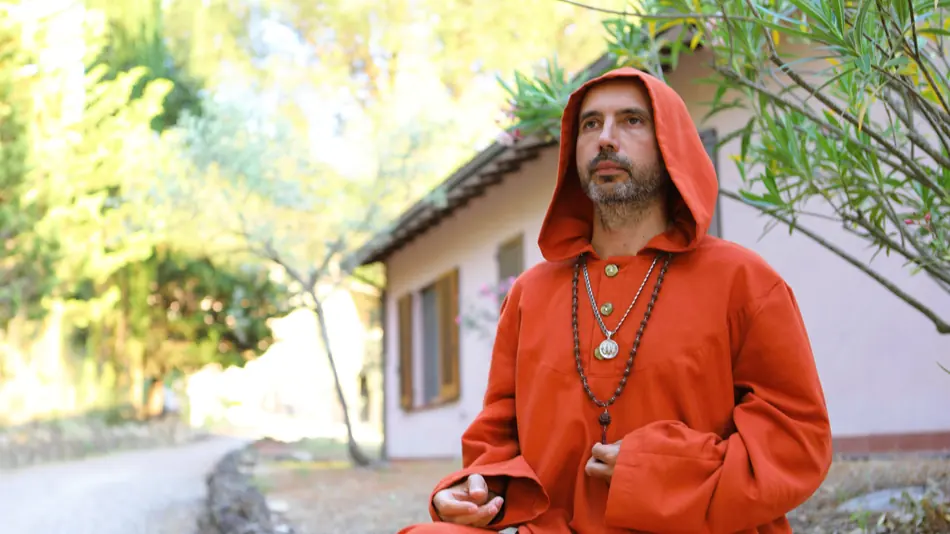
From November 13 to 18, 2026, a five-day meditation retreat led by Monk Ramanatha will take place at a retreat center near Bremen. Hatha yoga and Kundalini yoga practice sessions will be conducted by instructor Tejovati.
The program includes lectures and practical sessions on meditation, yogic self-regulation, and the Siddha tradition. The retreat is held in complete silence: for the duration of the stay, electronic devices are switched off and handed over to the organizers for safekeeping in sealed packaging.
Arrival: November 13, 2026, at 1:00 p.m.
Departure: November 18, 2026, at 12:00 p.m.
Venue: a retreat center near Bremen, Germany.
Session Leaders
Monk Ramanatha
Monk Ramanatha will give lectures and lead meditation sessions devoted to:
the fundamentals of meditation;
methods of yogic self-regulation;
working with attention, breathing, and physical relaxation;
contemplative walking;
the Siddha tradition;
the self-inquiry practice of ātma-vicāra—the “inquiry into the Atman,” or the true nature of one’s own “Self”;
contemplative methods of Shaiva yoga.
Instructor Tejovati
Tejovati will conduct Hatha yoga and Kundalini yoga sessions and will also handle participant registration and provide organizational support for the retreat.
Retreat Program
1. Relaxation and Physical Self-Regulation
This section includes methods of progressive relaxation, the restoration of steady attention, and mindful awareness of the body:
seated relaxation meditation;
identifying and releasing persistent physical and psychological tension;
the practice of complete yogic breathing;
active self-regulation meditation through free movement;
meditation on the inner smile, gratitude, and loving-kindness;
forming an inner image of health;
contemplative walking.
2. Contemplative Walking and Stability of Attention
Walking practice is used as a means of maintaining awareness in motion and includes:
walking with attention to support and the contact of the feet with the ground;
walking to develop physical stability;
“Mahashanti” contemplative walking;
walking while continuously observing sensations, breathing, and the state of mind.
The term mahāśānti consists of the words mahā—“great”—and śānti—“peace,” “tranquility.” In the program, this name refers to a set of exercises aimed at bringing the scattered inner dialogue to an end and establishing calm, clear attention.
This set includes:
seated “Mahashanti” meditation;
contemplative walking;
mindful tea preparation;
tea drinking in silence and continuous presence.
3. Breathing and Working with the Life Force
The Sanskrit word prāṇa means vital breath, life force. In yogic texts, prana is considered primarily in connection with breathing, sensory activity, and bodily functions. The practice includes:
complete yogic breathing;
gathering attention in the lower abdomen;
exercises for coordinating breath and movement;
methods for distributing the life force evenly;
working with the traditional concept of tejas—“radiance,” “vital energy,” “inner strength.”
The program also includes exercises involving smooth arm movements aimed at developing bodily sensitivity and coordinating the rhythm of breathing with movement.
4. Working with Chakras and Inner Channels
The program includes:
concentration on anāhata-cakra — the heart center;
concentration on sahasrāra-cakra — the center symbolically located above the crown of the head;
the practice of awareness of the central channel;
exercises for developing sensitivity in the hands and feet;
the practice of awareness of the crown area;
methods for harmonizing the five elements — earth, water, fire, air, and space;
visualization of the chakras and internal organs being filled with light;
gathering attention and vital energy in the lower abdomen.
5. Light Visualization Practices
A number of sessions are based on guided visualization. Participants are offered:
the “Healing Oil” meditation;
visualization of a sphere of light;
purification through the image of light;
concentration on filling the body with light;
directing attention to specific areas of the body;
the practice of loving-kindness and mentally dedicating beneficial states to others;
an in-depth meditation based on feelings of love and gratitude.
6. Shambhavi Mudra
The Sanskrit word mudrā means “seal” or “sign,” while śāmbhavī means “pertaining to Shambhu,” one of the names of Shiva. Shambhavi Mudra is a contemplative method associated with sustained attention and a particular positioning of the gaze.
The program includes:
contemplative Shambhavi Mudra meditation;
the practice of maintaining a steady gaze without excessive strain;
a combination of rotation, stillness, and contemplation;
revealing the natural state through motionless presence.
7. Atma Vichara: Self-Inquiry
Ātma-vicāra means “inquiry into Atman,” that is, an investigation into the nature of the conscious subject. The word ātman is translated as “Self” or “inner self,” while vicāra means “inquiry” or “discerning examination.”
During the practice, attention is directed not toward creating new concepts, but toward investigating the very source of perception, thought, and the sense of an individual “I.”
Daily Schedule
The retreat follows an established daily schedule. The program includes:
group meditations;
lectures and study of the teachings;
Hatha Yoga and Kundalini Yoga;
contemplative walking;
meals;
rest periods;
one-hour practice sessions.
Duration of each meditation session: 60 minutes.
The schedule involves a consistent alternation of seated meditation, movement, breathing practice, study of the teachings, and rest.
Participation Terms
Location: a retreat center near Bremen, Germany.
Accommodation: single rooms.
Meals: three vegetarian meals per day, included in the fee.
Practice venue: a fully equipped yoga and meditation hall.
Practice format: scheduled group sessions.
Communication policy: complete silence.
Organizational fee: €950.
Registration Procedure
Contact the organizer, Tejovati, and state your intention to participate.
Receive confirmation that a spot is available.
Review the terms and conditions for participation, payment, and booking cancellation.
Pay the required deposit.
Receive payment confirmation.
Once your registration has been confirmed, join the participants' information group.
Contact person: Tejovati.
Communication channels: Telegram, Instagram, WhatsApp.
Additional materials: tour of the premises, retreat center location and video interviews.
