

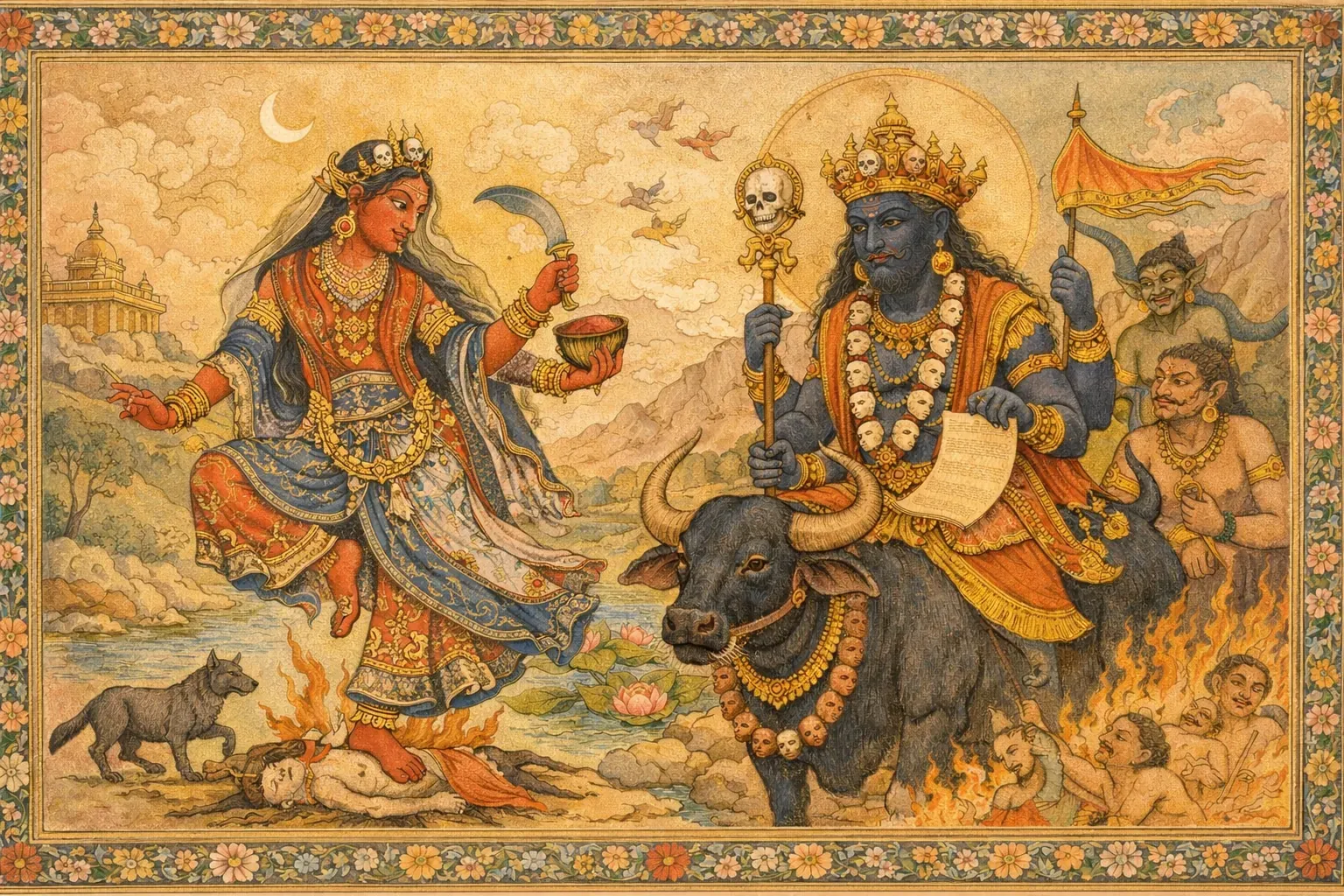
“The Tale of Choyjid Dakini” is an outstanding monument of 16th-century hagiographic literature, belonging to the genre of descriptions of travels to post-mortem states (known in Tibetan and Himalayan traditions as delog). The text recounts the experience of a spiritual practitioner whose consciousness, in a state of clinical death, visited spheres beyond the physical plane, including the judgment seat of Yamaraja.
Yamaraja (Skt. yamarāja) — in Vedic and Puranic mythology, the lord of the realm of ancestors and the deity of justice (Dharmaraja), personifying the impartial law of retribution. His role is established in such authoritative sources as the “Katha Upanishad” and the “Garuda Purana.”
Doctrinal Context: According to classical Dharma texts, the realization of impermanence is the first of the “four principles that turn the mind toward practice” (chatur-dharma). Without a deep understanding of the temporality of material forms, it is impossible to achieve vairagya (detachment) and genuine spiritual discipline.
“Just as the footprints of all living beings fit within the footprint of an elephant, so all good qualities of the mind originate in the realization of impermanence.” — A classical saying of the tradition's teachers.
III. EXPLANATION AND PRACTICAL APPLICATION
The presented study course is based on archival lectures by Guru Swami Vishnudevananda Giri, delivered in 2007. The educational goal of the course is to transform abstract knowledge about death and karma into effective motivation for inner transformation.
Key aspects of the study material:
- The Law of Causality (Karma-siddhanta): Through the lens of Choyjid Dakini's testimony, the mechanism of karmic impressions (samskaras) is revealed. The messages transmitted from the subtle worlds serve as documentary confirmation that ethical norms are not mere conventions, but metaphysical laws of the universe.
- Realization of Impermanence (Anitya-bhavana): A fundamental principle that allows the practitioner to overcome the illusion of the eternity of material existence. Understanding the brevity of human incarnation serves as a catalyst for daily sadhana.
- Lineage and Commentary: Guru Swami Vishnudevananda Giri, drawing on the authority of the Advaita Vedanta and Kashmir Shaivism traditions, adapts the ancient imagery of the 16th-century text for the modern seeker while maintaining doctrinal rigor.
TECHNICAL SPECIFICATIONS OF THE MATERIAL:
- Material Type: Video course (archival recording).
- Original Source: “The Tale of Choyjid Dakini” (16th century).
- Lecture Recording Date: 2007.
- Duration: 1 hour 22 minutes.
- Structure: 5 thematic parts, including the reading of iconic fragments of the text and deep philosophical commentary.
Intended Purpose: The course is recommended for researchers of Eastern philosophy, religious scholars, as well as followers of Sanatana Dharma seeking to lay a solid foundation in their personal practice through the awareness of responsibility for their own actions and understanding the laws of post-mortem existence.
This material is part of a program for the preservation and study of traditional texts of Himalayan Yoga and the Vedantic tradition.
