

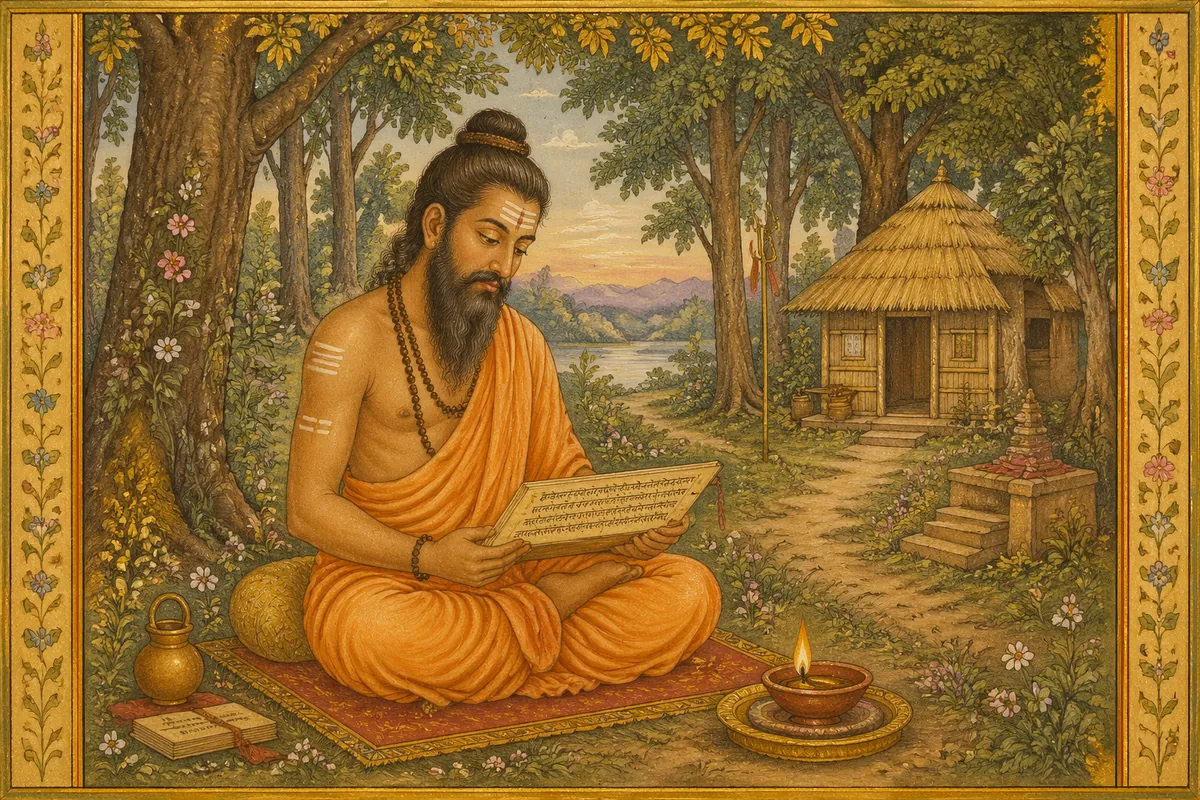
When a person first comes to spiritual practice, the word “meditation” evokes one image: sitting with closed eyes, thinking about nothing, simply watching the breath. Analytical meditation is structured differently. Here the mind does not fall silent — it works, but purposefully: it investigates, asks uncomfortable questions, and comes to conclusions that gradually change one’s view of life.
In the tradition of Sanatana Dharma, analytical meditation (Sanskrit manana — reflection, vicāra — inquiry) is a preparatory practice that precedes more subtle forms of meditation and contemplation. It creates the ground for them: a correct view, stable motivation, and an honest understanding of one’s situation.
Swami Vishnudevananda Giri on its role:
“Analytical meditation is not something one should do for one’s whole life — it prepares us for true meditation. In analytical meditation we are still thinking about God — this is much better than thinking about television or something else. Nevertheless, analytical meditation is not the final point; it should prepare us for true meditation — for natural contemplative presence.”
How to Perform Analytical Meditation
It does not require a special room or an hour in your schedule. A quiet corner, 20–30 minutes, and a readiness to think about serious things are enough.
Preparation. Sit in a comfortable posture — on a chair or on a cushion. Take several deep breaths. There is no need to achieve silence of the mind; simply slow down the flow of thoughts a little.
Choose one topic. Analytical meditation is always directed at something specific. For beginners, the “four awarenesses” are recommended — more on them below. Take one topic for one session.
Reflect slowly. Ask yourself questions. Bring in examples from your own life. Allow the thought to unfold; do not rush it toward a conclusion. The sign that the reflection has “worked” is not new information, but an inner shift: something has become important that you had not noticed before.
Completion. Sit in silence for a few minutes. You can make a brief note — a conclusion or a question that remains.
The Four Awarenesses
In the teaching, there is a special set of topics for analytical meditation — the “four awarenesses”: reflections on the preciousness of human birth, impermanence, the law of karma, and the sufferings of samsara.
The goal is not to plunge a person into anxiety. The goal is sobriety. To understand where we are, how life is arranged, and why spiritual practice is not an evening hobby, but an answer to the real question of existence.
“Constantly reflect on the four awarenesses in order to become detached from attachment. When you reflect on the four awarenesses, a different attitude toward the world, a different vision, arises within you. When a person practices for years and says that his life is not radically changing, I tell him: you have obviously ignored reflection on the four awarenesses. If you had reflected on them deeply, it would simply be impossible for a different vision not to arise in you, for a resolve to practice more radically not to appear.”
And one more word from the Guru — about how serious this practice is:
“Even if you do not teach another for twelve years, but reflect on the four awarenesses, you will become a strong sadhu. Whoever has realized the four awarenesses understands: there is no way back, only forward toward liberation.”
The First Awareness: the Preciousness of Human Birth
To be born human is rare. All the conditions for the spiritual path coincide very rarely: a sound mind, the opportunity to listen to the teaching, an encounter with a living tradition, and the absence of heavy karmic obstacles. This is called a “precious human birth.”
“We must realize that our precious, unique human birth is intended for liberation, for enlightenment, for the realization of God. The saints say: ‘Do not doubt for a minute. If you have a precious human birth, this is a great rarity; use this precious human birth to walk the path of liberation.’”
Swami Vishnudevananda Giri
It does not make us better than other beings in any way. It gives an opportunity — to leave the cycle of births and deaths in this very life. Most souls do not have such an opportunity.
Questions for meditation:
- What do I have right now: health, mind, time, access to the teaching. None of this is to be taken for granted.
- Am I using this opportunity? If not, what is really preventing me?
- What would become the center of my life if I seriously accepted: this birth was given for liberation?
This reflection does not give rise to guilt. It gives rise to gratitude — and, following it, responsibility. A person begins to look differently at how they spend their time.
Lecture “The Path to Liberation through the Four Awarenesses and Guru Yoga,” October 20, 2025
The Second Awareness: Impermanence
Everything changes and disappears. The body ages every day—imperceptibly, but steadily. Relationships, health, prosperity—all of this comes and goes. The most obvious expression of impermanence is death, which is inevitable, while its moment is unknown.
“As soon as a person receives a birth certificate, it would be fitting to issue a death certificate on the reverse side. No one can say that this is not so. The only question is the interval of time.”
Swami Vishnudevananda Giri
Reflection on impermanence is not a cult of death. It is sobriety. A person who has truly accepted this thought simply stops wasting energy on things that cannot withstand it. Everything that is called an “important matter” looks somewhat different upon closer examination.
Questions for meditation:
- What in my life do I consider permanent, although it is temporary?
- If I knew that I would die in a year, would my priorities change? What does this answer say about my current ones?
- Right now, while I am alive, what is truly important?
Lecture “Analytical Meditations: The Path to Freedom from Samsara and Karma,” March 25, 2017
The Third Awareness: The Law of Karma
Karma (Sanskrit karma) is the law of cause and effect in the sphere of consciousness and actions. Every deed, every intention, every deeply rooted desire creates consequences—in this life and in future incarnations.
“To understand the law of karma means to begin practicing, to begin sadhana, to govern one’s mind, to control one’s mind. If we control our mind well, we can direct it into the world of nonduality, the world of the Absolute.”
Swami Vishnudevananda Giri
Four things influence the strength of a karmic consequence: the action itself, its object (to whom it is directed), the motivation at the moment of action, and the state of mind afterward. A minor act done with sincere compassion weighs differently than an outwardly grand deed done for the sake of pride.
This is not a philosophical abstraction. It is a description of a mechanism that is working right now.
Questions for meditation:
- What patterns repeat in my life—relationships, difficulties, reactions? What does this say about the causes created in the past?
- What is the deeper motivation behind my daily actions?
- Right now I am creating new causes—which ones?
When the law of karma is not merely known but experienced as a fact, the position “why does this always happen to me” changes by itself. A person regains authorship over his or her destiny.
Lecture “The Law of Karma and the Sadhu’s Path to Liberation,” April 11, 2018
The Fourth Awareness: Suffering in Samsara
Life in samsara (Sanskrit saṃsāra—the cycle of births and deaths) is permeated with suffering: obvious and hidden, gross and barely noticeable. Illnesses, losses, dissatisfaction, anxiety about the future—these are not random obstacles in a good life. They are a structural property of existence without liberation.
“Attachment to samsara, from the point of view of saints, is nothing good. It is like an illness. People, for the most part, dwell in fears, hopes, dissatisfaction, opposition, and apprehension. That is, the spectrum of human emotions of souls stuck in samsara is precisely like this. Therefore, it is considered an illness.”
Swami Vishnudevananda Giri
There is joy in the world—but it is impermanent, depends on external circumstances, and comes to an end. Clinging to it itself becomes a source of suffering. One of the texts of the tradition describes this directly: “The severe illness of material attachments to samsara is well cured by the medicine of reflection on impermanence and the sufferings of birth and death” (Song of the Monk-Healer).
Questions for meditation:
- What sufferings in my life do I fail to notice, taking them as the norm?
- What do I do to avoid suffering? Does it work, or does it only postpone it?
- Is there anything in life that does not depend on external circumstances?
This reflection is honest, not gloomy. A person who has clearly seen suffering stops looking for the next painkiller and begins truly looking for a way out.
The Fruit of Practice: the Birth of Vairagya
When reflections on the four mindfulnesses are deeply assimilated, vairagya (Sanskrit vairāgya) gradually arises in a person — an inner non-attachment, a lack of interest in samsaric objects. Not indifference and not depression. Freedom. The mind stops seeking support in the temporary and begins to turn toward the permanent.
It is precisely vairagya that provides motivation for practice that does not run dry. Not because “one must” or because it is “interesting to try” — but because a person sees: liberation is the only goal worth living this birth for.
How to Include It in Daily Sadhana
Analytical meditation fits well into morning practice or as a separate evening session — 20–30 minutes several times a week. Work with one mindfulness for as long as necessary — until it truly “takes root,” rather than remaining mere words.
The sign of an effective practice is simple: life begins to change. Priorities are set differently. It becomes a pity to waste time. Minor irritations have less of a hold. Something appears that can be called seriousness — without heaviness.
If nothing changes for a long time, the reflection remains superficial. You need to go deeper: more slowly, more specifically, more honestly with yourself.
