

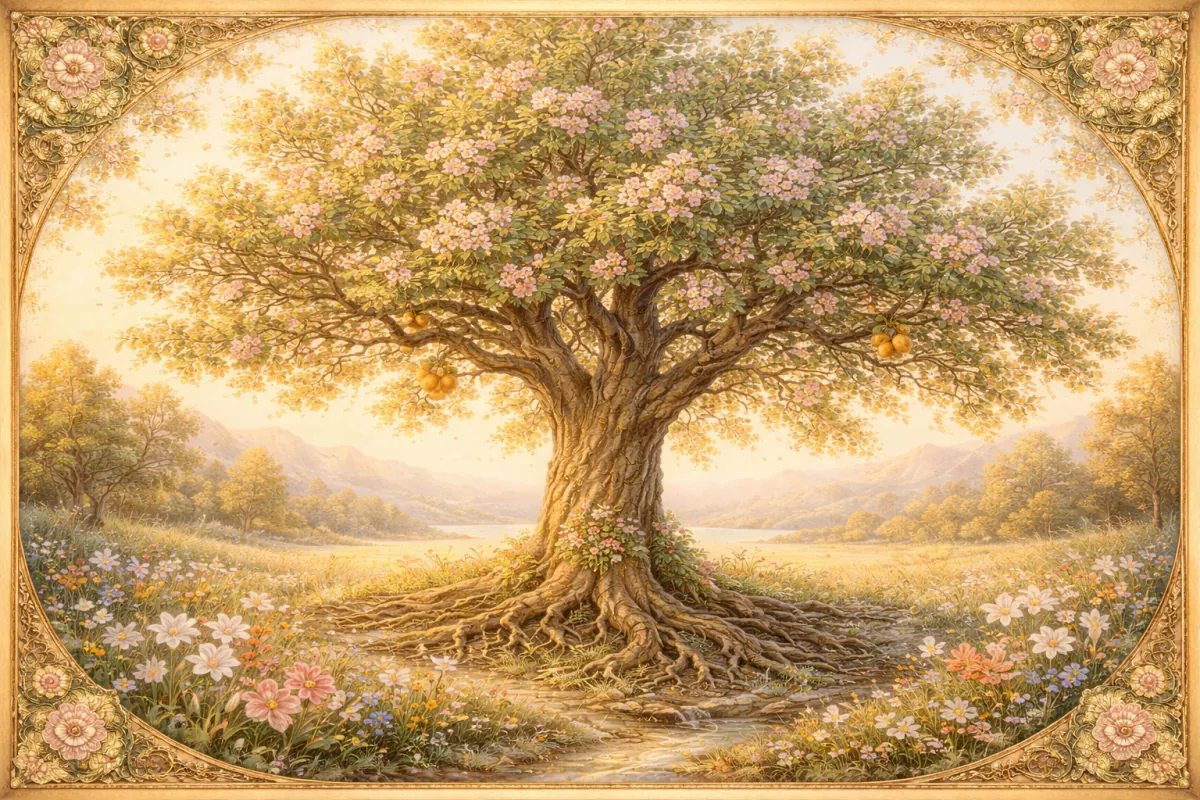
The teaching of Laya Yoga is like a large, beautifully flowering tree that has roots, a trunk, branches, leaves, flowers, and fruits. All the methods of the Teaching are in their proper place; they combine perfectly and coexist harmoniously within the Tree of Teaching, without contradicting one another. Everything within it has its own function, purpose, and goal.

Five Main Directions
There are five main directions in the Teaching:
- Wisdom (Prajna-yantra)
- Energy (Shakti-yantra)
- Dream Yoga (Nidra-yantra)
- Light (Jyoti-yantra)
Sound (Nada-yantra)
The Structure of the Tree of Teaching
Roots: The Three Freedoms
If we envision the Tree of Teaching as a whole, the roots here are the three awarenesses or three freedoms – of body, speech, and mind. The three freedoms mean that we are in a natural, relaxed, and unconditioned state. It is not conditioned in the body, nor in speech, nor in thoughts, and abiding in such a state constitutes the roots of the Teaching.
Trunk: Prajna-yantra (The Teaching of Wisdom)
But the tree also has a trunk, and the methods of the trunk are the methods of Prajna-yantra (the Teaching of Wisdom). These are the methods of the contemplation section – such as working with sankalpas, the art of Mahashanti or the nine self-liberations, the section of Divine Pride, and the section of Shambhavi-mudra. These are the primary methods related to the trunk of the Tree of Teaching. That is, the essence of the Teaching lies in contemplating, being aware, and abiding in a self-liberated presence.
Branches: The Four Yantras
There are also branch methods. These are special skillful means that allow one to develop and deepen contemplation. The branch methods are:
- Shakti-yantra (the Teaching of Energy)
- Nada-yantra (the Teaching of Sound)
- Nidra-yantra (the Teaching of Dream Yoga)
- Jyoti-yantra (the Teaching of Light)
Leaves: Additional Methods
There are the so-called leaf methods (additional minor methods). There is a vast number of them, like the leaves on a tree. The leaf methods are not the primary or root methods, but they help us develop our contemplation and various aspects of practice.
Flowers: The Aspect of Pure Vision
And there are flower methods. The flower methods express the aspect of pure vision, the aspect of the blooming of Dharma. They are like beautiful flowers on the tree of Dharma. These include, for example, the sadhanas of invoking Dattatreya or Lakshmi.
Multidimensionality of the Teaching
The Teaching, the practice of Dharma, is not just a single method; it is a tree-method that represents multidimensionality, a vast system, multivariance, and polyphony. The Teaching is not just some philosophical tenets or two or three methods; it is an entire large tree. And within this tree, it is very important not to get confused, understanding what constitutes the trunk, what the roots, what the leaves, and what the flowers. This is because if we do not understand the hierarchy of methods within this diversity, we may fail to understand where to place emphasis and what the place of each method is within the Teaching. But if we clearly understand that the root is abiding in the natural state, then it becomes clear that the essence of the Teaching is undefinable and lies in abiding in awareness. If we understand what the development of contemplative practices is, then it becomes clear what this tree stands on, what its trunk is. And when we apply other methods, we learn to weave and practice them within the context of understanding the Tree of Teaching.
“Use not one method, but many”
Tilopa
The Principle of Sahajya
Why are many methods necessary? The multitude of methods is only an apparent multitude and diversity. In reality, the method is one, and we are practitioners of a single method. This primary method consists of abiding in contemplative presence (Sahaja-sthiti). Therefore, our lineage is also called Sahajya, the school of Sahajya. The principle of Sahajya is the direct, immediate experience of non-duality. The Siddhas of Sahajayana taught that reality cannot be understood through methods, actions, conceptual limitations, or philosophy.
Priority of Internal Spontaneity
Abiding in the state of Sahajya is the root of the Teaching. That is, first and foremost, we listen to the internal spontaneity of natural awareness, and secondly, we perform techniques, ritual practices, methods, and so on. But if you perform many techniques and rituals, recite mantras, wear a certain type of clothing, and perform worship, yet you lack the practice of awareness—that is, you do not abide in this spontaneity—then it means you have not yet succeeded in entering the dimension of Laya Yoga teachings.
Deepening into the Natural State
As we abide in the natural state and learn to be aware, integrating contemplative presence with various manifestations of our life, a gradual surrender to this natural state occurs. The natural state is not connected to logic, philosophy, culture, or any religious tradition. Rather, it is the essence of our world, the essence of the Universe, which is also called Prajnana (the primordial wisdom of awareness) or Parabrahman. As we become rooted in the natural state, our mind trusts it more and surrenders to it more and more.
Three Sections of Prajna-yantra
The Teaching of Prajna-yantra, which is the trunk, describes the processes of self-liberation and self-transcendence. It teaches how to practice correctly so that we can enter these processes.
The section of Prajna-yantra concerning Divine Pride emphasizes pure vision and the Pride of the Deity (divya-bhava).
The section concerning Shambhavi-mudra emphasizes space and the contemplation of space.
The section of contemplation is related to the teaching of the "Nine Sankalpas" and the nine self-liberations; it teaches how to work with the mind and apply subtle methods that eliminate the attachments of our mind.
Unity of the Three Sections
All these three sections only seem different; essentially, they all lead to the same result, although they have their own characteristics and methodology. We study and practice these three sections throughout our entire lives, as they are crucial for understanding. If one enters the Teaching of Laya Yoga, one must thoroughly understand these sections. They have nothing in common with speculative philosophy; they are practical sections that speak only about how to engage in practice and contemplation to eliminate one's ignorance. And if you have correctly understood the Teaching of Prajna-yantra, you will easily fit and integrate any other methods into the general context of practice.
The Essence of the Teaching: Returning to the Original Nature
The Teaching possesses a rather sophisticated structure and a multitude of methods; however, the entire structure and all methods are intended only for convenience and understanding. In reality, all sections of the Teaching speak of only one thing: how to abide in our original nature. Why are so many methods and such skillful means necessary? Because we have wandered very far from our original nature, and even when we hear about it, it is not so easy to return to it; we have strayed very far, very significantly. Our original nature—Sahajya, the Supreme Source, God, Brahman, the Absolute—these are identical concepts. All we need is to learn how to return to this nature.
