

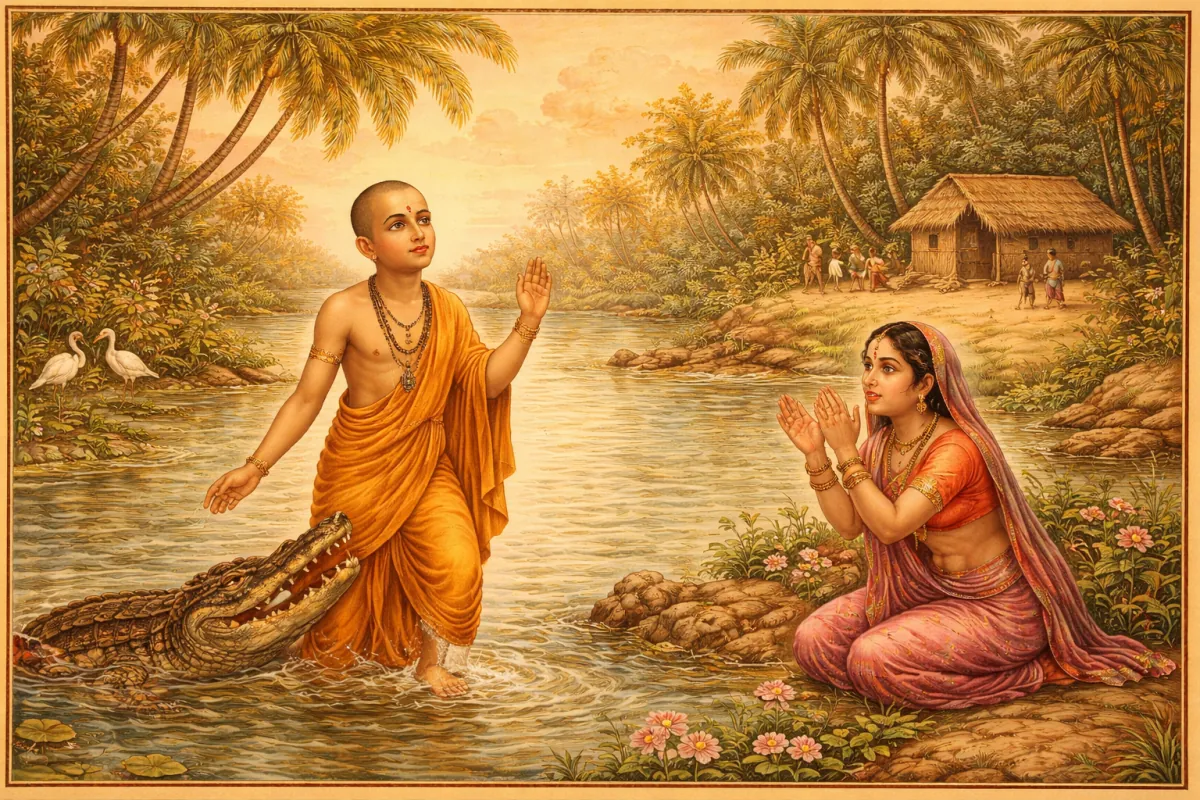
Adi Shankara (Ādi Śaṅkara, 788–820 CE) was an outstanding Indian philosopher and religious reformer, the founder of the systematized philosophy of Advaita Vedanta, the author of numerous commentaries on the foundational texts of the Vedic tradition, and the founder of the Dashanami Sampradaya monastic system, with four monasteries (mathas) in different parts of India.
Etymology
"Ādi Śaṅkara" consists of two Sanskrit words: "ādi" (आदि) means "first," "original," or "primordial," while "śaṅkara" (शङ्कर) is one of the names of Shiva, literally meaning "beneficent" or "one who brings well-being." Thus, the name "Adi Shankara" can be interpreted as "the primordial benefactor" or "the first Shankara," distinguishing him from later heads of the mathas, who also bore the title "Shankara."
Philosophical Significance
In a philosophical sense, the name Ādi Śaṅkara can be understood as a symbolic reference to one who leads back to the original good—the knowledge of non-dual reality. In the traditional interpretation, this is expressed through several layers of meaning:
Restoration of primordial knowledge—Shankara is regarded as the teacher who once again clearly articulated the doctrine of non-dual Brahman.
Elimination of ignorance—just as Shiva destroys illusions, Shankara’s philosophy destroys the erroneous notion of separateness.
Return to the ultimate ground—a reference to Atman as the very same reality as Brahman.
Therefore, in the spiritual tradition, the name Ādi Śaṅkara is understood not only as the historical name of a philosopher, but also as a reference to the principle of the teacher who reveals primordial non-dual knowledge.
Historical Context
Adi Shankara’s life is surrounded by numerous legends, and there is disagreement regarding its dating. Traditional Advaita chronology (according to the chronology of the mathas) places his lifetime in 788–820 CE, although modern scholars have proposed various dates ranging from the 6th to the 9th century. The most authoritative modern consensus dates his life to approximately 700–750 CE.
The main sources of information about Shankara are hagiographical texts, the best known of which are:
"Shankara Digvijaya" (Śaṅkara-digvijaya) by Madhava (also known as Vidyaranya)
"Shankara Vijaya" (Śaṅkara-vijaya) by Anandagiri
"Brihat Shankara Vijaya" (Bṛhat-śaṅkara-vijaya) by Chitsukhi
Although these texts contain numerous hagiographical elements, they reflect the traditional account of Shankara’s life and activities.
Birth and Early Years:
Adi Shankara was born into a Brahmin family in the village of Kaladi (in the present-day state of Kerala, India), within the Nambudiri Brahmin tradition. According to legend, his parents, Shivaguru and Aryamba, remained childless for many years and were blessed with a son after worshipping Lord Shiva at the Vadakkunnathan Temple in Thrissur. He was named "Shankara" in honor of Shiva.
From early childhood, Shankara displayed exceptional abilities and, according to tradition, by the age of eight had mastered the four Vedas and the six Shastras (Shadangas), as well as other traditional sciences. When Shankara was about seven years old, his father died, and the boy was raised by his mother.
Hagiographical literature contains numerous accounts of miracles that occurred during Shankara’s childhood, including how the Purna River changed its course to flow closer to his home after the boy had to travel a great distance every day to perform his ritual ablutions.
Taking Sannyasa and Spiritual Education:
According to legend, Shankara sought to take sannyasa (monastic vows) at a very young age, but his mother opposed it. One day, while Shankara was bathing in the river, a crocodile seized him. At that critical moment, he asked his mother for permission to take sannyasa, promising that the crocodile would release him. His mother agreed, and Shankara was miraculously freed.
Having received his mother's blessing, Shankara set out in search of a spiritual teacher (Guru. New version). He found his teacher, Govindapada, in a cave on the banks of the Narmada River. Govindapada, a disciple of Gaudapada (the author of the "Mandukya Karika"—the first systematic exposition of the Advaita position), initiated Shankara into sannyasa and taught him the philosophy of Advaita.
After several years of study under Govindapada, Shankara received his blessing to travel to Kashi (Varanasi), the sacred city of Hinduism, in order to spread the teachings of Advaita and write commentaries on the sacred texts. In Kashi, Shankara wrote most of his foundational works, including commentaries on the Brahma Sutras, the Upanishads, and the Bhagavad Gita.
Religious context:
The era in which Shankara lived was a turning point in the history of Indian religious thought. Hinduism was going through a period of crisis:
The spread of Buddhism and Jainism—by the 8th century CE, Buddhism, particularly in its Mahayana and Vajrayana forms, enjoyed considerable support from various Indian dynasties (the Guptas, Palas, and Chalukyas).
Fragmentation of the Brahmanical tradition—Brahmanism was divided into numerous rival schools:
Purva Mimamsa—a ritualistic school focused on the karma-kanda (ritual section) of the Vedas
Samkhya—a dualistic philosophy
Yoga—a practical system of psychophysical training
Nyaya and Vaisheshika—schools that study the laws of logic, the nature of knowledge, and the structure of the material world from indivisible particles
Various Tantric and Shakta cults
Decline of Vedic orthodoxy—strict adherence to Vedic ritualism persisted only in certain regions, while "popular Hinduism," with its temple worship and bhakti, became increasingly widespread.
Political fragmentation—after the collapse of the Gupta Empire, India was divided into numerous rival states, which was also reflected in religious life.
Under these conditions, Shankara emerged as a reformer and systematizer of the Vedic tradition, proposing a philosophical system that:
integrated the Vedic heritage
provided an intellectual alternative to Buddhism
reconciled various currents of Hinduism
revived the authority of the Upanishads
created a synthesis between ritual practice and philosophical knowledge
Digvijaya—philosophical conquests:
The most important aspect of Shankara's mission was his digvijaya ("conquest of the four quarters")—extensive pilgrimages throughout the Indian subcontinent aimed at spreading the teachings of Advaita and reviving the Vedic tradition. During these journeys, Shankara:
Engaged in philosophical debates with representatives of various schools:
With Buddhists of various traditions (Madhyamaka, Yogachara)
With Jains
With ritualists of the Mimamsa school
With representatives of Tantric traditions
With adherents of local cults
Visited key Hindu holy sites:
Prabhasa Kshetra (Gujarat)
Pushkar (Rajasthan)
Kashi (Varanasi, Uttar Pradesh)
Gaya (Bihar)
Ujjain (Madhya Pradesh)
Kanchipuram (Tamil Nadu)
Sringeri (Karnataka)
Rameswaram (Tamil Nadu)
Badrinath (Uttarakhand)
Kedarnath (Uttarakhand)
Established lineages of succession for the Advaita teaching and founded major monastic centers (mathas):
Jyotir Math (Badrinath, north)
Govardhan Math (Puri, east)
Sharada Math (Sringeri, south)
Kalika Math (Dwarka, west)
The heads of these mathas received the title of Shankaracharya and continue the Advaita tradition to this day.
He restored temples and places of worship in various parts of India, integrating local cults into the framework of the Vedic tradition and establishing strict principles of worship (Panchayatana Puja).
He reformed the monastic tradition by creating the Dashanami Sampradaya ("tradition of ten names")—a system of ten principal monastic orders:
Saraswati
Puri
Bharati
Tirtha
Ashrama
Giri
Parvata
Sagara
Vana
Aranya
Famous debates:
Among Shankara’s many philosophical debates, the best known are:
The debate with Mandana Mishra—an eminent representative of the Purva Mimamsa school. According to tradition, after several days of intense philosophical debate, adjudicated by Mandana’s wife, Ubhaya Bharati, Mandana acknowledged the superiority of Shankara’s arguments and subsequently became his disciple under the name Sureshvara.
The meeting with Kumarila Bhatta—another influential representative of Mimamsa. By the time he met Shankara, Kumarila had already undertaken self-immolation as atonement for studying Buddhism and, while on his deathbed, directed Shankara to his disciple Mandana Mishra.
The debate with the Kapalikas—followers of the Tantric tradition of worshipping Bhairava (a form of Shiva), who practised esoteric and sometimes unorthodox rituals. Tradition holds that Shankara succeeded in defeating the leader of the Kapalikas in debate, although the latter demanded that Shankara sacrifice his head to the goddess Kali.
Discussions with Buddhists at important Buddhist centres such as Nalanda and Vikramashila. Shankara borrowed elements of Buddhist logic and argumentation but used them to defend the Vedic heritage.
The final years of his life:
According to tradition, Shankara departed from this world at the age of 32 in Kedarnath (the Himalayas), where his samadhi (memorial) remains to this day. Another version claims that his final samadhi is located in Kanchipuram (Tamil Nadu).
Before his death, Shankara ensured the continuation of his teaching by appointing his four principal disciples—Sureshvara (Mandana Mishra), Padmapada, Hastamalaka, and Totaka—as heads of the monasteries he had founded.
Tradition also attributes to Shankara a visit to his mother shortly before his death and the performance of her final rites, despite the prohibition against sannyasins (renunciates) conducting such ceremonies—an expression of his filial devotion (matru-bhakti).
This episode has profound philosophical significance in the Advaita tradition. According to legend, when Shankara’s mother, Aryamba, was dying, he hurried to his native village of Kaladi. When she passed away, the local Brahmins refused to assist with the funerary rites because Shankara was a sannyasin, and sannyasins, being officially "dead to the world," were not supposed to perform funerary rites.
Shankara, understanding this contradiction but also recognising his duty as a son, decided to perform the final rites himself. He divided the backyard of his house into two parts and personally performed his mother’s funerary rite. This act can be interpreted on several levels:
Transcending the duality between tradition and love—Shankara demonstrated that the highest dharma may sometimes require going beyond formal rules when it comes to expressing unconditional love.
Reconciliation of the absolute and the relative — from the standpoint of paramarthika-satya (absolute reality), all roles and duties are illusory, but from the standpoint of vyavaharika-satya (empirical reality), Shankara recognized the importance of fulfilling his filial duty.
A reformist precedent — this act set an important precedent within the tradition, demonstrating that dharma must adapt to circumstances and that the highest spiritual status does not exempt one from human obligations.
As a consequence of this action, Shankara was criticized by orthodox Brahmins, but this only strengthened his resolve to reform the Hindu tradition by purging it of excessive formalism and restoring it to the true spirit of the Vedas and Upanishads. Today, this episode is often cited as an example of how even the highest spiritual realization should not conflict with natural expressions of love and gratitude, and how the spiritual path should not deny fundamental human values.
Socio-religious reform:
In addition to his philosophical systematization, Shankara is credited with important socio-religious reforms:
Integration of different worship traditions — Shankara synthesized the six major schools of Hinduism (shad-darshanas) and created a system of worship of five deities (panchayatana puja): Shiva, Vishnu, Shakti (Devi), Surya, and Ganesha.
Reconciliation of different philosophical schools — Shankara proposed an interpretation according to which the various darshanas lead to a single truth, corresponding to different levels of spiritual readiness.
Reform of temple worship — Shankara established rules and procedures for temple worship at many important shrines, including Badrinath and Puri Jagannath.
Codification of sannyasa rituals — Shankara formalized the rules and practices for sannyasins (renunciants), which helped preserve the monastic tradition.
Combating the extremes of ritualism and asceticism — Shankara criticized both excessive preoccupation with external rituals and extreme forms of asceticism, which he regarded as manifestations of egoism.
Through these reforms, Shankara had a profound influence not only on philosophical thought but also on the practical aspects of Hindu religious life, contributing to the revival and strengthening of the Vedic tradition during a period of crisis.
Philosophical System
Central to Shankara's philosophy is the thesis of the non-dual nature of reality—Advaita—according to which Brahman is the sole absolute reality (paramarthika-satya), while the diversity of the phenomenal world (jagat) is an illusory manifestation (maya) belonging to conventional or empirical reality (vyavaharika-satya).
Shankara systematized and developed the key principles of Advaita:
The identity of Atman and Brahman — the fundamental principle expressed in the mahavakya “Tat tvam asi” (“That thou art”).
The theory of vivarta — the concept of illusory transformation, according to which the world is merely an apparent manifestation of Brahman, just as a rope may be mistakenly perceived as a snake.
Adhyasa — imposition/superimposition, the psychological process of mistakenly transferring the attributes of one object onto another, which underlies all false notions, including the perception of multiplicity.
Three-level ontology — the distinction between three levels of reality: absolute (paramarthika-satya), empirical (vyavaharika-satya), and illusory (pratibhasika-satya).
Ishvara — in Shankara's system, Brahman, considered in relation to maya, appears as Ishvara (the personal God), the creator, preserver, and destroyer of the universe.
Shankara insisted on distinguishing between two kinds of knowledge: higher knowledge (para-vidya), aimed at realizing Brahman, and lower knowledge (apara-vidya), associated with the empirical world. This distinction explains why the ritual practices prescribed by the Vedas retain their significance for those who have not yet attained higher knowledge.
Contribution to the Tradition
Shankara left a profound and multifaceted legacy within the Hindu tradition:
Unification and systematization of philosophy — Shankara was the first to systematize Advaita philosophy, formulating its fundamental principles and defending them against criticism from other schools.
Organizational structure — he founded four monastic centers (mathas) in different parts of India (Sringeri in the south, Puri in the east, Dwarka in the west, and Joshimath in the north), thereby creating an institutional foundation for preserving and disseminating the teachings of Advaita.
Reformation of Hinduism — Shankara restored the authority of the Vedas and Upanishads, countering Buddhist influence and reviving the Hindu tradition.
Integration of various forms of worship — Shankara composed hymns dedicated to various deities of the Hindu pantheon, integrating different forms of worship within the framework of Advaita.
Dattatreya Sampradaya — Shankara is regarded as the founder of the Dashanami Sampradaya tradition, the ten monastic orders that continue to uphold the tradition of renunciation and the study of Advaita.
Opposition and criticism
Shankara's system was criticized by other Vedantic schools, particularly:
Ramanuja's Vishishtadvaita, which criticized the concept of the illusory nature of the world and insisted on the reality of individual souls and matter as attributes or modes of Brahman.
Madhva's Dvaita, which rejected the identity of Atman and Brahman and asserted that individual souls exist entirely independently of God.
These debates contributed to the further development and refinement of Advaita's arguments in the works of Shankara's followers, such as Vachaspati Mishra, Prakashatman, and Madhusudana Saraswati.
Practical application
Shankara not only developed the theoretical foundations of Advaita but also proposed a practical path toward realizing this knowledge:
Sadhana Chatushtaya — four preliminary qualifications for a spiritual seeker:
Viveka (discernment between the eternal and the transient)
Vairagya (detachment from worldly desires)
Shatsampatti (six virtues: tranquility of mind, self-control, contentment, forbearance, concentration, and faith)
Mumukshutva (an intense longing for liberation)
Shravana-manana-nididhyasana — a three-stage process of realizing the Truth:
Shravana (hearing the truth from a teacher)
Manana (reflection on what has been heard)
Nididhyasana (deep meditation on the truth)
Bhakti as a preliminary practice — contrary to popular belief, Shankara did not reject devotional worship. He regarded bhakti yoga as a means of purifying the mind that could prepare the seeker for the path of knowledge (jnana yoga), and he himself authored numerous devotional hymns, such as "Bhaja Govindam" and "Saundarya Lahari."
Atma-vichara (self-inquiry) — a method of systematically investigating the nature of the self by distinguishing between the true Self (Atman) and false identifications with the body, senses, mind, and so on.
Svadharma — Shankara emphasized the importance of fulfilling one's social duty (varnashrama dharma) as a means of purifying the mind and preparing for higher knowledge, although he believed that such duties are ultimately transcended upon realizing non-duality.
In texts
Shankara's literary legacy is extensive and includes:
Commentaries on the Prasthana Trayi (the triple canon):
"Brahma Sutra Bhashya" — a commentary on the Brahma Sutras
Commentaries on the principal Upanishads (Brihadaranyaka, Chandogya, Aitareya, Taittiriya, Kena, Isha, Katha, Prashna, Mundaka, and Mandukya)
"Bhagavad Gita Bhashya" — a commentary on the Bhagavad Gita
Independent treatises (Prakarana Granthas):
“Vivekachudamani” (The Crest-Jewel of Discrimination) — a poetic treatise expounding the essence of Advaita
“Upadeshasahasri” (A Thousand Teachings) — a work in prose and verse revealing the method of spiritual instruction
“Atma Bodha” (Knowledge of the Atman) — an introduction to the fundamentals of Advaita
“Tattva Bodha” (Knowledge of the Truth) — an exposition of metaphysical teachings
“Dakshinamurti Stotra” — a hymn to Shiva in the form of Dakshinamurti, the teacher of all teachers
“Aparoksha Anubhuti” (Direct Experience) — a short treatise on methods for attaining self-realization
Hymns and devotional literature:
“Bhaja Govindam” — a call to worship Govinda (Krishna) and renounce attachment to worldly pleasures
“Saundarya Lahari” (The Wave of Beauty) — a mystical hymn to the Divine Mother
“Shivananda Lahari” (The Wave of Shiva’s Bliss) — a devotional hymn to Shiva
“Gangashtakam” — an eight-verse hymn in honor of the Ganges
Critical scholarship disputes the authorship of some of these texts, especially the devotional hymns and certain prakaranas, but the Advaita tradition attributes them to Shankara. In any case, his commentaries on the Prasthana Trayi, especially the “Brahma Sutra Bhashya,” are considered the most authentic.
In his writings, Shankara employs various methods of argumentation:
Shruti-pramana — reliance on the authority of sacred texts
Yukti — logical argumentation
Anubhava — appeal to experience
Arthapatti — inference of a meaning that is implied but not explicitly stated
Anvaya-vyatireka — a method of establishing a connection through positive and negative correlation
His style is distinguished by clarity, precision, and depth, as well as by his ability to interpret the texts of the Upanishads subtly in the spirit of Advaita.
See also:
Advaita — the non-dual philosophy of Vedanta
Gaudapada — the teacher of Shankara’s teacher
Sureshvara — an eminent disciple of Shankara
Mathas — monastic centers founded by Shankara
Brahma Sutras — one of the principal texts on which Shankara wrote a commentary
Aparoksha Jnana — direct knowledge, a key concept in Shankara’s philosophy
Vivekachudamani — one of Shankara’s most important texts
Categories:
Historical aspects of Advaita Vedanta
Prominent figures of the tradition
Key texts and sources
Philosophical categories and methodology
