

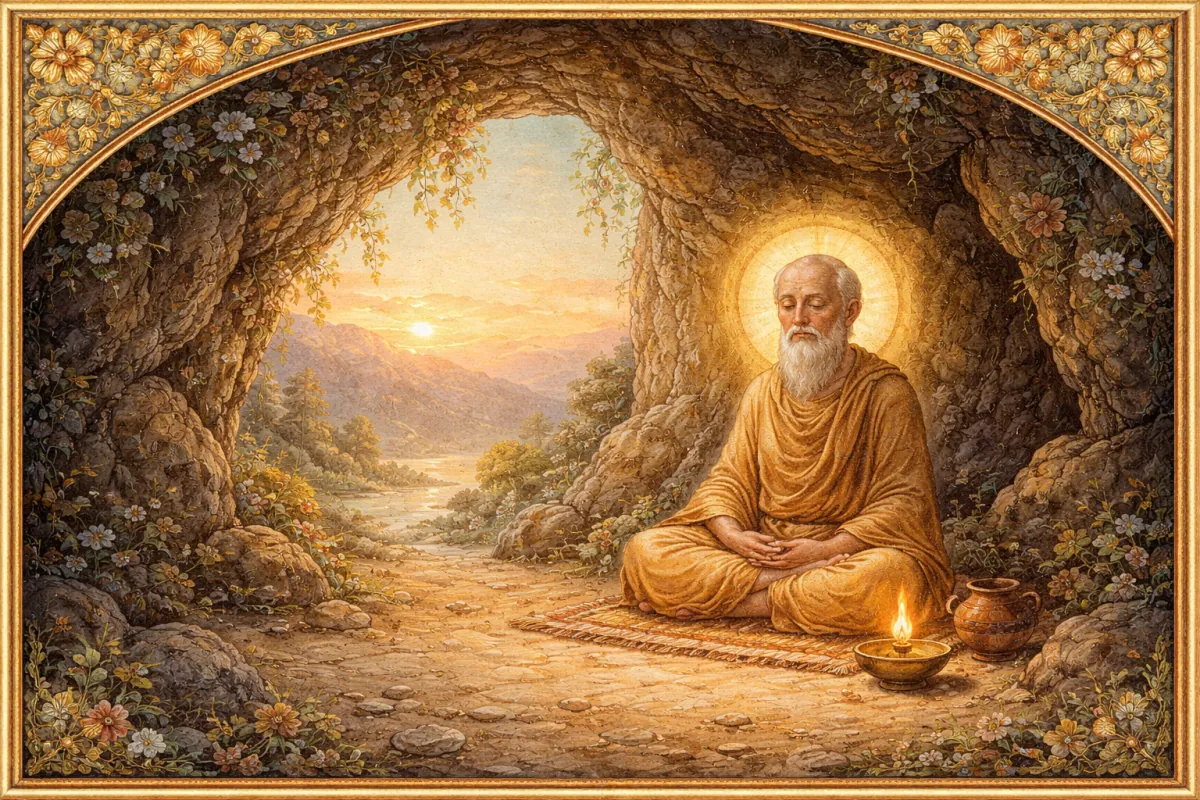
Antahkarana (antaḥkaraṇa) is the inner instrument of cognition in Advaita Vedanta, comprising four interconnected functions of the mind: manas, buddhi, ahamkara, and chitta. Antahkarana serves as an intermediary between the pure consciousness of Atman and the external world of objects, enabling all cognitive processes of the jiva.
Etymology
The Sanskrit term “antahkarana” (antaḥkaraṇa) is formed from two parts: “antah” (antaḥ), meaning “within” or “inner,” and “karana” (karaṇa), meaning “instrument,” “implement,” or “that which does.” The root “kri” (kṛ) means “to do” or “to perform an action,” while the suffix “-ana” (-ana) forms nouns denoting instruments. Thus, antahkarana literally means “inner instrument” or “inner implement of activity.” Grammatically, the word belongs to the tatpurusha (tatpuruṣa) class of compounds, in which the first element qualifies the second.
Philosophical Significance
Antahkarana occupies a central place in the Advaita Vedanta teaching on the structure of the mind, explaining how the one nondual consciousness of Brahman manifests as the manifold experience of an individual being. This concept was developed in detail by Adi Shankara and his followers to explain the mechanisms of cognition, memory, decision-making, and the formation of personal identity within a nondual philosophy.
Antahkarana consists of four interconnected aspects, each of which performs specific functions:
Manas (manas) is the “raw mind”—the instrument of perception and the primary processing of sensory data. Manas receives information from the five sense organs (indriyas) and forms initial mental images. Its primary function is sankalpa-vikalpa (saṃkalpa-vikalpa), that is, the construction and dissolution of mental constructs, doubt, and vacillation between different possibilities.
Buddhi (buddhi) is the discriminating intellect, the capacity for clear cognition and final decision-making. Buddhi possesses the function of adhyavasaya (adhyavasāya)—definite judgment that resolves the doubts of manas. It is buddhi that is capable of viveka—the discrimination between the eternal and the non-eternal, the real and the unreal—which makes it a key instrument in spiritual practice.
Ahamkara (ahaṃkāra) is the principle of individuation that creates the sense of “I” and “mine,” linking experiences with a sense of personal identity. Ahamkara produces abhimana (abhimāna)—identification, through which the impersonal consciousness of Atman is perceived as the personal “I.” It is ahamkara that is responsible for the formation of the ego and all the limitations associated with it.
Chitta (citta) functions as a repository of memory and subconscious impressions. Chitta contains vasanas—latent tendencies and imprints of past actions that influence present perception and behavior. It is also where samskaras (saṃskāra)—mental impressions that shape character and predispositions—are stored.
It is important to understand that antahkarana is not an independent reality but a modification of prakriti under the influence of maya. It is subtle matter (sūkṣma-prakṛti) that serves as an upadhi—a limiting condition for pure consciousness. Antahkarana is like a lens through which the formless consciousness of Atman is refracted and assumes the forms of individual experience.
According to Advaita teachings, antahkarana exists only in the states of jagrat (waking) and svapna (dreaming), but is absent in sushupti (deep sleep), when only pure witness-consciousness (sakshin) remains. This points to its relative nature and helps distinguish between the changing functions of the mind and the unchanging consciousness that underlies them.
Antahkarana is closely connected with the teaching of the five sheaths. It corresponds primarily to the manomaya kosha (mental sheath) and partly to the vijnanamaya kosha (intellect sheath), serving as a bridge between the physical body and the subtler aspects of existence.
Different schools of Advaita, such as Bhamati and Vivarana, offer somewhat different interpretations of the precise mechanism by which antahkarana functions, especially regarding its relationship with avidya and the process of cognition, but all acknowledge its fundamental role in explaining individual experience.
Practical Application
Understanding the nature and functions of antahkarana is fundamental to all spiritual practice in Advaita Vedanta:
Within the framework of sadhana-chatushtaya (the four preliminary qualifications), work with the antahkarana begins with the development of viveka through buddhi—the ability to clearly distinguish between Atman and non-Atman, the eternal and the impermanent. The practitioner learns to observe the functions of manas without identifying with its fluctuations, which develops vairagya—detachment from mental processes.
Shatsampatti (ṣatsampatti)—the six noble qualities—is aimed at purifying and harmonizing the antahkarana. Shama (śama) calms manas, dama (dama) controls the sense organs, uparati (uparati) withdraws the antahkarana from worldly objects, titiksha (titikṣā) makes it resilient to dualities, shraddha (śraddhā) attunes it to the perception of spiritual truth, and samadhana (samādhāna) brings about one-pointedness.
In the process of shravana-manana-nididhyasana, each function of the antahkarana is engaged in a specific way. In shravana, manas receives the guru’s teachings, while buddhi understands them. In manana, buddhi analyzes and removes doubts, while chitta integrates the understanding. In nididhyasana, the entire antahkarana is directed toward continuous contemplation of the truth of the Atman.
The practice of atma-vichara (self-inquiry) is based on using the antahkarana to investigate itself. The question “Who am I?” directs buddhi toward discovering the source of ahamkara, gradually dissolving false identifications and pointing to pure witness-consciousness.
The technique of sakshi-bhava teaches one to identify with the witness-consciousness that observes all the functions of the antahkarana without participating in them. The practitioner learns to distinguish between drashta (draṣṭā)—the seer, and drishya (dṛśya)—the seen, with the entire antahkarana belonging to the seen.
Understanding the nature of the antahkarana also helps in working with vasanas and samskaras. Knowing that chitta contains all accumulated impressions, the practitioner can consciously cultivate positive samskaras through sadhana and weaken negative ones through discernment and detachment.
In the Texts
The concept of the antahkarana has deep roots in Vedic literature and is systematically developed in Vedanta texts:
The Katha Upanishad (kaṭha upaniṣad) contains the famous chariot analogy (1.3.3–9), in which the antahkarana is compared to a charioteer who controls the horses of the senses, guiding the chariot of the body along the road of life toward the goal—the Atman.
The Maitri Upanishad (maitrī upaniṣad) provides a detailed description of the functions of the mind: “The mind is indeed of two kinds: pure and impure. Impure when associated with desire, pure when free from desire” (6.34), thus laying the foundation for understanding the purification of the antahkarana.
In the Brahma Sutras (brahma-sūtra), Vyasa examines the nature of the inner instrument in the context of discussing the knowledge of Brahman, especially in sutras such as 4.2.7, where the relationship between the individual mind and cosmic intelligence is analyzed.
Adi Shankara, in his Tattvabodha, gives the classical definition: “The antahkarana is that which has four functions: manas, buddhi, ahamkara, and chitta,” and explains each function in detail, along with its characteristic features.
In Vivekachudamani, Adi Shankara devotes several important verses to the antahkarana, including: “The antahkarana, endowed with the functions of doubt and determination, assumes various forms in accordance with the vasanas” (verse 96), emphasizing its dynamic nature.
In the “Chitra-dipa” chapter of Vidyaranya’s Panchadashi, the analogy of a lamp illuminating a painting is used to explain how consciousness, reflected in the antahkarana, cognizes objects: “Just as a lamp illuminates a painting, consciousness reflected in the antahkarana illuminates objects” (4.20).
Nrisimha Saraswati’s Vichara Sagara offers an in-depth analysis of the subtle distinctions between the four functions of the antahkarana and their role in the process of self-knowledge.
In modern literature, Ramana Maharshi often referred to the concept of the antahkarana in the context of atma-vichara, showing how the mind can be used to investigate its own source and dissolve into it.
See also:
Manas—the perceptive mind
Buddhi—the discerning intellect
Ahamkara—the ego-principle
Chitta—memory and the subconscious
Sakshin—witness-consciousness
Upadhi—limiting conditions
Koshas — the sheaths of consciousness
Categories:
Psychological concepts and the structure of the mind
Epistemology and cognition
The structure of the human being
Sadhana practices and methods
