

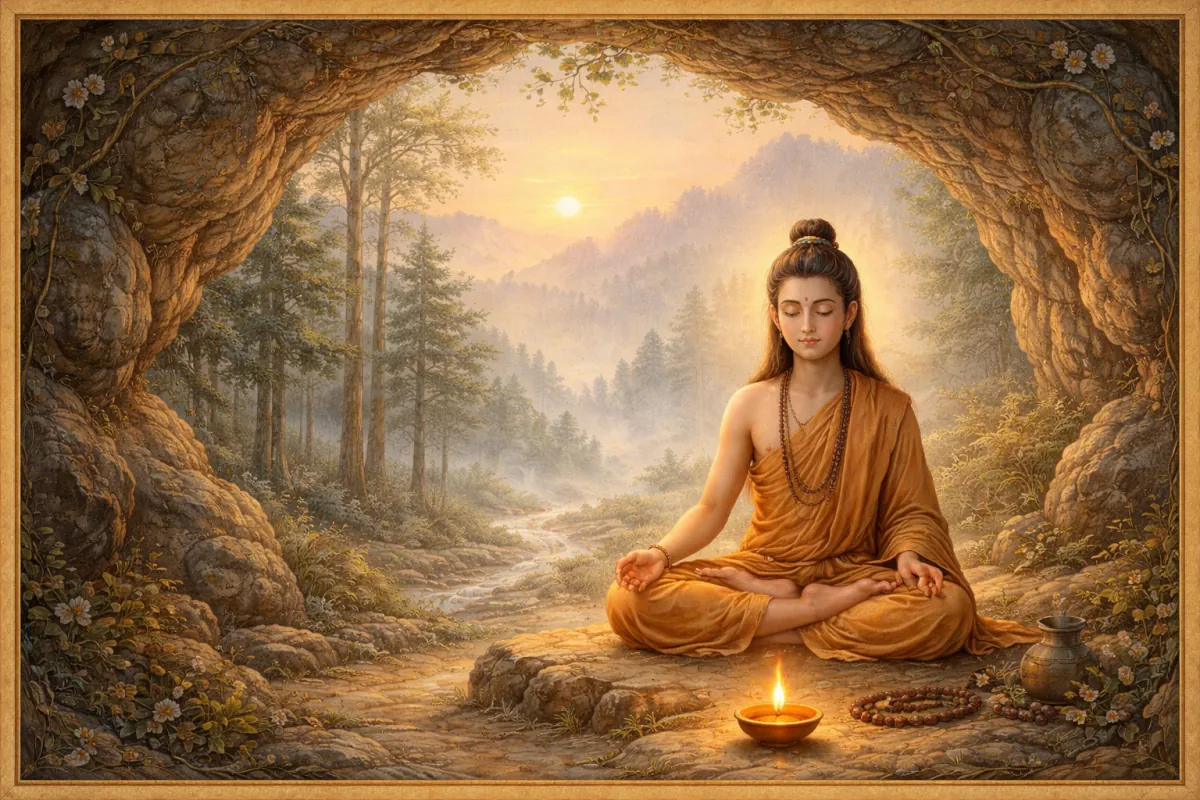
Aparoksha-jnana (aparokṣa-jñāna) is the direct, intuitive knowledge-experience of the ultimate reality (Brahman), unmediated by mental processes and free from the subject-object division. This knowledge constitutes the essence of spiritual liberation in Advaita Vedanta.
Etymology
The term “aparoksha-jnana” consists of two Sanskrit words:
aparoksha (aparokṣa) — formed from the negative prefix “a” (a) and the word “paroksha” (parokṣa, literally “beyond the eyes,” “invisible,” “indirect”). Thus, “aparoksha” means “not indirect,” “direct,” or “immediate.”
jnana (jñāna) — knowledge, wisdom, understanding.
Together, these words form the concept of “immediate knowledge” or “direct knowledge-experience of truth.”
Philosophical Significance
The Nature of Aparoksha-Jnana
The system of Advaita Vedanta distinguishes between two kinds of knowledge: indirect knowledge (parokṣa-jñāna) and direct knowledge (aparokṣa-jñāna). Aparoksha-jnana is not merely an intellectual understanding, but a direct, living experience of the identity of the individual self (Atman) and the ultimate reality (Brahman).
Unlike paroksha-jnana, which is acquired through the study of scriptures, reflection, and logical inference, aparoksha-jnana arises as the direct realization of the truth “I am Brahman” (aham brahmāsmi). This knowledge is not a new acquisition—it is the removal of the veils of ignorance (avidyā) that conceal the true nature of consciousness.
According to Advaita, all experiences of ordinary cognition involve a triad:
the knower (pramātā);
the process of knowing (pramāṇa);
the object of knowledge (prameya).
However, aparoksha-jnana transcends this triad, since in it the subject and object of knowledge prove to be identical—the knower realizes their true nature as pure consciousness.
Role in Liberation
Aparoksha-jnana occupies a central place in the Advaita Vedanta understanding of liberation (mokṣa). Only this direct knowledge, rather than intellectual understanding, can lead to final liberation from the cycle of rebirth (saṃsāra).
As Adi Shankara explains in his commentaries on the Brahma Sutras and the Upanishads, understanding the truth at the intellectual level can prepare the ground, but liberation itself occurs only with the arising of aparoksha-jnana. This idea is expressed in the famous mahavakya (great saying) “You are That” (tat tvam asi), where “You” refers to individual consciousness and “That” to absolute Brahman.
It is important to note that aparoksha-jnana is not a temporary state or experience that comes and goes. It is an abiding realization of one’s true nature that, once attained, cannot be lost. A person who has attained this knowledge becomes liberated while living (jīvanmukta).
The Distinction Between Knowledge and Understanding
Advaita Vedanta draws a clear distinction between “knowing about something” and “knowing something directly.” For example, one can know a great deal about the taste of honey from descriptions, but this is radically different from directly experiencing its taste. Likewise, an intellectual understanding of the unity of Atman and Brahman is fundamentally different from the direct experience of that unity.
The tradition often uses the metaphor of the pointing finger and the moon: the finger (scriptures, teachings) points to the moon (aparoksha-jnana), but is not itself the moon. Teachings can point the way to direct knowledge, but they cannot replace it.
Historical Development of the Concept
The concept of aparoksha-jnana developed throughout the history of Advaita Vedanta. Gaudapada, the teacher of Shankara’s teacher, emphasized the non-conceptual nature of supreme knowledge in his “Mandukya Karika.” Adi Shankara systematized the teaching of aparoksha-jnana in his commentaries on the Prasthana Trayi (the threefold canon).
Later, philosophers of the Bhamati and Vivarana schools developed various aspects of the understanding of direct knowledge. Representatives of the Bhamati school, beginning with Vachaspati Mishra, emphasized the role of the purified mind (antahkarana) in reflecting Brahman, while followers of the Vivarana school, such as Prakashatman, emphasized pure consciousness as the basis of aparoksha-jnana.
In modern Advaita, this concept was deeply explored and explained by teachers such as Ramana Maharshi and Nisargadatta Maharaj, who attached particular importance to direct self-inquiry (atma-vichara) as a path to aparoksha-jnana.
Practical Application
The attainment of aparoksha-jnana is the principal goal of spiritual practice in Advaita Vedanta. To this end, the tradition offers several methods and approaches:
Shravana-Manana-Nididhyasana
The classical path to aparoksha-jnana proceeds through three stages known as shravana-manana-nididhyasana:
Shravana (śravaṇa) — listening to or studying the teachings of Vedanta from authoritative sources and under a competent teacher (Guru. Edits). At this stage, the student receives paroksha-jnana—indirect knowledge of the supreme reality.
Manana (manana) — deep reflection on the teaching that has been heard, resolving doubts and strengthening understanding through logical analysis. This is the process of turning what has been heard into firm conviction.
Nididhyasana (nididhyāsana) — continuous meditative contemplation of the truth, leading to its direct experience. It is at this stage that paroksha-jnana is transformed into aparoksha-jnana.
It is important to emphasize that these three stages do not necessarily follow one another in a strictly sequential order—they may overlap and complement one another.
Atma-vichara
Atma-vichara (ātma-vicāra)—the method of self-inquiry particularly emphasized by Ramana Maharshi—is a direct path to aparoksha-jnana. This method consists of continuously asking “Who am I?” or “What is the source of this ‘I’?”, with the aim of discovering the true nature of consciousness.
In the process of atma-vichara, the practitioner traces the “I”-thought back to its source, gradually recognizing the illusory nature of the separate personality and arriving at the direct realization of oneself as pure consciousness.
The Role of Preparatory Practices
The attainment of aparoksha-jnana requires thorough preparation of the mind, which includes cultivating the four qualifications (sādhana-catuṣṭaya):
Viveka (viveka) — discrimination between the real and the unreal, the eternal and the temporary.
Vairagya (vairāgya) — dispassion or detachment from the objects of the world.
Shatsampatti (ṣatsampatti) — the six virtues, including control of the mind and senses, patience, and concentration.
Mumukshutva (mumukṣutva) — a sincere aspiration for liberation.
These qualities create the necessary foundation for the arising of aparoksha-jnana by purifying the mind of obstacles.
The Role of Devotion
Although Advaita Vedanta is known for its emphasis on the path of knowledge (jñāna-yoga), many Advaitins acknowledge the important role of devotion (bhakti) in attaining aparoksha-jnana. Emotional devotion to the personal aspect of Brahman (saguna Brahman) helps purify the heart and prepare it for direct knowledge.
As Adi Shankara explained in his devotional hymns, bhakti can be a powerful means of overcoming egoistic attachment and opening the heart to the supreme truth.
In the Texts
The concept of aparoksha-jnana, though not always referred to by this specific name, occupies a central place in many key texts of Advaita Vedanta:
In the Upanishads, the idea of direct knowledge is expressed in such statements as “one who knows the Atman overcomes sorrow” (Chandogya Upanishad 7.1.3) and “one who sees this does not see death” (Katha Upanishad 2.1.4).
In his commentary on the Brahma Sutras (1.1.2), Adi Shankara emphasizes that only direct knowledge of Brahman can lead to liberation.
The Vivekachudamani (verse 474) states: “Neither pilgrimages to holy places, nor the study of scriptures, nor the repetition of a deity’s name will lead to liberation if there is no direct experience of unity with the Atman.”
Vidyāranya’s Panchadashi (Chapter 1, verse 62) distinguishes between knowledge received from a teacher and direct experiential knowledge.
In the Upadesha Sahasri, Shankara devotes entire chapters to explaining the path to direct knowledge through inquiry into the nature of the “I.”
See also:
Paroksha Jnana (indirect knowledge)
Atma Vichara (self-inquiry)
Shravana-Manana-Nididhyasana (listening-reflection-contemplation)
Jnana (knowledge, wisdom)
Avidya (ignorance)
Sakshin (witness-consciousness)
Jivanmukta (liberated while living)
Categories:
Epistemology and Cognition
Philosophical Categories and Methodology
Sadhana Practice and Methods
