

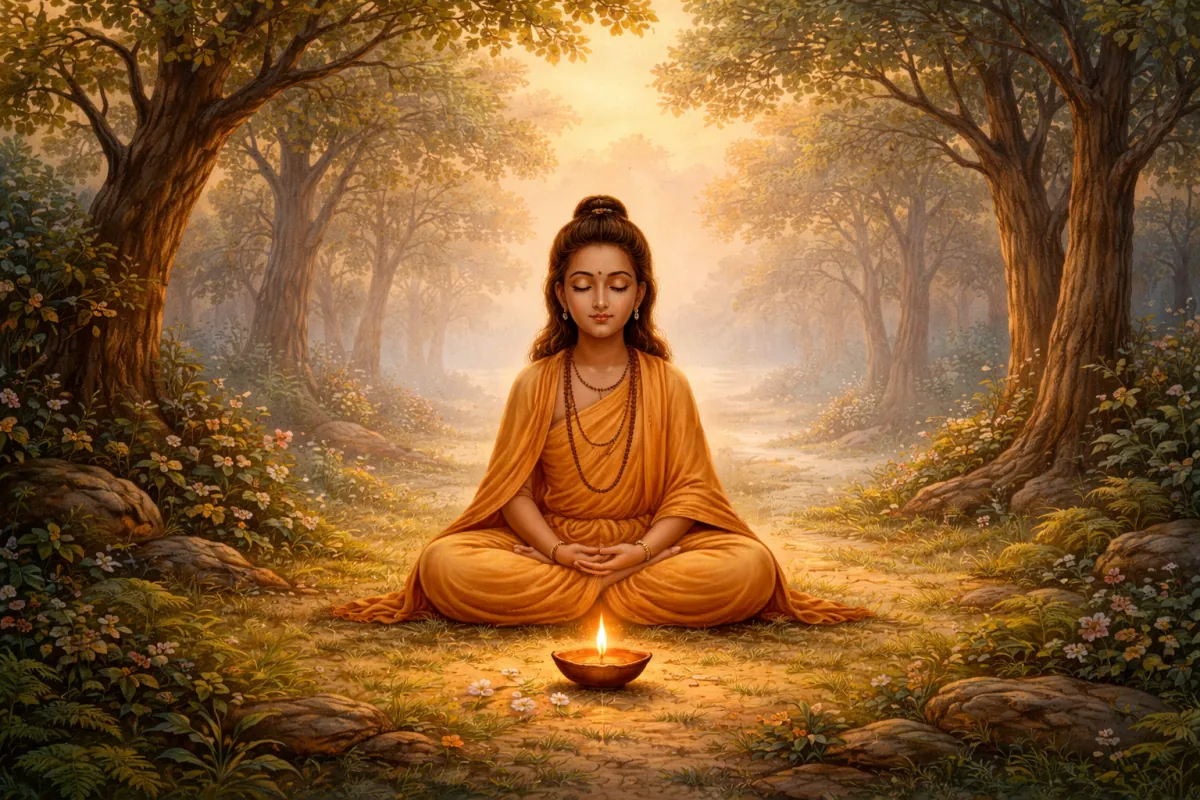
Atman (ātman) is one of the central and fundamental concepts in the philosophical system of Advaita Vedanta (advaita vedānta). In the broadest sense, Atman denotes the true Self, absolute subjectivity, pure consciousness underlying individual existence. A distinctive feature of the Advaitic interpretation of Atman is its complete identity with Brahman (brahman)—the absolute reality underlying all manifested and unmanifested existence. This fundamental non-duality (a-dvaita) of Atman and Brahman constitutes the very essence of the teaching, expressed in the famous mahavakya (mahāvākya) “Tat tvam asi” (tat tvam asi)—“You are That,” proclaiming the inseparable unity of the individual and universal principles.
Etymology
The word ātman derives from the ancient Indian root √an (अन्), which means “to breathe,” “breath.” In the early Vedic language, it was originally associated with the idea of breath, the breath of life—that which sustains life.
Over time, the meaning of the word expanded and passed through several semantic stages:
breath, vital force—that which animates the body;
the vital principle—the inner force or essence of a living being;
the inner “self,” selfhood—the deepest nature of a person;
the true Self—the spiritual essence independent of the body and mind.
In the texts of the Upanishads, the term ātman is already used precisely in the last sense—as the inner, immutable essence of a being that is neither born nor dies.
In Advaita philosophy, this concept attains its ultimate metaphysical meaning:
Ātman is the true Self, identical with Brahman, absolute reality.
That is why one of the central declarations of the Upanishads states:
“tat tvam asi”—“You are That.”
This means that the deepest essence of a person (ātman) does not differ from the supreme reality.
In the Sacred Texts
The concept of Atman has deep roots in Vedic literature, but receives its fullest development in the Upanishads (upaniṣad), particularly in such texts as the Brihadaranyaka Upanishad (Bṛhadāraṇyaka Upaniṣad), the Chandogya Upanishad (Chāndogya Upaniṣad), and the Mandukya Upanishad (Māṇḍūkya Upaniṣad).
In the Brihadaranyaka Upanishad (1.4.1), we find the fundamental passage:
“ātmā vā are draṣṭavyaḥ śrotavyo mantavyo nididhyāsitavyo”
“Verily, the Atman must be seen, heard, reflected upon, and deeply contemplated,”
which points to a special methodology for knowing Atman through shravana-manana-nididhyasana (śravaṇa-manana-nididhyāsana). The Chandogya Upanishad (6.8.7) contains the famous instruction given by the sage Uddalaka to his son Shvetaketu, including the formula “tat tvam asi,” which affirms the identity of the individual Atman with the universal Brahman.
The Metaphysical Nature of Atman
Advaita Vedanta defines Atman as possessing the nature of Sat-chit-ananda (sat-cit-ānanda):
Sat (sat)—pure being, existence as such, independent of time, space, and causality. Atman is that which always exists and can never cease to exist, beyond becoming, arising, and disappearing.
Chit (cit)—pure consciousness, self-luminous awareness requiring no external source of illumination. In Advaita, consciousness is regarded not as a property or function, but as the very essence of Atman.
Ananda (ānanda)—absolute bliss, fullness independent of objects and impressions. It is not a psychological state of pleasure, but an ontological characteristic of self-sufficiency and perfection.
Commenting on the Brahma Sutras (brahma-sūtra), Adi Shankara (Ādi Śaṅkara, 788–820 CE) emphasizes that Atman, in its true nature, is:
Unborn (aja) and indestructible (akṣara)
Omnipresent (vibhu) and all-pervading (sarvagata)
Immutable (kūṭastha) and eternal (nitya)
Formless (arūpa) and without attributes (nirguṇa)
Free from limitations (ananta) and imperishable (avyaya)
Relationship to Brahman
The fundamental thesis of Advaita, known as aikyavāda, asserts the absolute identity of Atman and Brahman. This distinguishes Advaita from other schools of Vedanta, such as Ramanuja's Viśiṣṭādvaita, in which Atman is regarded as a part or mode of Brahman, or Madhva's Dvaita, in which Atman is ontologically distinct from Brahman.
From the Advaitic perspective, any perceived difference between the individual self and the Absolute is the result of the cosmic illusion of māyā and individual ignorance, avidyā. The attainment of true knowledge (jñāna) reveals the originally existing and immutable identity.
How Atman Is Known
A distinctive feature of Atman is the way it is known, which differs radically from the cognition of objects in the external world. Atman cannot be an object of perception through the pramāṇas in Advaita – the means of valid knowledge. As Shankara states in his commentary on the Brahma Sutras:
"Atman cannot be perceived by means of the sense organs, for it is itself the subject of perception, not its object."
Atman is known through aparokṣa-jñāna – direct, non-reflective knowledge in which the subject-object dichotomy is eliminated. This distinguishes it from parokṣa-jñāna – mediated, discursive knowledge characteristic of the cognition of external objects.
A crucial characteristic of Atman is its svaprakāśa – self-luminosity or self-evidence. Atman requires nothing external in order to manifest, being the basis of all manifestation and experience. The Brihadaranyaka Upanishad (4.3.9) states: "na tatra sūryo bhāti na candra-tārakaṃ nemā vidyuto bhānti kuto'yamagniḥ" – "There neither the sun, nor the moon, nor the stars, nor lightning shines—how, then, could there be fire?" This passage points to the independence of the light of Atman's consciousness from any external sources of light.
Atman and Human Experience
According to Advaita, the individual being consists of five sheaths, or koṣas, that conceal the true nature of Atman:
Annamaya-koṣa – the sheath of the physical body, composed of food
Prāṇamaya-koṣa – the sheath of vital energy, including the respiratory system and energy flows
Manomaya-koṣa – the mental sheath, containing emotions and sensory perception
Vijñānamaya-koṣa – the intellectual sheath, including the capacity for discrimination and decision-making
Ānandamaya-koṣa – the sheath of the causal body, characterized by a state of bliss
Atman transcends all these sheaths, while being their substratum and witness. One method of realizing Atman is the successive identification with increasingly subtle sheaths and, finally, the transcendence of them all.
Atman and States of Consciousness
In the Mandukya Upanishad, Atman is considered in relation to four states of consciousness:
Jāgrat – the waking state, in which consciousness is directed outward through the sense organs
Svapna – the dream state, in which consciousness creates an inner world of images
Suṣupti – the state of deep, dreamless sleep, characterized by the absence of duality and undifferentiated consciousness
Turīya – the fourth state, which transcends the previous three and is pure nondual consciousness, the true nature of Atman
Atman remains the immutable witness of all these states, unaffected by their alternation. In the Māṇḍūkya Kārikā, Gauḍapāda (6th–7th centuries CE) develops this concept, using the analysis of the three states of consciousness as a methodological basis for establishing the nonduality of Atman.
Atman as Witness
One of the key concepts of Advaita is the understanding of Atman as sakshin (sākṣin)—the pure witness or observer of everything that occurs. Sakshin is the aspect of Atman that is invariably present in all states of consciousness while remaining unaffected by the content of experience. It does not engage in actions, experience the consequences of actions, or identify with the body, mind, senses, or intellect.
As stated in the Drig-Drishya-Viveka (Dṛg-Dṛśya-Viveka), attributed to Shankara: “The eye sees all forms but does not see itself. Similarly, the witness of consciousness knows the mind and its modifications but itself remains unknowable through them.”
Distinguishing Atman from Non-Atman
The “Neti Neti” Method
To comprehend the true nature of Atman, Advaita uses the apophatic method of neti neti (“not this, not this”), which refers to the process of successively negating everything that is not Atman. This method, described in the Brihadaranyaka Upanishad (2.3.6), involves systematically rejecting the identification of Atman with any objects of experience, including the body, senses, mind, and even subtle spiritual states.
Adhyasa
The concept of adhyasa (adhyāsa)—“imposition” or “superimposition”—plays a central role in the Advaitic theory of error. Shankara begins his commentary on the Brahma Sutras with a detailed discussion of adhyasa, defining it as “the appearance, elsewhere, of something previously perceived” (smṛti-rūpaḥ paratra pūrva-dṛṣṭāvabhāsaḥ).
According to this concept, the individual “I” is the result of superimposing the characteristics of non-Atman (anatman) upon Atman. We mistakenly take the body, senses, mind, and ego to be the true Self, just as we may mistake a rope for a snake in poor visibility. Recognizing the true nature of Atman requires the elimination of this fundamental error.
Practical Approaches to Realizing Atman
Atma-Vichara
The method of atma-vichara (ātma-vicāra)—self-inquiry or self-questioning—is one of the central practices in Advaitic sadhana. It consists of a consistent and continuous investigation into the nature of the “I” through the question “Who am I?” or “What is the source of this ‘I’?” This method was developed especially in the teachings of Ramana Maharshi (Ramaṇa Maharṣi, 1879–1950), who regarded it as a direct path to the realization of Atman.
Shravana-Manana-Nididhyasana
Classical Advaitic sadhana prescribes a threefold process:
Shravana (śravaṇa)—listening to the teaching on the nonduality of Atman and Brahman from authoritative sources (shruti) and from a qualified teacher (guru)
Manana (manana)—contemplation or reflection on what has been heard in order to eliminate doubts and contradictions
Nididhyasana (nididhyāsana)—deep meditative contemplation of the truth of Atman, leading to direct realization
This threefold methodology, described in the Brihadaranyaka Upanishad (2.4.5), is considered necessary for transforming theoretical knowledge (paroksha-jnana) into direct realization (aparoksha-jnana).
Role in Attaining Moksha
Realizing the true nature of Atman is not merely an intellectual achievement but the ultimate goal of the spiritual path, leading to moksha (mokṣa)—liberation from the cycle of rebirth (samsara, saṃsāra). In Advaita, moksha is understood not as acquiring something new, but as realizing what has always been true—the identity of Atman and Brahman.
A person who attains this realization while alive is called a jivanmukta (jīvanmukta)—“liberated while living.” Such a person continues to live in the body but no longer identifies with it, acting from a state of nondual awareness. After the death of the physical body, the jivanmukta attains videha-mukti (videha-mukti)—final liberation, in which individual consciousness completely merges with Brahman.
Different Interpretations
Within the Advaitic tradition, there are different approaches to understanding the relationship between Atman and Brahman:
Bhamati (bhāmatī) – the tradition of Vācaspati Miśra (9th century), emphasizing the role of avidya as subjective ignorance grounded in individual consciousness
Vivarana (vivaraṇa) – the tradition of Prakāśātman (10th century), which regards maya as a cosmic principle associated with Brahman
Drishti-srishti-vada (dṛṣṭi-sṛṣṭi-vāda) – “creation through perception,” the idea that the world arises simultaneously with its perception
Srishti-drishti-vada (sṛṣṭi-dṛṣṭi-vāda) – “perception of the created,” a more realistic approach that acknowledges the existence of the world prior to its perception
While preserving the fundamental principle of the non-duality of Atman and Brahman, these different interpretations reflect the depth and complexity of Advaitic thought.
Comparative Perspective
The concept of Atman in Advaita has both similarities to and differences from analogous concepts in other schools of Indian philosophy:
Buddhism – denies the existence of a permanent Atman (anatma-vada), which constitutes one of its main differences from Advaita. However, in the Mahayana tradition, particularly in the teaching of tathagatagarbha (tathāgatagarbha), concepts can be found that are functionally similar to the Advaitic Atman.
Kashmir Shaivism – recognizes absolute consciousness (prakasha, prakāśa), similar to the Advaitic Atman, but regards it as a dynamic and active principle possessing the power of self-manifestation (vimarsha, vimarśa).
Samkhya – recognizes a multiplicity of individual conscious principles (purusha, puruṣa), in contrast to the single Atman-Brahman of Advaita.
Vishishta-Advaita and Dvaita – recognize the reality of individual souls (jivas), but regard them as distinct from Brahman or as parts of it, rather than as identical with it.
The concept of Atman is a central element of the philosophical system of Advaita Vedanta, defining both its metaphysics and its doctrine of spiritual liberation. The assertion of the identity of individual consciousness (Atman) and absolute reality (Brahman) constitutes the essence of Advaitic non-dualism and distinguishes it from other philosophical schools.
In Advaita, Atman is not a part of the personality or its higher aspect, but rather the fundamental reality that only appears limited and individualized due to the operation of avidya and maya. Realizing the true nature of Atman by overcoming ignorance is the ultimate goal of the spiritual path, leading to liberation from conditioned existence.
The profound and subtle understanding of the nature of Atman developed within the Advaitic tradition not only constitutes the theoretical foundation of this philosophical system, but also serves as a guide for practical sadhana aimed at the direct realization of the non-dual nature of reality.
See also:
Brahman
Sat-chit-ananda
Maya
Avidya
Adhyasa
Jivanmukta
Sakshin
Categories:
Fundamental Metaphysical Principles
Fundamental Principles and Concepts
