

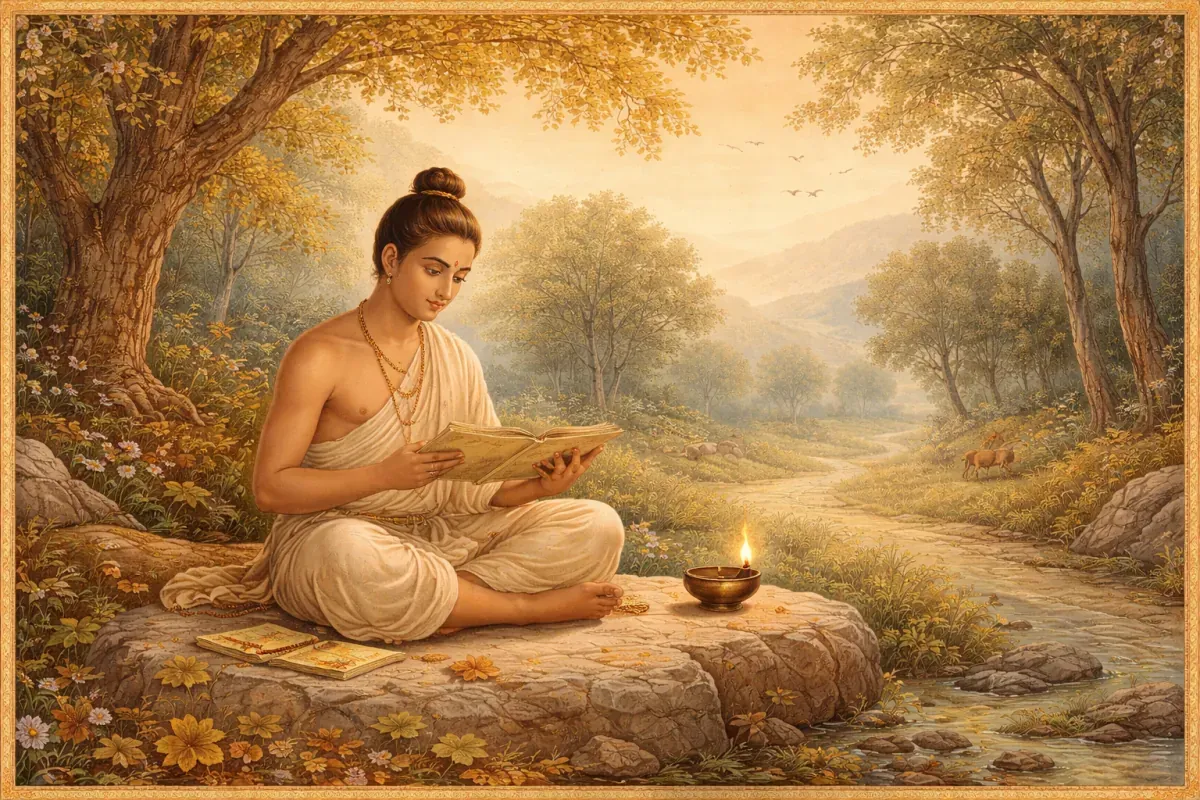
Buddhi
Buddhi is the discriminating intellect within the structure of the antahkarana, capable of final judgment and clear cognition of the truth in Advaita Vedanta. Buddhi possesses the function of adhyavasāya (determinate decision), which resolves the doubts of the manas and serves as the highest instrument of viveka (discrimination) between the real and the unreal, the eternal and the non-eternal.
Etymology
The Sanskrit term "buddhi" (buddhi) is derived from the root "budh," meaning "to awaken," "to be aware," "to understand," or "to perceive." From this same root are derived the words "buddha" (the awakened one), "bodha" (awakening, knowledge), and "avabodha" (understanding). The suffix "-i" forms feminine nouns denoting abilities or qualities. Thus, buddhi literally means the "capacity for awakening" or the "power of understanding." In a philosophical context, buddhi represents that aspect of consciousness capable of direct apprehension of the truth without distortion or wavering.
Philosophical Significance
Buddhi holds the highest position among the four functions of the antahkarana, representing the instrument of knowledge closest to the pure consciousness of the Atman. Adi Shankara and his followers view buddhi as that aspect of the internal instrument capable of aparoksha-jñāna (direct knowledge) and serving as a bridge between relative cognition and absolute realization.
The primary characteristic of buddhi is adhyavasāya, which signifies a final, determinate judgment or decision. While the manas constantly fluctuates between various possibilities (sankalpa-vikalpa), buddhi is able to arrive at a clear conclusion and eliminate all doubt. This function is described as niścaya—firm conviction or certainty in the truth.
Buddhi performs several key cognitive functions:
- Supreme Arbiter: It serves as the ultimate arbiter in the decision-making process. When manas presents various alternatives, buddhi evaluates them from the standpoint of truth, ethics, and spiritual welfare, making the final decision. This function is particularly vital in moral dilemmas where discrimination between dharma and adharma is required.
- Viveka: Buddhi possesses the capacity for viveka—discrimination between the Atman and the anatman (non-Self), between the eternal and the ephemeral, and between the real and the apparent. This capacity is fundamental for spiritual progress, as it is through viveka that the practitioner gradually frees themselves from false identifications with the body, mind, and ego.
- Comprehension of the Mahavakyas: The ability to grasp the mahavakyas ("great sayings") of the Upanishads, such as "Tat Tvam Asi" (That Thou Art) or "Aham Brahmasmi" (I am Brahman). Buddhi can directly seize the meaning of these statements, moving from intellectual understanding to direct realization.
- Abode of Vijnana: Buddhi also serves as the seat of vijñāna—higher knowledge or wisdom. Unlike ordinary intellectual knowledge (parā-jñāna), vijñāna represents an intuitive apprehension of truth that transforms the very being of the knower. It is through buddhi that the jiva is capable of brahma-sākshātkāra (direct experience of Brahman).
In the context of the five sheaths, buddhi corresponds to the vijñānamaya-kosha (the intellect sheath), which is the subtlest of the manifested sheaths and the closest to the ānandamaya-kosha (the bliss sheath), often identified with the Atman itself.
A crucial characteristic of buddhi is its relative purity compared to other functions of the antahkarana. Buddhi is less susceptible to the influence of vasanas (latent impressions) and tamas (inertia), possessing a predominantly sattvic nature. This makes it the most suitable instrument for spiritual realization.
Practical Application
The development and purification of buddhi is a central task of spiritual practice in Advaita Vedanta, as it is through buddhi that final realization is achieved:
- Sadhana-chatushtaya: Within the framework of sadhana-chatushtaya, buddhi plays a key role in developing all four qualifications. Viveka (discrimination) is a direct function of buddhi, which learns to distinguish the Atman from all its modifications and limitations. Vairagya (dispassion) arises naturally when buddhi clearly perceives the transient nature of all worldly objects and attachments.
- Shatsampatti: The six noble qualities are aimed at creating optimal conditions for the functioning of buddhi. Shama calms the manas, allowing buddhi to act without interference. Dama controls the sense organs, preventing the distraction of buddhi by external stimuli.
- Atma-vichara: The practice of atma-vichara (self-inquiry) utilizes the sharp discriminating power of buddhi to investigate the true nature of the "I." The question "Who am I?" directs buddhi to seek the source of all mental processes, including itself, which ultimately leads to the recognition of the pure witness-consciousness.
In the Texts
The concept of buddhi has ancient roots in Vedic literature and receives systematic development in Vedantic texts:
- The Rigveda mentions buddhi in the context of cosmic intelligence (10.71.2):
"When the wise ones through buddhi created speech with their thought, sifting it like grain through a sieve,"
indicating the creative and discriminating function of buddhi. In another hymn (1.23.16) it is said:
"May the buddhi, which sees far, lead us on the right path."
- The Katha Upanishad contains a fundamental description of the hierarchy of cognitive principles (1.3.10-11):
"Higher than the senses is the mind (manas), higher than the mind is the buddhi, higher than the buddhi is the great Atman (mahan atma), higher than the great is the unmanifest (avyakta), higher than the unmanifest is the Purusha."
Verse 1.3.12 explains the result of the correct use of buddhi:
"He who knows the Atman as the lord of the chariot and the buddhi as the charioteer, he who knows the manas as the reins—he, they say, reaches the end of the journey, the supreme abode of Vishnu."
- The Mundaka Upanishad (3.2.3) describes the role and limitations of buddhi in reaching the Atman:
"This Atman is not attained by study of the Vedas, nor by buddhi (medhā), nor by much hearing. Whomever this Atman chooses, by him it is attained."
- The Chandogya Upanishad (7.4.1) establishes:
"Buddhi is truly greater than manas. When a person possesses buddhi, he can say: 'May I possess manas, may I perceive, may I act'."
- The Bhagavad Gita contains extensive instructions on buddhi. Krishna says (2.49):
"Action is far inferior to buddhi-yoga, O Arjuna. Seek refuge in buddhi."
In verse 2.41, Krishna characterizes the quality of a developed buddhi:
"In those who follow this path, the buddhi is determinate and one-pointed."
Verse 10.4 lists buddhi among the divine manifestations.
- Adi Shankara in his commentary on the Bhagavad Gita explains:
"Vyavasāyātmikā buddhi ekeha—the resolute buddhi here is one,"
emphasizing one-pointedness as a key quality. In Tattvabodha, he gives a concise definition:
"Adhyavasāyātmikā buddhi"—"Buddhi is of the nature of determinate judgment."
- Vivekachudamani describes the clouded state in verse 176: "The buddhi of a person, clouded by dark avidya, mistakes the anatman for the Atman." Verse 242 explains the process of purification:
"Buddhi is purified by the repetition of the truths of shruti, by logical reasoning, and by the instructions of the guru."
- Panchadashi by Vidyaranya (1.46) explains the mechanism of the reflection of consciousness:
"Just as a crystal placed near a red flower appears red, so the buddhi, being near consciousness, appears conscious."
- Madhusudana Saraswati in Bhagavadgita-Gudharatha-Dipika notes:
"Buddhi, being the closest to consciousness among the modifications of the antahkarana, is capable of the clearest reflection of consciousness."
- Sadashiva Brahmendra explains:
"Buddhi is like a pure mirror. When there are no reflections of objects in it, it reflects only the pure consciousness of the Atman."
- Appayya Dikshita in Kalpataru writes:
"Buddhi, freed from the modifications of desire and aversion, becomes transparent to the light of the Atman."
- Ramana Maharshi explained:
"Buddhi is necessary to begin the vichara, but ultimately buddhi itself must dissolve into that which it investigates—the pure 'I'."
See Also
- Antahkarana — the internal instrument of knowledge
- Manas — the perceiving mind
- Viveka — discrimination
- Vijnanamaya-kosha — the intellect sheath
- Sakshin — the witness-consciousness
- Aparoksha-jnana — direct knowledge
- Mahavakya — the great sayings
Categories
- Psychological concepts and the structure of the mind
- Epistemology and cognition
- Sadhana practices and methods
- Structure of the human being
