

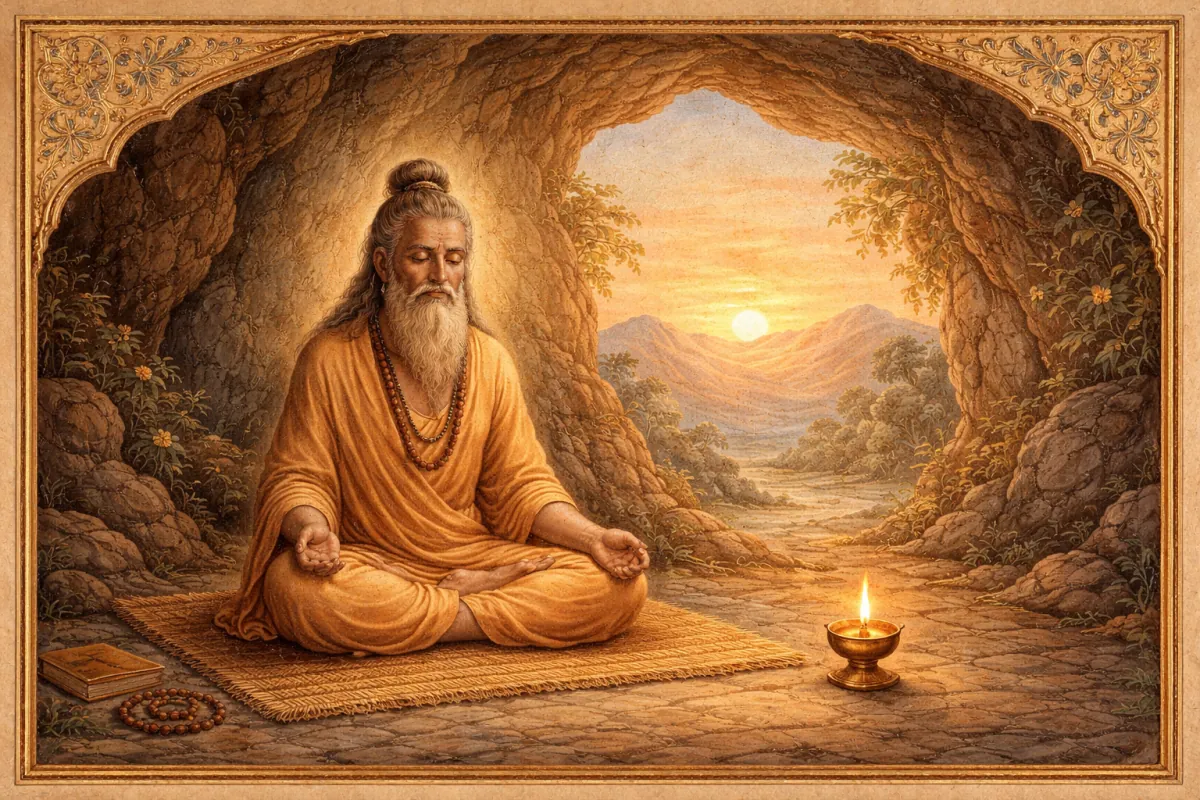
Aham Brahmasmi — one of the four great mahavakyas of Advaita Vedanta, meaning I am Brahman and expressing the direct realization of the identity of individual consciousness with the ultimate reality.
Etymology
The expression "Aham Brahmasmi" (अहं ब्रह्मास्मि) consists of three Sanskrit words:
Aham (अहम्) — the first-person personal pronoun meaning "I"
Brahma (ब्रह्म) — a form of the word Brahman, denoting the absolute reality and the foundation of all existence
Asmi (अस्मि) — the verb "to be" in the first-person singular, meaning "am"
The literal translation is "I am Brahman." Unlike the other mahavakyas, this formulation is expressed in the first person, giving it the particular power of a direct assertion.
Philosophical Meaning
Aham Brahmasmi — one of the great sayings of the Upanishads (mahavakya), expressing the essence of nondual experience and occupying a central place in the philosophy of Advaita Vedanta. While Tat Tvam Asi (You Are That) is an instruction from teacher to student, Aham Brahmasmi is a statement uttered in the first person as a direct recognition of one's true nature.
This mahavakya indicates that the limited "I," which is usually identified with the body, mind, and ego, is in essence no different from the ultimate reality—Brahman. Here, "Aham" refers not to the empirical ego (ahamkara), but to the true "Self" (Atman), which is pure consciousness.
Advaita philosophy emphasizes that Atman (the true "Self") and Brahman (the ultimate reality) are not two different entities, but one and the same reality viewed from different perspectives. Atman is Brahman viewed in the context of an individual being, while Brahman is Atman viewed in a universal context.
Aham Brahmasmi asserts this identity directly and unconditionally. It is not merely a philosophical proposition or belief, but an expression of the highest truth, realized in the state of enlightenment. When all limitations imposed by maya (cosmic illusion) and avidya (ignorance) are removed, only pure consciousness remains—the Self that is Brahman.
This mahavakya represents the realization attained by the seeker after prolonged spiritual practice. It is not a declaration of the ego but, on the contrary, a recognition that arises when egoic identification dissolves. When a person realizes Aham Brahmasmi, they are not claiming that their limited personality is God or the Absolute, but recognizing that their true nature beyond all limitations is universal consciousness itself.
Advaita explains that such realization is not the attainment of a new state, but merely the recognition of what has always been true. Just as someone who believed themselves poor suddenly discovers a hidden treasure they had always possessed, the realization of Aham Brahmasmi is the discovery of the eternal truth about one's own nature.
Practical Application
The mahavakya Aham Brahmasmi is used in Advaita Vedanta as a powerful tool in spiritual practice (sadhana):
Japa and meditation: Practitioners often repeat "Aham Brahmasmi" as a mantra during meditation. This is not mechanical repetition, but a deep contemplation of the statement's meaning, allowing the mind to gradually expand into awareness of its true nature.
Affirmation (bhavana): "Aham Brahmasmi" is used as an affirmation to cultivate a correct understanding of oneself. By regularly reminding themselves "I am Brahman," practitioners gradually replace false notions of themselves as limited beings with true knowledge of their boundless nature.
Self-inquiry (atma-vichara): This mahavakya serves as a support in the practice of self-inquiry, when the seeker asks, "Who am I?" Instead of automatically identifying with the body or mind, they go deeper, toward the true "Self" that is Brahman.
The practice of nididhyasana: After listening to the teachings of Vedanta (shravana) and reflecting on them (manana), “Aham Brahmasmi” is used for deep meditative contemplation (nididhyasana). In this practice, the seeker does not merely think about the statement but attempts to directly realize its truth in their own experience.
Overcoming fear and limitations: Understanding “Aham Brahmasmi” helps overcome deep-seated fears and a sense of limitation. By realizing their true nature as boundless and eternal consciousness, a person naturally becomes free from many psychological problems rooted in false identification.
Transformation of behavior: When a person begins to perceive themselves as Brahman, this naturally changes their attitude toward other beings. Seeing the same consciousness in everyone, they develop profound compassion and love for all existence.
Liberating knowledge: For those who have reached the highest stages of spiritual practice, “Aham Brahmasmi” ceases to be merely a statement and becomes direct knowledge that liberates one from the cycle of birth and death (samsara).
It is important to note that in Advaita Vedanta, the practice of “Aham Brahmasmi” is intended only for those who are sufficiently prepared and have completed the preliminary stages of spiritual development (sadhana-chatushtaya). Without proper understanding, this practice may lead to the strengthening of the ego rather than its transcendence.
In the texts:
The mahavakya “Aham Brahmasmi” comes from the Brihadaranyaka Upanishad (1.4.10), one of the oldest and most authoritative Upanishads. This text states:
“I am indeed Brahman” (aham brahmasmi).
In this context, the sage realizes his true nature as the ultimate reality and proclaims this realization.
In his commentary on this passage, Shankara emphasizes that this statement is not an expression of egotism but an expression of the highest truth, which is realized when all false superimpositions (adhyasa) are removed. He explains that such realization is possible only when duality and identification with the body and mind have been completely overcome.
In another famous Advaita text, the “Vivekachudamani,” Shankara writes about the state of an enlightened sage who has realized “Aham Brahmasmi”:
“I am Brahman, one, pure, knowledge itself, ever free, perfect, supreme bliss, eternal, beyond duality, continuous like space, unborn and infinite” (verse 503).
The “Panchadashi” by Vidyaranya, another classical Advaita text, also explains in detail the meaning of “Aham Brahmasmi” and the process of meditating on this mahavakya as a means of attaining the highest knowledge.
In the Advaita tradition, it is believed that this very realization—“Aham Brahmasmi”—was attained by great sages and spiritual teachers such as Yajnavalkya, Janaka, and Shankara himself, and that all spiritual seekers should strive for this realization.
See also:
Mahavakyas—the four great sayings of Advaita
The Mahavakya Tat Tvam Asi—the mahavakya “You Are That”
Prajnanam Brahma—the mahavakya “Consciousness Is Brahman”
Ayam Atma Brahma—the mahavakya “This Atman Is Brahman”
Atman—the true Self
Brahman—the ultimate reality
Jnana Yoga—the path of knowledge, which includes the practice of the mahavakyas
Jnana—liberating knowledge
Categories:
Fundamental principles and concepts
Key texts and sources
Methods of practice (sadhana)
