

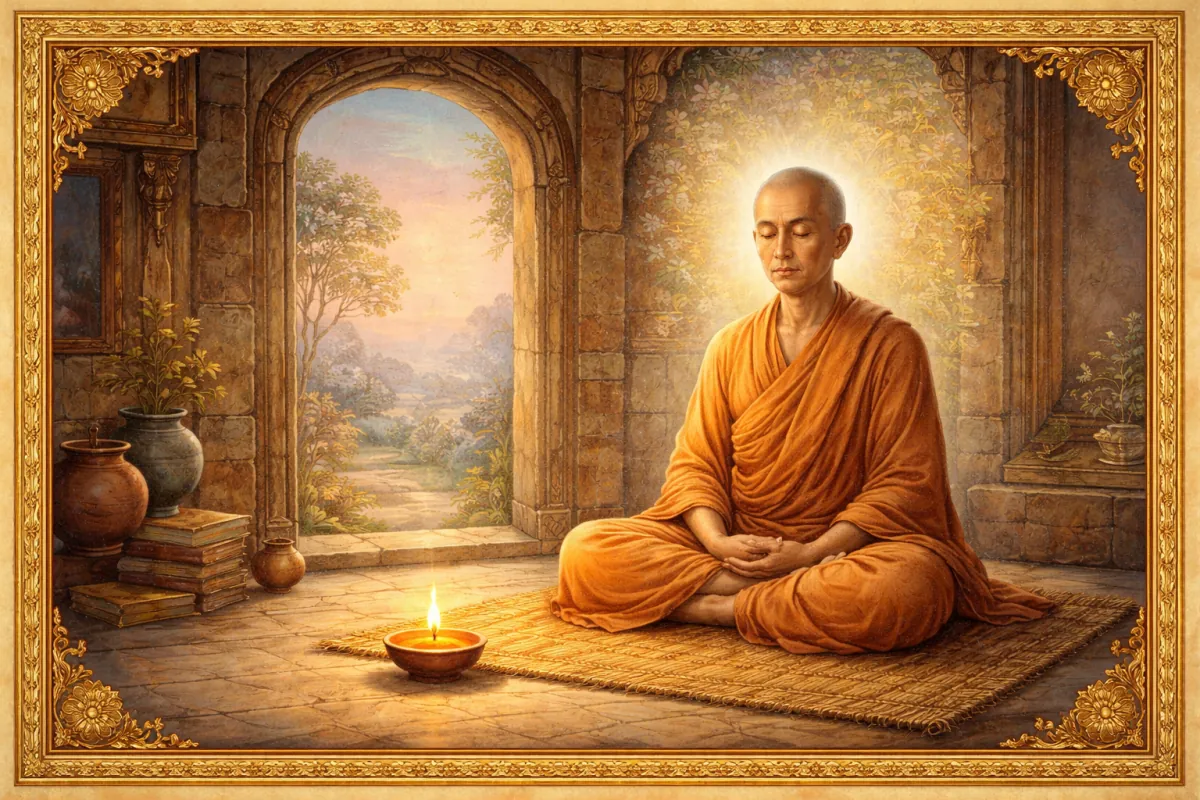
Ayam Atma Brahma (ayam ātmā brahma) is one of the four great mahavakyas of Advaita Vedanta, meaning “This Atman is Brahman” and pointing to the identity of the inner Self (Atman) and the supreme cosmic reality (Brahman).
Etymology
The expression “Ayam Atma Brahma” (अयम् आत्मा ब्रह्म) consists of three Sanskrit words:
“Ayam” (अयम्) is a demonstrative pronoun meaning “this”
“Atma” (आत्मा) is a noun meaning “Self,” “soul”, “true essence,” or “inner reality”
“Brahma” (ब्रह्म) in this context refers to Brahman, the absolute reality, the foundation and source of all existence
Thus, the literal translation is “This Atman (the true Self) is Brahman.”
Philosophical Significance
“Ayam Atma Brahma” is a statement that directly points to the unity of the individual true Self (Atman) and the supreme reality (Brahman). It is one of the most direct formulations of non-duality (Advaita) in the Upanishads.
The distinctive feature of this mahavakya is that it contains the demonstrative pronoun “ayam” (this), which lends it special immediacy and concreteness. “This Atman” is not an abstract concept but an immediate reality accessible here and now. The mahavakya points out that the supreme reality is not somewhere far away, but right here, in the heart of every being.
In Advaita Vedanta philosophy, Atman is understood as pure consciousness, which is the basis of individual existence but is not limited to it. It is not a soul in the ordinary religious sense, nor a part of Brahman, but Brahman itself viewed in the context of an individual being.
Brahman is the absolute reality that is the foundation, source, and essence of all existence. It is described as sat-chit-ananda (being-consciousness-bliss), and in its true nature it lies beyond all definitions and limitations (nirguna Brahman).
The mahavakya “Ayam Atma Brahma” affirms the complete identity of Atman and Brahman. This means that there are not two separate realities—individual and cosmic. There is only one non-dual reality, which appears as multiplicity because of maya (cosmic illusion) and avidya (ignorance).
This identity should not be understood as similarity or partial correspondence. Advaita emphasizes that Atman is not merely similar to Brahman or a part of it—Atman is Brahman, without any distinction whatsoever. The apparent difference between them is merely the result of superimposition (adhyasa), whereby we mistakenly attribute limited qualities and definitions to limitless reality.
The mahavakya “Ayam Atma Brahma” has ontological significance (relating to the nature of being): it indicates that the true nature of all that exists is non-dual consciousness. Beyond the apparent diversity of names and forms (nama-rupa), there is only one reality. This reality is not something external or separate from us—it is our deepest essence.
Practical Application
The mahavakya “Ayam Atma Brahma” serves not only as a philosophical statement but also as an important tool in the spiritual practice (sadhana) of Advaita Vedanta:
Meditation and contemplation: Practitioners use this mahavakya as an object of deep contemplation (nididhyasana). By reflecting on the meaning of “This Atman is Brahman,” they gradually transcend their limited perception of themselves and the world.
Practice of self-inquiry: In the tradition of atma-vichara (self-inquiry), “Ayam Atma Brahma” is used as a pointer to the true nature of the “I.” By asking themselves “Who am I?” and systematically negating all temporary and limited identifications, practitioners come to realize their identity with Brahman.
Morning and evening reflections: Many Advaita practitioners begin and end the day by contemplating this mahavakya, reminding themselves of their true nature and establishing the right mindset for all their daily activities.
Overcoming Duality in Perception: Understanding "Ayam Atma Brahma" helps practitioners gradually transcend dualistic perception (the subject-object division) and see the one consciousness within the entire diversity of the manifested world.
Cultivating the Inner Witness: This mahavakya helps develop the quality of witnessing (sakshin), whereby a person observes all their experiences from the standpoint of pure consciousness, without fully identifying with the body and mind.
Integration into Everyday Life: For advanced practitioners, "Ayam Atma Brahma" becomes not merely an object of contemplation, but a living awareness that permeates every aspect of life. This leads to the state of a jivanmukta (one liberated while still alive), in which a person acts in the world while inwardly remaining rooted in the awareness of non-duality.
Transformation of Relationships: By seeing the same supreme Self in all beings, practitioners naturally develop the qualities of compassion, love, and unity with all existence. This is not an artificially cultivated attitude, but a natural expression of the understanding of the one reality.
Radical Acceptance: Realizing that "This Atman is Brahman," practitioners come to a profound acceptance of the whole experience of life, including both its pleasant and unpleasant aspects. This is based on the understanding that everything that occurs is a manifestation of the same non-dual reality.
Advaita Vedanta emphasizes that the true understanding of this mahavakya is not intellectual but existential. A person must not merely believe or think that "This Atman is Brahman," but directly realize this truth in their own experience through the practice of shravana-manana-nididhyasana (listening, reflection, and contemplation).
In the Texts
The mahavakya "Ayam Atma Brahma" comes from the Mandukya Upanishad (2), one of the shortest yet most profound Upanishads. This text states:
"अयमात्मा ब्रह्म" (ayam ātmā brahma) — "This Atman is Brahman."
The Mandukya Upanishad is particularly important in the Advaita tradition because it contains the teaching on the four states of consciousness (jagrat, svapna, sushupti, and turiya) and on the sacred syllable Om, which symbolizes Brahman. The mahavakya "Ayam Atma Brahma" appears at the beginning of this Upanishad, establishing the central assertion of non-duality, which is then explained throughout the rest of the text.
Shankara attached particular importance to the Mandukya Upanishad and "Ayam Atma Brahma," regarding it as one of the most direct and clear formulations of non-duality. In his commentaries, he emphasizes that this mahavakya affirms the absolute identity of Atman and Brahman, leaving no room for any distinction between them.
Gaudapada, the teacher of Shankara's teacher, wrote the famous "Mandukya Karika"—a commentary on the Mandukya Upanishad in which he deeply analyzes the meaning of "Ayam Atma Brahma" and shows its connection with other key Advaita teachings, such as ajati-vada (the doctrine of non-origination).
The "Vivekachudamani," a text attributed to Shankara, also contains numerous references to the meaning of this mahavakya. It states that realizing the identity of Atman and Brahman is the highest goal of spiritual practice and leads to complete liberation (moksha).
In the Advaita tradition, "Ayam Atma Brahma" is often considered alongside the other three mahavakyas, each of which emphasizes the same principle of non-duality from a slightly different perspective. Together, they create a complete picture of the Advaitic understanding of reality.
See also:
Mahavakyas—the four great sayings of Advaita
The Mahavakya Tat Tvam Asi—the mahavakya "You Are That"
The Mahavakya Aham Brahmasmi—the mahavakya "I Am Brahman"
Prajnanam Brahma—the mahavakya "Consciousness Is Brahman"
Atman—the true Self
Brahman—the supreme reality
Mandukya Upanishad—the source of the mahavakya "Ayam Atma Brahma"
Turiya—the fourth state of consciousness in which "Ayam Atma Brahma" is realized
Categories:
Fundamental Principles and Concepts
Key Texts and Sources
Practice Methods (Sadhana)
