

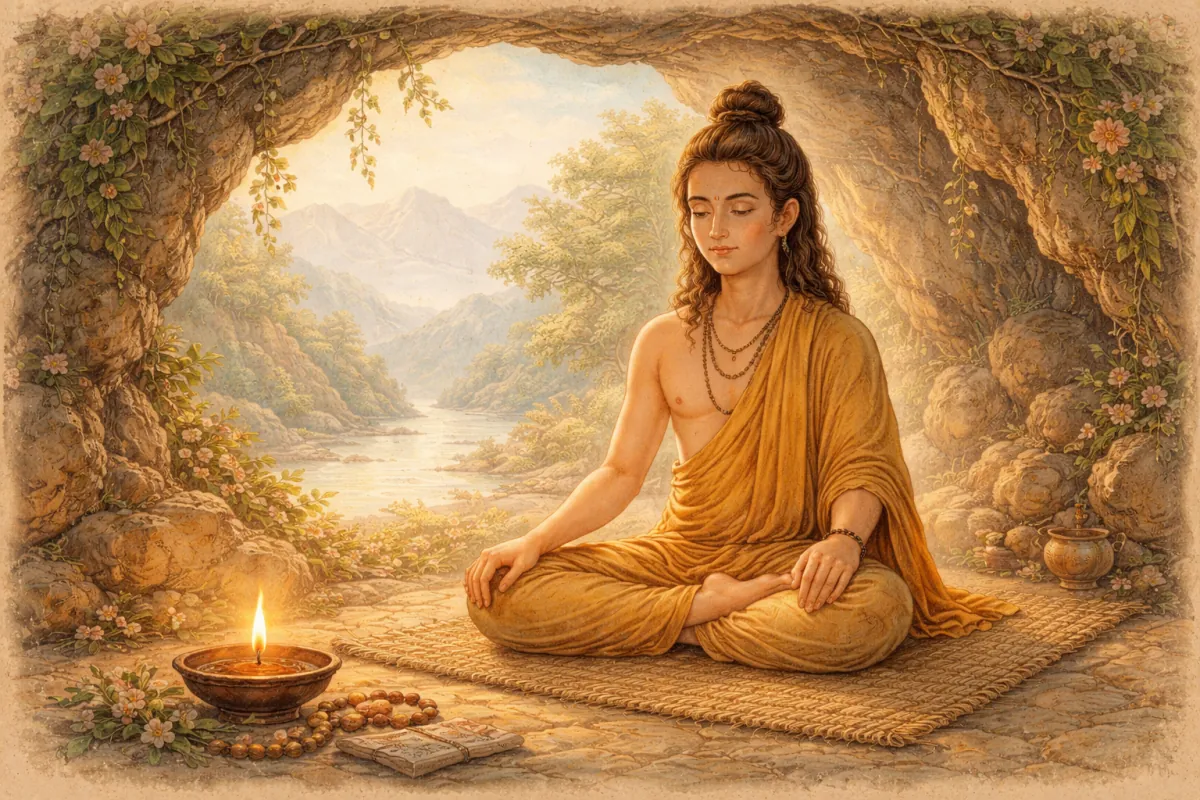
Prajñānaṃ Brahma (prajñānaṃ brahma) — one of the four great mahāvākyas of Advaita Vedānta, meaning "Consciousness is Brahman" and asserting that the essence of ultimate reality is pure consciousness.
Etymology
The expression "Prajñānaṃ Brahma" (प्रज्ञानं ब्रह्म) consists of two Sanskrit words:
"Prajñānam" (प्रज्ञानम्) — a noun derived from the root "jñā" (to know) with the prefix "pra" (forward, intensely), meaning "supreme knowledge," "intuitive wisdom," "pure consciousness," or "the principle of awareness"
"Brahma" (ब्रह्म) — in this context, it refers to Brahman, the absolute reality and the foundation of all existence
Thus, the expression can be translated literally as "Consciousness (or supreme knowledge) is Brahman."
Philosophical Significance
"Prajñānaṃ Brahma" is one of the key statements of Advaita Vedānta, defining the very nature of Brahman (the ultimate reality) as pure consciousness. This mahāvākya is of particular significance because it does not merely establish the identity of the individual and the universal, as the other mahāvākyas do, but directly points to the essential nature of the Absolute.
The term "prajñānam" in this context refers not to ordinary knowledge or intellect, but to pure consciousness, which is the basis of all experience and cognition. It is the very consciousness that makes perception, thought, and all other cognitive functions possible, while not itself being any one of them. It is the fundamental capacity to "know" or "be aware," from which all forms of knowledge arise.
In Advaita Vedānta, pure consciousness (chit) is considered one of the three aspects of Brahman, along with being (sat) and bliss (ānanda). These three aspects are not separate qualities of Brahman but constitute a single undifferentiated reality called sat-chit-ānanda.
By asserting that "Prajñānaṃ Brahma," Advaita emphasizes that consciousness is not merely a property or attribute of ultimate reality, but its very essence. Brahman does not merely possess consciousness—Brahman is consciousness.
This consciousness (prajñānam) should not be understood as something individual or limited. It is the universal field of pure awareness, without boundaries, beginning, or end. It is not localized in space or time and is not tied to specific objects. It is the very consciousness that manifests as all forms of cognition in all beings.
The mahāvākya "Prajñānaṃ Brahma" refutes the notion that Brahman is merely an inert substance or an abstract principle. It asserts that Brahman is alive, aware, and is the very principle of consciousness. This has profound implications for understanding reality, since it means that the very foundation of the universe is not blind matter or energy, but a living, conscious presence.
Unlike materialistic views, which regard consciousness as a by-product of matter, Advaita asserts that consciousness is primary, while matter and energy are merely its manifestations or expressions through māyā.
Practical Application
The mahāvākya "Prajñānaṃ Brahma" has profound practical applications in the spiritual life and sādhana (spiritual practice) of Advaita Vedānta:
Meditation on pure consciousness: Practitioners use this mahāvākya as an object of meditation, directing attention not toward particular thoughts or sensations, but toward the consciousness that underlies them. This is known as the practice of "witnessing" (sākṣin), in which one observes the contents of the mind without identifying with them, while abiding in a state of pure awareness.
Separating consciousness from thoughts: Understanding that consciousness (prajñānam) is the foundation of all existence helps the practitioner distinguish pure awareness from its contents. This leads to the realization that thoughts, emotions, and sensations come and go, while consciousness itself remains unchanged.
Awareness in everyday life: Practitioners use the mahāvākya "Prajñānaṃ Brahma" as a reminder that the consciousness present in every moment of their experience is identical to the ultimate reality. This helps them maintain a state of awareness in their daily activities.
Overcoming identification with the body and mind: Understanding that consciousness is Brahman helps the practitioner overcome false identification with the physical body (annamaya kosha) and the mind (manomaya kosha), recognizing their true nature as pure consciousness.
The path of knowledge: "Prajnanam Brahma" points to the path of knowledge (jnana yoga) as the direct path to realizing one’s true nature. By contemplating the nature of consciousness and investigating it through direct experience, the practitioner can directly realize their identity with Brahman.
Practice of self-inquiry: This mahavakya forms the basis of the practice of self-inquiry (atma-vichara). By asking the question "Who am I?", the practitioner discards all temporary and limited identifications in order to discover their true nature as pure consciousness.
Developing impartial witnessing: Understanding that consciousness is Brahman helps the practitioner develop the quality of impartial witnessing (sakshin), observing all experiences without attachment or aversion.
Practice based on the understanding of "Prajnanam Brahma" leads to a gradual expansion of identification: from the limited ego to pure consciousness, which is the foundation of all existence. This, in turn, leads to the state of liberation (moksha), in which a person realizes their true nature as sat-chit-ananda (being-consciousness-bliss).
In the Texts
The mahavakya "Prajnanam Brahma" comes from the Aitareya Upanishad (3.1.3), one of the ten principal Upanishads commented upon by Shankara. The text states:
"प्रज्ञानं ब्रह्म" (prajñānaṃ brahma) — "Consciousness is Brahman."
This brief and succinct formulation appears after a discussion of the nature of Atman and its relationship to the world of manifested objects. In the context of the Upanishad, it indicates that behind all manifestations stands a single consciousness, which is the ultimate reality.
In his commentary on the Aitareya Upanishad, Shankara explains that "prajnanam" here means pure consciousness, which is the basis of all cognitive processes but is itself none of them. He emphasizes that this consciousness neither depends on objects nor is limited by them, but is self-luminous and self-existent.
Another important Advaita text, the "Brahma Sutras," also contains references to this concept. In his commentary on Sutra 1.1.1, Shankara explains that Brahman is pure consciousness, which is the cause, support, and goal of all existence.
In Vidyaranya’s "Panchadashi," a classical Advaita text, an entire chapter is devoted to explaining the nature of pure consciousness and its identity with Brahman. There, the author uses various metaphors to explain how the same consciousness manifests in all beings and forms the basis of all experience.
Ramana Maharshi often referred to this mahavakya in his teachings, emphasizing that the pure awareness present in every moment of our experience is that very consciousness (prajnanam) which is identical with Brahman.
See also:
Mahavakyas — the four great sayings of Advaita
Tat Tvam Asi — the mahavakya "You Are That"
Aham Brahmasmi — the mahavakya "I Am Brahman"
Ayam Atma Brahma — the mahavakya "This Atman Is Brahman"
Chit — pure consciousness, one of the aspects of Brahman
Sat-chit-ananda — being-consciousness-bliss, the nature of Brahman
Sakshin — the witness, an aspect of consciousness
Atma-vichara — self-inquiry based on awareness
Categories:
Fundamental Principles and Concepts
Key Texts and Sources
Methods of Practice (Sadhana)
