

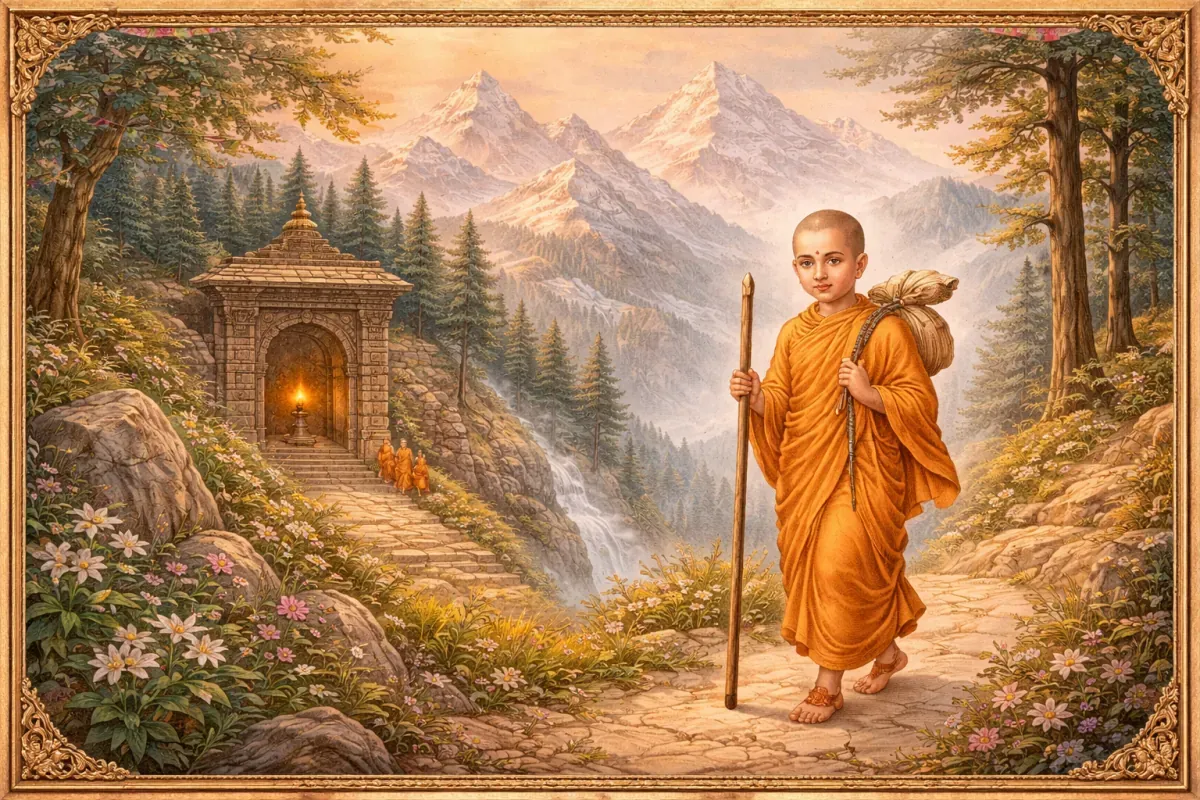
Mathas of Adi Shankara
Brief Definition
The Mathas of Adi Shankara are the four primary monastic centers established by Adi Shankara in the 8th century to preserve and propagate the teachings of Advaita Vedanta across the four cardinal directions of India, each associated with one of the Vedas and possessing its own lineage of succession.
Etymology
The Sanskrit word "maṭha" (मठ) derives from the verbal root "maṭh" or "manth", which means "to stir", "to churn", or "to immerse oneself in reflection". In the context of spiritual tradition, the word acquired the meaning of a place where students "immerse" themselves in spiritual knowledge under the guidance of teachers.
Philosophical Significance
The creation of the Matha system became a key element in preserving the Advaita Vedanta tradition founded by Adi Shankara. According to tradition, around 788-820 CE, Shankara, after his victorious journey of philosophical debates across India (dig-vijaya), established four main Mathas in the four cardinal directions of the subcontinent.
These Mathas were established not merely as monasteries in the conventional sense, but as full-fledged centers for the study of Vedanta, the preservation of the Vedic tradition, and the dissemination of the teachings of non-duality (Advaita). Each Matha was strategically placed in one of the four geographical directions of India, symbolizing the all-encompassing nature of Advaita teachings and its goal to unite the diverse spiritual traditions of the subcontinent under a single philosophical system.
An important aspect of the Matha system is their connection with the four Vedas. Each Matha was designated as the guardian of one of the Vedas, ensuring the preservation and transmission of the entire corpus of Vedic knowledge. This structure reflects Shankara's holistic approach to preserving India's spiritual heritage.
At the head of each Matha stands a Shankaracharya — a spiritual leader who is considered a direct successor of Adi Shankara and the bearer of his teachings. The succession (parampara) in each Matha is carefully maintained, ensuring a continuous line of knowledge transmission from teacher to student.
The Four Main Mathas and Their Characteristics
- Northern Matha — Jyotirmaṭha in Badrinath (now Uttarakhand):
- Associated with the Atharvaveda
- Spiritual instruction (Mahavakya): "Ayam ātmā brahma" ("This Atman is Brahman") from the Mandukya Upanishad
- Shankara's disciple Totaka was appointed as the first head
- Associated with the spiritual practice of Bhakti
- Southern Matha — Śṛṅgeri Maṭha in Sringeri (Karnataka):
- Associated with the Yajurveda
- Spiritual instruction: "Aham brahmāsmi" ("I am Brahman") from the Brihadaranyaka Upanishad
- Sureshvara was appointed as the first head
- Special emphasis is placed on Jnana Yoga
- Eastern Matha — Govardhana Maṭha in Puri (Odisha):
- Associated with the Rigveda
- Spiritual instruction: "Prajñānam brahma" ("Consciousness is Brahman") from the Aitareya Upanishad
- Padmapada was appointed as the first head
- Emphasis on Yogic practice
- Western Matha — Dvārakā Maṭha in Dwarka (Gujarat):
- Associated with the Samaveda
- Spiritual instruction: "Tat tvam asi" ("That thou art") from the Chandogya Upanishad
- Hastamalaka was appointed as the first head
- Special emphasis is placed on Karma Yoga
In addition to the four main Mathas, additional centers emerged over time, the most significant of which is the Kanchi Kamakoti Peetham in Kanchipuram (Tamil Nadu). While some researchers dispute its founding by Shankara himself, this Matha holds significant influence and authority in South India and is considered by many as the fifth major Advaita Matha.
The Matha system was closely linked to Shankara's socio-religious reforms aimed at reviving Sanatana Dharma and strengthening the position of the Vedic tradition during a period when its influence was waning due to Buddhism and other non-Vedic teachings.
Historical Development of the Mathas
During the Middle Ages (approximately 11th–17th centuries), the Mathas underwent significant development, expanding their influence and strengthening ties with local rulers and communities. They received land grants (agraharas), which ensured their economic independence. During this period, the Mathas became not only spiritual but also educational, cultural, and even political centers.
During the colonial period (17th–20th centuries), the Mathas faced serious challenges, including changes in the land tenure system, declining support from rulers, and the influence of Western education. However, they managed to adapt, maintaining their role as guardians of tradition.
In the modern era (after India gained independence in 1947), the Shankara Mathas have been actively involved in the revival of Indian spirituality, adapting ancient teachings to modern conditions. They have expanded their activities by establishing educational institutions, hospitals, charitable organizations, and centers for the study of Sanskrit and Vedic literature.
Practical Application
The Mathas of Adi Shankara perform several important functions in the context of Advaita Vedanta:
- Educational function: The Mathas serve as centers for teaching Advaita philosophy, Sanskrit, Vedic literature, and other traditional sciences. Future acharyas and pandits are trained here, who then disseminate the teachings of Advaita.
- Preservation of tradition: The Mathas ensure the continuity of the lineage of knowledge transmission (parampara) from Guru to disciple, preserving the authentic teachings of Advaita.
- Spiritual practice: The Mathas provide an environment for spiritual practice (sadhana), including listening, reflection, and contemplation (shravana-manana-nididhyasana), self-inquiry (atma-vichara), as well as traditional rituals and worship.
- Social service: Modern Mathas are actively involved in charitable activities, including education, healthcare, aid to those in need, and the preservation of cultural heritage.
- Spiritual guidance: The Shankaracharyas of the Mathas act as spiritual authorities, providing guidance to seekers, interpreting sacred texts, and resolving matters of Dharma.
Daily Life in the Mathas
Daily life in the Mathas is strictly organized and includes:
- Daily rituals: Morning and evening prayers (Sandhya Vandana), deity worship (Puja), and the study and recitation of sacred texts.
- Educational activities: Regular classes on the Upanishads, Brahma Sutras, Bhagavad Gita, and Shankara's commentaries.
- Community life: The Mathas function as communities where renunciates (Sannyasins) and disciples live together, following principles of simplicity, self-discipline, and service.
In the Texts
Adi Shankara himself did not leave detailed written instructions about the Matha system in his philosophical works. Information about the establishment and organization of the Mathas comes primarily from later sources:
- Shankara Digvijaya (Śaṅkara Digvijaya) — biographical works about Shankara's life written after his passing. The most famous are the "Mādhavīya Śaṅkara Vijaya" by Madhava (Vidyaranya) and "Cidvilāsīya Śaṅkara Vijaya".
- Mathamnaya (Maṭhāmnāya) — texts describing the tradition and lineages of the Mathas, their organization, and their functions.
- Puranas — some Puranic texts contain references and predictions about Shankara's role and the centers he established.
The archival records of the Mathas themselves, including succession lists (guru-parampara), administrative documents, and records of land grants, are also important sources of information about their history.
See also
- Adi Shankara
- Advaita
- Lineage of succession (Parampara)
- Shankaracharya
- Spiritual tradition
- Guru-disciple relationship
- Renunciation (Sannyasa)
Categories
- Historical aspects of Advaita Vedanta
- Institutional aspect of Advaita Vedanta
- Adi Shankara and his legacy
