

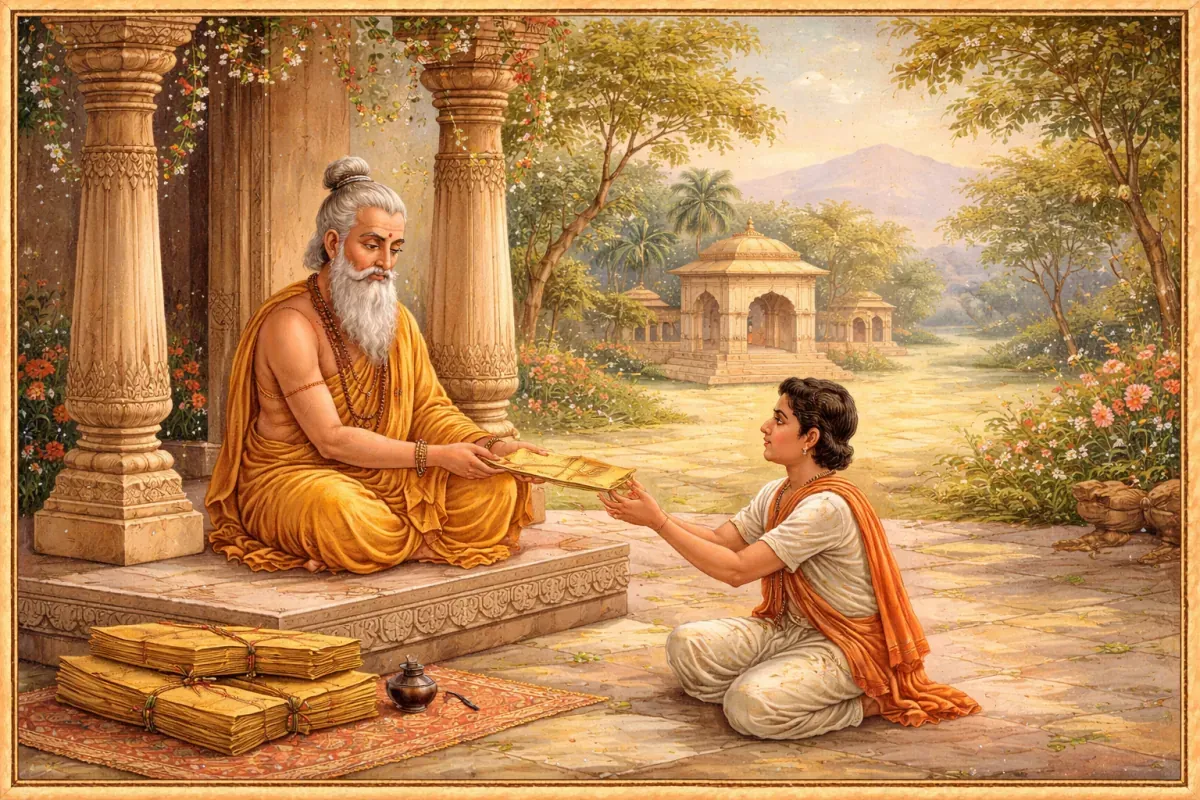
Major Lines of Succession after Shankara
Brief Definition
The lineages of succession after Shankara represent the historically established traditions of transmitting Advaita teachings, originating from Adi Shankara (788–820 CE) and his direct disciples, which developed based on his philosophical system with various interpretative approaches and institutional structures.
Etymology
The term paramparā (paramparā) originates from the Sanskrit root para (para), meaning "other," "subsequent," with a repetition indicating a continuous sequence. In the context of Advaita, śaṅkarācārya-paramparā (śaṅkarācārya-paramparā) signifies an unbroken line of teachers transmitting the teachings tracing back to Adi Shankara (ādi śaṅkara). The word ācārya (ācārya) comes from the root car (car) — "to behave, to practice" with the prefix ā (ā), and means "teacher, one who embodies and transmits knowledge."
Philosophical Significance
Historical Formation and Structure
The system of succession created by Adi Shankara was both philosophical and institutional in nature. Shankara established four mathas (maṭha, monasteries) in different parts of India, each associated with one of the Vedas and one of his primary disciples:
- Sringeri Maṭha (Śṛṅgeri Maṭha) in South India, associated with the Yajur Veda, where Suresvara (Sureśvara) was appointed as the head.
- Puri Maṭha (Purī Maṭha) in East India, associated with the Rig Veda, headed by Padmapada (Padmapāda).
- Dvaraka Maṭha (Dvārakā Maṭha) in West India, associated with the Sama Veda, headed by Hastamalaka (Hastāmalaka).
- Jyotirmaṭha (Jyotirmaṭha) in North India, associated with the Atharva Veda, headed by Totaka (Toṭaka).
This geographical structure facilitated the spread of Advaita throughout India and the formation of various sub-traditions. The heads of these mathas bear the title śaṅkarācārya (śaṅkarācārya) and are considered the spiritual heirs of Shankara.
Major Philosophical Lines of Succession
Following Shankara, two main philosophical lines of Advaita interpretation emerged, known as:
- Bhāmatī (Bhāmatī) — the school founded by Vachaspati Misra (Vācaspati Miśra, 9th century), named after his commentary "Bhamati" on Shankara’s "Brahma-sutra-bhashya." This school emphasizes avidyā (avidyā) as a positive force with its own nature. According to Bhamati, the jīva (jīva) is the locus of ignorance, while Ishwara (īśvara) is its controller.
- Vivaraṇa (Vivaraṇa) — the school founded by Prakashatman (Prakāśātman, 10th century), named after his commentary "Vivarana" on Padmapada’s "Panchapadika." According to this line, māyā (māyā) and avidyā are identical, and ignorance has Brahman (brahman) itself as its locus.
These schools differed in their interpretation of the relationship between the jiva, avidya, and Brahman, as well as in their methodological approaches to textual interpretation.
Dashanami Sampradaya
Shankara also established the daśanāmi saṃpradāya (daśanāmi saṃpradāya) system — the "tradition of ten names," which organizes Advaita sannyasins (monks) into ten orders, each with its own name suffix:
- Sarasvati (sarasvatī) — associated with the goddess of knowledge.
- Bharati (bhāratī) — associated with the goddess of speech.
- Puri (purī) — "city."
- Tirtha (tīrtha) — "place of pilgrimage."
- Ashrama (āśrama) — "abode."
- Giri (giri) — "mountain."
- Parvata (parvata) — "mountain peak."
- Sagara (sāgara) — "ocean."
- Vana (vana) — "forest."
- Aranya (araṇya) — "wilderness, wild place."
These orders were distributed among the four mathas to maintain discipline and the orderly transmission of teachings.
Medieval and Later Lines
During the medieval period (13th–17th centuries), Advaitic thought saw further branching and deepening. Particularly significant figures include:
- Vidyaranya (Vidyāraṇya, 14th century) — author of "Panchadashi" (Pañcadaśī) and "Jivanmuktiviveka" (Jīvanmuktiviveka), who systematized the practical aspects of Advaita.
- Madhusudana Sarasvati (Madhusūdana Sarasvatī, 16th century) — creator of a synthesis between Advaita and Bhakti, author of "Advaita-siddhi," where he defended Advaita against the criticisms of Dvaita Vedanta representatives.
- Appayya Dikshita (Appayya Dīkṣita, 16th century) — a prolific scholar and author who combined elements of Advaita and Shaivism.
- Sadananda (Sadānanda, 15th–16th centuries) — author of "Vedanta-sara" (Vedānta-sāra), one of the most popular textbooks on Advaita.
These thinkers enriched Advaita with new approaches and interpretations, responding to challenges from other philosophical schools and religious movements.
Schools of Interpretation on Maya and Causality
Within Advaita, two influential positions regarding creation and perception also developed:
- Drishti-srishti-vada (dṛṣṭi-sṛṣṭi-vāda) — "the doctrine of creation through perception," according to which the world arises at the moment of its perception. This approach is closer to subjective idealism and is often associated with Prakashatman.
- Srishti-drishti-vada (sṛṣṭi-dṛṣṭi-vāda) — "the doctrine of perception after creation," according to which the objective world exists prior to its perception. This approach is more characteristic of the Bhamati line.
Modern Lines of Succession
In the 19th and 20th centuries, there was a revival of Advaita through the activities of several prominent teachers and organizations:
- Ramakrishna – Vivekananda Lineage — formed "Neo-Advaita," a practical and universalist interpretation accessible to the Western world.
- Ramana Maharshi Lineage — developed the method of atma-vichara (ātma-vicāra), self-inquiry as a direct path to the realization of non-duality.
- Chinmaya Mission — founded by Swami Chinmayananda, specializing in the systematic study of Advaita texts.
- Arsha Vidya — the tradition represented by Swami Dayananda Saraswati (contemporary), focusing on strict textual tradition.
These modern lines strive to preserve the essence of Advaita while making it accessible to a contemporary audience.
Practical Application
Lineages of succession play a key role in the practical study of Advaita:
- Authentic Transmission of Knowledge — the traditional bond between Guru (guru) and shishya (śiṣya) ensures not only the transmission of texts but also their correct understanding through upadesha (upadeśa, instructions) from the teacher.
- Methodological Accents — different lines develop various methods of sadhana (sādhana): some emphasize jnana-yoga (jñāna-yoga), while others integrate elements of bhakti or karma-yoga.
- Interpretative Keys — belonging to a specific line provides the student with methods of interpretation and approaches to understanding complex Advaita concepts, such as the relationship between Maya and Brahman.
- Ritual and Disciplinary Foundation — each line maintains specific practices, including puja, meditation, and asceticism, which create favorable conditions for spiritual progress.
In Texts
Information about lineages of succession is found in the following sources:
- Shankara-digvijaya (Śaṅkara-digvijaya) — hagiographic texts about the life of Shankara, describing the founding of the mathas and the appointment of disciples.
- Mathamnaya (Maṭhāmnāya) — texts describing the structure and rules of the mathas established by Shankara.
- Guruvamsha-kavya (Guruvaṃśa-kāvya) — poetic works glorifying the lineages of gurus.
- Temple Records and Inscriptions — epigraphic sources containing information on the sequence of matha heads.
- Introductions to Commentaries — many commentators mention their teachers and lineage at the beginning of their works.
See Also
- Adi Shankara — founder of the tradition
- Matha — monastic centers of Advaita
- Bhamati — one of the major sub-schools
- Vivarana — the second major sub-school
- Guru-shishya-parampara — the teacher-disciple relationship
- Sannyasa — monasticism in Advaita
- Shastradhyayana — traditional study of texts
Categories
- Historical aspects of Advaita Vedanta
- Institutional elements of the tradition
- Schools and directions
