

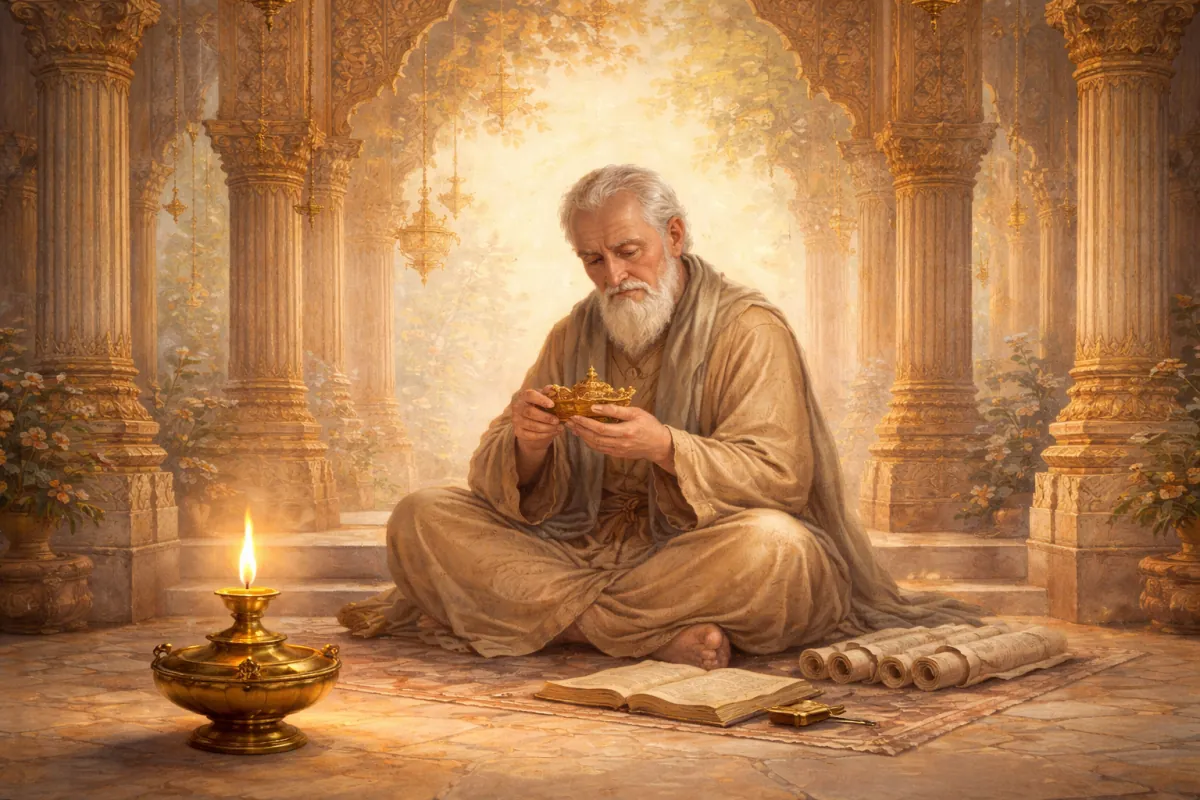
Paramarthika-satya (pāramārthika-satya) is the highest level of reality in Advaita Vedanta, denoting absolute, imperishable truth that is not subject to change and transcends all relative categories. It is the reality of Brahman or Atman, the only eternal and unchanging reality.
Etymology
The term "paramarthika-satya" (pāramārthika-satya) consists of two Sanskrit words:
Paramarthika — derived from "parama," meaning "highest," "supreme," or "ultimate," and "artha," meaning "goal," "meaning," or "reality."
Satya — means "truth" or "reality."
Thus, paramarthika-satya literally means "the highest true reality" or "absolute truth."
Philosophical Significance
Paramarthika-satya is a fundamental philosophical principle of Advaita Vedanta, referring to the immutable, eternal, and absolute level of being. According to Shankara's teaching, it is the only reality that exists in itself and does not depend on anything else.
Key aspects:
Identification with Brahman: In the Advaita system, paramarthika-satya is identified with Brahman—the impersonal, attributeless absolute principle. It is also the reality of Atman—the true Self—as expressed in the mahavakya "Tat tvam asi" ("You are That").
Absence of duality: At this level, there are no distinctions, multiplicity, or duality (advaita). There is neither subject nor object, neither knower nor known.
Nature of reality: Paramarthika-satya is characterized as sat-chit-ananda:
Sat — pure existence.
Chit — pure consciousness.
Ananda — pure bliss.
Realization: From the standpoint of perception, it cannot be comprehended through ordinary sensory or mental cognition. It can be realized only through direct spiritual awareness (aparoksha-jnana) or supreme wisdom (jnana) when ignorance (avidya) is eliminated.
Relationship to the world: The world of multiplicity results from superimposition (adhyasa), or projection onto the immutable reality of Brahman, due to maya. However, maya operates only at the levels of vyavaharika-satya and pratibhasika-satya, without affecting paramarthika-satya.
Examples of Paramarthika-satya
Pure consciousness: It remains unchanged behind all phenomena of experience. It is present in each of the three states of consciousness—waking, dreaming, and deep sleep—while preserving its integrity as the witness (sakshin).
Gold and ornaments: Ornaments have different forms and names, but their essence—gold—remains unchanged. Similarly, the multiplicity of the world consists merely of different names and forms (nama-rupa) superimposed upon the one reality.
Practical Application
Understanding paramarthika-satya has profound practical significance:
It forms the basis of the practice of atma-vichara (self-inquiry), which distinguishes the eternal Atman from transient experience.
It is realized through the process of shravana-manana-nididhyasana (listening, reflection, and meditation).
Meditation on mahavakyas such as "Aham Brahmasmi" ("I am Brahman") is aimed at the direct realization of this reality, leading to moksha (liberation).
One who has attained this state becomes a jivanmukta—liberated while still alive and constantly aware of absolute reality.
In the Texts
The concept of paramarthika-satya is deeply rooted in classical works:
Upanishads: Descriptions of the nature of the highest reality in the Mandukya, Brihadaranyaka, and Chandogya Upanishads.
Brahma Sutras: Indications of the nature of absolute reality, especially in the Chatussutri.
Adi Shankara: A systematic development of the theory of levels of reality in commentaries and treatises such as the "Vivekachudamani" and the "Upadesha Sahasri."
Later teachers: Further development of the concept in the works of Vidyaranya ("Panchadashi") and Madhusudana Sarasvati ("Advaita Siddhi").
See also:
Empirical reality (vyavaharika-satya)
Illusory reality (pratibhasika-satya)
The Absolute (Brahman)
The true Self (Atman)
Cosmic illusion (maya)
Superimposition (adhyasa)
Liberation (moksha)
Categories:
Fundamental principles and concepts
Levels and types of reality
Philosophical categories and methodology
