

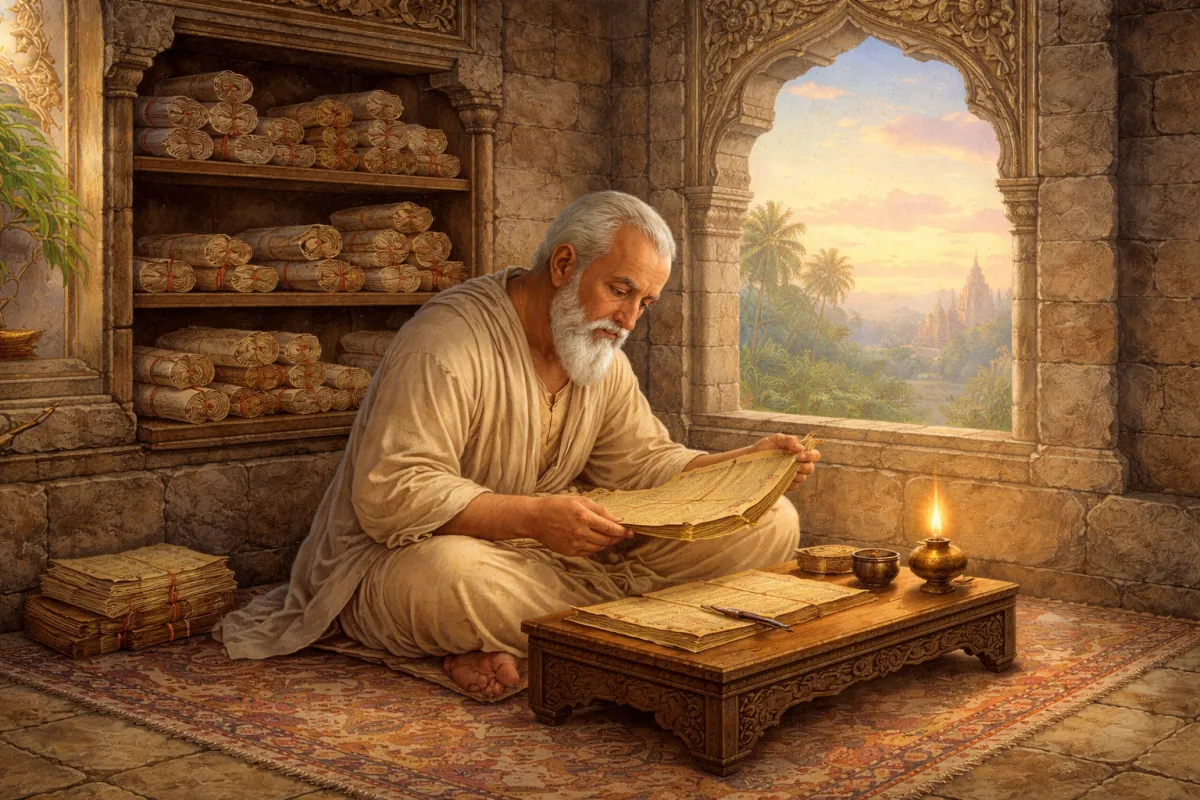
Prakaraṇa Grantha (prakaraṇa grantha) — independent philosophical treatises in the Advaita Vedanta tradition that systematically expound its teachings without being directly tied to commentaries on the canonical texts of the triple canon. These works serve as important guides for the study and practice of Advaita.
Etymology
The term consists of two Sanskrit words: “prakaraṇa” comes from the root “kṛ” (to do, to create) with the prefix “pra” (forward, onward), meaning “exposition, examination, treatise.” “Grantha” comes from the root “granth” (to bind, to connect), meaning “book, text, literary work.” Together, “prakaraṇa grantha” denotes a systematically organized exposition of a particular subject or teaching in the form of an independent treatise.
Philosophical Significance
Prakaraṇa granthas occupy a special place in the corpus of Advaita Vedanta literature. Unlike commentaries on the principal texts of the triple canon (consisting of the Upanishads, the Brahma Sutras, and the Bhagavad Gita), prakaraṇas are independent works in which authors systematically expound the teachings of Advaita.
These treatises arose as a way to present the key ideas of Advaita in a more accessible and structured form than is possible in commentaries. They are often organized thematically, beginning with basic premises and gradually moving on to more complex aspects of nondual philosophy.
The historical development of prakaraṇas began with Adi Shankara, who wrote several such works, including the famous “Vivekachudamani” (The Crest-Jewel of Discrimination). After Shankara, the tradition of composing prakaraṇas was continued by his disciples and followers, forming a rich corpus of literature covering various aspects of Advaita.
The significance of prakaraṇa granthas lies in the fact that they:
Present the teachings of Advaita in a systematic form
Make complex philosophical ideas more accessible to students
Often provide practical guidance for spiritual practice
Serve as a bridge between theoretical understanding and practical application
Develop and clarify various aspects of Advaita, adapting them to different levels of understanding
From a historical perspective, prakaraṇas can be divided into several periods:
Early prakaraṇas (Shankara and his immediate disciples)
Medieval prakaraṇas (the period of consolidation of the tradition)
Late prakaraṇas (further development and refinement of the teachings)
Many prakaraṇas are organized around particular themes or methods, such as:
The nature of Brahman and Atman
Understanding maya and avidya
Methods of meditation and self-inquiry
The process of liberation
States of consciousness and their transcendence
Practical Application
Prakaraṇa granthas are used in the traditional teaching of Advaita Vedanta in several ways:
As instructional texts for beginners and advanced students
As guides for the systematic study of Advaita
As a basis for meditation and reflection
To clarify complex concepts from the principal texts
As a supplement to the principal texts of the triple canon
Traditionally, study begins with simpler prakaraṇas, such as “Tattva Bodha” or “Atma Bodha,” before proceeding to more complex works, such as “Upadesha Sahasri” or “Panchadashi.”
In practical spiritual practice, prakaraṇas are often used for listening to the teachings and reflecting on the teachings—the first two stages in the traditional triad of shravana-manana-nididhyasana.
In the Texts
Among the most important prakaraṇa granthas in the Advaita Vedanta tradition are:
“Vivekachudamani” (The Crest-Jewel of Discrimination)—attributed to Shankara, it describes the path to liberation through discrimination between the real and the unreal.
"Upadesha Sahasri" (A Thousand Teachings) — authentically attributed to Shankara and contains both prose and verse sections.
"Atma Bodha" (Knowledge of the Atman) — a short treatise attributed to Shankara that sets forth the fundamentals of Self-knowledge.
"Tattva Bodha" (Knowledge of the Truth) — an introductory text on Advaita attributed to Shankara.
"Panchadashi" (Fifteen Chapters) — a medieval treatise by Vidyaranya consisting of 15 chapters covering various aspects of Advaita.
"Vedantasara" (The Essence of Vedanta) — a concise and systematic exposition of Advaita by Sadananda.
"Drig-Drishya-Viveka" (Discrimination Between the Seer and the Seen) — attributed to Shankara or Vidyaranya, it focuses on distinguishing the observer from the observed.
See also:
Prasthana-trayi (the triple canon)
Shravana-manana-nididhyasana
Upanishads
Brahma Sutras
Advaita
Shastra
Vidya
Categories:
Key Texts and Sources
Methods of Practice (Sadhana)
Philosophical Categories and Methodology
