

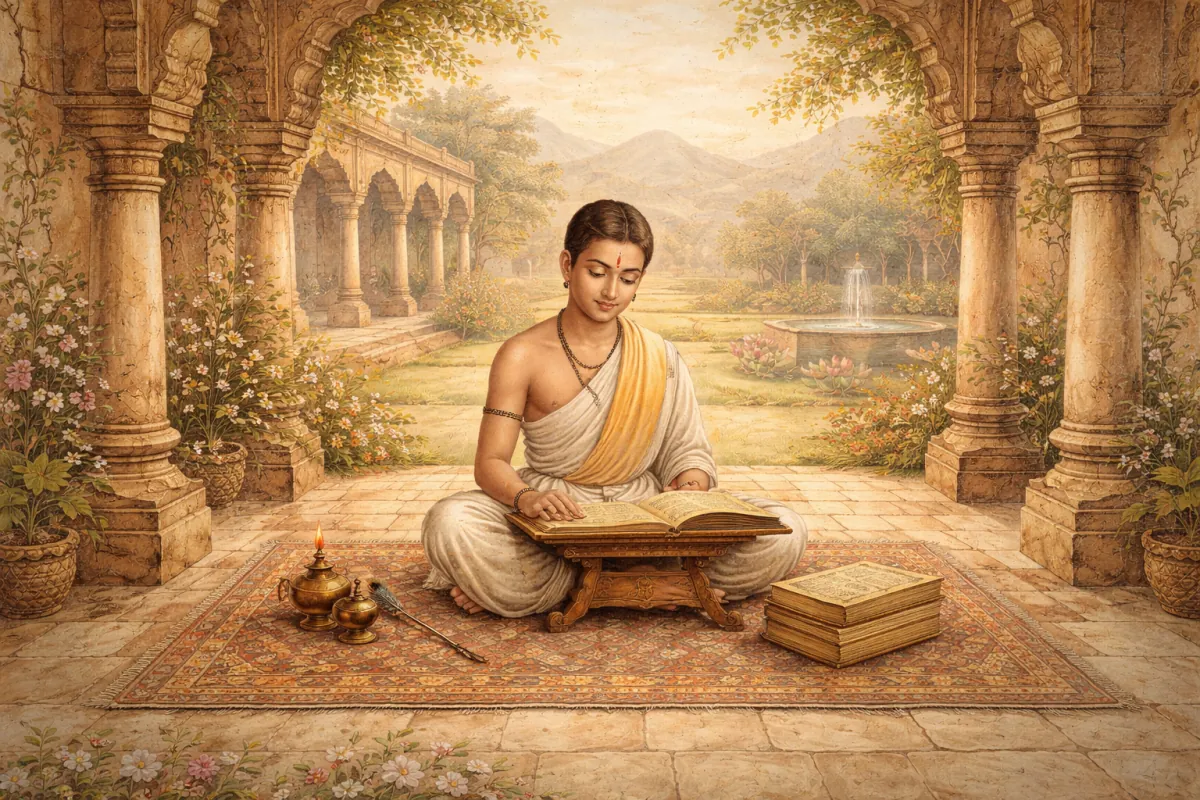
Prasthana-trayi (prasthāna-trayī) is the threefold canon of sacred texts of Advaita Vedanta, consisting of the Upanishads, the Brahma Sutras, and the Bhagavad Gita, upon which the tradition’s entire philosophical system and practice are based.
Etymology
The term prasthana-trayi (prasthāna-trayī) consists of two Sanskrit words: prasthana (prasthāna) – “path,” “starting point,” “foundation,” or “means of attainment” (from the prefix pra (pra), meaning “forward” or “onward,” and the root stha (sthā) – “to stand,” “to be situated”); and trayi (trayī) – “three,” “triad” (from the Sanskrit numeral tri (tri)). Thus, the full term can be translated as “the threefold path” or “the three starting points.”
Philosophical Significance
The Prasthana-trayi comprises the three principal authoritative sources upon which the entire system of Advaita Vedanta and other schools of Vedanta is based. These three textual corpora complement one another and together form a complete foundation for the philosophical system:
The Upanishads (śruti-prasthāna) – the foundational texts of revelation, regarded as the direct source of knowledge about Brahman and Atman. They belong to the category of shruti (śruti) – “that which is heard,” representing direct revelation received by sages in deep meditation. Of particular importance are the ten principal Upanishads on which Adi Shankara wrote commentaries:
Ishavasya;
Kena;
Katha;
Prashna;
Mundaka;
Mandukya;
Taittiriya;
Aitareya;
Chandogya;
Brihadaranyaka.
They contain such key concepts as sat-chit-ananda, the Mahavakya Tat tvam asi, and other mahavakyas.
The Brahma Sutras (nyāya-prasthāna) – also known as the Vedanta Sutras or Shariraka Sutras. They are a systematic exposition of Vedanta philosophy in the form of aphorisms (sutras), attributed to the sage Badarayana Vyasa. They provide a logical substantiation of the teachings of the Upanishads, organized into four chapters (adhyayas), each divided into four sections (padas). The Brahma Sutras begin with the famous statement “athato brahma-jijnasa” (“now, therefore, the inquiry into Brahman”). In the Advaita tradition, Shankara’s commentary on the Brahma Sutras, known as the “Brahma-sutra-bhashya,” is of particular importance, as it establishes a non-dual (Advaita) interpretation of these texts.
The Bhagavad Gita (smṛti-prasthāna) – part of the epic “Mahabharata,” containing Krishna’s teaching to Arjuna before the beginning of the battle of Kurukshetra. This text belongs to the category of smriti shastras (smṛti) – “that which is remembered,” recorded by human beings on the basis of recollections of divine revelation. The Bhagavad Gita presents the practical aspect of Vedanta philosophy, describing various paths of sadhana: jnana yoga, bhakti yoga, and karma yoga. In his commentary on the Gita, Shankara emphasizes the paramount importance of jnana yoga, regarding bhakti and karma as preparatory practices.
Historically, it was Adi Shankara (788–820 CE) who first systematized and unified the understanding of these three textual traditions, creating on their basis a coherent philosophical system of Advaita Vedanta. His commentaries (bhashyas) on these texts laid the foundation for all subsequent development of Advaita. After Shankara, all the major acharyas (teachers) of Vedanta also wrote commentaries on the Prasthana-trayi, offering their own interpretations.
In the context of the pramanas (means of valid knowledge) used in Advaita, the Prasthana-trayi represents the source of shabda-pramana – the authoritative testimony of texts. At the same time, shruti (the Upanishads) possesses the highest authority, and the other texts must be interpreted in accordance with it.
Each school of Vedanta – Advaita, Vishishtadvaita, Dvaita, and others – has its own interpretation of the Prasthana-trayi, which defines its unique philosophical position. Different approaches to understanding the same texts became the basis for centuries-long philosophical debates among the schools.
Practical Application
The Prasthana-trayi has not only philosophical but also immense practical significance in the Advaita tradition:
Basis for shravana-manana-nididhyasana. The process of spiritual development in Advaita includes three stages: shravana (listening to the teaching), manana (reflecting on it), and nididhyasana (deep meditation on the truth). The texts of the Prasthana-trayi serve as the primary source for shravana—study under the guidance of a Guru. New version.
Source of upadesha. In the Advaita tradition, the teacher (Guru. New version) transmits the teaching to the disciple (shishya) through upadesha—instruction based on the scriptures. The Prasthana-trayi is the principal source of such instruction.
Material for svadhyaya. Regular study of sacred texts (svadhyaya) is an important part of sadhana. The Prasthana-trayi constitutes the primary material for this practice.
Basis for vichara. The method of self-inquiry (atma-vichara) rests on a deep understanding of the nature of Atman and Brahman as described in the Prasthana-trayi.
Guidance for sadhana-chatushtaya. The four preliminary qualifications for the spiritual path (viveka, vairagya, shatsampatti, and mumukshutva) are developed through deep study and understanding of these texts.
Traditionally, a serious student of Advaita must master all three groups of texts under the guidance of a qualified teacher. In all Advaita mathas (monasteries) and traditional centers for the study of Vedanta (pathashalas), instruction is based primarily on the texts of the Prasthana-trayi and their commentaries.
In Texts
The term "Prasthana-trayi" itself came into widespread use during the medieval period of Vedanta’s development. Key mentions of and references to this concept can be found in the following texts:
In the "Sarva-darshana-sangraha" by the 14th-century Madhavacharya (also known as Vidyaranya), which presents an overview of all the major philosophical systems of India, including Advaita Vedanta and its reliance on the three sources.
In Ramanuja’s "Vedartha-sangraha", which, although written from the standpoint of Vishishtadvaita, discusses the authority of the three groups of texts.
In the "Brahma-sutra-bhashya-varttika" by Sureshvara, a disciple of Shankara, which emphasizes the importance of a coherent understanding of all three sources.
In Vidyaranya’s "Panchadashi", where all three groups of texts are quoted and discussed in various contexts as mutually complementary sources of knowledge.
In Sadananda’s "Vedantasara", which systematically explains the process of studying Vedantic texts, beginning with the Prasthana-trayi.
See also:
Upanishads
Brahma Sutras
Bhagavad Gita
Adi Shankara
Shruti
Bhashya
Advaita
Categories:
Key Texts and Sources
Fundamental Principles and Concepts
Historical Aspects
