

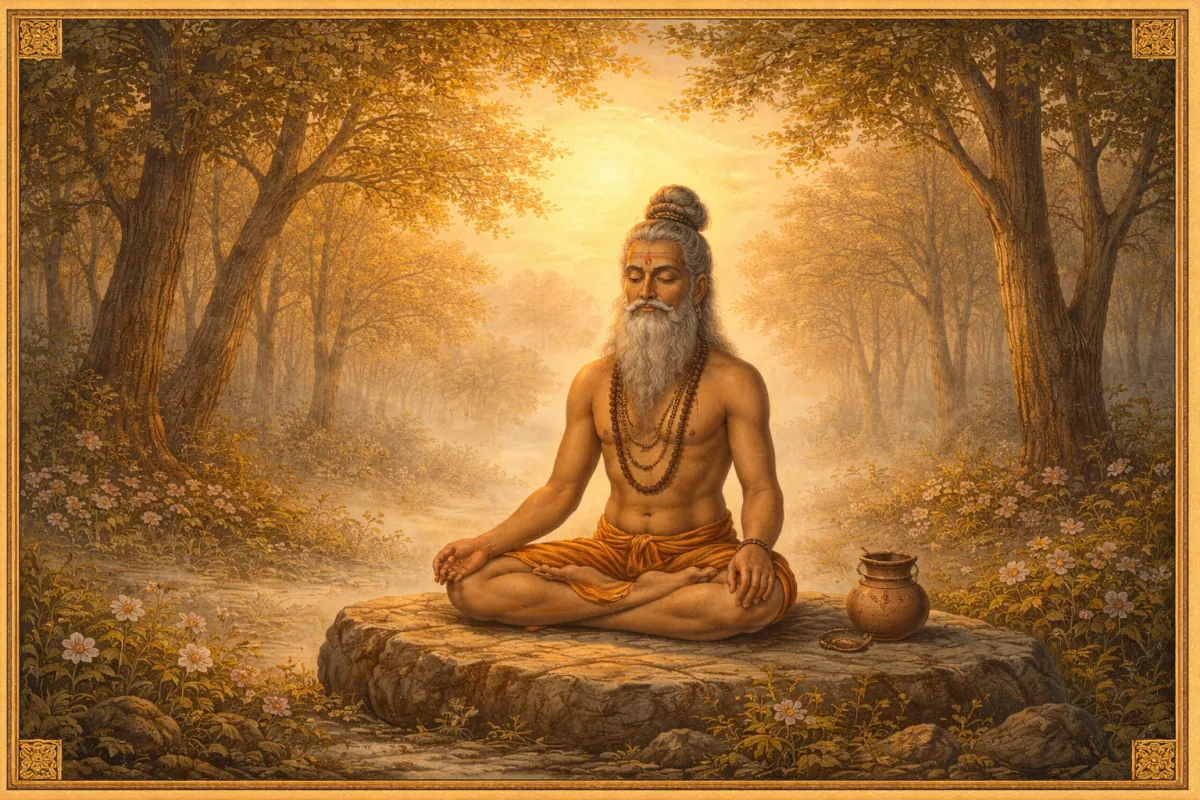
Sat-Chit-Ananda is one of the central concepts of Indian philosophy, describing the nature of ultimate reality (Brahman) and the true Self (Atman). The three words—Sat, Chit, and Ananda—do not enumerate separate properties. They point to the single, indivisible nature of the Absolute, which language is forced to express in parts, although in reality there is no division. The Taittiriya Upanishad (II.1.1) proclaims that Brahman is satyam (truth), jnana (knowledge), and anantam (infinity)—a formula that crystallized into the triad Sat-Chit-Ananda in the later Vedanta tradition.
Etymology
The compound word satchitananda (Sanskrit: saccidānanda) is formed from three roots:
Sat (Sanskrit: sat) is the present participle of the root as (“to be”). It means “that which exists,” “true,” “that which really is.” In the Vedic language, sat was contrasted with asat—“the non-existent,” non-being. The Rigveda (X.129.1) begins its cosmogonic hymn with this pair: “Then there was neither the existent (sat) nor the non-existent (asat).”
Chit (Sanskrit: cit) comes from the root cit (“to perceive,” “to be aware”). It means pure awareness—not a thought or a mental process, but the very light of awareness through which anything at all can be known.
Ananda (Sanskrit: ānanda) comes from the root nand (“to rejoice”) with the prefix ā-. It means bliss, but not in the sense of an emotional experience. It is the fullness of being in which there is no lack and, therefore, no suffering.
When the words are combined in Sanskrit, the standard rules of sandhi apply: sat + cit = sac-cit, cit + ānanda = cid-ānanda, resulting in saccidānanda.
Definition in the Vedanta Tradition
The formula Sat-Chit-Ananda does not occur in the early Upanishads as a single compound word. It emerged gradually.
The Taittiriya Upanishad (II.1.1) describes Brahman as “satyaṃ jñānam anantam”—truth, knowledge, and infinity. The Mandukya Upanishad defines the fourth state of consciousness (Turiya) as “śāntam, śivam, advaitam”—peaceful, auspicious, and non-dual. The Chandogya Upanishad (VI.2.1) opens its teaching with the words: “In the beginning there was only Sat, one without a second.”
Shankaracharya (788–820 CE), in his commentaries on the Upanishads and the Brahma Sutras, systematized these descriptions. He insisted that Sat-Chit-Ananda is an attempt to indicate what Brahman is by His very nature (svarupa-lakshana), rather than attributes ascribed to Him from outside. Brahman does not “possess” being, consciousness, and bliss—He is being, consciousness, and bliss.
This distinction is worth clarifying. An ordinary object possesses qualities: a pot is red, heavy, and made of clay. Its qualities may change while the object remains. Brahman is different: remove Sat, and there is no Brahman; remove Chit, and there is no Brahman. The three words describe the same reality from different perspectives, like three windows looking into the same room.
Sat—Being That Neither Arises nor Disappears
Sat is often translated as “existence” or “being,” but this is an oversimplification. In Vedanta, Sat means being that depends on nothing else. It did not arise at some point and will never cease. In the Vivekachudamani (verse 227), Shankaracharya defines Sat as “that which is never negated in the three times—past, present, and future.”
Everything we observe in the world exists conditionally. The body appears at birth and disintegrates at death. A thought arises and fades away. Mountains were once the ocean floor. Nothing observable possesses absolute being. But the very capacity “to be”—the fact that existence as such is present—is Sat.
The Bhagavad Gita (II.16) expresses this with utmost brevity: “The unreal has no being; the real never ceases to be” (nāsato vidyate bhāvo nābhāvo vidyate sataḥ). Krishna points Arjuna to the distinction between what is real (sat) and what is merely apparent (asat). The body, emotions, and circumstances belong to the realm of change. That which remains unchanged in every state is Sat.
Chit—Consciousness, Not Thought
Chit is translated as “consciousness,” but a distinction must be made here. In Advaita Vedanta, chit (cit) and chitta (citta) are different things. Chitta is the mind, the mental instrument that thinks, remembers, and imagines. Chitta belongs to the realm of prakriti (nature) and is constantly changing. Chit is consciousness in its pure form, the unchanging light of awareness that allows the mind to function but is not itself the mind.
An analogy from the tradition: the sun illuminates both a palace and a rubbish dump, yet becomes neither luxurious nor dirty. Likewise, Chit illuminates all states of mind but is not colored by them. In Atma Bodha (verse 28), Shankaracharya compares the Atman to the sun, which illuminates the entire world but remains unaffected by what happens within it.
Drig-Drishya-Viveka (“Discrimination between the Seer and the Seen”), a text attributed to Shankaracharya, builds its argument on distinguishing Chit from chitta. Thoughts can be observed, which means they are objects. And that which observes thoughts cannot itself be a thought. It is the pure subject, Chit. This subject cannot be grasped by thought or described in words. It is indicated through negation: “not this, not this” (neti neti).
Ananda Is Fullness, Not Pleasure
Ananda is the most frequently misunderstood component of the formula. It is translated as “bliss,” evoking in the reader an image of an ecstatic experience. But Vedanta means something else.
The Taittiriya Upanishad (II.5) describes five sheaths (pancha-kosha), the last of which is anandamaya-kosha, the “bliss sheath.” It is a subtle structure associated with deep sleep and samadhi. In his commentary on this passage, Shankaracharya specifically notes that anandamaya-kosha is still a sheath, not the Atman itself. It is “made of” (maya) ananda, but is not identical to it.
The Ananda of Brahman is not an experience that comes and goes. Every experience, however exalted it may be, is limited in time. Ananda is timeless. It is fullness in which there is nothing to desire and nothing to fear. The Brihadaranyaka Upanishad (IV.3.32) says: “When there is no other, there is no fear”—and where there is no fear or division, ananda is present as the natural state.
The Taittiriya Upanishad (II.8) presents a “scale of bliss”: the bliss of a young man, multiplied a hundredfold, yields the bliss of a gandharva; the bliss of a gandharva, multiplied a hundredfold, yields the bliss of the devas, and so on, all the way to Brahman. This scale is a pedagogical device. The Ananda of Brahman is not a quantitative increase in ordinary joy. It is qualitatively different.
The nature of every living being is happiness. That is why no one is surprised when a person is happy, yet everyone looks for a reason when that person suffers. Happiness is natural; suffering is not. An ordinary person can easily be deprived of joy: a disapproving look or a slight to their pride is enough. But a sadhu (ascetic) cannot be deprived of ananda—he draws it from within and does not rely on the ego.
Why Sat-Chit-Ananda Is a Trinity, Not Three Qualities
A question arises: if Sat, Chit, and Ananda are different aspects, does that not mean that Brahman is composite? No. Vedanta insists on the absolute simplicity (akhanda—“indivisible”) of Brahman.
The three words arise because of the limitations of language. When we ask, “Does Brahman exist?” the answer is Sat. When we ask, “Is It conscious?”—Chit. When we ask, “What is Its nature?”—Ananda. All three answers point to the same reality.
In Upadesha Sahasri (Chapter 12), Shankaracharya explains: being without consciousness is inert matter; consciousness without bliss is a suffering mind; bliss without being is an illusion. Only when all three are inseparable are we dealing with Brahman. Sat-Chit-Ananda is not an additive formula (Sat + Chit + Ananda = Brahman), but three ways of pointing to that which has no parts.
Madhusudana Saraswati, a sixteenth-century Vedantin, uses an image in Advaita Siddhi: when we say “a large blue lotus,” we do not mean that “large,” “blue,” and “lotus” are three different things. Likewise, “being-consciousness-bliss” is the one Brahman described by three words.
Sat-Chit-Ananda in the Teachings of Swami Vishnudevananda Giri
Swami Vishnudevananda Giri speaks of Sat-Chit-Ananda as the foundation of the path, not its distant goal. It is the essence of the nature of Mind—it is already present in everyone but remains unrecognized:
“Sat-Chit-Ananda is Brahman. It is the essence of the nature of Mind, but without the ability to comprehend it, it remains concealed, hidden, veiled. It is as though you possessed a large bar of gold but did not even know about it. The whole point is to discover that it exists, to see it, and then to apply it in life.”
— Lecture “The Three Principles of the Path: Shravana, Manana, and Nididhyasana,” 2020
Interestingly, the Guru describes the Absolute as a fractal structure. When a disciple asked whether Parabrahman could be associated with “Sat,” and Ishvara with “Chit” and “Ananda,” the Guru replied:
“You could put it that way, but in fact, you can never say anything definitively about absolute reality, because absolute reality is fractal—it is a structure that repeats at every level. You will find the concept of Sat-Chit-Ananda at all levels, from the lowest being to Parabrahman.”
— Lecture on the Ishvara Gita, 2018
In practice, this recognition occurs through contemplation (Prajna Yantra). Every perceived object contains five aspects: Sat, Chit, and Ananda (the three “layers” of Brahman), plus nama and rupa (name and form—the superimposition of illusion). When a practitioner cuts away name and form and discovers being, consciousness, and bliss in every phenomenon, the experience of the single “taste” of reality arises, and contemplation is transformed from a separate exercise into a way of life.
Realization: Three Enlightened Bodies
According to the teachings of the siddhas, Sat-Chit-Ananda comprises the three seeds of the Absolute, which blossom in the course of spiritual practice. The principle of Sat is realized as jnana-deha—an infinite body of wisdom, akin to light and space. The principle of Chit is realized as pranava-deha, the subtle divine illusory body. The principle of Ananda is realized as siddha-deha, the body of bliss.
Related Concepts
Brahman—the Absolute Reality described as Sat-Chit-Ananda
Atman—the true Self, identical to Brahman (mahavakya: “Aham Brahmasmi”)
Turiya—the fourth state of consciousness beyond waking, dreaming, and deep sleep
Sahaja—the “natural” state of abiding in one’s own nature
Avidya—ignorance due to which Sat-Chit-Ananda is not recognized
Pancha-kosha—the five sheaths that “conceal” Atman from itself
Neti-neti—a method of knowledge through negation: “not this, not this”
Mahavakyas—the great sayings of the Upanishads expressing the identity of Atman and Brahman
Viveka—discriminating wisdom, the ability to distinguish the real (Sat) from the unreal (asat)
