

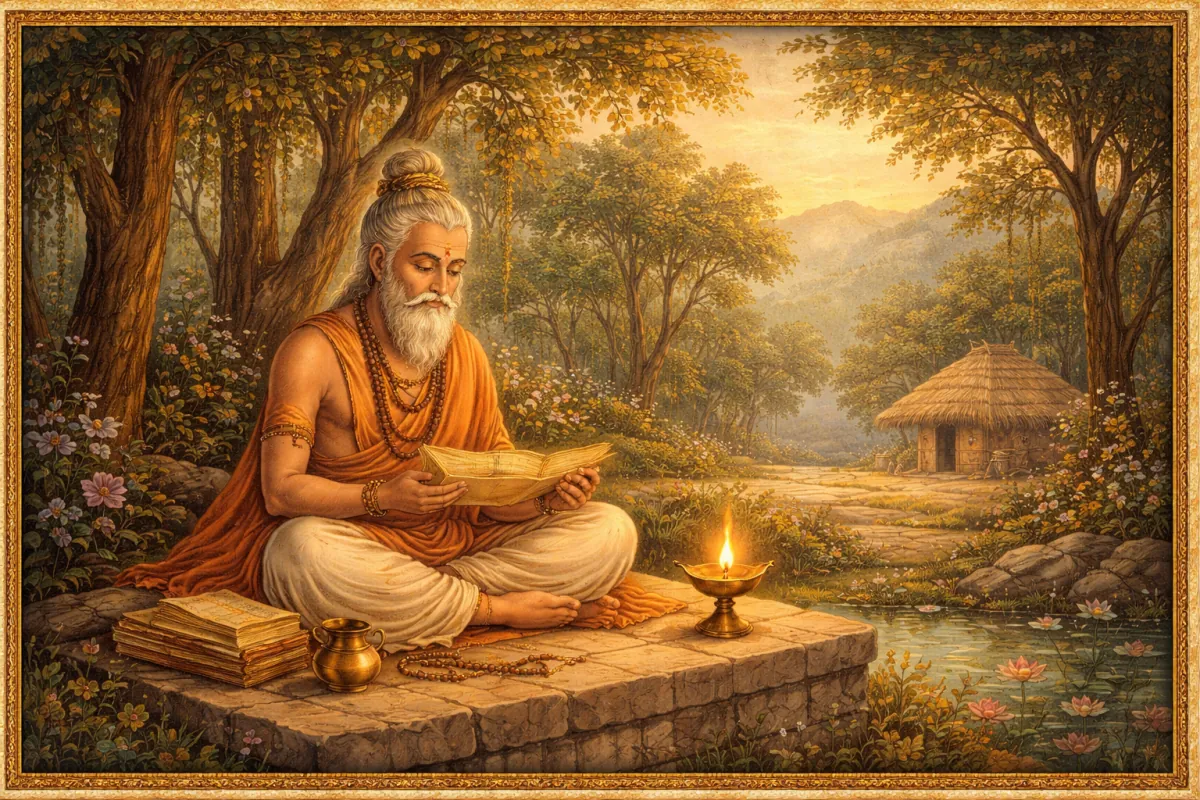
The Identity of Atman and Brahman is a fundamental metaphysical principle of Advaita Vedanta that asserts the absolute ontological identity of individual consciousness (Atman) and the supreme reality (Brahman), often expressed by the mahavakya (great saying) “aham brahmasmi” (ahaṃ brahmāsmi, अहं ब्रह्मास्मि)—“I am Brahman.”
Etymology
This philosophical principle consists of three Sanskrit elements:
Atman (ātman, आत्मन्)—from the root at (“to move,” “to breathe”), meaning the true “Self,” the transcendent self independent of physical and mental phenomena. Brahman (brahman, ब्रह्मн)—from the root bṛh (“to grow,” “to expand”), denoting the absolute, immutable, boundless reality that underlies all existence. Aikya (aikya, ऐक्य)—from eka* (“one”), meaning unity, identity, non-duality.
Philosophical Significance
The identity of Atman and Brahman is the cornerstone of Advaita philosophy, distinguishing it from other schools of Vedanta and Indian philosophy as a whole. This doctrine asserts that behind the apparent diversity of the phenomenal world lies a single reality—Brahman—and that our true nature (Atman) is essentially indistinguishable from that reality.
Historical Development of the Concept
The origins of the idea of identity can be traced to the Upanishads, particularly the Brihadaranyaka, Chandogya, and Mandukya Upanishads. However, a systematic philosophical justification of this concept first appears in the works of Gaudapada (7th–8th centuries), in his “Mandukya Karika,” where he analyzes the nature of reality through the prism of the three states of consciousness (jagrat, svapna, sushupti) and the fourth, transcendent state (turiya).
The doctrine was fully developed in the works of Adi Shankara (8th century), who, in his commentaries on the Brahma Sutras, the Upanishads, and the Bhagavad Gita, substantiated a metaphysical monism according to which multiplicity is a consequence of avidya (ignorance).
Key Aspects of Identity
1. The Aspect of the Nature of Reality
From the standpoint of understanding the true nature of being, identity means that Atman and Brahman are not two separate realities but constitute a single non-dual reality (Advaita). The apparent distinction between them is the result of upadhis (limiting adjuncts) and adhyasa (superimposition).
2. The Aspect of Knowing the Truth
In terms of the process of comprehending the truth, the realization of identity occurs through direct knowledge, rather than through logical reasoning or sensory experience. This knowledge is not the acquisition of new information but the removal of the fundamental ignorance (avidya) that conceals the true nature of reality.
3. The Aspect of Spiritual Liberation
In the context of liberation (moksha in Advaita Vedanta), realizing this identity means the final release from the cycle of rebirth (samsara) and the overcoming of all forms of duality and suffering. This realization is described as a state of absolute bliss (ananda), which is one of the attributes of Brahman, along with being (sat) and consciousness (chit).
Logical Justification of Identity
Advaitins justify the identity of Atman and Brahman through several logical arguments:
Argument from unity: If Atman and Brahman were different realities, this would contradict the principle of absolute unity proclaimed in the Upanishads.
Argument from infinity: Brahman is infinite by definition. If Atman were distinct from Brahman, this would limit Brahman, which is incompatible with its infinite nature.
Argument from immutability: Both Atman and Brahman are described as immutable, eternal, and self-existent. Two entities with identical essential properties must logically be one and the same entity.
Argument from direct experience: In the state of deep sleep (sushupti) and in samadhi, when all mental modifications cease, a single, undifferentiated reality is directly experienced, attesting to the identity of Atman and Brahman.
Differences in Interpretation
Throughout the history of Advaita, various sub-schools have existed, interpreting the nature of identity in different ways:
Bhamati (founded by Vachaspati Mishra): emphasizes that identity is realized through the negation (neti-neti) of all upadhis that limit the Atman.
Vivarana (founded by Prakashatman): emphasizes the positive aspect of identity as the direct experience of pure consciousness.
Drishti-srishti-vada: considers identity from the perspective of perception-creation, in which the realization of identity precedes and conditions the manifestation of the world.
Practical Application
The realization of the identity of Atman and Brahman is the ultimate goal of all spiritual practices in Advaita. The principal methods include:
1. Shravana-manana-nididhyasana
The classical threefold path described in the Brihadaranyaka Upanishad:
Shravana: listening to teachings on identity from a qualified teacher (Guru. Edits).
Manana: deep reflection on what has been heard in order to eliminate intellectual doubts.
Nididhyasana: continuous meditative contemplation of identity until its complete realization.
2. Atma-vichara
Self-inquiry, a method particularly emphasized in the later Advaita tradition (for example, by Ramana Maharshi), consists of continuously asking “Who am I?” with the aim of discovering the unchanging subject of all experience, which ultimately proves to be identical with Brahman.
3. Meditation on the Mahavakyas
Deep contemplation of the great sayings (mahavakyas) of the Upanishads that express identity:
“Prajnanam brahma” (prajñānaṃ brahma) — “Consciousness is Brahman” (Aitareya Upanishad)
“Aham brahmasmi” (ahaṃ brahmāsmi) — “I am Brahman” (Brihadaranyaka Upanishad)
“Tat tvam asi” (tat tvam asi) — “You are That” (Chandogya Upanishad)
“Ayam atma brahma” (ayam ātmā brahma) — “This Atman is Brahman” (Mandukya Upanishad)
In the Texts
The concept of the identity of Atman and Brahman permeates the entire threefold foundation of Advaita:
In the Upanishads:
Chandogya Upanishad (6.8.7): “Tat tvam asi” — the famous instruction given by the sage Uddalaka to his son Shvetaketu.
Brihadaranyaka Upanishad (1.4.10): “Aham brahmasmi” — a direct affirmation of identity.
Mandukya Upanishad: An analysis of the syllable Om and the four states of consciousness, leading to an understanding of identity.
2. In the Brahma Sutras:
Brahma Sutras (1.1.2): “Janmady asya yatah” — the definition of Brahman as the source of the world’s origin, existence, and dissolution, implying its identity with the inner principle of consciousness.
Brahma Sutras (1.1.4): “Tat tu samanvayat” — the assertion that the identity of Atman and Brahman follows logically from a consistent interpretation of all the Upanishadic texts.
3. In the Bhagavad Gita:
Bhagavad Gita (13.2): The distinction between the “field” (kshetra) and the “knower of the field” (kshetrajna), corresponding to the distinction between the phenomenal world and Atman-Brahman.
Bhagavad Gita (13.12-17): A description of the nature of Brahman as “the light of lights, dwelling beyond darkness” and “knowledge, the object of knowledge, and the goal of knowledge, dwelling in the heart of everyone.”
In the Prakarana Granthas:
Viveka Chudamani by Shankara: A detailed philosophical substantiation of identity through the discrimination between the real and the unreal.
Drig-Drishya-Viveka (attributed to Shankara or Bharati Tirtha): A methodical distinction between the seer (Atman) and the seen (non-Atman), leading to an understanding of identity.
Upadesha Sahasri by Shankara: A systematic exposition of the doctrine of identity in prose and verse.
See also:
Atman (the true Self)
Brahman (absolute reality)
Maya (cosmic illusion)
Avidya (ignorance)
Adhyasa (superimposition)
Moksha (liberation)
Mahavakyas (great sayings)
Categories:
Fundamental Principles and Concepts
Fundamental Metaphysical Principles
Anthropology and Psychology
