

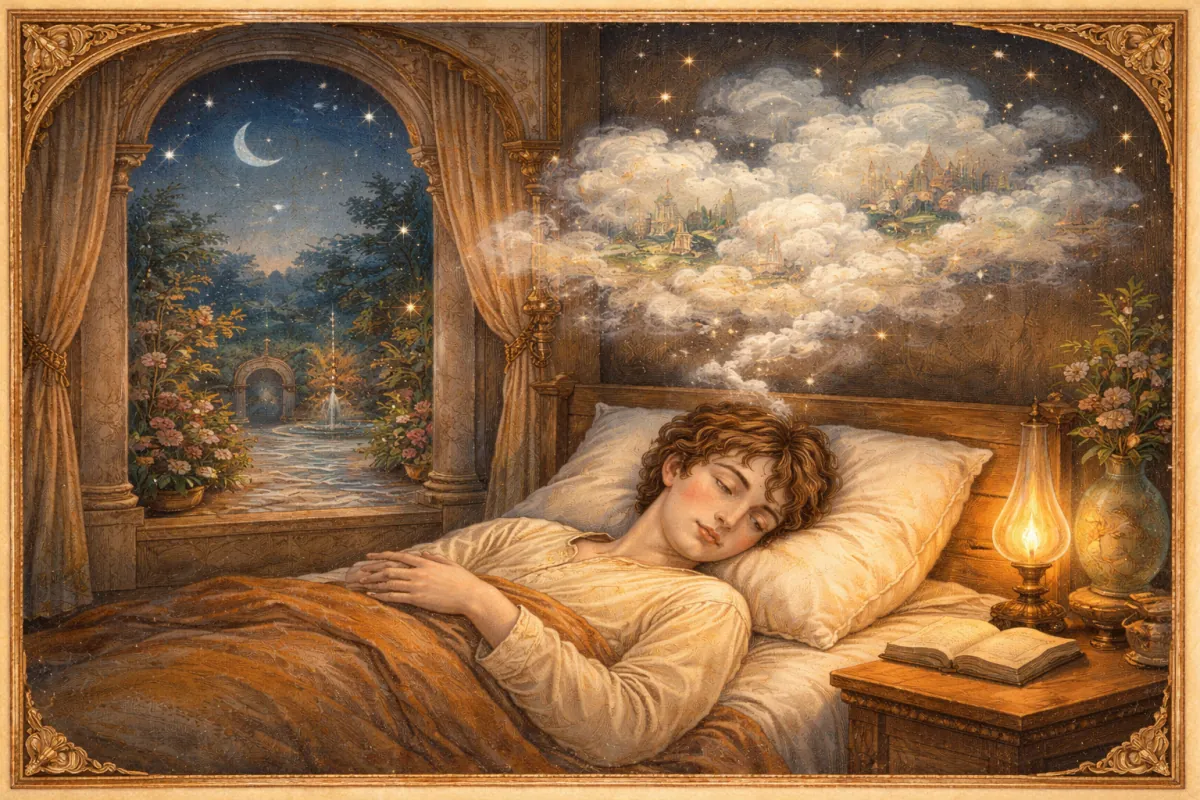
The three states of consciousness (avasthā-traya) are a fundamental classification in Advaita Vedanta describing different levels of the manifestation of consciousness: jāgrat (waking), svapna (dreaming), and suṣupti (deep sleep). This triad provides the basis for understanding the nature of Ātman and its relationship to Brahman by analyzing what remains unchanged in all states.
Etymology
The Sanskrit term avasthā-traya consists of two parts: avasthā (अवस्था) — “state, position, condition,” derived from the root sthā (“to stand, to abide”) with the prefix ava (“down, toward”), and traya (त्रय) — “three, triad,” derived from the root tri (“three”). Thus, the term literally means “three states” or “three modes of being.”
Philosophical Significance
The doctrine of the three states of consciousness is one of the cornerstones of the Advaitic methodology of self-knowledge. First systematically expounded in the Māṇḍūkya Upaniṣad and further developed in the works of Gauḍapāda and Ādi Śaṅkara, this teaching offers a unique way of comprehending the nondual nature of reality through an analysis of everyday experience.
Jāgrat — the Waking State
The first state, jāgrat (जाग्रत्), is characterized by the active perception of the external world through the sense organs. In this state, the jīva (individual soul) identifies itself with the gross body (sthūla-śarīra) and experiences the multiplicity of objects through the inner instrument of cognition. Here consciousness appears limited and conditioned by māyā, creating the impression of separation from Brahman.
The Māṇḍūkya Upaniṣad describes this state as follows: “Jāgrat is the first quarter (of Ātman). It is all-pervading, enjoying gross objects, seven-limbed, nineteen-mouthed, Viśva” (1.3). Here Viśva means “all-encompassing,” indicating that in the waking state consciousness appears to encompass the entire perceived world.
Detailed structure of the state:
Seven limbs (sapta-aṅga): heaven as the head, the sun as the eye, air as the breath, fire as the mouth, water as the bladder, the earth as the feet, and space as the body Nineteen mouths (ekonaviṃśati-mukha): the five organs of cognition, the five organs of action, the five prāṇas, manas, buddhi, ahaṃkāra, and citta
Thirteen instruments: the ten organs of sense and action, plus manas, buddhi, and ahaṃkāra
In the waking state, all means of knowledge (pramāṇa) operate, including perception, inference, and sacred testimony. It is in this state that the Vedas are studied and spiritual practice aimed at realizing the truth is undertaken.
An example from everyday experience: When we see a rope at twilight and mistake it for a snake, this demonstrates the nature of perception in jāgrat—the blending of the real substratum (the rope-Brahman) with projected forms (the snake-world). Ādi Śaṅkara often uses this example to explain the mechanism of superimposition.
Svapna — the Dream State
The second state, svapna (स्वप्न), is the world of inner images and experiences created by the mind from impressions (vāsanā) accumulated in the waking state. In a dream, the jīva identifies itself with the subtle body (sūkṣma-śarīra) and simultaneously becomes the creator, experiencer, and destroyer of its dream world.
The Māṇḍūkya Upaniṣad describes this state: “Taijasa is the second quarter. It is inwardly luminous, enjoying subtle objects, seven-limbed, nineteen-mouthed” (1.4). Taijasa means “luminous,” referring to the inner light of consciousness that illuminates dream images.
Philosophical features of svapna:
The creative function of the mind: In a dream, the mind creates entire worlds, characters, and narratives, demonstrating their illusory nature
Subject-object duality: The dreamer is simultaneously both the seer and everything seen in the dream
Absence of external objects: All experiences occur without the involvement of the physical sense organs
Karmic imprints: The content of dreams is shaped by vāsanās—the deep impressions left by past actions and experiences
Gaudapada emphasizes in the Mandukya Karika: "In a dream, the mind illuminates itself through its own maya, creating and experiencing the duality of subject and object" (2.4). This demonstrates consciousness's ability to create an apparent reality without relying on external objects.
Classical example: The Brihadaranyaka Upanishad presents the image of a king who becomes a beggar in a dream and suffers, but upon awakening realizes the unreality of that experience. Likewise, ordinary wakefulness is merely another kind of dream in relation to true awakening in Brahman.
This state is especially important for understanding the nature of maya, since it demonstrates consciousness's ability to create an apparent reality without relying on external objects. Dreaming shows that multiplicity and duality can be projections of a single consciousness, which is a key insight in Advaita.
Sushupti (suṣupti) — the state of deep sleep
The third state, sushupti (सुषुप्ति), is characterized by the absence of both external perception and internal images. In deep sleep, the antahkarana temporarily dissolves into its cause—avidya (avidyā)—and only witnessing consciousness remains in a potential form. This state is closest to the nature of Brahman, but it is not yet complete realization.
The Mandukya Upanishad describes sushupti as follows: "Prajna is the third quarter. He is one, consisting of cognition, full of bliss, enjoying bliss, the gateway to consciousness" (1.5). Prajna means "wisdom" or "cognition," indicating undifferentiated consciousness-being.
Unique characteristics of sushupti:
Absence of duality: There is no distinction between subject and object, "I" and "this"
Natural bliss: The state is characterized by profound peace and contentment
Potentiality: All vasanas and samskaras remain in an unmanifest state
Unity of consciousness: Consciousness exists in an undifferentiated form close to its true nature
Adi Shankara explains in his commentary: "In sushupti, all mental modifications (vṛtti) dissolve, but consciousness continues to exist as the witness even of this dissolution. The evidence for this is the recollection upon awakening: 'I slept well; I knew nothing'".
Philosophical significance of remembering sleep: The fact that a person remembers "I slept" indicates the continuity of witnessing consciousness even in the absence of the ego and mind. Gaudapada emphasizes: "If consciousness were completely absent in deep sleep, there would be no memory of it" (Mandukya Karika 1.15).
Example for understanding: Just as an actor remains himself even when playing no role, Atman remains unchanged even when it does not manifest through individuality. Deep sleep is a natural return to this state of rest.
Difference from samadhi: Although sushupti outwardly resembles samadhi, the key difference is that a subtle veil of avidya is present in deep sleep, whereas in samadhi there is clear awareness of one's true nature.
The importance of sushupti lies in the fact that it demonstrates the possibility of existence without the ego and mental modifications. Awakening with the feeling "I slept happily" indicates that the witness (sākṣin) was present even in the absence of ordinary self-awareness.
Turiya (turīya) — the fourth state
Although not formally included in avastha-traya, turiya is the foundation of all three states—pure, nondual consciousness that remains unchanged in every state. Turiya is not one state among others, but the very nature of Atman, the realization of which is the goal of jnana yoga.
The Mandukya Upanishad gives a unique description of turiya through negation: "Turiya is not that which knows the internal, not that which knows the external, not that which knows both, not a mass of cognition, not knowing, not unknowing. It is invisible, without relations, incomprehensible, indefinable, unthinkable, indescribable, the essence of the cognition of the one Atman, that in which prapancha (the visible world) ceases, peaceful, auspicious, nondual" (1.7).
Characteristics of turiya:
Non-duality (advaita): Complete absence of subject-object division Self-luminosity (svayam-prakāśa): Requires no external illumination to reveal itself Immutability (kūṭastha): Remains the same in all states and circumstances Completeness (pūrṇa): Lacks nothing whatsoever Immediacy (aparokṣa): Is not known through the senses or the mind, but is the very basis of knowledge*
Gaudapada explains: "Turiya is not a fourth state, but the witness of all states. It is not emptiness or inertness, but pure consciousness free from all limitations" (Mandukya Karika 1.2).
Practical instruction: Ramana Maharshi often said: "Turiya is not something new that must be attained. It is your true nature right now. Simply cease identifying with the states, and it will reveal itself spontaneously."
The Witness of the States
The central idea of the teaching is that an unchanging witness is present in all three states—pure consciousness, which remains unaffected by the changes of state. This witness is the true nature of Atman, identical with Brahman. Through self-inquiry, the practitioner discovers themselves not as the one experiencing various states, but as consciousness itself, in which all states appear and disappear.
Practical Application
The analysis of the three states serves as a practical method of discrimination (viveka) between the real and the unreal. The practitioner learns to observe what exactly changes during transitions between states and what remains constant. This leads to the realization that the body, mind, and world are temporary manifestations in eternal consciousness.
The Technique of Conscious Falling Asleep
One of the specific Advaita practices involves observing the moment of transition from wakefulness to sleep. The practitioner tries to maintain awareness while falling asleep, observing how thoughts and sensations dissolve while the witnessing consciousness remains. This technique helps one directly experience the distinction between the contents of consciousness and consciousness itself.
Analyzing Dreams as Maya
Working with dreams in Advaita differs from psychological approaches. Instead of analyzing symbols, the practitioner studies the very mechanism by which the mind creates dream reality. Questions for inquiry include: "Who sees the dream?", "What are dream objects made of?", "Why does a dream seem real while it is being dreamed?" This develops an understanding of the illusory nature of all manifestations.
Meditation on "I Am" (aham asmi)
A special technique involves maintaining the sense of "I am" throughout all three states. While awake, the practitioner notes: "I am, and I know that I am awake." Before sleep: "I am, and I am observing the approach of sleep." After awakening: "I am, and I remember that I slept." This reveals the continuity of pure self-awareness.
Inquiry into Deep Sleep
Advaita practitioners pay special attention to analyzing the state of sushupti. After awakening, a detailed inquiry is conducted: "What exactly do I remember about sleep?", "Who knows that sleep occurred?", "Where does the sense of peace after deep sleep come from?" This points to the nature of consciousness, which does not depend on mental activity.
The Technique of Witnessing States
In daily practice, the standpoint of observing consciousness is cultivated. Instead of becoming fully immersed in each state, the practitioner learns to partially "step back" and observe: "Wakefulness is occurring now," "Drowsiness is arising now," "The mind is creating images now." This gradually stabilizes abiding in turiya.
The Practice of "Gateways" (dvāra)
The Mandukya Upanishad calls sushupti the "gateway of consciousness." There is a practice of using the moments of falling asleep and awakening as "gateways" to the direct realization of turiya. In these transitional moments, the ordinary ego is weakened, making it easier to recognize one's true nature.
In the Texts
Mandukya Upanishad
The principal source of the teaching on the three states is the Mandukya Upanishad, in which each state is correlated with a part of the sacred syllable Om. The first sound, "A," corresponds to wakefulness; the second, "U," to dreaming; the third, "M," to deep sleep; and the silence following the syllable points to turiya.
Gaudapada's Mandukya Karika
In his Mandukya Karika, Gaudapada develops the teachings of the Upanishad, placing particular emphasis on the unreality of duality in all three states and pointing to the nondual nature of reality.
Shankara's Commentaries
In his commentaries, Adi Shankara systematizes the understanding of the three states within the broader context of Advaita Vedanta doctrine, particularly in connection with the teachings on maya and avidya.
References in Other Upanishads
Various aspects of the three states are discussed in the Brihadaranyaka Upanishad, the Chandogya Upanishad, and other Upanishads, where they are linked to the teachings on Atman and Brahman.
See also:
Turiya (the fourth state)
Sakshin (the witness)
Mandukya Upanishad
Maya (cosmic illusion)
Atma-vichara (self-inquiry)
Avidya (primordial ignorance)
Jnana Yoga (the path of knowledge)
Categories:
Fundamental Principles of Advaita Vedanta
Psychology and Anthropology in Advaita
Methods of Practice in Advaita Vedanta
The Upanishads and Their Teachings
