

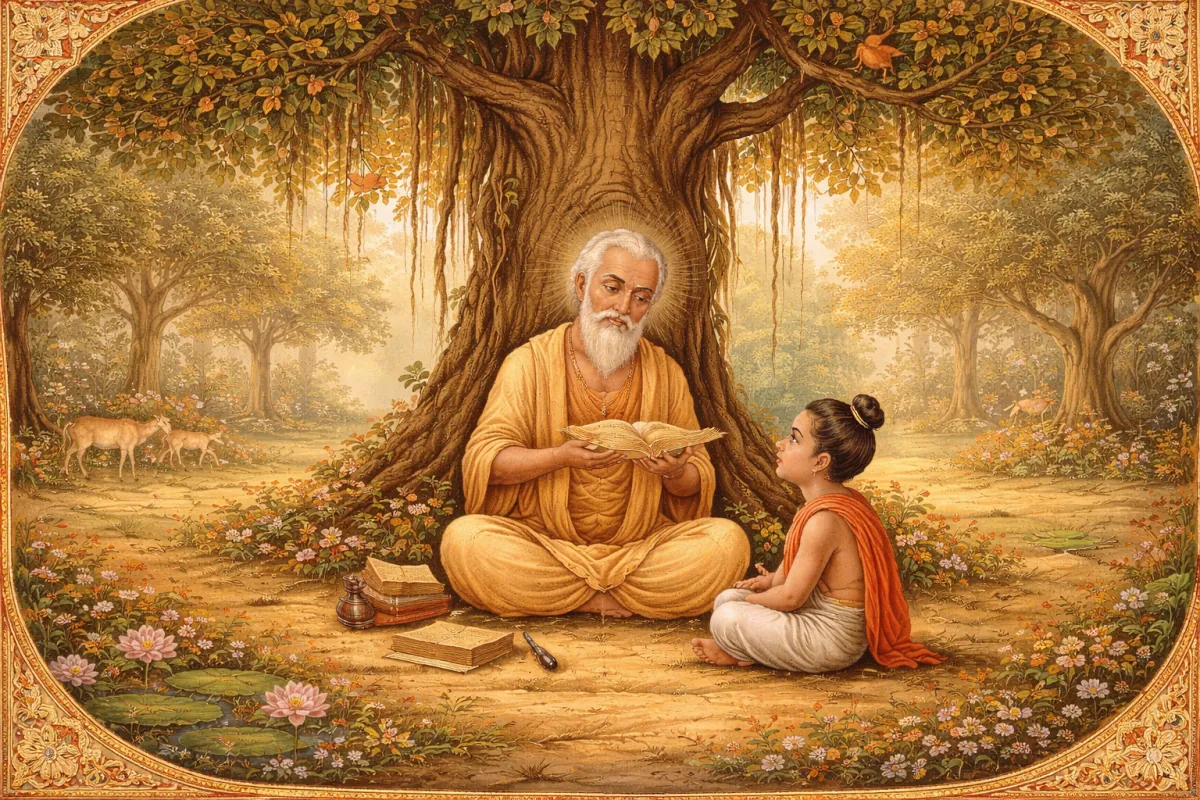
The Upanishads (upaniṣad) are the concluding part of the Vedic texts, containing profound philosophical teachings on the nature of ultimate reality, the relationship between individual consciousness and universal consciousness, as well as the paths to spiritual liberation that form the foundation of Advaita Vedanta.
Etymology
The term “Upanishad” (upaniṣad) derives from the Sanskrit root “sad,” meaning “to sit,” with the prefixes “upa” — “near, close” and “ni” — “down.” Its literal meaning is “sitting near [at the feet of the teacher],” which reflects the tradition of transmitting esoteric knowledge from teacher to disciple. Another traditional etymology interprets the term as “that which destroys ignorance (avidyā) and brings one closer to Brahman.”
Philosophical Significance
The place of the Upanishads in Vedic literature:
The Upanishads form the concluding part of the Vedas (vedānta, where “anta” means “end”), from which the Vedanta philosophical system derives its name. They are regarded as the jñāna-kāṇḍa (the section of knowledge), as opposed to the karma-kāṇḍa (the section of rituals) of the Vedas.
According to the Advaita tradition, there are 108 Upanishads, but particular importance is attached to a group of 10–12 ancient (principal) Upanishads on which Shankara wrote commentaries, laying the foundations of systematic Advaita philosophy.
The Principal Upanishads of Advaita
The ten principal Upanishads commented upon by Shankara constitute the core canon of Advaita Vedanta:
Ishavasya Upanishad (Īśāvāsya) — the shortest of the principal Upanishads, belonging to the Shukla Yajurveda, which affirms the all-pervading nature of Brahman and the unity of all beings.
Kena Upanishad (Kena) — from the Samaveda, it explores the nature of knowledge and identifies Brahman as the basis of all cognitive faculties.
Katha Upanishad (Kaṭha) — from the Krishna Yajurveda, it contains a dialogue between the youth Nachiketas and Yama (the god of death) on the nature of Atman and Brahman.
Prashna Upanishad (Praśna) — from the Atharvaveda, it is structured as six questions posed by disciples to the sage Pippalada concerning the origin of life and the nature of reality.
Mundaka Upanishad (Muṇḍaka) — from the Atharvaveda, it distinguishes between higher knowledge (parā-vidyā) and lower knowledge (aparā-vidyā).
Mandukya Upanishad (Māṇḍūkya) — from the Atharvaveda, the shortest one (12 passages), it explores the four states of consciousness (waking, dreaming, deep sleep, and turīya) and their relationship to the sacred syllable Om.
Taittiriya Upanishad (Taittirīya) — from the Krishna Yajurveda, it describes the five sheaths (kośas) of the individual being and the teaching of Brahman as bliss.
Aitareya Upanishad (Aitareya) — from the Rigveda, it examines cosmology and the nature of Atman as all-pervading consciousness.
Chandogya Upanishad (Chāndogya) — from the Samaveda, one of the most extensive and ancient Upanishads, it contains many key teachings, including the famous mahāvākya “Tat tvam asi” (You are That).
Brihadaranyaka Upanishad (Bṛhadāraṇyaka) — from the Shukla Yajurveda, the longest of the Upanishads, it contains dialogues of the sage Yajnavalkya, the teaching on Atman, and the neti-neti method (“not this, not this”).
Some traditions also include the Shvetashvatara Upanishad (Śvetāśvatara) and the Kaushitaki Upanishad (Kauṣītaki) among the principal Upanishads.
Key Upanishadic Teachings in Advaita
Advaita Vedanta is based on the following Upanishadic teachings:
The unity of Atman and Brahman — the central teaching expressed in the mahāvākyas (great sayings) of the Upanishads:
“Tat tvam asi” (You are That) from the Chandogya Upanishad
“Aham brahmāsmi” (I am Brahman) from the Brihadaranyaka Upanishad
“Prajñānam brahma” (Consciousness is Brahman) from the Aitareya Upanishad
“Ayam ātmā brahma” (This Atman is Brahman) from the Mandukya Upanishad
The nature of Brahman as sat-chit-ananda (being-consciousness-bliss), and as nirguna Brahman (Brahman without attributes) and saguna Brahman (Brahman with attributes).
Maya and avidya — the teaching that the multiplicity of the world is a manifestation of cosmic illusion (maya) and the result of ignorance (avidya).
Paths to liberation — the Upanishads describe various paths to attaining liberation, which were later systematized as jnana yoga, bhakti yoga, and karma yoga.
The neti-neti method (not this, not this) — a method of realizing Brahman through the negation and rejection of all limited definitions.
The four states of consciousness — waking, dreaming, deep sleep, and turiya (the fourth, transcendent state).
Historical Development
The Upanishads were composed approximately between 800 and 500 BCE, although their dating remains a subject of scholarly debate. They mark the transition from the ritualistic approach of the early Vedas to a philosophical understanding of reality.
Over the centuries, the Upanishads were interpreted by various schools of Indian philosophy. However, it was Shankara (788–820 CE) who created a comprehensive system of non-dual philosophy based on the Upanishads, establishing Advaita as the principal interpretation of these texts.
Role in Advaita Philosophy
In Advaita Vedanta, the Upanishads occupy a central place as shruti (revealed knowledge) and constitute the first part of the prasthana-trayi (the triple canon), complemented by the Brahma Sutras and the Bhagavad Gita.
Shankara and other Advaita teachers regarded the Upanishads as the highest truth and the Brahma Sutras as its systematic exposition. According to Advaita, the Upanishads represent a direct revelation of the reality of Brahman, accessible through the intuitive insight of the rishis (sages).
Shankara’s commentaries on the Upanishads are classical texts that define the understanding of the Upanishads in the Advaita tradition. In these commentaries, he consistently defends the non-dual interpretation, using logic and principles of textual interpretation from the Mimamsa tradition.
Practical Application
In the practice of Advaita Vedanta, the Upanishads are studied and applied in the following ways:
Shravana — listening to the teachings of the Upanishads from a competent teacher (Guru. New version). This is the first stage of Advaita spiritual practice. Because of their depth and the potential for misinterpretation, the Upanishadic texts are not intended for independent study without the guidance of a guru.
Manana — reflecting on the teachings one has heard, resolving doubts, and strengthening understanding through rational contemplation.
Nididhyasana — deep meditation on the truths of the Upanishads, leading to their direct realization.
Repetition of and reflection on the mahavakyas as a method of realizing the unity of Atman and Brahman.
Studying Shankara’s commentaries to correctly understand the texts in the light of Advaita.
Recitation of the Upanishads as a spiritual practice, especially texts such as the Mandukya Upanishad and the Ishavasya Upanishad.
Traditionally, the study of the Upanishads in Advaita takes place after mastering the preliminary qualifications (sadhana-chatushtaya), which include discrimination (viveka), detachment (vairagya), the six virtues (shat-sampatti), and the desire for liberation (mumukshutva).
In Texts
In addition to the Upanishads themselves and Shankara’s commentaries on them, the Upanishads are mentioned and quoted in the following texts:
The Brahma Sutras — systematize and summarize the teachings of the Upanishads, resolving apparent contradictions between different Upanishads.
The Bhagavad Gita — contains numerous references to the Upanishads and develops their teachings in the context of the dialogue between Krishna and Arjuna.
Vivekachudamani — a work by Shankara that extensively quotes the Upanishads and explains their key concepts.
Upadeshasahasri — another important text by Shankara based on the teachings of the Upanishads.
Commentaries by later Advaita teachers, such as Sureshvara, Vidyaranya, and Madhusudana Saraswati, who further developed the interpretation of the Upanishads in the spirit of Advaita.
See also:
Prasthanatrayi (the threefold canon)
Vedas
Adi Shankara
Brahma Sutras
Shruti
Mahavakyas
Shravana-Manana-Nididhyasana
Categories:
Key Texts and Sources
Fundamental Principles and Concepts
Historical Aspects
