

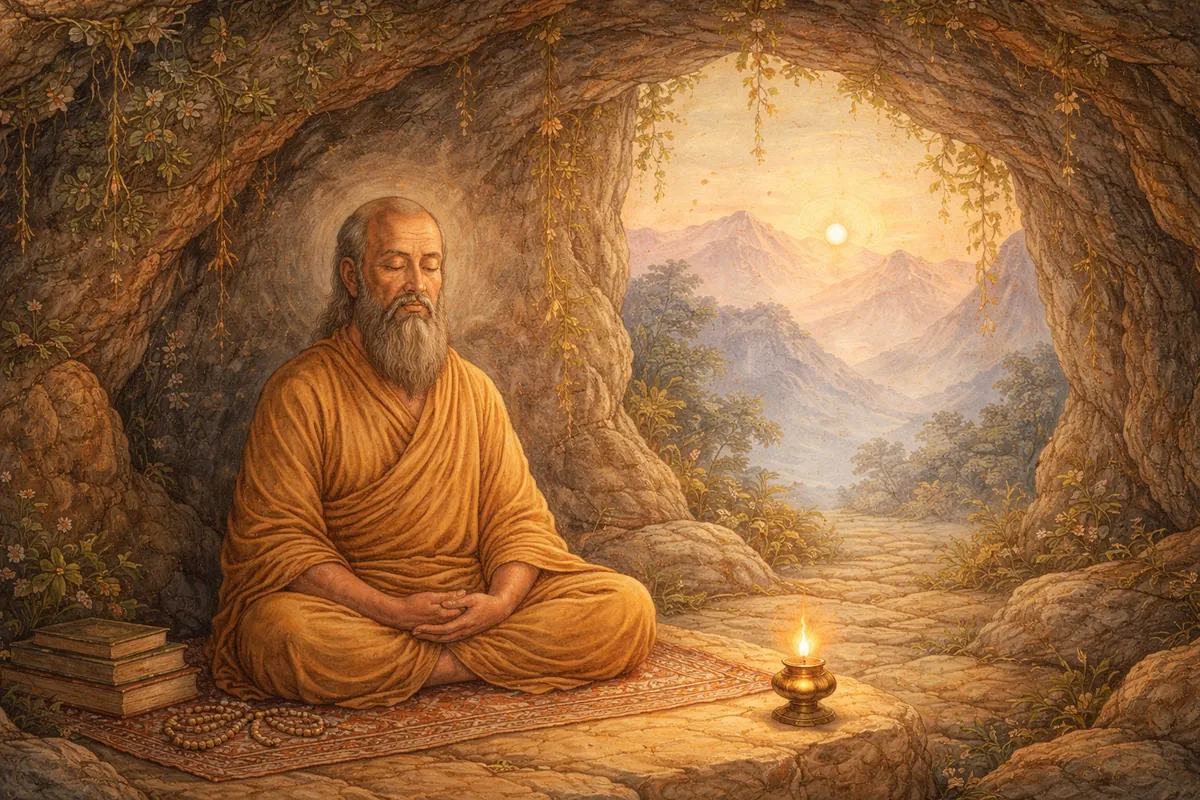
Question: Is there a recipe for happiness?
Swami Vishnudevananda Giri: Vedic Dharma teaches us to seek happiness within. We cannot find our happiness outside because the very source of happiness lies hidden in our consciousness.
When we experience fleeting happiness, for example, from wealth, do we not feel it within ourselves? Where do we feel the joy of possessing wealth? We feel it within ourselves, somewhere around the abdomen or the center of the chest, as a sense of spaciousness, power, stability, and new possibilities.
How do we experience the joy arising from attachment to a loved one? It is a certain bliss in our body and euphoria in our consciousness. It follows that our happiness is a sensation in our mind and body, while external material well-being is merely the cause that activates these sensations.
But we constantly confuse happiness itself with the external cause that activates it. That is why we try to seek happiness outside ourselves and are always dissatisfied. It is impossible to find happiness outside, yet generation after generation, people make the same mistake, stubbornly trying to seek it externally while ignoring the teachings of saints and the scriptures.
The more they seek external happiness, the further they move away from themselves, from their divine inner essence.
In Hinduism, this essence is called the Atman, while the state of mind in which we seek happiness outside is called ignorance (avidya). The teachings of the yogis enable us to find happiness within, in a state of meditation, and to become free from the pursuit of external happiness.
Therefore, the recipe for happiness is this: seek your divine Self within, meditate, develop the power of consciousness, seek Enlightenment and samadhi, strive to discover your inner divine being, and follow the path of the ancient sages—the rishis, munis, and siddhas.
We consider these great saints to be experts in attaining happiness.
Question: How can one overcome dissatisfaction?
Swami V.D.G.: Dissatisfaction has a cause, and this cause is twofold: the first is a failure to understand the divine nature of one’s Self, the forgetting of God within (asmita); the second cause of dissatisfaction is strong desires (raga), which torment our mind while it is in a state of ignorance (avidya).
To overcome dissatisfaction, one must embark on the path of Enlightenment and Liberation; one must become a sadhu—a spiritual practitioner, one who seeks the absolute truth. There is no alternative here—you either practice or you do not.
It is like a woman being either pregnant or not. If a woman is pregnant, sooner or later a child will be born. If you practice, sooner or later you will be transformed and reborn in the Spirit. At the moment of this birth, dissatisfaction will leave you because you will know God, you will know the Absolute within yourself. And God, the Absolute, is truth, goodness, and beauty (satyam, shivam, sundaram); truth, consciousness, and bliss—sat-chit-ananda.
Question: What is the meaning of life?
Swami V.D.G.: The meaning lies in seeking it. There is no single meaning of life common to everyone. The meaning of life is not a static category but a dynamic one. We seek it, but it constantly eludes us, receding ever deeper into divinity, holiness, and transcendence.
All we can do is eternally deepen our understanding of the meaning of life. And this eternal deepening of our understanding of life’s meaning is what we call Dharma, the spiritual path. When we follow the spiritual path, we develop our awareness, grow, rise higher and higher, and ultimately grow into a great, universal, transcendent, immortal divine being—omniscient, omnipresent, omnipotent, and all-pervading.
Such a being is called Brahma, or God the Creator, in the sacred scriptures. To become such a being is the meaning of life for a seeker in our spiritual tradition. We must ascend the evolutionary ladder, growing from an ordinary worldly person into an enlightened sage, a saint. From a sage, we must rise even higher—to a perfected siddha; from a siddha, grow to the level of a deity (deva); and from a deity, to that of a great deity (mahadeva), such as Brahma, Vishnu, or Shiva.
Q: Why did God create this world?
Swami V.D.G.: According to Hindu cosmology, the eternal law of the universe, or Sanatana Dharma, the Primordial God, or Brahma the Creator, first emerged from the unmanifest empty space of the Absolute, the primordial quantum chaos in which neither time nor space yet existed. He was born like a bubble on water due to the collective karma of souls that existed in an unmanifest state. This karma was present in the unmanifest primordial chaos in the form of subtle causes (seeds).
Brahma engaged in ascetic meditation for a hundred celestial years, abiding in empty space as pure, omnipresent consciousness, after which the seeds of all worlds and beings in the universe were awakened by the power of the Creator’s intention. When these seeds awakened, the universal essence of the material elements arose, and then deities, stars, and planets were born.
Thus, the universe was created by Brahma the Creator so that undeveloped souls could evolve and develop spiritually—each according to its karma. Souls needed a playground in order to continue growing, and they received one.
Brahma the Creator can be likened to a brilliant web designer or programmer who develops a computer game. There are various companies engaged in such development. They assess the target audience, market conditions, potential economic benefits, and risks. Then they assemble a team and create the game over the course of one, two, or three years. Once the game has been created, the testing phase begins, and they invite friends to beta-test it in order to eliminate all the “bugs” and “glitches.” Once testing has been successfully completed, the game is released onto the market, it is advertised, and millions of users are invited to play it.
These users are like human souls that incarnate, while the lead developer and his team are like Brahma the Creator and his divine retinue—the Kumaras, rishis, Prajapatis, and Manus.
Question: What are the true values in our world?
Swami V.D.G.: We must distinguish true, timeless values from illusory, transient ones. True values are divine wisdom (jnana), which enables us to know the Absolute; discernment (viveka), which enables us not to confuse true values with illusory ones; and the capacity to inquire into the Absolute, our Higher Self (vichara). From these fundamental values arise faith, the immortality of the soul, love, compassion, beauty, freedom, and the ability to control the energy of the elements of the universe.
People in society are often confused by false values imposed upon them; they strive to enrich themselves while ignoring spiritual development. But in the end, they become disappointed, all because they chased false values and discarded the true ones.
It is like a person who was fortunate enough to find a bar of gold on a riverbank. He then met three fellow villagers who convinced him that the bar was merely a lump of dirt and promised to show him where the real treasures—platinum and diamonds—lay. He believed them, threw his bar into the river, and followed them, but where they took him there were only ordinary stones and shells mixed with glass marbles.
We do not need to chase the stones and glass marbles of the material world; we need to follow the spiritual path, carrying out our inner alchemy, performing our spiritual practice (sadhana), and developing our consciousness and energy in order to grow from a human being into a divine human.
These are the true values. They are spoken of in sacred texts and by great saintly sages such as Dattatreya, Rishi Vasishtha, and Sri Shankaracharya.
Question: How can we distinguish good from evil?
Swami V.D.G.: Evil is always selfish, unconscious, and unaware. It always occurs at the level of the ego and mind. Evil always obscures and constricts us, limits us, and makes us feel shriveled and confined. Good, on the other hand, is always conscious; it connects us with the Absolute, the Supreme Source; it expands and opens us, purifies us, and makes us freer and more playful.
Question: How can the level of aggression in society be reduced?
Swami V.D.G.: There is no single person who could control society as though it were their radio. The level of aggression cannot be increased or reduced by any legislative decision.
The fact is that no civilized society can be governed by direct instructions and directives. This is because it is a complex system. But it is possible to create an atmosphere in which aggression is reduced to zero and becomes unacceptable.
We cannot reduce the level of aggression in society, but we can create an atmosphere based on different principles and a different worldview—an atmosphere in which aggression is simply impossible.
The problem with modern society is that divisive forces are strong within it. People are divided along ethnic, national, religious, and economic lines. Society is not currently a unified whole, a cohesive organism.
Today, it consists of many disparate groups, each pursuing its own narrow interests. This is precisely why the level of aggression in society is quite high. I am referring primarily to psycho-emotional, verbal, and mental aggression.
Such a high level of aggression in society can only be reduced through the active education of its members and the creation of a new atmosphere. I believe this should begin with religion. If religious leaders sit down at a round table and agree on a new interfaith ethic for the people of the third millennium, if they clearly state that we will not call one another sects or think badly of one another, but will instead trust, love, and respect one another, and if all the leaders of the world’s religions sign such a resolution, then their followers will also have to heed it.
And when religious people set an example of how one can live on the basis of love, trust, and mutual respect, and show that their worldview is more flexible, broad, and progressive, then others will begin to follow their example.
This should then give rise to a new culture—a tolerant and respectful culture of pure vision, pure speech, and pure thoughts. And it is very important to promote such a culture. A Japanese scientist conducted an experiment showing how the power of thought affects the structure of water molecules. Such things should be publicized, demonstrating how our impure thoughts and words undermine the immune system and human genetics, worsen a person’s fate, and harm them.
We need to create a culture of a pure psycho-emotional environment, seriously address the ecology of thought, and develop a strategic program for the ecology of thought. The Earth’s psycho-emotional and mental aura is currently polluted.
Thought forms of aggression, ill will, criticism, impurity, and curses envelop many cities and countries. All of this creates a general atmosphere of dissatisfaction, which then spills over into velvet and not-so-velvet revolutions, protests, and cataclysms.
This is a sign to humanity: the ecology of thought has been disrupted. If we want to reduce the level of aggression in society, we must seriously address the ecology of thought. This cannot be achieved through legislation; no prohibitive measures will help here. We need to take the cultivation of a culture of thought seriously. We must create a long-term strategy for fostering such a culture.
And this should be initiated by spiritual institutions and the spiritual hierarchy, after which society, cultural institutions, and politicians will become involved. And when a society with a highly developed ecology of thought has been created, when the ecology of thought begins to be taught from the very first years of schooling, or even from kindergarten, then by the age of 18–20, fully conscious citizens trained in the ecology of thought will emerge.
Then, I think, the issue of aggression in society will simply cease to exist. In this respect, we (the Divya Loka Vedic Cultural Center—editor’s note) are trying to do something, but our efforts are insufficient.
For example, we have announced the creation of a movement for pure vision; we are also trying to hold interfaith round tables and raise questions concerning a new ethic for the people of the third millennium, a new interfaith ethic.
But this is far too little; society as a whole must support such ideas, and the issue of the ecology of thought must become a top priority. I believe it is not so important to raise the issue of ozone holes, global warming, and the greenhouse effect; it is far more important to consider the ecology of thought and the purity of thoughts.
Because it is thought that creates the world around us. The world is a manifestation of consciousness. If we purify our thoughts, then the climate will change and even physical laws will become more favorable. Paradoxical as this may sound, it is fully consistent with the theory of Advaita Vedanta and the worldview of Sanatana Dharma.
Source: http://www.advaitatoday.ru/interview
