

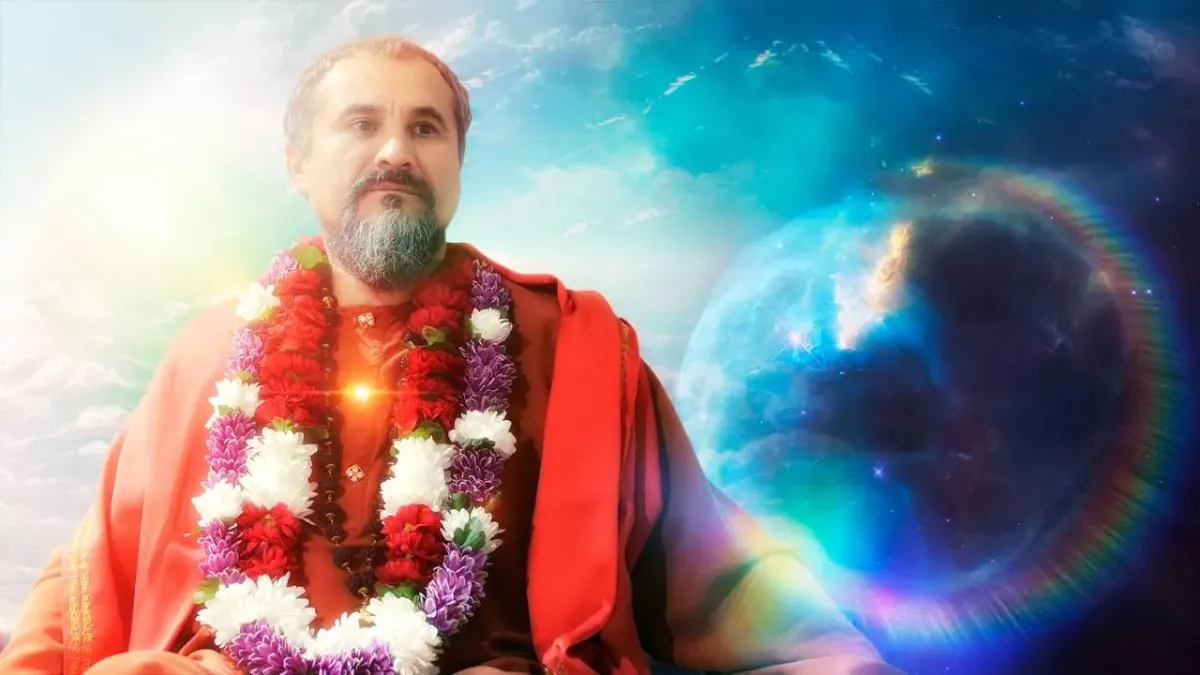
Interview with Advaita Vedanta Master Swami Vishnudevananda Giri Ji Maharaj about spiritual knowledge, happiness, and the meaning of life. Part one. (January 2014)
Swami Vishnudevananda Giri Maharaj is a Mahamandaleshwar of the Juna Akhara Order. He is a spiritual teacher and a realized jnani-master in the lineage of Advaita Vedanta, Shaivism, and Anuttara Tantra.
✦ Philosopher, theologian, writer, and pilgrim-traveler.
✦ He has been preaching Sanatana Dharma, the path of practical Vedanta, and the teachings of Anuttara Tantra for over 25 years.
✦ He has more than 5,000 followers, including monastic disciples and laypeople, worldwide.
✦ Recognized by the BBC as one of the three most influential European Hindu sannyasis.
✦ Founder of the World Community of Sanatana Dharma (WCSD).
✦ He teaches Jnana, Raja, Bhakti, Karma, Kundalini, and Laya Yoga, as well as the Anuttara Tantra teachings of the Siddhas.
✦ Creator of a unique 12-year training program for students seeking systematic spiritual education and deep practice of Liberation.
✦ Founder of 10 yoga ashrams in several countries, including Italy, Russia, Ukraine, Kazakhstan, India, and Nepal, as well as Dharma centers worldwide.
✦ Author of more than 50 books. The most significant and well-known include: "The Radiance of the Precious Secrets of Laya Yoga," "Songs of the Awakened One," "The Jnani's Universe," and "Spiritual Alchemy."
✦ Initiator and inspirer of the "Yogis for Peace" movement.
Question: In the modern world, human life does not have a very long duration. And everyone has their own. People live short lives, rarely reaching 80–100 years, according to their karma (the universal law of cause and effect). Being born into the world of humans again, we remember nothing of our past incarnations, our past merits and flaws, or our good and not-so-good deeds.
In this regard, I want to ask: what is the role of spiritual knowledge in the modern world for a person? Why should we study spiritual knowledge?
Answer: Spiritual knowledge is the foundation of life. Spiritual knowledge is the expression of God in man.
Currently, we are living not in Satya Yuga, Treta Yuga, or Dvapara Yuga, but in Kali Yuga. In Kali Yuga, it is said that the bull of Dharma stands on only one leg—meaning spiritual knowledge is often distorted, understood with difficulty, and spreads poorly, while a mundane consumerist culture dominates.
Originally, Sanatana Dharma—the eternal Divine law—is the source of all spiritual knowledge. Sanatana Dharma was not created by anyone; it has no specific founding date and no specific founder.
Sanatana Dharma is the eternal divine law that contains all spiritual knowledge. It is the law given by Brahma the Creator. This law was expounded in the Vedas and Upanishads (the Upanishads are part of the Vedas), and all of humanity should study it. For what purpose? To understand that it is one’s destiny to comprehend Divine wisdom, to understand the Divine will, and to grow personally, moving along the path of spiritual evolution.
Unfortunately, today, questions of spiritual evolution are not raised in society. Instead, questions of consumption, the satisfaction of human desires, and individual freedom are emphasized. But all of these represent a low level of meaning, values, and goals. There were more ancient times and more ancient societies with higher meanings, values, and goals. Today, technologies are developing, but unfortunately, people do not always develop along with the technologies. One can even observe an evolutionary regression—regression in goal-setting, regression in the scale of values, and regression in the meaning-forming vectors of social development. Spiritual knowledge is needed precisely to counteract this regression, so that humanity does not stray from the path of evolutionary progress. This spiritual knowledge was not invented recently by some masters or New Age trainers. This knowledge belongs to the Vedic tradition; it has been passed down through a descending branch of knowledge, via a chain of disciplic succession. Therefore, it is very important; it is the standard of spiritual culture. Everyone who comes into contact with it changes their life. I believe the time has come for this spiritual knowledge to be read anew for modern society. Society is in great need of it.
Question: So, all the knowledge and wisdom we accumulate during our life—all this spiritual and cultural potential—remains with us in each subsequent birth? We do not lose it?
Answer: In the Bhagavad Gita, Arjuna asks Krishna: — What happens to those yogis who do not achieve liberation or success? Do they not become like a cloud torn in half? Having failed to realize themselves in mundane life and having not achieved success in the spiritual?
Krishna reassures him: — Do not worry; everything you have achieved in yoga in this life will be with you in the next life.
It is believed that if a person in this life reached the level of the Ajna chakra and realized, for example, the causal body, but did not realize the Atman, then in the next life, they will begin their spiritual practice from the Ajna chakra and the causal body. Their spiritual wisdom will be preserved, even if they do not remember any of it. Intuitively, they will be aware of the level previously reached in the past.
Question: Where can a modern person turn for spiritual knowledge? Where should one start accumulating it? What books or texts should one read?
Answer: For spiritual knowledge, one should turn to spiritual teachers. Since time immemorial, there has been a tradition of spiritual teachers who are the carriers of knowledge. Besides the tradition of spiritual teachers, there is the tradition of sacred scriptures. The sacred scriptures of the Vedic tradition are: the Vedas, Upanishads, Puranas, and Itihasas.
In our tradition, these are the texts of Dattatreya: Avadhuta Gita, Tripura Rahasya, and Yoga Vasistha. Also, the texts of Adi Shankaracharya—the founder of modern Advaita Vedanta—such as Viveka Chudamani, Atma Bodha, and Tattva Bodha.
Texts of other great holy teachers of the Vedic tradition include: the texts of Sri Gaudapada—Mandukya Karika, and the texts of Vidyaranya—Panchadasi. All of this is Advaita Vedanta—the essence of the Vedic tradition.
If we want to know the quintessence of Vedic knowledge, we must study Advaita Vedanta through canonical texts. Regarding modern texts, I can say that the books of Sri Ramana Maharshi and the records of his talks are beyond all praise.
Question: What happens on a subtle level to a person who has begun spiritual practice and started reading sacred texts? Does their destiny change?
Answer: If it didn't change, there would be no point in practicing. Of course, it changes. Any book, even a mundane one or a work of fiction, is capable of changing a person's fate. What can we say about spiritual texts? Sacred texts such as the Yoga Vasistha, Tripura Rahasya, and Avadhuta Gita can completely change a person's destiny, free them from karma, and grant them enlightenment.
Vasistha himself and Dattatreya himself speak of this in the Tripura Rahasya. This is because these texts are not written by people from the mind. A text is Vidya. Vidya is an expression of blessing divine grace, the descending energy of the Divine. And Divine grace can free one from karma, change destiny, or do anything else.
Therefore, in our tradition, we treat sacred texts with reverence and respect. It is believed they should be kept in clean places, not stepped on, and not thrown on the floor. Every text is, in a way, a manifested, embodied form of the Deity. It is a manifestation of the Deity's energy—Vidya.
Temples, sacred texts, teachers, sculptures, statues, and images of Deities are Vidya—materialized bodies of the Deities in the material world. We provide people with the opportunity to establish a karmic connection with these things—with sacred objects, sacred images, and sacred texts.
If a person establishes a karmic connection with Vidya, they, as it were, come into contact with Divine grace, become a participant in it, and receive a blessing. But this does not mean that it is enough for them to touch a book or a sacred object and they need do nothing more to become enlightened. They must, of course, do their own work as well. And when they have done their work and emptied the vessel of the ego, purifying themselves, then they will be truly touched by what we call Anugraha—the energy of divine blessing.
Question: What is done by yoga masters, sages, and saints to interest a person and tear them away from mundanity and worldly conditioning, to turn their attention toward spirituality, holiness, and the transcendental?
Answer: A mystery is being performed constantly. The fact is that the division into mystery and non-mystery, into miracles and non-miracles, exists only for ordinary people. Holy sages always live in mystery; they do not live in the ordinary dimension.
They live in a sacred dimension, even while in the profane dimension. For them, every sound is a mantra, every action is a play (Lila), and every event is a darshan of the Divine.
For them, the entire world is a mandala, a dimension of pure vision. And some saints indeed manifest miracles. For example, the ring on my hand—it was materialized by Swami Vishwananda. He manifested a miracle. Some can materialize scents and let people smell them. Different saints may demonstrate different miracles.
Pilot Baba demonstrates miracles of long stays in Samadhi with the cessation of breath all over India—more than 100 times. Но these are merely "skillful means" or tricks of the saints to attract attention to spirituality. True spirituality, however, is not related to miracles.
Miracles are, so to speak, side effects of spirituality. Moreover, Patanjali, as well as many other holy teachers, warn yogis not to get carried away by miracles on the spiritual path. This is because the highest miracle is God and the self-surrender of the soul to God.
Various small material miracles are just certain energies interacting. Through the power of mantra, visualization, and the power of prana, one can manifest various miracles. Saints, as always, work for the benefit of the whole world and all living beings. In ancient times, the Siddhas once expressed a wish at a gathering. This wish was expressed in one word—Aruppadai.
Aruppadai means universal enlightenment. Another wish was expressed in the words Loka Sangraha. Loka Sangraha means universal good, universal prosperity. What does universal good mean? Universal good means all people realizing their Divine nature. Saints think only in this way, only within this framework. Even now, these concepts—Loka Sangraha (universal good for all living beings) and Aruppadai (universal Divine enlightenment)—remain relevant. All saints are conduits of the Divine will. There is not a single saint who is not the hands and feet of God. Saints do not live for themselves; they are conduits of the Divine will.
An ordinary person wakes up and asks: "What do I want?" A saint wakes up and asks: "What does God want?"
Saints are the flawless soldiers of God. They do not do what they feel like doing; they do what is necessary for the divine plan and for Divine realization. People are egoistic; they do not serve God. They serve themselves and their loved ones. Therefore, they have much suffering, many problems, and many attachments. But sages serve God. They know that this is the only way to build their relationships.
This includes the service of saints to people on Earth on the path of their evolution. Because the Divine will is for all living beings to evolve and move along the path to enlightenment, liberation, and God-realization. The destiny of all living beings is to be conduits of the Divine will; this is the universal cosmic law.
If we do not conduct the Divine will, we are like a diseased cell, like a clog in a water pipe, or a break in an electrical circuit. It means we are doing something wrong.
And why do people suffer? Why do various conflicts and wars occur? Because people are not fulfilling their cosmic destiny. They are not following the laws of the universe. They are not conducting the will of God.
They conduct some other will: the will of their ego, their mind, perhaps some demonic will, or simply some human will. But if all people conducted God's will, we would live in the era of a Golden Age, in a pure land, in Satya Yuga; we would be divine beings, and the Earth would be a paradise.
Saints help people understand this. But since there are few saints and many people, the Earth has not yet become a paradise. It is impossible to explain it to everyone, and everyone is at their own level of evolutionary development.
Question: Sanatana Dharma is the oldest religion on Earth. As you previously mentioned, it has no specific founder; it is believed it has always existed. It includes many different teachings and currents of Hinduism. The core of Sanatana Dharma is Advaita Vedanta—the teaching of the non-duality of the world. This is a very deep, transcendental teaching that takes a limited human being beyond the boundaries of their mind. In this regard, the question is: is the study of Advaita and the spiritual practice of the teaching within everyone's reach? After all, it is believed that Sanatana Dharma is the "native" knowledge for the Russian person, as the ancient Aryan civilization was located in the territory of Northern Russia.
Answer: Advaita is not within everyone's reach. Advaita is an elite teaching, an elite philosophy. Intellectually, of course, anyone can study Advaita. It doesn't take much for that. But intellectual comprehension of Advaita is not Advaita itself. Advaita is not graspable intellectually. Advaita is realized through the experience of meditation, through awareness and contemplation.
Before a soul can comprehend Advaita, it must be ready. Therefore, saints recommend doing this gradually. Start with Dvaita, then Vishishta-Advaita, with the worship of God who has a form, a name, and an image. A gradual process of spiritual training is needed here. But modern society, of course, needs the teaching of Sanatana Dharma. However, what must be understood? Dharma cannot be spread by proselytizing methods. You cannot drag a person into Dharma. The soul must ripen for it. But conditions can be created so that the soul becomes acquainted with Dharma.
Holy teachers labor so that humanity can understand Sanatana Dharma. They constantly give lectures and teach their disciples—this is their duty. But out of many disciples, only a few are capable of truly comprehending Advaita. This is a process of more than one lifetime.
We will be comprehending Advaita in the next life, and in 20,000 years. Even in 500,000 years, we will not say that we have fully comprehended Advaita. Who has fully comprehended Advaita? Lord Shiva, Dattatreya, Lord Brahma, Lord Vishnu. They, one might say, have fully comprehended Advaita. As for a human being—no, that is not the case.
Question: Can we say that the teaching of Advaita begins with faith in God, the Divine, the Absolute?
Answer: Certainly. Without this, it is impossible to understand Advaita. Because Advaita is the completion, the end of spiritual searching. But before you reach the end, you must start somewhere. And where to start? You must have some urge, motivation, or interest. And all this must lead to faith. If there is no faith—one can study Advaita as a philosophy intellectually, but it will not become something transforming. It will just become another book on the shelf, another monograph, or another PhD thesis. But we are not talking about scientific dissertations; we are talking about spiritual search. And spiritual search is unthinkable without faith. Faith is the cornerstone of the universe. It is important in any religion. For example, you come to a master, and you need to cultivate faith in the master. You study sacred texts, and you reflect—should you take the sacred texts on faith as an authority? Unfortunately, society today is devoid of any faith. Especially our post-Soviet society. The communist experiment destroyed the opportunity for people to have faith, values, meanings, and goals. People have great skepticism when you talk to them about ideology, values, and meanings. Because our society was cruelly mistaken in the communist experiment. And then another extreme was taken. We decided that we didn't need any values or any ideology at all. For a long time, nihilism and a purely materialistic consumer culture were cultivated. Over 20 years, this consumer culture has deeply filled people's minds. And when they talk about corruption, about bribes... Why be surprised? For 20 years, you taught people that material prosperity is the most important thing in human life. For 20 years, you showed them commercials. What do you expect? Whatever you showed people on TV, whatever you talked about—that is what people strive for. If you make the Golden Calf your God, you will serve it. And no incantations about the immorality of corruption will help.
Because at the subcortical level, a person has already formed a firm conviction that the goal of their life is material well-being and prosperity. And ideology, ethics, and culture are not important. But if we educate people by talking about spiritual values, spiritual practices, spiritual development, the path of liberation and enlightenment, about the fact that a human is not the body but the Atman, then the charm of the materiality of the world and the charm of the cult of material consumption will gradually fade. Material things, technologies, and wealth are important for the comfort of this world and the body, but they can never be the meaning of life. They can never be the real goal in life. If they become the goal and meaning of life, it means the soul is in ignorance, it is subject to illusion, and it has lost itself and the meaning of its existence. It is like a ship that has lost its way at sea. Unfortunately, a large part of modern society represents such a ship lost at sea. And the task of spiritual knowledge is to give coordinates to this ship.
Question: The first postulate of Advaita states: — The entire world is a manifestation of the mind. The creating consciousness and the created world are inseparable, like a dream and the dreamer.
I understand this postulate as follows: the world in which we live depends on the manifestation of our universal consciousness, which in turn depends on our vision (pure or impure). That is, all of us, all 7 billion people living on Earth, create our world. Here, the practice of pure vision and the practice of the ecology of our thinking—purity of thoughts, words, and deeds—is very important. After all, thought is material and creative. Please comment on this.
Answer: Yes! The world becomes exactly as we conceive it in our thoughts. What we think about most, that we become. Whatever the mind loves most, it takes on that form. This means that both the body and the environment in the next life we acquire are exactly what we love most. If a person loves women most of all, there is a high probability that in the next life they will receive the body of a woman. If a person loves to fight, then in the next life they may be born as a warring asura. The world is created as we represent it in our thoughts. We do not notice that it is our thinking that becomes our words, and our words become our deeds.
Deeds form our personality and character. Personality and character form the environment and the body in the next life. But everything begins with thinking! Our mind can be likened to a magical, mystical 3D printer. And this 3D printer can print for us any situation, any person, any course of events, any imagined thought. Nowadays, with the help of a 3D printer, human organs can already be printed. And many think that with the help of a 3D printer, various problems can be solved.
For example, it is not necessary to deliver objects or materials to a desert island or the moon. You can deliver a 3D printer, and it will print everything. But inside us, there is such a 3D printer. It is our consciousness. That is, our consciousness is a mystical, magical wish-fulfilling stone—Chintamani. It can be likened to the Kalpa-vriksha, the wish-fulfilling tree. If we learn to set a sankalpa (intention) and send commands to our consciousness, and consciousness perceives them correctly, we will be able to materialize any event, any tunnel of reality, any karmic vision, and materialize any desire.
There is a story about a yogi who achieved great power of concentration and once, emerging from meditation, thought: "It would be good to eat!" And immediately a fruit fell before him. Then he wanted to drink. And a jug of water materialized before him. He thought: "Wow, all my desires are coming true!" Then a fear arose in him: "What if I think of a tiger, will a tiger appear?" He thought of a tiger, it appeared and ate him.
By the power of our intention, we can materialize any tunnel of reality. For example, a tunnel of reality where all of humanity is immortal. Where all people are like Gods. The Gods themselves have lived this way for a long time. They control time and space and possess many bodies. For them, there is no history in the human sense. A human lives from the past into the future; they are like a passive subject of history. They do not create history; they are like a splinter carried by the waves of history. Gods, however, create history by the power of thought. They create cause-and-effect relationships and event sequences. They are not passive objects of the historical process. They themselves are psycho-operators. For them, history is subjective. For them, history is what they conceive in their thoughts. Just think, we were taught in school that historical processes are linear, flowing from the past to the future, and while the role of personality in history is recognized, it is small. And there is supposedly no correlation between consciousness, the psychic state of a person, and history. It is seen as a physical, objective, historical process.
The teaching of Advaita says that in reality, this is not so. Consciousness creates history. Consciousness materializes various events. Based on this, if we decide to change the past by the power of consciousness—it will change. Gods know these secrets—that time has no self-existing intervals, that it originates from consciousness. Space and distance also do not possess any self-existence; they are factors of consciousness. And they control time and space, creating their own universes and their own tunnels of reality. They are the power-willed psycho-operators of the Universe. They attract some probabilities and remove others. They are not slaves to karma, not slaves to cause-and-effect relationships. But humans are slaves to karma. And what is the difference between humans and Gods? Why can Gods live in any point of space and be immortal? Because they have realized Advaita. Advaita is life without subject and object.
Question: Were Gods once ordinary humans?
Answer: Some of them were. For example, Dhruva. He was a simple boy who was hurt by his stepmother. But thanks to his asceticism, tapas, and the grace of Lord Vishnu, he received a body in the form of the Pole Star. He attained enlightenment and became a great Deity, a Mahasiddha.
Question: So there is a chance for everyone?
Answer: There is a chance for all living beings because every living being is the Atman. First and foremost, it is Divine. Another question is that its level of identification and comprehension of its divinity is still low.
Question: Why are the levels of comprehending divinity different? Were they different and individual originally, or were all once equally endowed with divine potential, but for various reasons, these levels changed?
Answer: There are eternally free souls. They are called Nitya-siddhas. There are eternally conditioned souls—Nitya-bandhas. Eternally free souls are the saints, Gods, and siddhas. From the beginning of the creation of the Universe, they are already free. They are luminous; their minds are empty and like space. Eternally conditioned souls are very ignorant, dark souls—sinners, snakes, nagas, worms, various lower souls. Between them is humanity, humans. They are not eternally free and not eternally bound. They have the opportunity to be liberated during this era, this creation. One can say that even before the Universe is created, souls already have differences. They sleep in an unmanifested state, but differences already exist.
The Creator Brahma creates the Universe in accordance with the levels of the soul, so that each soul can receive the necessary karmic experience of living in different lokas (realms) and bodies that it requires. Brahma creates the Universe in connection with this. Therefore, it cannot be said that souls were once homogeneous. Differences existed. And these differences go back to the depths of billions of millennia. Because in the Absolute, there are no differences. In it, there are no qualities, gunas, or definitions. Но we are taking a lower plane—the relative one. And in the relative plane, there are always differences; the combinations of gunas and tattvas are always different.
There are Divine beings—in them, there is more sattva (luminosity), and there are beings with an admixture of rajas. These are humans and some Deities and siddhas. There are beings with an admixture of tamas—nagas and animals. The ratio of these three gunas produces these differences. And this ratio of the three gunas was not created just now. It was created in the vast, infinite past. Even before the creation of this Universe. Before the creation of the previous Brahma. It has, one might say, an infinite history. But when we conduct spiritual practice, we change this ratio of gunas so as to achieve enlightenment and be freed from ignorance.
Question: The second postulate of Advaita states: The thought "I am the body" is false. The understanding "I am the Absolute" is true. Please comment.
Answer: In the teaching of Advaita Vedanta, there is the concept of "pancha-kosha-viveka." Pancha is five, kosha is sheath, and viveka means recognition or discernment. Advaita Vedanta says that a human being is not the body. They are not the energy body, not the astral body, and not the causal body. They are the Atman. When we learn to recognize and disidentify with the five sheaths and identify ourselves with the Atman, we will comprehend Advaita Vedanta. But why does comprehension not occur? Because a person identifies with the lower sheaths. These sheaths are like five veils thrown over their soul. They identify with the body, but the body is a derivative of elements. It is not the true essence of a person. The body is inert; it does not live by its own light. It is illuminated by the light of the Divine Atman. It is simply a biomechanism. Likewise with energies. Energies do not live their own life; they have no mind of their own; they are illuminated by the light of the Atman. Likewise with the astral body. In the astral body, there is no light of its own, no intellect of its own, no spiritual mind of its own. The body feeds on the reflections of the Atman. Likewise with the mental body. The mental body is all clarities, theories, concepts, and doctrines. It is a consequence of the light of the Atman, which casts its rays and feeds this body. Но the body itself, the mental one, is just an intellectual sheath. It is like a program on a computer. Finally, the causal body. This is the feeling "I am an individual," the sense of personality; it too is merely a reflection of the Atman. That is, all these sheaths do not exist by themselves. They are not endowed with Divinity. The teaching of pancha-kosha-viveka means that we must first by analysis and intellect, and then by meditation and contemplation, understand each sheath, know it, and detach from it: this is not me, this is not me, this is not me. It is as if you were dressed in five layers of clothing and you didn't know who you were.
Are you a fur coat, or a suit, or are you in your underwear? You are none of these, and to find out that you are none of these, you must take it all off. Then you see—here I am. After that, you can wear it all, but you will no longer forget who you are. Avidya (ignorance) is the influence of the Absolute's energy, maya, on the living being. The influence of avidya on the living being is that the soul does not understand its true nature as the Atman and identifies with the sheaths. And it also does not understand others and identifies them with their sheaths. For example, a person comes. And you saw their hat and thought: "A hat has come to me." You talk to the hat, but you don't understand or see the person. This is ignorance. Thus, when we judge a person by their body, appearance, or intellect, but do not see their Divinity, it is the same thing.
Question: The last postulate of Advaita tells us that: All ignorance regarding the nature of the mind is eliminated through self-inquiry and meditation.
Answer: Vichara, viveka, vairagya. These are the three key principles in the teaching of Advaita Vedanta. Vichara means self-inquiry. Viveka is the discernment that arises as a result of self-inquiry. Vairagya is the wisdom or knowledge that leads to detachment. If we have not understood the principles of self-inquiry, we will never be able to understand Advaita Vedanta.
What is the principle of self-inquiry? it consists in the fact that we must ask ourselves: Who am I? And then apply this feeling of "I" to the five sheaths. Am I perhaps the physical body? If I am the body, where am I? In the thumb, in the bones, maybe in the skin? If I am not in the body, where am I? Maybe I am in the pranas, in the next sheath? Maybe I am in the apana, samana, vyana, or udana? If I am not in the pranas, maybe I am in the astral body? The astral body consists of seventeen components: five karma indriyas, five jnana indriyas, manas, and buddhi. When we examine all bodies in succession this way, we discover that "I" am not in any of the bodies. "I" am beyond the five bodies. "I," as a complete personality, am not in the waking state, nor in the dream state, nor in the state of deep sleep. At first, this happens intellectually. And then you must do this in meditation. When we go beyond the waking state, dream state, and deep sleep with the help of meditation, we can understand—I am not this body. I am not the five sheaths. I am pure Existence, Consciousness, Bliss. I am Divinity itself. I am beyond the five sheaths, I am beyond the three states. I am turiya—the fourth, transcendental state. But all of this is philosophy.
In reality, self-inquiry is simply your consciousness going deeper, deeper, deeper until it reaches the purest divine source. And Atma-vichara, ultimately, grows from an investigation of one’s "I" into an investigation of God—Brahma-vichara. We start by asking, "Who am I?" because we are very egoistic. We want to know who "I" am, and we don't care about God. We care about ourselves personally and our own destiny. But in the process of this self-inquiry, everything turns upside down. We see that "I" is an illusion. And, in fact, God lies at the foundation of everything, including our "I."
Then we ask: "And who is God?" And then the turn for Brahma-vichara comes.
Brahma-vichara is the inquiry into the Absolute, the inquiry into God. It consists of us directing our mind toward God. Remembering Him all the time. Never forgetting Him. Just as a scientist points their telescope at the moon and studies it every day, thinks about it, looks at what seas and oceans are there?
So must we point the telescope of our consciousness at God. This is the investigation. In the process of such an inquiry, our ignorance will begin to leave, our false identification will begin to leave, and a return impulse will come from God—Anugraha-shakti.
Anugraha-shakti is the power of blessing, the power of Divine grace. There is a saying: "If you gaze long into an abyss, the abyss also gazes into you." If we begin to observe God for a long time, God begins to respond. Brahma begins to send the powers of his enlightenment upon us. And it is precisely with the help of this power that we eliminate fundamental ignorance and our egoism.
(to be continued)
