

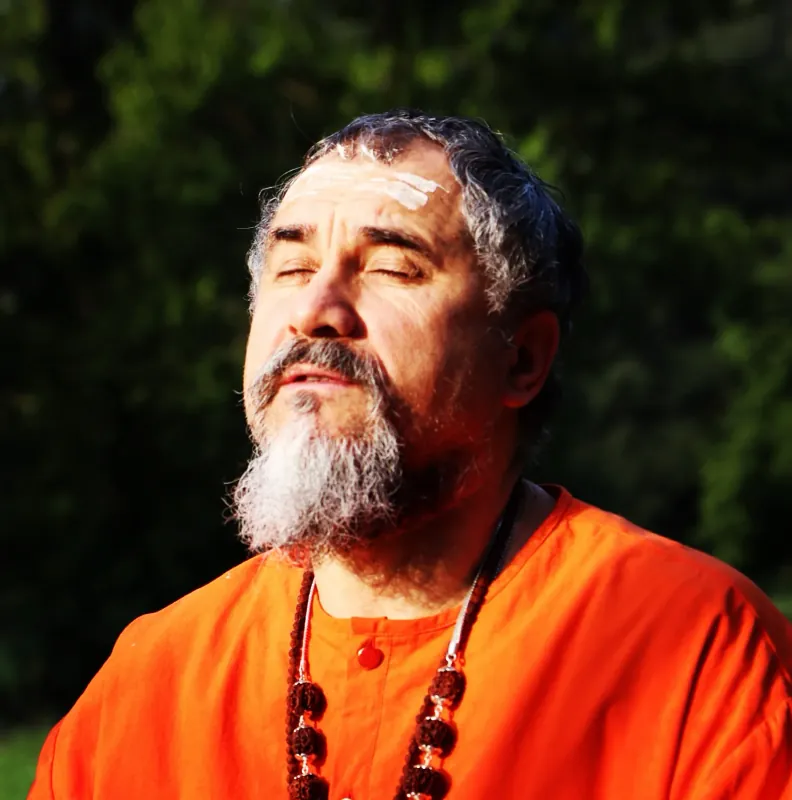
Interview with Advaita Vedanta Master Swami Vishnudevananda Giri Ji Maharaj on happiness and the meaning of life. Part Two (February 2014)
Swami Vishnudevananda Giri Maharaj - Mahamandaleshwar of the Juna Akhara Order.
Spiritual teacher, realized master-jnani in the lineage of Advaita Vedanta, Shaivism, and Anuttara Tantra.
✦ Philosopher, theologian, writer, pilgrim-traveler.
✦ Has been preaching Sanatana Dharma, the path of practical Vedanta, and the teachings of Anuttara Tantra for over 25 years.
✦ Has more than 5,000 followers, including monastic and lay disciples worldwide.
✦ Ranked among the top three most influential Hindu sannyasis of European origin according to the BBC.
✦ Founder of the World Community of Sanatana Dharma (WCSD).
✦ Teaches Jnana, Raja, Bhakti, Karma, Kundalini, and Laya Yoga, as well as the Anuttara Tantra teachings of the Siddhas.
✦ Creator of a unique 12-year training program for students seeking systematic spiritual education and deep practice of Liberation.
✦ Founder of 10 yoga ashrams in several countries: Italy, Russia, Ukraine, Kazakhstan, India, Nepal, and Dharma centers worldwide.
✦ Author of over 50 books. The most significant and well-known among them are:
"The Radiance of Precious Secrets of Laya Yoga," "Songs of the Awakened,"
"The Jnani's Universe," "Spiritual Alchemy."
✦ Initiator and inspirer of the "Yogis for Peace" movement.
Question: What happens on a subtle level when we pray?
Answer: Various Divine forces are invoked, and these forces enter our subtle body. With their help, the subtle body is blessed, purified, and protected, depending on who is being invoked. The subtle world is like the internet. It is also an information field, only more refined. Reciting a mantra is like typing into an address bar, a URL in a browser. When we type an address and search—what happens?
Information arrives, a mass of information. In the same way, when we recite a mantra, we send a signal into the subtle world, into the spiritual space. In response to this signal, much different information comes back. If we invoke Divine beings, a message from Divine beings arrives. But we must do this with a pure heart, a one-pointed mind, in a state of non-duality and pure vision.
You cannot simply invoke a Deity by reciting a mantra three times. You must be in contact with that Deity; you must be initiated by your spiritual teacher. You must truly know them, love them, be devoted to them, and believe—then there will be a response. Without faith, you can recite a mantra as much as you like, but there will be no response.
There is a story. A Brahmin constantly performed rituals for a Goddess he worshipped. But he never saw any response, nothing miraculous. One day, a beggar yogi came to him. He simply placed a flower on the altar, and the Goddess appeared before him. The Brahmin said: "Some beggar placed a flower for you, yet I perform so many rituals, pujas, and rich offerings, and you never responded!"
The Goddess replied: "This yogi made an offering with love and a pure heart. But you were always trying to gain a benefit from me, and in reality, you had no devotion." Everyone receives according to their devotion. According to their faith.
Question: Is there a practice of penance or repentance in the teaching of Advaita?
Answer: Yes, of course. It is called Prayaschitta. Prayaschitta means that if you have done something wrong, you can repent and atone for your sin.
What is sin? Sin is an impure state of mind, an obscured state of mind. It is an action that created disharmony, violated the laws of the Universe, and established incorrect cause-and-effect relationships. It is as if some energy has descended to a dark level, entered your destiny and the destinies of others, and begun to influence your life. To purify this energy and balance it, one must perform virtuous deeds.
That is, sin is papa. Merit is punya, and Prayaschitta—atonement, repentance—purifies the sin. And it is not enough to purify the sin through repentance; one must also accumulate punya—merit. Punya is pure, good, holy energy in the stream of your consciousness, in the stream of your karma. A person with much punya has a good destiny, strong health, high intelligence, and a joyful state. If a person has little punya, everything goes wrong—there are always failures and difficulties. People need punya, great merits. On the scale of humanity, it cannot be said that humanity is a very fortunate race.
People do not live very long; they suffer, get sick, and have many unresolved problems. The problem of hunger has not yet been solved, nor the problem of wars and inter-ethnic, inter-state, and inter-religious conflicts; the elements of nature often trouble them. They are forced to work hard to provide for their existence. All this indicates that humanity does not have that many merits. For instance, from the perspective of some fantastic Divine race looking at humans, humanity is a low-developed civilization.
Humanity has not even mastered any alternative energy sources, has not solved the problem of moving through time and space, and has not solved the problem of conflicts. All of humanity needs to accumulate a lot of merit to overcome its karma. Prayaschitta is needed when we do something wrong. Then we can go to a temple, make offerings to the Deities, and ask for their forgiveness. Sing a refuge mantra, prostrate, or go to a spiritual teacher or mentor and speak openly with them. This is called "opening one's thoughts." There are different types of Prayaschitta described in the Vedic sacred texts.
Question: What is the meaning of human life?
Answer: To evolve from a human into a sadhu—a spiritual practitioner. To evolve from a sadhu into an enlightened sage—a jnani. From a jnani to a perfected being—a siddha. And from a perfected siddha to a Deity. That is, the meaning of human life lies in spiritual evolution. In knowing spiritual wisdom and carrying out the Divine will.
Question: Can it be said that for a monk the meaning of life is in monasticism, for a layperson in lay life, and for a Guru or master in teaching wisdom?
Answer: No. This is acceptable from a secular point of view, but from the point of view of Sanatana Dharma and Advaita Vedanta—no. Both the monk, the layperson, and the Guru have the same meaning of life.
Question: What is happiness? And what prevents people from being happy?
Answer: Happiness is God. Sat-Chit-Ananda. These are three Sanskrit words that describe God: Existence, Consciousness, Bliss. Other words are: Satyam, Shivam, Sundaram. They mean: Truth, Goodness, Beauty.
Any other attempts to seek happiness outside of God are futile. These are attempts made from a state of delusion. And what prevents people from becoming happy? The fact that they are not in God. They do not live in God; they live in themselves. There are two ways to live. The first way to live is when you live in God.
The second way to live is when you live in yourself. If you live in yourself, you live in your mind, in your body, in your destiny, in your karma, in your desires, in your attachments, in your personality, in your character. And karma enslaves you. You live in all this as if in a cage. You live for yourself, not for God. This means you are violating the cosmic laws of the Universe. That is why you suffer. And all people living materialistically or atheistically live for themselves. Since they live for themselves, they cannot be happy, because happiness is God.
But the moment we begin to live for God, to live not in ourselves but in God—and living in God means abiding in a state of awareness, starting with contemplative presence—from that moment, happiness begins.
That is, there is the profane world—the world of materialistic consumer culture. And there is the sacred, holy, Divine world. In the sacred world, there is faith, purity, beauty, harmony, love, compassion, bliss, play, refinement, loftiness, pure vision, "one taste," and Divine pride. Saints live only in this world. All of this is God. All of these are the "feet of God," so to speak, contemplated by saints, masters, and teachers. And happiness is found in this sacred dimension.
However, if a person lives in the ego, in the mind, oriented toward the body and material consumption, they do not enter this space. They cannot be happy by definition. They may be happy for a short time by obtaining an object or fulfilling a desire. But this is a quickly perishable happiness. To be in God, to live in God, to serve God, to be a channel for the Divine will, to realize Divine wisdom—this is the recipe for happiness. Why are people not happy? It is clear to everyone why.
Question: In the age of Kali Yuga (which some call the age of "degradation and intolerance toward others' faiths"), is it possible to reconcile and unite all spiritual schools of the world for the benefit of all living beings?
Answer: This is impossible. For it to become possible, all people would need to enter the spiritual path, the path of holiness. And can they all enter the spiritual path? No, they cannot. Because souls are at different stages of maturity. There are young, immature souls in a state of childhood consciousness. There are old, experienced, wise souls. There are souls with an average degree of awareness. And each has their own scale of values, their own vision of the world, their own understanding of the world. But if we all make an effort in service, if we become channels of Dharma, then gradually the situation can change—if we connect and help the saints carry out the Divine will at our own level, diligently performing service not for ourselves, but for the Divine will.
If we ourselves meditate and purify ourselves, then over time, the Earth can change. It can even become a heavenly place in this very life. Life expectancy will increase, diseases will disappear, people will become immortal, all material problems will be solved, the climate will become milder, and the elements will become pure. The Earth can become a "Pure Land." But for this, it is necessary for all people to unite and begin accumulating merit. For this reason, every day in the monastery, we perform the "Four Infinitudes" meditation. And we ask everyone to join us from 21:55 to 22:00 Moscow time.
Question: What would you wish for a modern person, a spiritual seeker? What path should they choose, what values and priorities should they bring into their life?
Answer: I would recommend the modern person to study the sacred texts of the Vedic tradition. And to accept them as their authority. It is very important to have an authority. If we take Russia, for example, authorities and values have changed several times in just the last hundred years. In 1905, they sang: "God Save the Tsar!"
In 1917: "Down with the Tsar, all power to the Soviets!" In 1991: "Down with Soviet power, down with communism!"—democracy and European values. In 2010: "We don't need European democracy, we need Orthodoxy, autocracy, and nationality!" In a hundred years, the vector of values was changed four times. Can people be happy, can there be stable development of a state when values change so much?
Why do they change? Because, in reality, these values are not given by authorities, because in modern society, there are no spiritual authorities. A society that lives without spiritual authorities and arbitrarily chooses values based on its world-understanding or its own choices is an unstable society. Therefore, one must start, first of all, by accepting authorities. One must accept sacred texts as authority. One must accept the holy sages who transmitted these texts as authority.
For example, in my youth, I was taught that the authority was Lenin, and the authoritative texts were the Complete Works of V.I. Lenin. And that the authoritative and only true teaching was Marxism-Leninism. But all this is a delusion, in fact. Because humans cannot be authorities for humans—no matter how smart they are. Divine beings can be authorities for humans. In the Vedic tradition, we accept the authority of Divine beings, Divine sages, and the authority of sacred scriptures.
And if a person accepts the sacred scripture as an authority and begins to live in accordance with it, to think and act accordingly, they will change their karma and be liberated from ignorance. And after the holy scriptures and holy sages are accepted as authorities, a person's life gradually changes.
The person accepts a spiritual master, establishes a connection with them, begins to practice spiritual discipline, and their entire life begins to move toward spiritual evolution, the spiritual practice of liberation, and enlightenment. This is exactly what I wish for everyone.
Thank you for the interview, Swami.
