

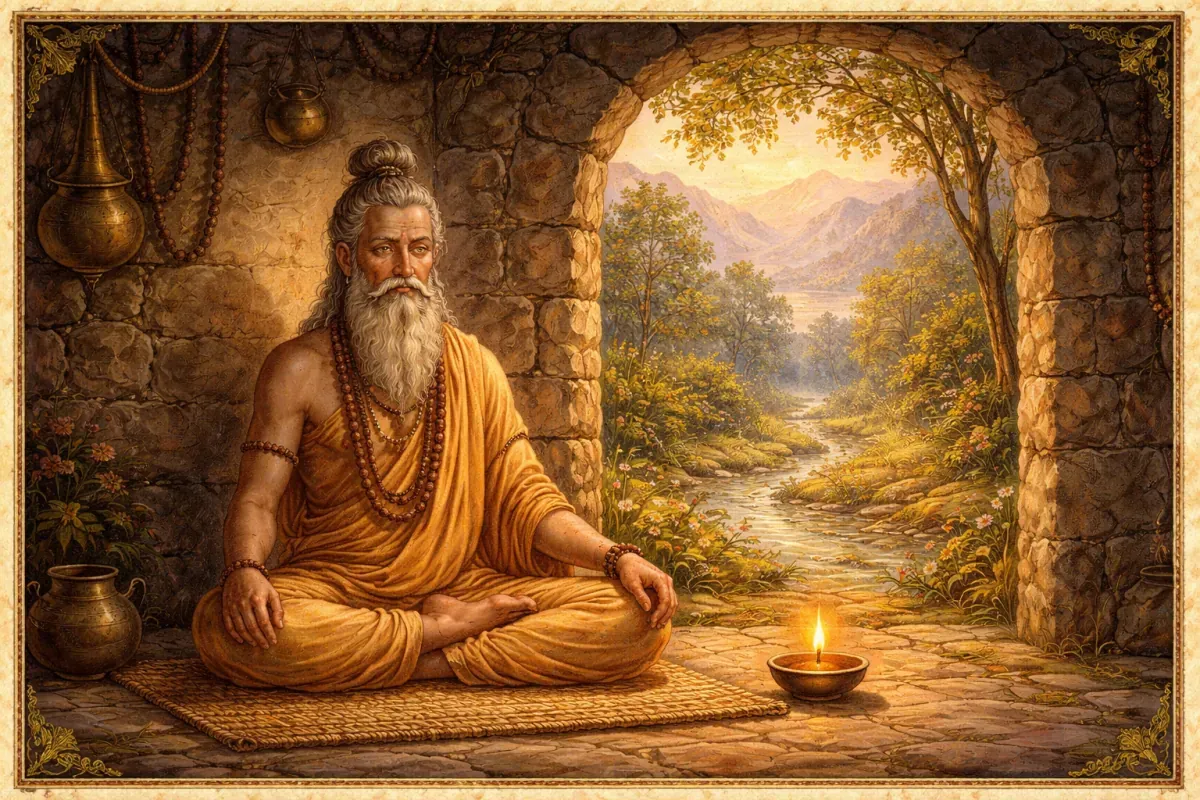
A retreat is a regulated period of intensive spiritual practice, characterized by physical seclusion and the observance of discipline regarding the body, speech, and mind, aimed at stabilizing contemplative awareness. In any serious spiritual tradition, a retreat is not an optional addition to daily practice, but a fundamental condition for spiritual transformation and the attainment of liberation (moksha) within a single human lifetime.
Retreat (from the English word retreat — "withdrawal," "seclusion") in Sanatana Dharma corresponds to the Sanskrit concepts of vivikta-sadhana (vivikta-sādhana) — "solitary practice," and ekantavasa (ekāntavāsa) — "dwelling in solitude."
In the context of ascetic discipline, a retreat is a form of tapasya (tapasya) — a spiritual endeavor or "inner heat" that burns the seeds of karma and purifies consciousness. The root tap means "to heat" or "to perform austerity," indicating the intensity of the spiritual effort.
The necessity of solitary practice is attested in the canonical texts of Sanatana Dharma.
"A yogi should constantly engage the mind, remaining in seclusion (rahasi), alone, having subdued the mind and body, free from desires and possessiveness." (Bhagavad Gita 6.10)
"In a clean, solitary (vivikta), level place... there the yogi should practice contemplation." (Shvetashvatara Upanishad 2.10-11)
Three Levels of Retreat
A retreat is structured across three levels of deepening:
1. Outer retreat — the discipline of spatial boundaries. The practitioner is physically isolated from ordinary worldly contacts. The retreat territory becomes a sacred boundary that is neither crossed from the outside nor left from the inside. This is the level of bodily discipline.
2. Inner retreat — the discipline of the three gates: body, speech, and mind. This involves the cessation of mundane actions, worldly conversations, and non-religious thoughts. A state of silence (mauna) is established, along with restrictions on movement and the total orientation of consciousness toward the object of contemplation. This is the level of subduing the senses.
3. Secret retreat — the highest level, representing a continuous abiding in the natural state of awareness of the nature of the Mind. At this level, external restrictions become redundant, as non-distraction (avikshepa) from the contemplation of the Absolute is achieved. This is a state of uninterrupted meditation.
Algorithm of Progressive Practice
The classical system of retreat discipline provides for a stepwise increase in practice intensity, following the principle of krama (gradualness):
- Daily practice: A minimum of three sessions of formal meditation, each lasting one hour.
- Monthly seclusion: A five-to-seven-day period of continuous practice observed in silence, combining seated meditation and meditative walking (chankramanam).
- Annual retreat: A three-month period of intensive practice with a complete abandonment of worldly duties.
- Advanced seclusion: A one-year retreat every three to five years to stabilize realization.
- Great seclusion: One three-year retreat during a twelve-year cycle of sadhana.
This system, based on traditional methods of preparing Mahasiddhas, ensures a systematic deepening of contemplative experience and leads to results attested in the hagiographies of liberated masters.
Principles of Conduct
Discipline of the body (kaya-samyama): Maintaining physical stillness within the place of practice, refraining from aimless movement, and maintaining the correct asana for meditation.
Discipline of speech (vak-samyama): Observing silence (mauna), which allows for the preservation of energy and prevents the dissipation of consciousness through verbal activity.
Discipline of the mind (manah-samyama): Cutting off mental wandering (vikalpa), directing the full force of attention toward the contemplation of Reality.
The True Goal
The authentic goal of a retreat is not the achievement of extraordinary experiences or paranormal powers (siddhis). The central task is the taming of the mind and the acquisition of the ability to abide in natural happiness (sahajananda) regardless of external circumstances. When a practitioner can maintain inner peace (shanti) and contentment (santosha) under conditions of complete isolation, without external stimuli or distractions, it serves as evidence of genuine progress in spiritual discipline.
According to the instructions of the tradition, "the true place of retreat is a deeply internalized understanding of impermanence." Meditation on death and the realization of the fragility of existence become the inner "hermit's hut" that surpasses any external walls. When the understanding of impermanence pierces the heart, renunciation (vairagya) arises naturally, and attachments to samsara fall away without effort.
Retreat as a Spiritual Necessity
For the modern seeker, immersed in a continuous flow of information, social obligations, and sensory stimulation, the concept of a retreat may initially seem foreign or even frightening. However, it is precisely this reaction that indicates the degree to which the mind is conditioned by external factors and confirms the necessity of solitary practice.
A retreat functions as a spiritual "laboratory" in which the practitioner is given the opportunity to observe the workings of their own consciousness under conditions of minimal external influence. Just as an athlete undergoes intensive training camps before a championship, a spiritual seeker needs periods of concentrated practice to achieve stable realizations. Without regular retreats, attaining full Awakening within a single lifetime remains a theoretical possibility devoid of a practical foundation.
The essential difference between ordinary solitude and a spiritual retreat lies in purposefulness and discipline. A retreat is not a vacation, not an escape from problems, and not psychological decompression. It is intensive work on the transformation of consciousness, requiring full involvement and adherence to established rules. The discipline of the three gates creates conditions under which the mind, deprived of its usual supports and distractions, is forced to turn toward its own nature.
Practical Aspects
For beginning practitioners, a gradual entry into retreat discipline is recommended. If prolonged meditation is still difficult, it is permissible to replace individual sessions with the practice of mantra-japa or meditative walking. The key principle is maintaining the continuity of practice while preserving the quality of awareness.
A vital aspect of traditional discipline is the maintenance of secrecy: details of instructions received, the content of personal practice, and internal experiences are not to be disclosed without the teacher's sanction. This secrecy protects the practitioner from the dissipation of spiritual power through verbalization and from the distortion of understanding resulting from premature discussion.
Retreats of the World Community of Sanatana Dharma
The World Community of Sanatana Dharma provides structured opportunities for retreats in both online and offline formats:
Online retreats: The community's ashrams hold regular three-day online retreats designed for students undergoing the twelve-year course of study at the Vasishtha Institute. Participation in these retreats is open to students who have taken refuge (sharana), signifying their formal entry into the spiritual parampara (lineage). The schedule of upcoming retreats, their thematic content, and registration procedures are available via the specified link on the community's official portal.
Offline retreats in ashrams: The community invites all students to visit the ashrams to undergo retreats in the traditional format of physical seclusion. Staying in an ashram creates the most favorable conditions for spiritual practice: a sacralized space, the energetically charged atmosphere of long-term sadhana by previous generations of practitioners, physical isolation from the worldly environment, and direct proximity to a spiritual preceptor. In the ashram environment, all three levels of retreat discipline are naturally supported, facilitating the deepening of practice and the attainment of stable results.
Completing a retreat within the community under the guidance of a realized teacher ensures not only the technical correctness of the practice but also the transmission of the living experience of the tradition — that non-verbalizable dimension of spiritual transformation that cannot be obtained through self-study of texts. This is participation in the continuous flow of grace (anugraha) descending through the chain of teachers from the primordial sources of wisdom.
For the seeker of liberation, a retreat is not an optional addition to ordinary life, but a necessary element of the spiritual path, allowing for a qualitative transition from superficial understanding to the deep realization of non-dual Truth.
