

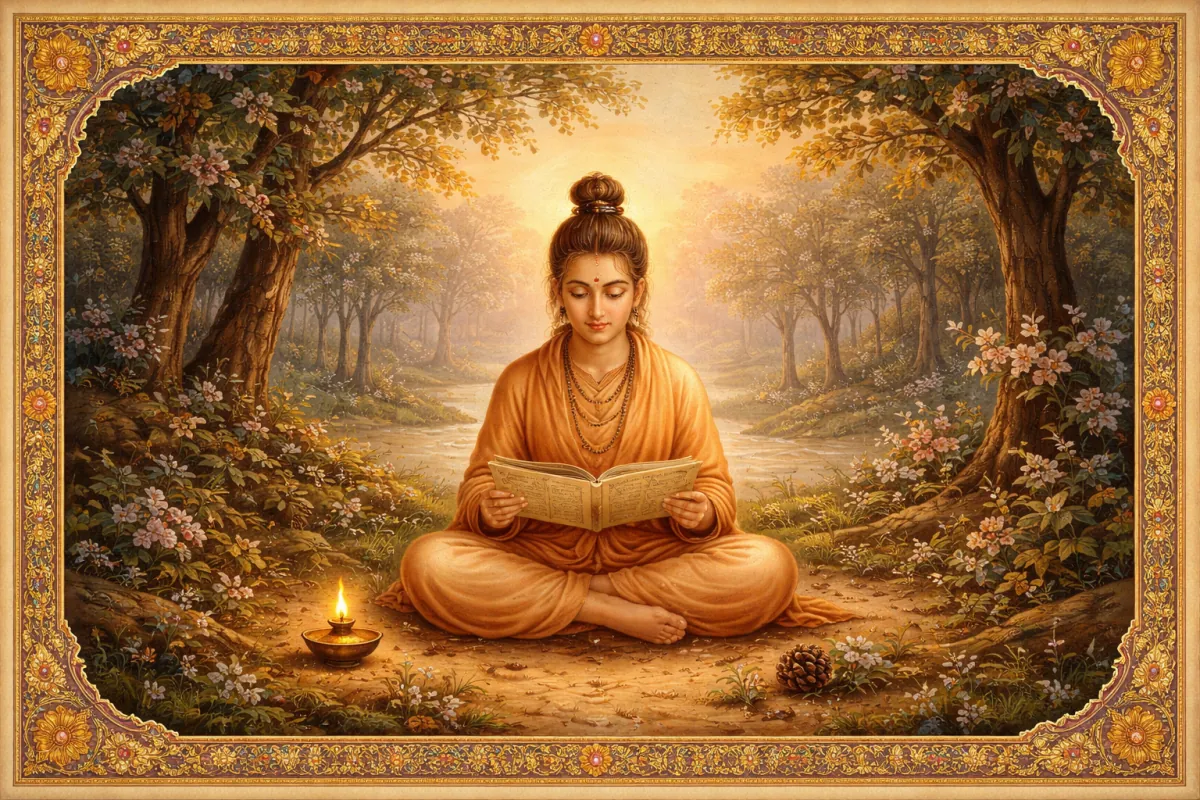
Bhagavan Shri Guru Avadhuta Dattatreya - ki-jaya!
- Dharma, artha, kama, and moksha are the four goals of life (purusharthas) that are attractive and desirable for a human being (purusha).
- Out of all these goals, the wise one chooses only moksha, Liberation, and nothing else.
Not choosing moksha as one's highest life value and goal in favor of other goals is, according to the Shrutis, a sign of great ignorance (maha-moha) and leads to delusion and suffering.
- Animals also strive for pleasure and security; almost all humans can, in addition to this, be aware of sins and merits and follow religious ethics (dharma), but only a few, the wisest, are capable of striving for moksha (complete Liberation).
- To attain Liberation, the seeker (mumukshu) must first turn to the Shastra (scripture), leaving behind "kutarka," false arguments and reasoning.
- Reasoning in Vedanta is necessary, but it must be based on the scriptures; so says the great Acharya Shankara, who has no equal in jnana.
Also, the great Vidyaranya says in the "Vedanta Panchadasi":
“Kutarkam santyajya mumukshuh shrutimashrayet”
"Having abandoned false arguments, the mumukshu should take refuge in the Shruti."
Turning to the Shrutis is the cause of moksha. Not turning to them is the cause of ignorance.
- The foundations for understanding Advaita Vedanta are:
- Shruti (scriptures);
- "Yukti" — correct reasoning;
- "Anubhava" — one's own spiritual experience obtained under the guidance of a guru.
- Our nature is the happiness and bliss of Brahman, and not suffering at all — such is the statement of the Vedanta scriptures. This is what the Vedanta guru teaches.
- The Taittiriya Upanishad says: "Bhrigu discovered that Ananda is Brahman."
Since, according to the Shrutis, Atman and Brahman are identical, understanding Advaita Vedanta is nothing other than realizing one's own eternal happiness hidden within.
- The instruction of Vedanta is addressed only to those who are mature and, by their qualities, are sufficiently suitable, "madhyama" or "uttama adhikari," but not to those who are foolish, deluded, and do not control their senses.
An adhikari has faith, is able to listen to and understand the guru, and can control their senses.
- The realization of Advaita is not the acquisition of new knowledge or the creation of something new; it is merely the attainment of one's own true nature — Sat-Chit-Ananda, which has always been free but seemed hidden due to ignorance.
- To purify the mind (but not to reveal the true nature of the "Self"), certain actions on the Path of Liberation are necessary, such as:
- Karma yoga;
- Yoga;
- Seva;
- Upasana.
- Atman is realized only through inquiry (vichara), and not by means of various external actions.
- The main method of such inquiry is the discrimination of the five sheaths — "pancha-kosha-viveka."
- Through inquiry, the yogi penetrates into "tattvam" — their true nature, attains "vairagya," detachment from samsara, and realizes the bliss of Brahman.
- The Path of Advaita Vedanta includes:
- Reasoning (yukti) based on the scriptures (shruti);
- Analysis of the mahavakya "Tat Tvam Asi";
- Meditation on the mahavakya "Aham Brahmasmi";
- Entry into samadhi.
- The Path in Advaita Vedanta, prescribed by the scriptures (shruti) and saints, consists of the following stages:
- Shravana — hearing the teacher's instructions about Brahman;
- Manana — reflection;
- Nididhyasana — unceasing contemplation of Brahman.
Other Paths are not described by Advaita Vedanta.
- In reality, I am Sat, Chit, Ananda, and identical to Brahman:
- Sat is eternal, indestructible existence;
- Chit is Samvit, eternal, indestructible knowledge, unlimited by anything;
- Ananda is infinite happiness and bliss, independent of anything.
The jiva (the "I," the human soul) is Samvit. Samvit is eternal, self-perceiving bliss, Sat-Chit-Ananda.
- The spiritual teacher, using these words, leads the disciple beyond them, to that which is beyond words and is understood only through experience.
- The goal of Advaita is to find oneself, not anything external.
- As long as there is duality, there exists:
- "Aham" (I) and "idam" (this);
- "Vishayi" (subject) and "vishaya" (sensory object).
Becoming free from duality is the Path to Moksha.
- The hope of obtaining happiness from external objects is the root of ignorance.
- I am already Ananda, happiness and bliss, free from suffering — this is what the seeker needs to realize.
- Everything that is visible and perceivable in this world does not exist by itself; it is the eternal, reflected Chit, "chidabhasa," infinite consciousness reflected in the antahkarana and illuminating thoughts.
- The yogi-mumukshu must, while contemplating, seek the Single Source, pure consciousness — Samvit, beyond all these reflections, without being carried away by them.
- Knowledge of any thing in this world consists of thoughts about its qualities superimposed on Samvit, pure consciousness. By casting aside thoughts of qualities, the jnani realizes Samvit, and then, remaining in the contemplation of this Samvit, realizes Brahman.
- Samvit is the transcendent light of the Absolute, and it is always one, while the qualities of things are diverse, just as the shapes of jars are different, but not the space that fills them.
- The objects of the world, the thoughts perceiving them, and the antahkarana are only upadhis, vessels for Samvit, the one consciousness.
- One should, while contemplating, separate pure consciousness from objects and perception.
- Perception flows through the channels of the sense organs toward objects. Touching objects, it takes their form. This form is illuminated by "chidabhasa" — the reflected pure consciousness (chit) present in the antahkarana.
- The antahkarana, when chidabhasa (reflection) is available to it, is like a mirror. "Vedya" are the objects of the world reflected in the mirror. They are all transient, for they disappear in one of the states:
- Waking;
- Dream sleep;
- Deep sleep without dreams.
- Samvit (awareness) is like the Sun, which illuminates both the mirror of the mind and the objects of the world; it always is, one and the same, eternal, and never disappears.
- The wise one seeks the Sun of awareness, without striving for the reflections of the world.
- In waking, dream sleep, and deep sleep without dreams, objects and perception are different, while Samvit — the "I am" awareness — is always one, therefore it is called "eka-rupa," identical in form.
- Only its realization leads to true happiness, and nothing else.
- Having realized this awareness as one's essence with the help of internal tapas, the jnani realizes Brahman, attains eternal happiness, and no longer seeks anything else, remaining unshakably in it in sahaja-samadhi.
- Thus, by steadily abiding in it for minutes, hours, days, weeks, months, years, he realizes the bliss of Brahman, burns all his karma, and attains Moksha in this very life, becoming a jivanmukta.
- Continuing to abide thus in the unwavering contemplation of Brahman for centuries, millennia, kalpas, yugas, and even greater epochs, he fully merges with Brahman in the manifested and unmanifested, saguna and nirguna aspects, reveals all his inner divine energies and powers, and eventually becomes the Creator God, Preserver, and Destroyer, Ishwara, the divine lord of the universal Shakti and all creation.
Shivaprabhakara Siddha Yogi Brahmananda Avadhuta ki-jaya!
Om Shanti Shanti Shanti
Written in October 2018 by the Panch Dashanam Juna Akhara Mahamandaleshwar Shri Guru Swami Vishnudevananda Giri for the benefit of his devoted disciples and all worthy seekers of Liberation on the great direct path of the Advaita Vedanta tradition.
