

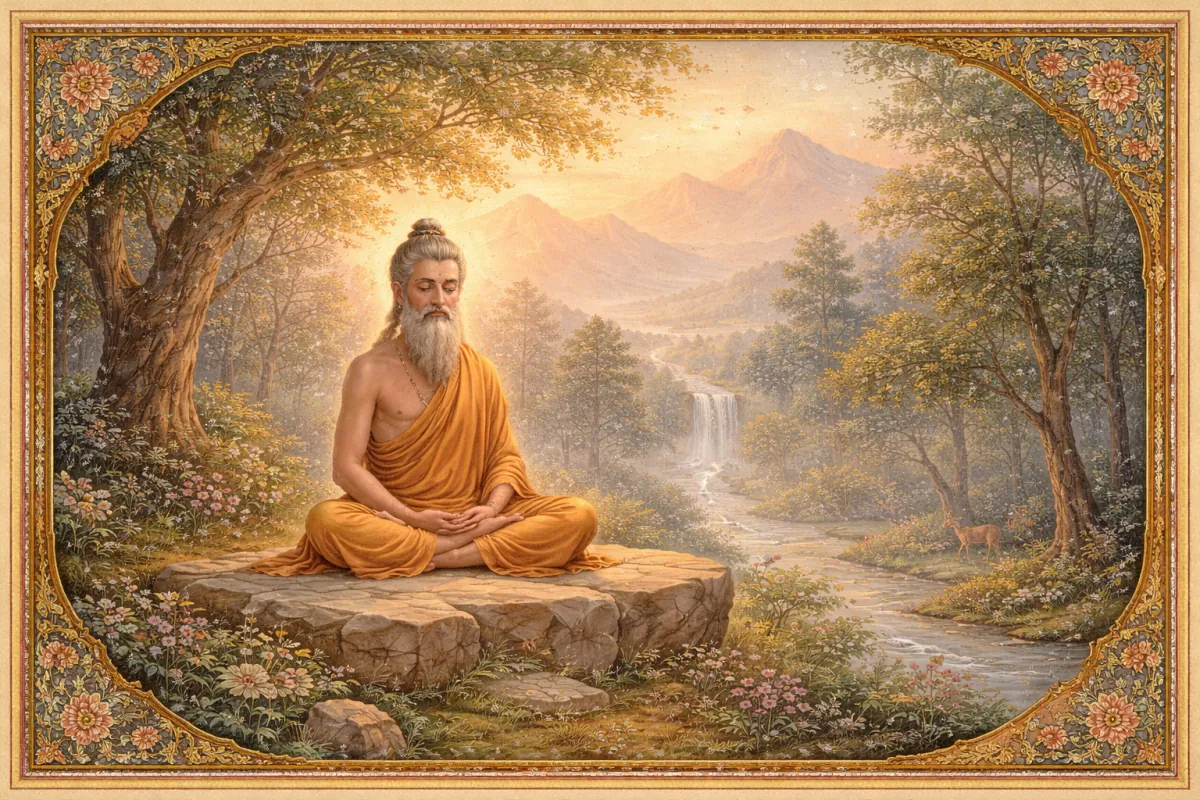
First Jnana-bhumi (Ground of Wisdom) Second Jnana-bhumi (Ground of Wisdom) Third Jnana-bhumi (Ground of Wisdom) Fourth Jnana-bhumi (Ground of Wisdom) Fifth Jnana-bhumi (Ground of Wisdom) Sixth Jnana-bhumi (Ground of Wisdom) Seventh Jnana-bhumi (Ground of Wisdom)
A GARLAND OF ORAL INSTRUCTIONS ON THE SEVEN STAGES OF ENLIGHTENMENT
OM
My boundless respect and reverence to Lord Ganesha, the source of all existence – Mahadev, the great Saraswati, Adi-Guru Dattatreya, Siddha-Avadhuta Brahmananda, and all the saints of the Refuge Tree of the Siddha lineage!
Here are the instructions for disciples and all seekers of God and the path to liberation regarding the seven stages of awakening, known as "Jnana-bhumis."
When a yogi walks the path to liberation, he sees favorable signs (lakshanas) of his progress. Knowing these signs, as laid down by the holy sages, he will never be mistaken or stray from the path. Without knowing them, he may fall into one of the many thousands of insidious traps that lie in wait for a yogi.
He who follows them with understanding and diligence will truly become fortunate, for he will gain a correct understanding of the meaning of yoga, and his goal will be achieved – as indicated in the Prakriyas (main concepts) of Vedanta and in the scriptures of the saints, such as the "Yoga Vasistha" and others.
THE FIRST JNANA-BHUMI (GROUND OF WISDOM) "Shubheccha" (Good Desire for Enlightenment)
- When the first bhumi is reached, the spiritual seeker gains discrimination and understanding (Viveka); he clearly distinguishes between truth and untruth.
- The signs of the first bhumi are as follows:
- the person serves holy sages;
- he studies the sacred scriptures;
- he is absorbed in various commendable dharmic actions: worshiping deities, singing bhajans, japa, yoga, serving sadhus, visiting temples of his tradition, gurus' ashrams, and holy places;
- he is not interested in the world;
- he strives not to sin;
- his goal is liberation (Moksha), crossing the ocean of Samsara, and he thinks about this constantly.
- Dispassion, peace, and joy have appeared in his heart; his speech is soft, honest, kind, and appropriate to the situation.
- A beginner should strive with all his might to reach this bhumi. Until the first ground is reached, it is impossible to attain higher stages, such as Vicharana and Tanumanasi.
- The first ground is the foundation of Moksha. It is potential holiness in an embryonic state, like a seed cast into the soil.
THE SECOND JNANA-BHUMI (GROUND OF WISDOM) "Vicharana" (Self-Investigation)
- On the second bhumi, the yogi learns all the secrets of yoga from a teacher. Having received transmission and secret instructions from the guru, he proceeds to the practice of inner contemplation.
- The stage of Vicharana is the steady turning of consciousness toward "I AM." When the second bhumi is reached, such Atma-vichara (self-investigation) becomes continuous.
- The yogi established in the second bhumi, always, while awake and not asleep, remains without distraction in the investigation of the "Self"; his mind is partially submerged within and partially remains without.
- From the moment of waking until falling asleep, he remains in Atma-vichara and remembers his "Self" while meditating, lying, standing, walking, eating, speaking, doing asanas, singing bhajans, sitting at satsang, performing rituals, visiting temples, bowing, working, or putting on clothes.
- The yogi will not abandon such contemplation even if seven enraged dogs chase him or if Apsaras (celestial maidens) attempt to seduce him.
- He does not abandon contemplation even if he is entertained, praised, scolded, distracted, frightened, or tempted by something alluring, amazing, or pleasant.
- Such a sadhu seeks the company of other sages who have studied the scriptures and practices.
- He intuitively knows what should be done in accordance with Dharma and the scriptures and what should not.
- He subdues the Kleshas, abandoning the sins of pride, delusion, and jealousy.
- He easily dissolves arising thoughts and emotions through the power of mindfulness, the liberating remembrance – Atma-vichara.
- Vikalpa-kshaya – the instantaneous destruction of surfacing thoughts and emotions – occurs by itself.
- Thus, the yogi gradually becomes established in the inexpressible state beyond mind and concepts (Amanaska). He becomes accustomed to it and learns to live in it anew, like a small child learning to walk and talk.
- His holiness on the second bhumi sprouts like a tender shoot from the soil.
THE THIRD JNANA-BHUMI (GROUND OF WISDOM) "Tanumanasi" (Thinned Mind)
- On the third bhumi, the yogi becomes unattached and unperturbed, achieving detachment (Vairagya) toward the world and its objects. Vairagya becomes habitual for him, so the third bhumi is also called "Asanga-bhavana" – "the state of non-attachment."
- The yogi's mind on the third bhumi becomes calm, empty, expanded, liberated, and open. It is like a thin thread and contemplates the void beyond qualities, subject, and object.
- "Tanu" means "thread," "Manas" means "mind." Thus, it is a "subtle state of mind, like a thread."
- With a refined mind, remaining in contemplation, the yogi wanders through forests and mountains in solitude. He practices calming the mind through Dharana, Dhyana, and Samadhi.
- He always sees and investigates the truth of Brahman (Brahma-vichara) and remains in contemplation of the nature of the Mind, without distraction during the day while awake, but not in sleep.
- He follows the scriptures; his behavior is virtuous and always corresponds to the truth. The yogi on the third bhumi has no attraction to the objects of this world; his motives and actions are always lofty and pure, though he may manifest in various ways.
- He feels: "I am not the one who acts or enjoys. I do not affect others; others do not affect me. I do nothing, even when in pain, pleasure, luck, or misfortune."
- His Karma-mala (impurity of the notion of authorship of actions) and Kartritva-buddhi (sense of being the doer) dissolve. He realizes: "I do not act; only God acts. Even in the past, I did nothing. All this, as well as meetings and partings, different experiences and states, is brought and taken away by almighty Time."
- He dwells in Antar-mauna (inner silence) and always enjoys peace, contentment, wisdom, and self-awareness.
- His mind shines like infinite space, like a supportless sky supporting itself.
- On the third bhumi comes Manonasha – the destruction of identification with the gross mind and ego, the refinement of consciousness.
- If a practitioner dies at this stage, he will be born in the heavens, live there for a very long time, and then be reborn on Earth as a wise Jnani and continue his path.
- The holiness of a yogi who has reached the third bhumi is like a small sprout that has risen upward and put forth its first green leaves.
THE FOURTH JNANA-BHUMI (GROUND OF WISDOM) "Sattvapatti" (Mastery of Sattva) Title of the Jnani – Brahmavid
- The fourth bhumi is called "Sattvapatti," which means "attainment of Sattva."
- One who enters it gains knowledge of the Supreme Self, Atma-jnana, achieving an initial union with the object of his knowledge – Brahman; therefore, he is given the title "Brahmavid," which means "knower of Brahman." The "Varaha Upanishad" states: "He who dwells in the fourth bhumi is called a Brahmavid."
- This bhumi radically destroys the Vasanas – the seeds of the sadhu's negative tendencies. When the Vasanas are destroyed, "Bodha" ensues – enlightenment by the light of supreme wisdom.
- The continuous contemplation of "I AM," the space of awareness like the sky, penetrates the dream state (Svapna).
- In the dream state, the yogi is not only awake but also remains in the natural knowledge of Brahman – Sahaja. The penetration of mindfulness (Sahaja) into the dream state is his main achievement.
- The entire visible external world feels like a dream to the sadhaka. Separation has ceased; unity is constant. Everything that exists, he sees as one Consciousness.
- The "Varaha Upanishad" states:
> "That stage in which one becomes indifferent to all sense objects through progress in the three previous stages, when the purified chitta rests on the Atman, which has the nature of Sat, is called 'Sattvapatti.' > When the mind is firmly fixed on the non-dual and the concept of duality is suppressed, then he sees this universe as a dream through his union with the fourth stage. > Just as an autumn cloud disappears, scattered by the wind, in the same way, this universe dissolves in the consciousness of the yogi. > O Nidagha, believe me, only such a person is stable in Sattva."
THE FIFTH JNANA-BHUMI (GROUND OF WISDOM) "Asamshakti" (Non-attachment to Objects) Title of the Jnani – Brahmavidvara
- The light of Sattva-guna, attained through practice in the four previous stages, which shines steadily in the mind of the Jnani, who is one with Brahman and has eliminated the desire for the fruits of his actions, is called "Asamshakti."
- On the fifth bhumi, the yogi achieves perfect independence from the influences of the objects of this world and the strongest sensations.
- In this stage, there is no longer sleep or waking – awareness is continuous. His state of awareness encompasses three dimensions: waking, dreaming, and deep dreamless sleep.
- The penetration of natural awareness (Sahaja) into dreamless sleep is the main achievement on the fifth bhumi; therefore, this stage in the "Varaha Upanishad" is called "Sushupti-pada."
> "Having ascended to the fifth stage, called 'Sushupti-pada' (the abode of dreamless sleep), he remains simply in the non-dual state free from numerous distinctions." ("Varaha Upanishad," Ch. 4, v. 14)
- the Jnani of the fifth bhumi is in the experience of "Ananda-svarupa" (the bliss of Brahman) day and night and possesses wisdom beyond any point of reference.
- For him, only non-dual reality remains. Even while involved in various actions due to Prarabdha, he remains unaffected within, being liberated while living (Jivanmukta).
- Such a saint is a great sage (Jnani), illuminating the entire world with the light of his consciousness.
THE SIXTH JNANA-BHUMI (GROUND OF WISDOM) "Padartha-bhavana" (Non-perception of Objects) Title of the Jnani – Brahmavidvariya
- The sixth bhumi is "Padartha-bhavana" – knowledge of the Truth. The yogi of the sixth bhumi always remains in the awareness of Turya – the fourth dimension of consciousness.
- The "Varaha Upanishad" states:
> "That stage in which unity is achieved through practice in the previous five stages, when the yogi, having found refuge in the Atman, has no concept of internal or external, although participating in actions only out of motives for the sake of others, is called 'Padartha-bhavana,' the sixth stage of the bhumi. > Remaining always in the inner vision of God (sphurti), whenever participating in external actions, those who dwell in this sixth stage are like those asleep even when they act."
- The "Yoga Vasistha" states:
> "The yogi of the sixth bhumi realizes: 'I am neither real nor unreal, neither having ego nor not having it. I am beyond duality and unity. All doubts inherent in duality have disappeared.' > He is nothing within, nothing without, nothing like an empty vessel, and at the same time, he is full within and without, like a full vessel submerged in the sea."
- Yogis of the sixth bhumi are inconceivable to the mind and indescribable. They do not live – they play, manifesting through body, speech, and mind the play of the energies of the Absolute, the Lila of Ishvara, Bhagavan. Their plays are transcendental. They are liberated while living (Jivanmuktas).
- The yogi of the sixth bhumi is always absorbed in Brahman and remains in Sahaja-samadhi. His Sahaja-samadhi penetrates all four types of consciousness:
- waking;
- dreaming;
- dreamless sleep;
- Turya.
- His awareness, shining like the sun, encompasses all sixteen levels of consciousness:
- jagrat-jagrat; jagrat-svapna; jagrat-sushupti; jagrat-turya;
- svapna-jagrat; svapna-svapna; svapna-sushupti; svapna-turya;
- sushupti-jagrat; sushupti-svapna; sushupti-sushupti; sushupti-turya;
- turya-jagrat; turya-svapna; turya-sushupti; turya-turya.
- Only great souls who have performed tapasya over many lives, purified their vision, or received great grace, Shaktipata from Shiva, becoming filled with His grace (Samavesha) and completely surrendering themselves to Him, can ascend to this bhumi.
- Such Jnanis and yogis live in the awareness "I am Shiva," "I am Brahman" (Brahma-aham-bhava), in divine awareness (Divya-bhava), remaining beyond time, life, and death.
- They are the very essence of the happiness of all living beings, from humans and spirits to gods.
- They, being one with Shiva, are themselves the goal and refuge of all living beings.
- They, being full of happiness (Purnatva), nourish all living beings with the light of their grace.
- They are always one with the source of universal happiness.
- They – sources of happiness and grace for others – have no concepts of "I" and "others" within them.
- They are vessels of divine wisdom, channels of divine will, and transcendental players of the divine.
THE SEVENTH JNANA-BHUMI (GROUND OF WISDOM) "Turyaga" (Transcendence) Title of the Jnani – Brahmavidvarishtha
- The "Varaha Upanishad" states: "The stage in which, after an exceedingly long practice of contemplation in the previous six stages, the yogi is immovably established in the consideration of the solitary Atman without any division, is the seventh stage named Turya." Then he remains in this state of the One without a second, without fear and with a consciousness barely existing as something separate, where there is neither Sat nor A-sat, neither "I" nor "not-I." This stage is also called "Gudhasushupti."
- The yogi on the seventh bhumi steadily remains in Turya – the highest state of superconsciousness – and then goes further into the indescribable dimension of Turyatita. "He is like an empty pot in space; he is emptiness both within and without; like a filled vessel in the middle of the ocean, he is full both within and without." ("Varaha Upanishad," Ch. 4)
- He experiences different levels of the subtlest bliss:
- Nijananda;
- Nirananda;
- Parananda;
- Brahmananda;
- Mahananda;
- Chidananda (all-pervading bliss);
- Jagadananda (infinite supreme bliss).
Thus he conquers Maya and attains Moksha. All three Gunas – ignorance, passion, and goodness – disappear for him, and he remains beyond body, speech, and mind in a state of liberation as Videha-mukti.
- Such a yogi becomes omnipresent consciousness-being, like a space of consciousness full of power. He no longer has identification with the body; he is like a disembodied powerful saint and an eternally free deity. He can take the form of anyone or create any number of bodies by the power of will, emanating them from his "Self."
- He steadily knows: "I myself am this Brahman, one without another," "I myself am Shiva, and my inner energy (Atma-shakti) can manifest as this entire universe."
- He transcends the five sheaths (Koshas) and conquers the subtle cosmic forces (Shaktis), the chief of which is Vamesvari, moving within the sheaths and limiting the Jiva.
- In the physical sheath, he transcends Bhuchari-shakti; in the subtle, Dikchari-shakti; in the mental, Gochari-shakti; in the causal, Khechari-shakti.
- Having overcome Khechari-shakti, he transcends the subtlest limitations of the five Kanchukas: Vidya, Kalaa, Niyati, Kaala, and Raga. The sixth is Maya. These five energies together with Maya form the sixfold covering (Shat-kanchuka) enveloping the Atman.
- Enveloping the Atman, they hide the divine consciousness and its infinite powers:
- omniscience (Sarva-jnatva);
- omnipresence (Vyapakatva);
- fullness (Purnatva);
- freedom of will (Svatantrya);
- omnipotence (Aishvarya);
- eternity (Nityatva).
The great Siddha-yogi who has reached the seventh bhumi conquers them.
- The energies that previously limited him are purified and transformed into five divine Shaktis:
- energy of consciousness (Chit-shakti);
- energy of bliss (Ananda-shakti);
- power of will (Iccha-shakti);
- power of knowledge (Jnana-shakti);
- creative power of action (Kriya-shakti).
- With the victory over the energies acting in the Koshas, the Kanchukas are also conquered in the consciousness of such a great Jnani:
- Maya and Vidya-kanchuka are transformed into the pure power of divine omniscience of Ishvara (Sarva-jnatva).
- Kalaa-kanchuka is transformed into the power of divine omnipotence (Sarva-kartritva).
- Niyati-kanchuka is transformed into the power of omnipresence and all-pervasiveness of Ishvara (Sarva-vyapakatva).
- Kaala-kanchuka is transformed into the eternal existence of Ishvara (Nityatva).
- Raga-kanchuka is transformed into the energy of fullness and wholeness of Ishvara (Paripurnatva).
- Then, freely soaring at the highest level of the seventh bhumi, such a Mahasiddha can create his own magical and divine worlds, pure lands, and even his own universes.
- He can govern them as Brahma, Vishnu, and Shiva, like the son of the sage Gana or the ten brothers of Indu who created their own universe.
- Thus, Maya (illusion) is finally overcome, and he recognizes himself as Shiva, the non-dual Brahman, victoriously realizing the great mahavakyas: "Shivoham" ("I am Shiva") and "Aham Brahmasmi" ("I am Brahman").
OM TAT SAT
The Upadesha "Garland of Oral Instructions on the Seven Stages of Enlightenment" ("Jnana-bhumi Upadesha Mala") is completed. It was written for the benefit of all disciples and sincere seekers following the great path of liberation (Moksha Dharma).
Pancha Dashanam Juna Akhara Mahamandaleshwar Sri Guru Swami Vishnudevananda Giri. Year 2021
