

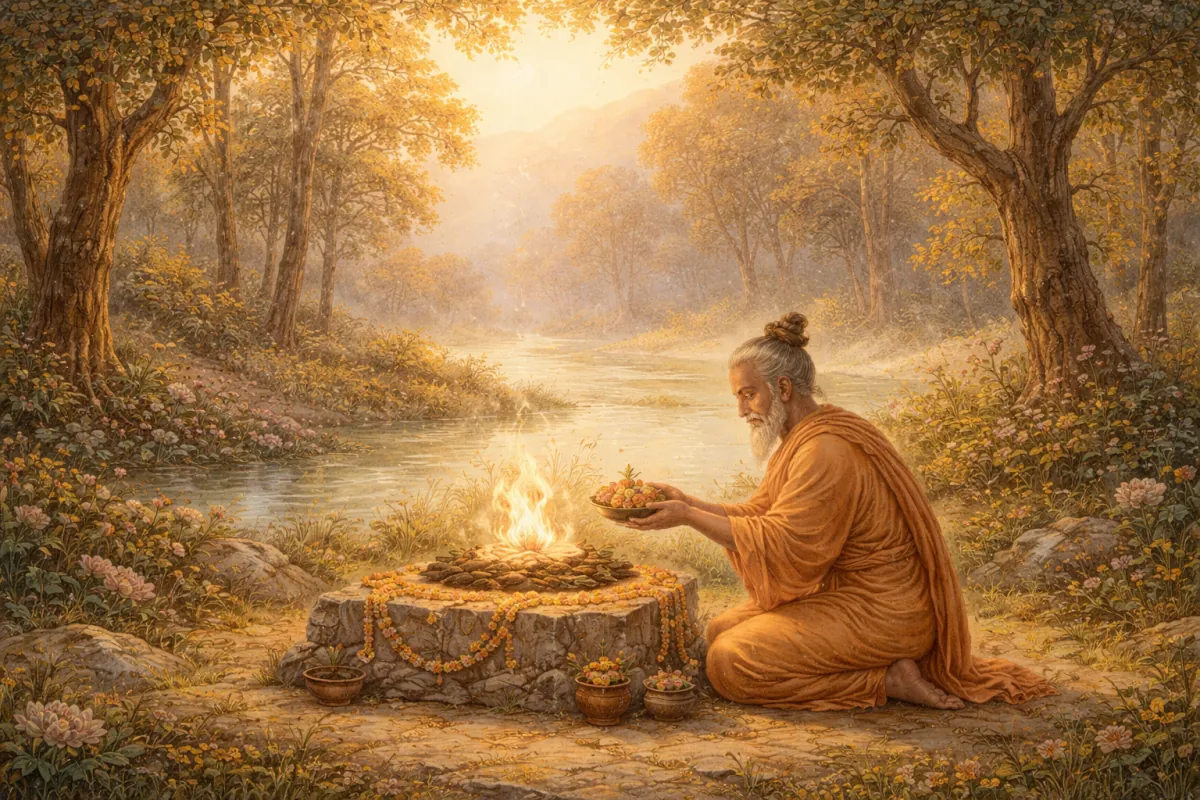
This text contains the Guru's commentary on the Yoga Sutras of Patanjali, Chapter 1, shlokas 23-29.
Om. Salutations to Ganesha and Saraswati.
Salutations to Dattatreya, Shiva Prabhakara siddha-yogi avadhuta Brahmananda.
To Mahayogi Pilot Baba and all the saints of the Refuge Tree.
Who is Ishvara
- Ishvara is Brahman reflected in Maya. He is the sole Supreme Source of everything that exists.
- Ishvara is one without a second, for He Himself is Brahman who has awakened His creative power and is reflected in it.
- Ishvara, as the witness, is the infinite Consciousness that transcends Maya.
- Prakriti (the material nature of the Universe) is Maya. Maheshvara is the creator of Maya.
- Ishvara is beginningless, since Maya, in which He is reflected, is beginningless.
- Maya, being fundamentally a luminous Emptiness, does not obscure Ishvara when He creates a body by clothing Himself in it, for Ishvara is its substrate.
- Sattvic Maya is the upadhi of Ishvara, a projection superimposed upon Brahman.
- Since Maya is unique and beginningless, Ishvara is unique and beginningless. The Consciousness that constitutes the nature of Ishvara is also beginningless.
- The Supreme Ishvara is Parameshvara, Shiva, the first tattva. These are the six qualities of Ishvara:
- Power (bala)
- Glory (yashas, kirti)
- Wisdom of omniscience (jnana)
- Boundless wealth (sarshiti)
- Beauty (shri)
- Detachment (vairagya)
- The state of Ishvara, His disposition to create, is Ishvarata.
- The state of Ishvara as the witness of all is called ishvara-sakshitva.
- Parameshvara is one, but because there are differences in Maya (gunas, etc.), He acquires the ability to be Brahma, Vishnu, Shiva, and Maheshvara, the Great Ishvara.
- Ishvara and Ishvara-sakshitva differ as the qualities of the same person differ—being a cook and being a teacher.
- Parameshvara (the Supreme Ishvara) is Brahman Himself, who brought forth Maya. The same Brahman—Parameshvara, limited by Maya as an upadhi, is the Witness-Ishvara (sakshi).
- Brahma, Vishnu, Shiva, Dattatreya, and other gods are His forms.
Attributes of Ishvara
- These are the attributes of Ishvara:
- Eternity (nityattva)
- Divine Fullness (purnatva)
- Divine Freedom (svatantrya)
- Omnipotence (aishvarya)
- Omniscience (sarvajnatva)
- All-pervasiveness and omnipresence (vyapakatva)
- The Consciousness of Ishvara, conditioned by Maya in which sattva-guna prevails, is called Vishnu, Narayana.
- The Consciousness of Ishvara, conditioned by Maya in which rajas-guna prevails, is called the Creator, Brahma.
- The Consciousness of Ishvara, conditioned by Maya in which tamas-guna prevails, is called the Destroyer, Maheshvara, Rudra. This is confirmed by a quote from the Maitri Upanishad (5.2): "That part of Him which is tamas is indeed Rudra. That part of Him which is rajas is Brahman. That part of Him which is sattva is indeed Vishnu."
- Vishnu, Maheshvara, Ganesha, Durga, Dattatreya, and other gods are forms of Ishvara.
- In Maya, which is the limitation of Parameshvara, there arises a desire for creation, caused by the power of the karma of living beings. Then various vrittis appear:
- "Now it is time for creation"
- "Now this should be preserved"
- "Now this must be destroyed"
- These vrittis have a beginning and an end. And the consciousness reflected in them has a beginning and an end. Therefore, it is said that Brahma, Vishnu, and Shiva have their lifespans, though very long. Although, as stated in the shastras, their bodies dissolve during Mahapralaya, they themselves are immortal, because they are identified not with their bodies, but with Brahman, and the bhava "Aham Brahmasmi" prevails in them.
Sacrifice to God (Ishvara-yagya) – the Purpose of Human Life
- Human life, which is identified with the body and ego, is intended for Mahayagya—the Great Sacrifice, service to His will, self-surrender to Ishvara, and for nothing else. This is so because man and every living being are inseparable from Ishvara and are His parts. This means that by giving oneself to Ishvara, by serving Him, a person serves and gives oneself not to something external, but to oneself, to one's Supreme Self, which is invisibly present within as the Atman.
- Ishvara-yagya is threefold: it includes the attainment of Ishvara's wisdom (jnana-shakti), the discovery of His will (iccha-shakti) and self-surrender to it, and the manifestation of Ishvara's lila always and everywhere (kriya-shakti).
- By following this threefold yagya, the soul (jiva) liberates itself from the suffering of samsara. This is called self-liberation (pratimoksha). Acting in the spirit of self-renunciation, it surrenders itself to the Grace of Ishvara's energy. This is called self-surrender (prapatti). And finally, it recognizes itself as one with Ishvara. This is called self-recognition (pratyabhijna), when Ishvara, having taken the form of a soul and seemingly entering ignorance for a time, and shrouding Himself in kanchukas, malas, koshas, and other limitations, recognizes Himself again.
- Such a yagya is the essence of any seva (service), any spiritual practice (sadhana), any asceticism (tapas), and svadhyaya (study of scriptures).
- When seva, sadhana, and svadhyaya are done in the spirit of love and devotion to Ishvara, the soul, passing through these three stages, perceives the essence of Ishvara, merging into bhava- and sahaja-samadhi, and attains self-recognition and Liberation.
- In this way, the mahavakyas "Tat Tvam Asi" and "Aham Brahmasmi" are realized.
- These are the 7 colors in Advaita-Ishvara yoga at the kriya-pada stage, given by Saint Narada in the "Bhakti Narada Sutra":
- Shravana (listening)
- Kirtana (glorification)
- Smarana (remembrance of Ishvara)
- Vandana (offering prayers)
- Pada (worshipping the feet of the chosen deity, Guru, or sadhu)
- Dasya (abiding in the mood of a servant of Ishvara)
The Four Padas Leading to Ishvara
- Following the commandments, karma yoga, actions in the spirit of self-renunciation, offering all fruits and results to God, and relinquishing the sense of being the doer and the doing. This is Charya-pada.
- Daily shravana, manana, followed by nididhyasana, including upasana, chanting mantras, bhajans, kirtans, contemplative remembrance of Ishvara, offering prayers, and service in the spirit of a devoted son serving the Almighty as a father. This is the Kriya-pada that saves from treacherous Maya.
- Ritual invocation of the ishta-devata, transformation into the radiant form of the ishta-devata, contemplating oneself in the form of the ishta-devata, the arising of divine pride, and reciting the mantra with the thought: "my mind is the mind of the deity, my speech is the speech of the deity, my actions are the manifestation of the deity, the whole world is the mandala of my deity." This is the great Yoga-pada, in which the sadhu follows the path of ishta-devata yoga.
- Constant natural contemplation of Brahman, abiding in the Nature of the Mind according to the Three Main Principles—shravana, manana, nididhyasana, as well as self-liberation, self-surrender, and self-recognition, up to merging into sahaja-samadhi, the bhava "Aham Brahmasmi." This is the unsurpassed, highest Jnana-pada, concluding Ishvara-yoga.
- Types of liberation:
- Charya-pada grants salokya-mukti (liberation in the heaven of one's deity).
- Kriya-pada grants samipya-mukti (liberation through proximity to one's deity, being part of His retinue).
- Yoga-pada grants sarupya and sarshita-mukti (attaining a radiant divine form like that of one's deity and gaining boundless energy like that of one's deity).
- Jnana-pada grants sayujya-mukti (dissolution in Ishvara and Brahman, like the dissolution of butter in butter and milk in milk, followed by manifesting oneself in the form of a new Brahma, Vishnu, or Shiva).
- In Charya-pada, the sadhu serves Ishvara as a servant. In Kriya-pada, he perceives Ishvara as the Supreme Lord. In Yoga-pada, the sadhu perceives the Atman as being close to Ishvara. In Jnana-pada, the sadhu perceives the unity of Atman, Brahman, and Ishvara, becoming Ishvara and giving rise to himself in the form of Brahma, Vishnu, and Shiva.
The Essence of Ishvara
- Shiva, Shakti, and Nara are the three eternal essences. Shiva is the pure unity of prakasha, abheda-tattva. Prakasha is the Light of the pure consciousness of Ishvara, which has no distinctions (abheda). Prakasha is pure unity.
- Shakti is the inconceivable unity in diversity (achintya-bheda-abheda tattva). Vimarsha is the vibrating energy of Ishvara, in which there is both difference and absence of difference (bheda-abheda). Vimarsha is unity and diversity. Prakasha is Nada (vibration of consciousness). Vimarsha is bindu (the primary pulsation caused by the will of Ishvara).
- Nara is diversity (bheda-tattva).
- Analogy with a mirror:
- Shiva, prakasha is like the mirror
- Shakti, vimarsha is the reflective capacity of the mirror
- Nara, the objective world is the reflection in the mirror
External Manifestations
- Externally, Ishvara appears before the sadhu in the form of his root guru (mula), shiksha-guru, chosen deity (ishta-devata), the Teaching (dharma), his sampradaya, the Guru-shishya-parampara, as well as the sadhus and the sangha, which together form the Refuge (sharanam).
- For the sake of his own liberation, the yogi should worship Ishvara in all these forms with faith and devotion, showing respect and pure vision.
- Guru-yoga, ishta-devata-yoga, bhakti-yoga, jnana-yoga—all of them ultimately lead to the realization of Ishvara and Brahman. They lead to Supreme Liberation.
Written by yogin panch-dashanam Dhuna-akhara Mahamandaleshwar Swami Vishnudevananda Giri, sadhu, in the continuous lineage of teachers for the benefit of all living beings following the path of Liberation,
June 2018, Trimurti-Ashram
Recorded by Trailokyadevi Giri
May all living beings enter the Path of Advaita Vedanta and, having realized Ishvara and Brahman, achieve Liberation and Enlightenment!
