

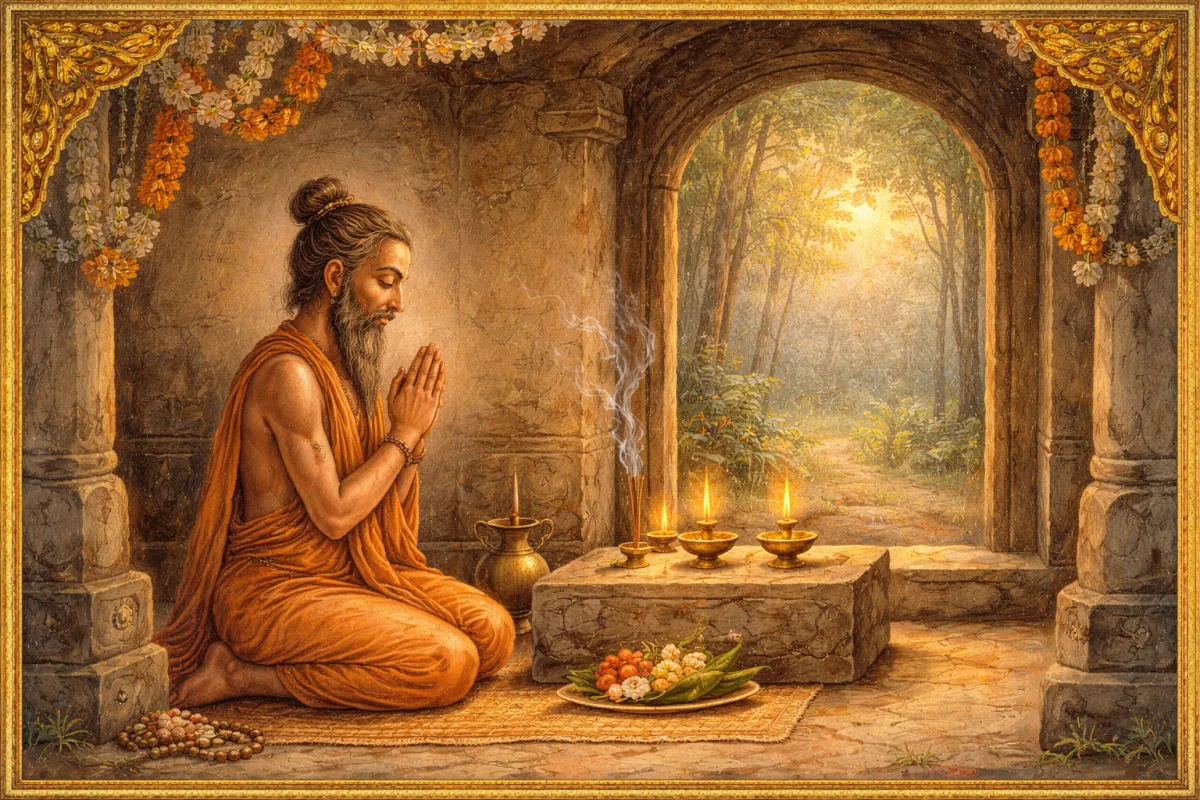
The cause of current problems. How to discard false perceptions. How to combine the Advaita view with the pursuit of Moksha. How to understand what liberation is. What the Acharyas say. How to contemplate. How to pray.
Precious Instructions
on cultivating the intention for liberation
OM
My boundless respect and reverence to:
- Lord Ganesha,
- The Source of all existence – Mahadev,
- The great Saraswati,
- Adi-guru Dattatreya,
- Siddha-Avadhuta Brahmananda,
- Somnath Giri Maharaj (Mahayogi Pilot Babaji)
- and all the saints of the Refuge tree of the Siddha lineage!
Here are the precious instructions for a student or a devotee of Dharma and a Guru-seeker on cultivating Mumukshutva (the intention for liberation and enlightenment), based on the texts of the holy Acharyas. They are a true jewel, for without Mumukshutva, Moksha (liberation) is impossible.
The Cause of Current Problems
- Why do you suffer?
Because in the past you did not create a strong intention for liberation.
2. Why were you born as a mortal human in Samsara, conditioned by karma, instead of becoming a playing deity in a body of light living in pure abodes? Why are you subject to impermanence, old age, sickness, and death?
Because in the past you did not create an intention for liberation, did not strive for it, or even if you did, it was very weak. Because in the past you did not give rise to the aspiration for Moksha.
Therefore, the intention to achieve Moksha and the purposeful cultivation of such an intention is the most important thing for a Sadhu.
- Without it, one cannot become a Sadhu.
- Without it, Tapas is useless, as it will only yield temporary results.
- Without it, the Mantras you recite will only grant temporary powers.
- Without it, the merits you diligently accumulate will be wasted in vain.
- Without it, ignorance will not be destroyed, which means suffering will not cease, even if you are born in the future as a Samsaric god in the heavens.
3. Why do years go by while you remain in the same place, absorbed in your karma?
Because in the past you did not create a strong intention for liberation.
4. Why are you so indecisive and unable to follow the path of Tapas and the self-surrender of the Vira – hero-yogis?
Because in the past you did not create a strong intention for liberation.
How to Discard False Perceptions
- If you strive to follow the path of the saints, the path of Moksha, discard all hindering false perceptions, such as:
- That "striving for liberation should not be nurtured because this striving supposedly only feeds the ego."
- That "it is enough to relax and be 'here and now,' and everything will happen by itself, without your participation, by God's grace," for your sensitivity and devotion to God are insufficient for such a level of effortless perception of divine grace.
- That "such a concept is from the mind, and God and Moksha are beyond the mind."
- That "one should enjoy life, having what there is, and not strive for anything else."
- That "striving for Moksha is also an ego's desire, no different from other desires, and therefore it should not be cultivated."
2. Such statements might have been heard from holy people, but they fell upon unsuitable ears and were misunderstood and misinterpreted—that is, not in accordance with place, time, and circumstances, nor consistent with the student's qualities and karma; therefore, they are useless to you or may even hinder you.
3. These words should be heard by an experienced student who has gone through the experience of Tapas and Samadhi, not from just anyone, but only from their Guru personally and at the right time; then they will be helpful.
For beginners, such statements are incorrect and do not correspond to the Pramanas and Prakarana-granthas of Advaita—the statements of the Acharyas concerning the fourfold practice (Sadhana-chatushtaya) and the four connections (Anubandha-chatushtaya).
4. There is no end to such false perceptions held by ignorant people who have heard a little about Dharma, yet these perceptions have never saved anyone. For until the fourth Bhumi is realized, all these perceptions and experiences will be superficial and worldly; they will not destroy ignorance and will not free the soul from new births.
5. If you stray onto the wrong path by adopting superficial notions of innate perfection or the identity of Jiva and Brahman without understanding their essence and without clarification from a Guru, and without experience confirmed by the Guru and Shastras, you will gain nothing in Sadhana.
6. Resolve firmly:
"No matter who says what, I will strive for liberation as the saints teach, as the saints do. Let others seek entertainment, pleasures, enjoyments, worldly success, worldly happiness, wealth, power, influence, and fame; I will seek Moksha until I find it."
How to Combine the Advaita View with the Pursuit of Moksha
- Abiding in Sahaja, relying on Advaita views, and realizing one's own perfection through the Mahavakyas "Aham Brahmasmi" and "Shivoham" do not contradict the cultivation of Mumuksha; on the contrary, they only clarify it.
- The main thing here is to understand, with the help of a Guru, the difference between Shuddha-jnana and Kriya-jnana, Aparoksha-jnana and Paroksha-jnana, view and conduct, relative truth and absolute truth.
How to Understand What Liberation Is
- Liberation is such a realization of Brahman, the Absolute, or Shiva, Ishvara, which forever destroys all ignorance of the soul, dissolves karma, and manifests innate wisdom and power sufficient to leave the cycle of Samsara and live in pure dimensions.
- To avoid doubt about what true liberation is, study the teaching of the seven Jnana-bhumis described in the Upanishads.
- The temporary dissolution of the mind (Manolaya), the dissolution of all concepts (Vikalpa-kshaya), the destruction of identification with the mind (Manonasha), the destruction of Vasanas (Vasana-kshaya), and enlightenment (Bodha) of various levels—this is the process of the stage of liberation in Advaita.
- Yama, Niyama, Asana, Pranayama, Pratyahara, Dharana, Dhyana, Savikalpa-samadhi, Nirvikalpa-samadhi, Sahaja-samadhi—these are the stages of liberation in Yoga according to the Shastras.
- Shubhecha, Vicharana, Tanumanasa, Sattvapatti, Asamsakti, Padartha-bhavana, Turyaga—these are the seven stages of liberation, according to the seven Bhumis, ordained by Shiva, Vasistha, Dattatreya, and all the saints, described in the Upanishads and other Shastras. All this should be studied to know where to strive.
- One should heed these instructions so as not to lose the understanding of what true liberation is.
What the Acharyas Say
- Acharya Shankara says in the "Viveka Chudamani":
"Before practicing the path of the Sadhu and Antar-tapasya in Advaita Vedanta, the student should cultivate:
* discrimination (Viveka) between truth and untruth, i.e., the Absolute and illusion, Brahman and Maya;
* detachment from ignorance and Samsara (Vairagya);
* Mumukshutva (the intense desire for liberation);
* the sixfold wealth (Shat-sampat), which are qualities of Sattva such as Shama, Dama, Uparati, Titiksha, Shraddha, and Samadhana."
2. Acharya Sadananda says in the "Essence of Vedanta" ("Vedanta Sara"):
"The Adhikari (student) must possess four qualities (Sadhana-chatushtaya): discrimination, dispassion, the six perfections, and the thirst for liberation."
3. Rishi Vasistha says to Rama in the "Yoga Vasistha":
"With teeth clenched, one must strive for liberation."
The saints are truth itself. Therefore, what they teach is the unyielding truth. And a Sadhu must follow the truth.
How to Contemplate
- Study the scriptures of the holy sages, the Upanishads, Sutras, Tantras, and hagiographies of the saints, and contemplate thus:
"All saints speak of the importance of liberation; therefore, I too will strive to achieve it."
2. Then analyze this life and contemplate thus:
"Undoubtedly, the world is impermanent, everything is impermanent, everything is subject to the influence of time. Living beings are born, live in worldly vanity, and then die, parting with everything dear to them, without ever understanding what is happening to them. The only thing indestructible is the state of the liberated ones. Therefore, striving for liberation is the only true and wise goal."
3. Then contemplate thus:
"Alas, everything in this world is subject to suffering. Suffering comes from impermanence through old age, sickness, death, and rebirth. The only noble beings who are not subject to suffering are the saints who have achieved liberation. Therefore, I too will strive to join their number, to achieve the state of a liberated saint. Let others seek worldly happiness in ordinary life, sensual pleasures, wealth, prestige, power, art, information, sciences, fame, and pleasant entertainment; I will go straight—along the path of liberation."
4. Then contemplate thus:
"Alas, in this world, everything is subject to the law of karma. Old causes prompt everyone to act in accordance with it and generate new effects. Then one must die and be reborn again and again, spinning in this wheel of births and deaths, and there is no end to it. The only ones free from this are the saints who have achieved liberation from karma and this cycle. Therefore, I too will strive with all my soul, with all my strength, to achieve liberation."
5. Then contemplate thus:
"This born human body is like a boat, and liberation is like the other shore to which one must strive to sail. Thus, I will strive for liberation!"
6. Then contemplate thus:
"Not everyone born in the world is ready to enter the path of liberation (Moksha), but only the one whose merit is very great. Such a birth is simply a unique jewel, more precious than all the diamonds and jewels of the world combined. Thus, I will strive for liberation with all my strength!"
7. Then contemplate thus:
"Undoubtedly, to follow the path of liberation, it was necessary for me to accumulate a huge amount of merit in past lives. Oh, what happiness that I was able to accumulate them, even if I do not remember; how wonderful it is that in the past I thought, spoke, and acted in such a way that in this life I can move toward liberation!"
8. Then contemplate thus:
"Oh, how many living beings are born as animals (dogs, wolves, cats, birds, deer, lions, turtles, rats, flies, and other insects), trees, ghost spirits (Bhutas), hungry ghosts (Pretas), hell beings, while I was lucky enough to be born human! Oh, how many people are born in barbaric, poor, or wild countries where people have very little merit and no comforts, rights, or education, where it is completely impossible to follow Moksha Dharma because of their way of life and customs, while I was lucky enough to be born in a good country! And such a birth is precious. It must be valued so as not to miss the chance to enter the path of Moksha!"
9. Then contemplate thus:
"Oh, how many people are born in good and prosperous countries where people have comfort, conveniences, all rights, and education, much material merit, but where they do not even hear the words 'Dharma' and 'Moksha'; people living there think only of worldly pleasures, material wealth, and prosperity, while I was born in a good place where there are teachings, teachers, and opportunities to practice Dharma! Undoubtedly, these are signs of a precious human birth, where all conditions exist to go toward liberation. And such a birth is precious. It must be valued so as not to miss the chance to enter the path of Moksha!"
10. Then contemplate thus:
"Oh, how many people are born in good prosperous countries, but they have limited opportunities or lack the proper intellect and abilities, or their memory is weak, or they have flaws of the mind, and therefore are unable to study Dharma and think about it. I, however, am born with a good mind, abilities for learning, memory, and all the sense organs. Undoubtedly, this points to a precious human birth capable of the path of liberation. And such a birth is precious. It must be valued so as not to miss the chance to enter the path of Moksha!"
11. Having contemplated all this properly, give rise to an unyielding determination (Sankalpa) in the mind:
"From now on, in this and in all subsequent lives, may I strive for liberation with all my soul and all my heart. No matter what, no matter how karma influences, no matter how the Maras create obstacles, I will strive for liberation."
How to Pray
- Next, establish an altar with images of the gods and saints of the Refuge, burn incense, make offerings, ring the bell, bow by touching the floor with five parts of the body (Panchanga-pranam), and recite this prayer:
"O holy ones and deities of the Refuge tree! O lineage of Gurus, O Root Guru, O Param-Guru! I pray, turn the gaze of your compassionate eyes upon me! I beg you, bless me to enter the flawless path of supreme liberation, pure like a lotus!"
Then repeat: "From now on, in this and in all subsequent lives, may I strive for liberation with all my soul and all my heart. No matter what, no matter how karma influences, no matter how the Maras create obstacles, I will strive for liberation." Recite this and make a bow.
2. Then give rise to this intention:
"I will strive for liberation not only for myself but also for the benefit of my parents, friends, relatives, as well as all sentient living beings of Samsara, who, reincarnating in the countless past, were all my kind parents, cared for me, and loved me." Having said this, perform Sashtanga-pranam (full prostration).
Perform this practice morning and evening during the waxing moon before the altar, facing east, without ornaments on the body, for one or three months, and undoubtedly, you will generate a strong Mumukshutva that will change your destiny and lead you to the path of refuge, Sadhana, Tapas, and to Moksha.
Thus ends the "Mumukshutva Upadesha Chintamani."
This Upadesha is written for the benefit of all students and sincere seekers following the great path of liberation (Moksha Dharma).
OM TAT SAT
Panch Dashanam Juna Akhara Mahamandaleshwar Shri Guru Swami Vishnudevananda Giri. "Trimurti Ashram", 2021
Notes:
Anubandha-chatushtaya (Skt.) literally means "four connections"; consequently, it has four aspects in its nature and content, namely:
- a) Adhikari ("qualified student"), who has developed Ekagrata ("one-pointed mind"), Chitta-shuddhi ("purity of mind"), and Vikshepa ("freedom from agitation and impurity") or Adhikara (competence);
- b) Vishaya ("subject" or "topic"), referring to the Jiva-Brahman identity;
- c) Prayojana ("result" or "fruit"), which is Atyantika-dukkha-nivritti ("complete cessation of sorrow") and Paramananda-prapti ("attainment of supreme happiness"), i.e., Moksha;
- d) Sambandha ("relationship") between the Adhikara, Vishaya, and Prayojana.
Saint Sadananda reminds:
"The preliminary questions of Vedanta are the definition of the student's competence, the subject matter, its connection with the teaching, the Shastra, and the necessity of studying it."
