

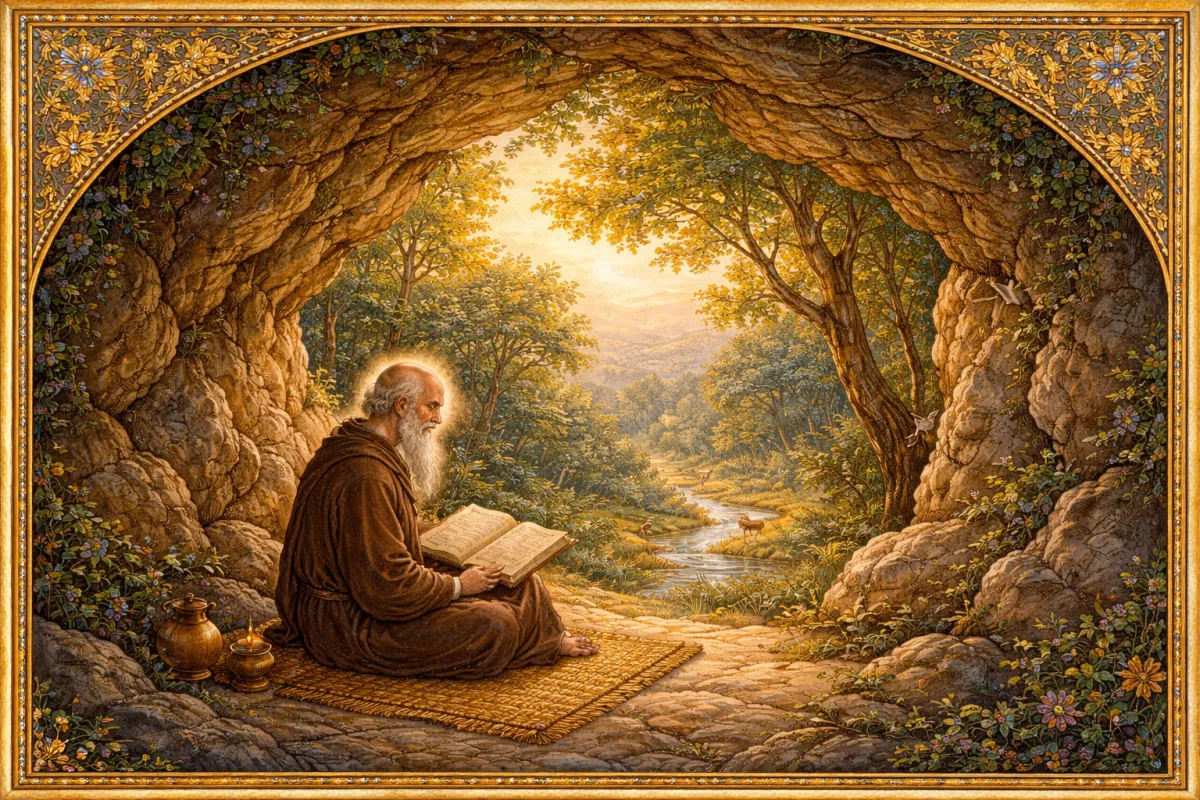
- Correct Observation
- Correct Analysis
- Correct Motivation
- Correct Intention (Sat-Sankalpa)
- Correct Lifestyle (Sad-Achara)
- Correct Thinking (Sad-Yukti)
- Correct Faith
- Correct Refuge (Sharanam)
- Correct Practice
- Correct View
- Correct Contemplation
- Correct Conduct
- Correct Samadhi
- Correct Liberation
- Correct Enlightened Activity
- Becoming a Correct Being
1. Correct Observation
This is the first of the sixteen stages of the path of liberation, called "Arya Shodasha Marga," which means the "Sublime Path of Sixteen Stages" (not to be confused with the teaching of the 16 Kalas, the stages of contemplative practice, although they speak of the same thing).
"Correct Observation" means observing important things in order to later perform a correct analysis of what has been observed.
A yogi must observe:
- Birth, death, suffering, old age, disease;
- The spiritual path of saints, the lives of ordinary people and sannyasis, holy sadhus;
- The instructions of holy teachers;
- The lives of gods and spirits, beings of hell, pretas, asuras, animals, and other beings of samsara.
The seeker-yogi here is like a researcher, an anthropologist, a zoologist, or an entomologist, observing life around them in the city, forest, or field. He meticulously accumulates factual material for its subsequent thorough analysis.
Without such correct observation, a person will always live, from life to life, immersed in the bustle of samsara, without a single chance to stop, look around, and realize:
- "Who am I?"
- "What is this world?"
- "Why do I live?"
- "What is my future?"
2. Correct Analysis
This is the second of the 16 stages of the path of liberation, called "Arya Shodasha Marga," the "Sublime Path of Sixteen Stages." It means a thorough analysis and evaluation of everything we observe in life. The motto of this stage is: "Analyze what you observe!"
Examples of analysis:
- "What is the cause of old age, disease, birth, and death?", "What is the cause of the suffering of beings?" — this gives a true assessment of our material world as samsara, from whose limitations one must quickly escape.
- Analysis of sacred scriptures, the lives of saints, and satsangs of teachers provides clear guidance on where to move in the future.
- Analysis of "Why are the destinies and abilities of people different?" gives an understanding of human souls as being bound by the laws of karma.
This is also called "Bahir-Vichara" — the analysis of external conditions. A correctly performed analysis inevitably gives rise to true meanings and values, the same as those held by the great saints of any tradition. It puts everything "on the shelves" and gives a true direction to your soul.
To have true meanings and values in life is worth a great deal; it can save decades of this life or even tens, hundreds, or even billions of your future lives from being wasted.
Stages of the Divine Path
The number sixteen is very important on the path of liberation in Tantrism; the avatar of Dattatreya, Sripada Vallabha, also spoke about this.
- Sixteen vowels are placed on the outer petals of the Sri Yantra.
- The name of the goddess Shodashi, Tripura Sundari, is identified with this number. Shodashi can be translated as "the sixteenth," from the Sanskrit "Shodasha" — "sixteen."
- This is the playing energy of Clear Light, Brahman Himself in His aspect of luminous Shakti.
Sixteen is the number of Divine perfection, fullness, and integrity in Tantrism. Each stage points to a certain degree of soul maturity:
- Correct Motivation — stage 3;
- Correct Intention — stage 4;
- True Refuge — stage 8;
- Correct Sadhana — stage 9;
- Correct View — stage 10;
- Correct Samadhi — stage 13;
- True Liberation — stage 14;
- Becoming a Divine Being — stage 16.
3. Correct Motivation
The third stage is called "Correct Motivation." This means that based on the previous correct analysis, you develop true motives within yourself to go towards God.
Main motives:
- The desire to follow the Dharma of liberation (Moksha Dharma);
- The desire for sadhana;
- The desire to associate with saints and sadhus and to serve them;
- The desire to become a sadhu yourself;
- The desire for Moksha;
- The desire for happiness for all living beings;
- The desire to be a channel for the Divine.
You think about the path of liberation and try it on for yourself, considering the status of a grihastha, karma-sannyasi, brahmachari, or purna-sannyasi. You gain the strength of motivation for the birth of the great intention to reach liberation — mumukshuttva. This is not yet mumukshuttva itself, but only the desire for it. If motives do not arise, one must return to the second or first stage.
4. Correct Intention (Sat-Sankalpa)
The fourth stage is called "Correct Intention," Sat-Sankalpa. This is the thirst for supreme freedom — mumukshuttva.
It sounds like this:
- "May I steadily seek liberation in God for the benefit of all living beings!"
- "May I diligently perform sadhana daily to realize Brahman!"
- "May I strive with all my soul to transcend the samsaric circle of birth and death!"
- "May all living beings achieve a clear realization of the nature of mind!"
This is the greatest intention a soul can create. The traditional training of a Vedanta student (Sadhana-Chatushtaya) includes:
- Viveka (discrimination between the real and the unreal);
- Vairagya (detachment);
- Mumukshuttva (intense longing for liberation);
- Six qualities of Sattva (Shat-Sampat).
Here, the desire becomes an unwavering intention. The soul understands that it needs only God and that its destiny is the full unfolding of its Divine nature.
5. Correct Lifestyle (Sad-Achara)
The fifth stage is "Correct Lifestyle" (Sad-Achara). You move from words to action. Until your lifestyle actually changes, karma will not be purified.
Signs of transition to this stage:
- You remove everything superfluous and introduce what is beneficial for liberation.
- You set up a home altar and a meditation mat.
- You decide to observe the principles of vegetarianism and non-violence.
- You give up cigarettes, alcohol, and meat (Dina-Charya).
- You begin to attend satsangs, temples, and places of pilgrimage.
- You take on service (Seva).
"Knowledge devoid of achara does not lead to success." ("Chandra Jnana Agama," ch. 9. 19)
You follow the initial rules of Yama-Niyama naturally, for you have decided to become a yogi. What was an intention has become behavior.
6. Correct Thinking (Sad-Yukti)
The sixth stage is the cultivation of correct thinking. To walk the path of liberation, an instrument is needed — thinking based on valid knowledge (Pramana).
Correct thinking means:
- Creating a personal system of concepts based on the teachings of Dharma.
- The ability to see the world through the eyes of the teacher and the sacred scriptures.
- Seeing the impermanence and suffering of samsara.
In our tradition, correct thinking includes an understanding of:
- The philosophy of Advaita Vedanta;
- The teachings of Shaivism in the Siddha tradition;
- Tantric Shaktism;
- Anuttara Tantra and Laya Yoga.
7. Correct Faith
The seventh stage is "Correct Faith." This is a personal choice of a true direction corresponding to the lineage of transmission.
This is a vector for the application of will through:
- Listening (Shravana);
- Contemplation/Reflection (Manana);
- Constant meditation (Nididhyasana);
- Worship (Upasana) and service (Seva).
Incorrect faith means striving for the "eight worldly dharmas":
- Praise and criticism;
- Good and bad news;
- Gain and loss;
- Success and failure.
Correct faith is oriented toward the Absolute (Brahman), experienced as Turiya — the fourth superconscious dimension.
8. Correct Refuge (Sharanam)
The eighth step is "Correct Refuge." Faith materializes and becomes a support. Sharanam is a symbol of faith, a foundation for receiving divine grace.
The Three Treasures and The Five Treasures
The Three Treasures (Tri-Ratna):
- Guru;
- Linga (Shiva, Shakti, Dharma);
- Jangama (Sangha).
The Five Treasures (Pancha-Ratna):
- SHIVA — The Absolute, pure non-dual consciousness.
- SHAKTI — Universal Divine energy.
- GURU — The lineage of deities, rishis, and saints (Parampara).
- DHARMA — The holy teaching (Vedas, Tantras, Upanishads).
- SANGHA — The community of practitioners (Mandala).
Five Reasons for Taking Refuge
- The mind gains unshakable faith in liberation.
- Blessings begin to pour forth, purifying karma.
- A reliable spiritual support appears.
- Deep methods of Tantra and Yoga are revealed.
- You do not stray from the path, and in case of an error, you receive help.
9. Correct Practice
The ninth step is "Correct Spiritual Practice (Sadhana)." Siddhis are achieved only through untiring practice.
Ten aspects of correct sadhana:
- Direction toward the Supreme Source;
- Non-egoistic motivation;
- Receiving transmission from a realized Guru;
- Correspondence with sacred scriptures (Shastras);
- Continuity;
- Impeccability (observance of ethics and samayas);
- Correspondence to the type of soul (Bhava);
- Correspondence to the stage of maturity (Achara);
- Correspondence to the level of preparation (Adhikara);
- Correspondence to place, time, and circumstances.
10. Correct View
The tenth step is "Correct View" (Jnana-Drishti). This is seeing reality through the eyes of the enlightened. In this vision, the subject is one with the object, and the world is like a play of energy.
Stages of attainment:
- Intellectual understanding through listening (Shravana).
- Direct introduction into the nature of mind from the Guru.
- Constant internal Experience (Camatkara — a sense of wonder).
Here, the student is introduced to the "Seven Principles of the View."
11. Correct Contemplation
The eleventh step is "Correct Contemplation" (Nididhyasana). This is the establishment in the non-dual view. It must be natural and continuous (Sahaja).
Contemplation should last:
- In three positions: standing, sitting, lying down.
- In five actions: walking, working, sleeping, eating, attending to needs.
Errors in contemplation:
- Distraction;
- Excessive effort;
- Freezing of the senses.
Until the view is mastered, any attempt to contemplate is merely a practice of mindfulness.
12. Correct Conduct
The twelfth step is correct conduct. It means the ability to make any situation a path for contemplation. These are not external rules, but the art of being spontaneous (like an Avadhuta).
Characteristics of correct conduct:
- Living in harmony without accepting or rejecting.
- Full freedom of the "three staffs": body, speech, and mind.
- Absence of karma, perceiving everything as the Lila (play) of the deities.
13. Correct Samadhi
The thirteenth stage is correct Samadhi. First, Nirbija-Samadhi (Nirvikalpa) is achieved, then Sahaja-Samadhi (the king of all Samadhis).
Types of Raja Yoga Samadhi (Sabija-Samadhi):
- Savitarka-Samadhi;
- Nirvitarka-Samadhi;
- Savichara-Samadhi;
- Nirvichara-Samadhi;
- Ananda-Samadhi;
- Asmita-Samadhi.
Sahaja-Samadhi is abiding in one's innate divine nature without effort day and night.
14. Correct Liberation
The fourteenth stage is correct liberation (Moksha). This is the merging of the individual soul with the Absolute.
Types of Liberation
- Samipya-mukti — proximity to the deity, membership in their retinue.
- Sarupya-mukti — obtaining a subtle body similar to the body of the deity.
- Sayujya-mukti — dissolution in the light of Brahman or the body of Ishvara.
- Sarshti-mukti — attaining the same powers and riches as God.
- Salokya-mukti — the possibility of living in the same abode as the deity.
Among the Siddhas, three types of bodies are mentioned:
- Sthula-deha (Yoga-deha);
- Siddha-deha (Pranava-deha);
- Jnana-deha (Divya-deha).
15. Correct Enlightened Activity
The fifteenth stage is the magical operation of reality from an enlightened state.
Four types of activity:
- Shanti-karma (white) — pacification and healing.
- Paushti-karma (yellow) — enrichment and prosperity.
- Vashya-karma (red) — enchantment and subjugation.
- Rudra-karma (black/blue) — destruction of evil.
Enlightened actions are spontaneous, free from ego, filled with compassion, and correspond to the supreme will of Ishvara.
Song of the Mahasiddha
I change space and time For the benefit of the living, I create time loops and holes, I freely change history, the destinies of nations. If I have decided something – so it shall be! The logic of karma has no power over me, For it is I who speak – the Lord of Aishvarya-siddhi! I am your reflection, I am the one who soars with the clouds, Who walks across the sky, Leaving no traces...
16. Becoming a Correct Being
OM SHRI DATTATREYAYA NAMAH OM NAMAH SHIVAYA
The sixteenth stage is full deification. Having passed through the stages of self-surrender and self-recognition, the soul acquires the qualities of Shiva: omniscience, omnipresence, omnipotence, and eternity.
Liberated beings:
- Are immortal and multi-bodied;
- Live in multi-reality and mandalas;
- Themselves create new universes by the power of thought;
- Abide in a state of eternal blissful play (Lila).
Thus, starting with correct observation, the soul step by step comes to the ultimate unity with Brahman.
Om Tat Sat Om Shanti Shanti Shanti
Completed teaching-upadesha "Arya Shodasha Marga." March 2, 2023. Mahamandaleshwar Sri Guru Swami Vishnudevananda Giri
